
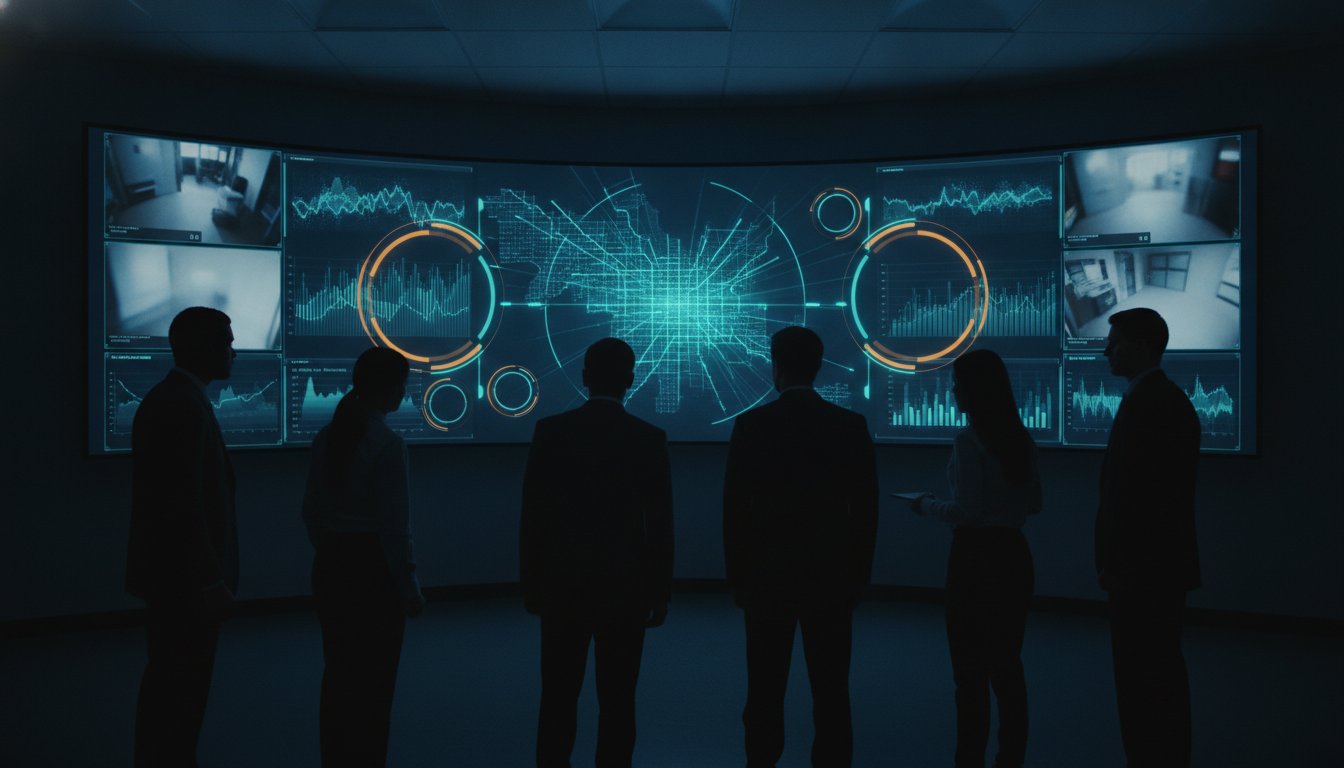
A dashboard full of critical data is effectively invisible if the person who needs it most is buried under a dozen competing windows. In high-stakes emergency operations, you’ve likely experienced the exhaustion of toggling between GIS maps, live video feeds, and incident logs. While your WebEOC integration provides a vital record of events, the most urgent alerts often remain trapped in software sub-menus during the moments they matter most. You’re managing a wealth of information, yet your team still lacks a single, cohesive view that drives immediate action.
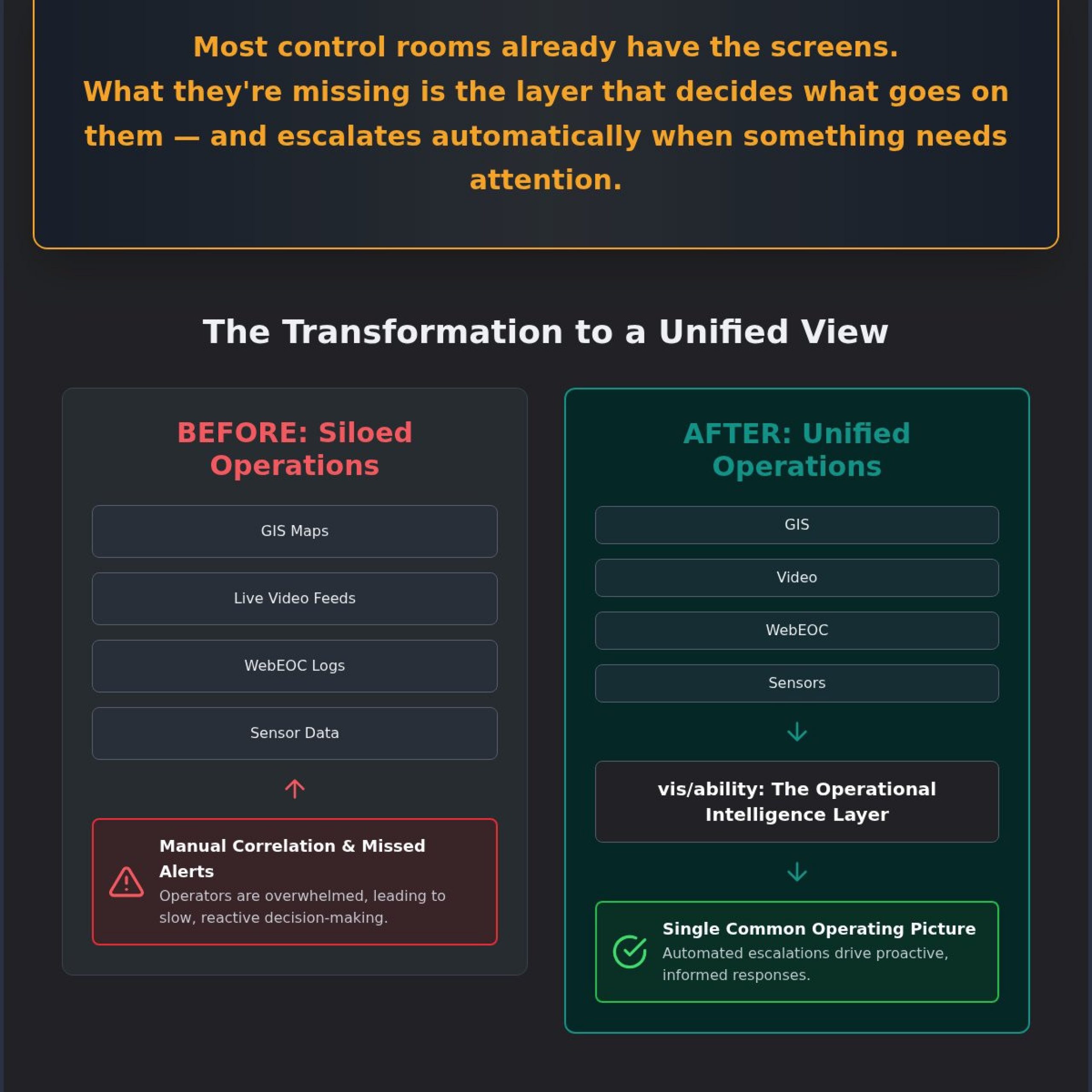
Most control rooms already have the screens. What they’re missing is the layer that decides what goes on them: the one that escalates automatically when something needs attention. While many specialized data tools offer valuable insights, they often provide only partial solutions that leave gaps in your situational awareness. Activu Corporation presents a comprehensive approach: this article explains how to transform fragmented data into a unified, event-driven common operating picture using vis/ability as your operational intelligence layer. You’ll learn how to automate visual escalations to the video wall and share real-time intelligence seamlessly with distributed stakeholders, ensuring that mission-critical decisions are based on clarity rather than complexity.
Key Takeaways
- Identify why standalone dashboards often lead to operator fatigue and how managing multiple high-stakes applications simultaneously creates critical gaps in situational awareness.
- Discover how a robust WebEOC integration serves as the foundation for a unified platform, moving beyond simple logging to proactive incident management.
- Learn why vis/ability acts as the essential operational intelligence layer that unifies fragmented data streams into a single, actionable common operating picture.
- Understand the impact of event-driven automation, which ensures that mission-critical alerts are prioritized and visually escalated to the video wall exactly when they require attention.
- Explore how to bridge the gap between the command center and distributed teams by sharing real-time intelligence across mobile devices and huddle rooms.
Beyond the Dashboard: The Challenge of Unified Critical Operations
High-stakes environments demand immediate clarity. In a modern Emergency Operations Center (EOC), operators often juggle a dozen high-stakes applications simultaneously. This creates a fragmented environment where critical details are easily overlooked. While a robust WebEOC integration ensures that incident logs are accurate and compliant, it doesn’t solve the problem of visual priority. Data sits in a browser tab, waiting for someone to find it, while the crisis continues to evolve on the ground.
This “dashboard trap” is a common failure point in mission-critical operations. Operators experience fatigue from constant manual correlation, leading to delayed response times. The operational cost of siloed data is high. When information is trapped within separate software modules, the team loses the ability to see the full scope of an event. Recording an incident is only the first step. Visualizing the response requires a different approach that moves beyond the confines of a single monitor.
The Problem of Fragmented Situational Awareness
Disconnected systems create operational blind spots that can prove fatal during an emergency. Most Emergency management software focuses on the administrative and logging aspects of a crisis. Specialized tools like Axon provide essential video evidence, but they only offer a partial solution that remains siloed from your primary logs. The cognitive load of manually correlating that data with GIS maps and weather alerts is immense. Without a unifying layer, more data often results in less clarity. The team spends valuable time searching for answers rather than executing mission-critical decisions.
Entering Through the Pain: Why Operators Miss Incidents
Critical incident alerts are frequently buried in software sub-menus, invisible to the rest of the room. In an escalating crisis, the danger of manual screen-switching becomes a liability. If an operator is focused on one specific task, they’ll likely miss a high-priority alert occurring in another application. A seamless WebEOC integration is only as effective as the operator’s ability to see the data in real time. The visibility gap in modern command centers is the direct result of having too many disconnected tools and no automated way to prioritize the most essential information. While control rooms have the necessary screens, they often lack the automated intelligence to prioritize and display critical events, ensuring immediate escalation when action is required.
Understanding the Role of Juvare in Emergency Management
Juvare represents the administrative backbone for thousands of public safety agencies. Its ecosystem, comprised of tools like WebEOC, EMResource, and Crisis Track, provides a structured environment for compliance, detailed logging, and multi-agency coordination. These platforms act as a vital repository for incident management data, ensuring that every action taken during a disaster is documented and every resource is accounted for. While these tools are essential for the record of truth, they don’t always provide the real-time visual clarity needed during an active crisis.
WebEOC and EMResource: Pillars of Response
Public safety organizations use these tools to standardize incident reporting, creating a consistent flow of information between local, state, and federal partners. A successful WebEOC integration allows for standardized reporting across disparate jurisdictions, which is critical for large-scale disaster management. In practice, WebEOC implementations nationwide illustrate how this software facilitates real-time information sharing within state-level Emergency Operations Centers. Similarly, EMResource tracks healthcare capacity and first responder assets, providing a clear view of available beds or emergency vehicles. These tools are widely adopted because they solve the problem of data standardization across complex organizational boundaries.
The Boundary of Software-Only Solutions
Despite these strengths, a fundamental limitation exists: Juvare is a data source, not a visualization engine. Software logs provide the “what” and the “when,” but they struggle to provide the “where” and “how” in a way that’s instantly digestible for an entire command center team. Projecting dynamic Juvare boards onto room-wide video walls often results in cluttered, illegible screens that fail to highlight the most urgent priorities. Software-only dashboards are designed for individual users at workstations, not for the collective situational awareness required in a physical EOC or a shared huddle room.
Siloed software requires a unifying hub to become truly operationally intelligent. A standalone WebEOC integration within a browser tab is a partial solution that leaves operators responsible for manually spotting critical changes. What they’re missing is the layer that decides what goes on them, and escalates automatically when something needs attention. By connecting these data streams to an operational intelligence layer, agencies ensure that mission-critical information moves from a hidden log to a prominent, shared view. Organizations looking to enhance their response can explore how to build a more resilient public safety common operating picture.
The Dashboard Trap: Why Partial Solutions Require a Unifying Layer
Many organizations rely on Juvare as their primary logging tool, and for good reason. It provides a structured history of actions and decisions that is indispensable for post-incident analysis and legal compliance. However, relying on a standalone logging system creates a “dashboard trap.” These systems are designed to store and display records, but they lack the dynamic visualization required for a true common operating picture (COP). A log tells you what happened; a COP shows you what is happening and where resources need to move right now.
This operational intelligence layer serves as the essential bridge between raw data and human judgment. It transforms static reports into active intelligence, ensuring that the team isn’t just watching a list of events grow, but is instead focused on the most critical developments as they occur.
When Logging Isn’t Enough for Real-Time Response
There is a significant difference between recording an event for the archives and managing an active crisis in the field. When a situation is rapidly evolving, operators need more than a list of incidents to act with certainty. They require the context provided by live video feeds, real-time weather overlays, and GIS data. A standard WebEOC integration that only displays text on a screen leaves the burden of correlation on the human operator. Specialized systems like Axon provide critical video evidence, but they only offer a partial solution that remains siloed from your broader strategy. To reduce cognitive load, the system must integrate these disparate streams into a single view. If a high-priority incident is logged, the operational intelligence layer should automatically trigger relevant camera feeds and map locations on the main display.
The Role of vis/ability as the Unifying Platform
The vis/ability platform acts as the central hub where all other tools flow. It doesn’t replace your existing investments; it makes them more useful for the entire command team. By acting as the operational intelligence layer, vis/ability pulls data from your WebEOC integration and visualizes it alongside every other critical feed. This visibility isn’t limited to the main video wall. It extends seamlessly to huddle rooms and mobile devices, ensuring that distributed stakeholders see exactly what the command center sees. This unified approach eliminates the siloes that often lead to missed incidents and delayed responses during mission-critical events.
Integrating Juvare into a Unified Common Operating Picture
Transitioning from a static log to a dynamic response requires a structured integration process. First, agencies must identify which specific data points within Juvare demand immediate, room-wide attention. This typically includes high-priority incident reports or critical changes in resource availability. Once these triggers are defined, the next phase involves connecting disparate streams. A successful WebEOC integration shouldn’t exist in a vacuum. It must be layered with real-time GIS data, live traffic feeds, and weather overlays to provide the necessary geographic context for every recorded event.
Automated triggers serve as the engine of this transition. By defining these rules, the system can instantly change the video wall layout based on the severity of the incoming data. Finally, this intelligence must extend beyond the physical EOC. The common operating picture must be accessible to mobile teams and remote stakeholders, ensuring everyone operates from the same set of facts regardless of their location.
Building the Incident Management Framework
Standardizing how alerts translate into visual layouts is essential for reducing reaction time. When a specific incident type is logged, the vis/ability Platform can automatically pull up pre-defined layouts that include relevant camera feeds and regional maps. While specialized tools like Axon provide critical video evidence, they often function as siloed applications that require manual intervention to view. Without a unifying layer, these partial solutions can actually increase the cognitive load on operators during a crisis. By using vis/ability as the hub, these tools become part of a cohesive strategy rather than just another window to manage.
Overcoming Integration Hurdles
Managing diverse data formats and varying bitrates within a single interface is a significant technical challenge. An effective operational intelligence layer handles these complexities in the background, providing a smooth experience for the end user. This technical reliability is especially important when maintaining a Cybersecurity Common Operating Picture. Modern EOCs must monitor digital threats with the same intensity as physical ones. Complex integrations can feel overwhelming, but a well-designed platform manages these connections simply and reliably. If you are ready to move beyond fragmented dashboards, contact our team for a consultation on your control room design.
Activu vis/ability: The Operational Intelligence Layer
Activu provides the bedrock for mission-critical decision making by transforming raw data into actionable intelligence. This is the role of vis/ability. It functions as the central hub where every data stream, from GIS to live video, converges into a single common operating picture.
The platform excels at event-driven situational awareness. It automates the “what” and “where” of your data. When a WebEOC integration is active, the system doesn’t just wait for an operator to check a log. It identifies critical thresholds and triggers visual responses across the EOC. A seamless WebEOC integration allows for standardized reporting, but vis/ability ensures that reporting is actually seen by those who need to act. This automation reduces operator fatigue by ensuring the most important information is always front and center, eliminating the need for manual screen switching during an escalating crisis.
Collaboration shouldn’t stop at the command center walls. Mobile vis/ability extends this unified view to field teams and distributed stakeholders. Whether in a huddle room or on a mobile device, every team member sees the same real-time intelligence. To ensure these systems operate at peak efficiency, Activu offers professional control room design services. These services optimize the physical and digital environment, ensuring your technology supports your mission rather than complicating it.
A Strategic Partner for Mission-Critical Resilience
Activu empowers individuals to act with greater certainty when stakes are highest. We view technology as the essential bridge between raw data and human judgment. By prioritizing essential information, we ensure that operators can focus on the pivotal moments of a crisis. Our Public Safety Solutions are designed to provide steady reassurance and absolute technical reliability in the most demanding environments.
Next Steps for Operational Clarity
Moving from a reactive to a proactive operations model is essential for long-term continuity. A unified operating picture ensures that your team isn’t just responding to incidents, but is actively managing the entire operational landscape. This transition requires more than just new software; it requires a strategic approach to information prioritization. Explore our insights on Incident Management Software for Mission-Critical Environments to learn how to enhance your agency’s resilience.
Achieving Operational Clarity Through Intelligence Integration
The transition from reactive logging to proactive response requires a fundamental change in how data is visualized. A standalone WebEOC integration provides the necessary record of truth, but true situational awareness demands a platform that unifies this data with live video and geospatial intelligence. By automating the visual escalation of critical alerts, you ensure that your team remains focused on the mission rather than the software.
Activu vis/ability serves as this operational intelligence layer, providing the bedrock upon which Federal, Defense, and Public Safety agencies nationwide build their common operating picture. With integrated cybersecurity oversight and event-driven automation, your command center can move with absolute certainty when stakes are highest.
Ready to transform your EOC? Request a Demo of the vis/ability Operational Intelligence Layer to see how we empower your team to act with greater clarity and confidence.
Frequently Asked Questions
What is the difference between Juvare and Activu vis/ability?
Juvare serves as the vital repository for incident management data. Activu vis/ability acts as the operational intelligence layer that unifies this data with live video and GIS streams. While Juvare records the “what” and “when,” vis/ability provides the “where” and “how” through real-time visualization. It transforms static logs into a dynamic common operating picture for the entire team.
Can vis/ability integrate directly with WebEOC boards?
Activu vis/ability integrates directly with WebEOC boards to pull live data into the visual environment. This WebEOC integration ensures that incident management logs aren’t siloed within a browser tab. The platform captures dynamic data points. It then displays them alongside other critical feeds, such as traffic cameras or weather sensors. This process turns a single-user software tool into a shared asset for everyone in the control room.
How does an operational intelligence layer reduce operator fatigue?
An operational intelligence layer reduces fatigue by automating the prioritization of essential information. By using event-driven automation, vis/ability eliminates the need for operators to manually correlate data. This proactive approach ensures that mission-critical alerts aren’t buried in sub-menus during a crisis.
Does vis/ability support mobile users in the field?
Mobile vis/ability extends situational awareness beyond the physical command center. It allows remote users to access the same unified common operating picture on their mobile devices or within local huddle rooms. This ensures that every individual acts with the same set of facts. Seamless data sharing between the center and the field is essential. It remains a cornerstone of Activu’s mission-oriented collaboration strategy.
Is it possible to automate video wall layouts based on Juvare alerts?
Automation is a core feature of the vis/ability platform. You can define specific triggers within your WebEOC integration that automatically change the video wall layout when certain thresholds are met. For example, a high-priority incident report can instantly trigger the display of relevant GIS maps and nearby camera feeds. This event-driven situational awareness ensures that the right information reaches the right people. It happens without manual intervention.
Why is a common operating picture (COP) essential for emergency management?
A common operating picture is essential. It provides a single, shared source of truth for all responding agencies. Without a unified view, teams often work from fragmented data. This leads to delayed responses and operational blind spots. A true COP integrates every available stream into one pane of glass. This clarity is the bedrock upon which successful mission-critical decisions are made during high-stakes emergency operations.
How does Activu handle cybersecurity data alongside incident management tools?
Activu provides a Cybersecurity Common Operating Picture. It visualizes network health and security threats alongside traditional incident management tools. This provides a holistic view of the operational environment. Digital threats can impact physical response capabilities. The platform unifies these disparate data streams. It enables security operations centers to monitor threats through a centralized interface. This integration ensures that digital and physical security postures don’t remain siloed.