
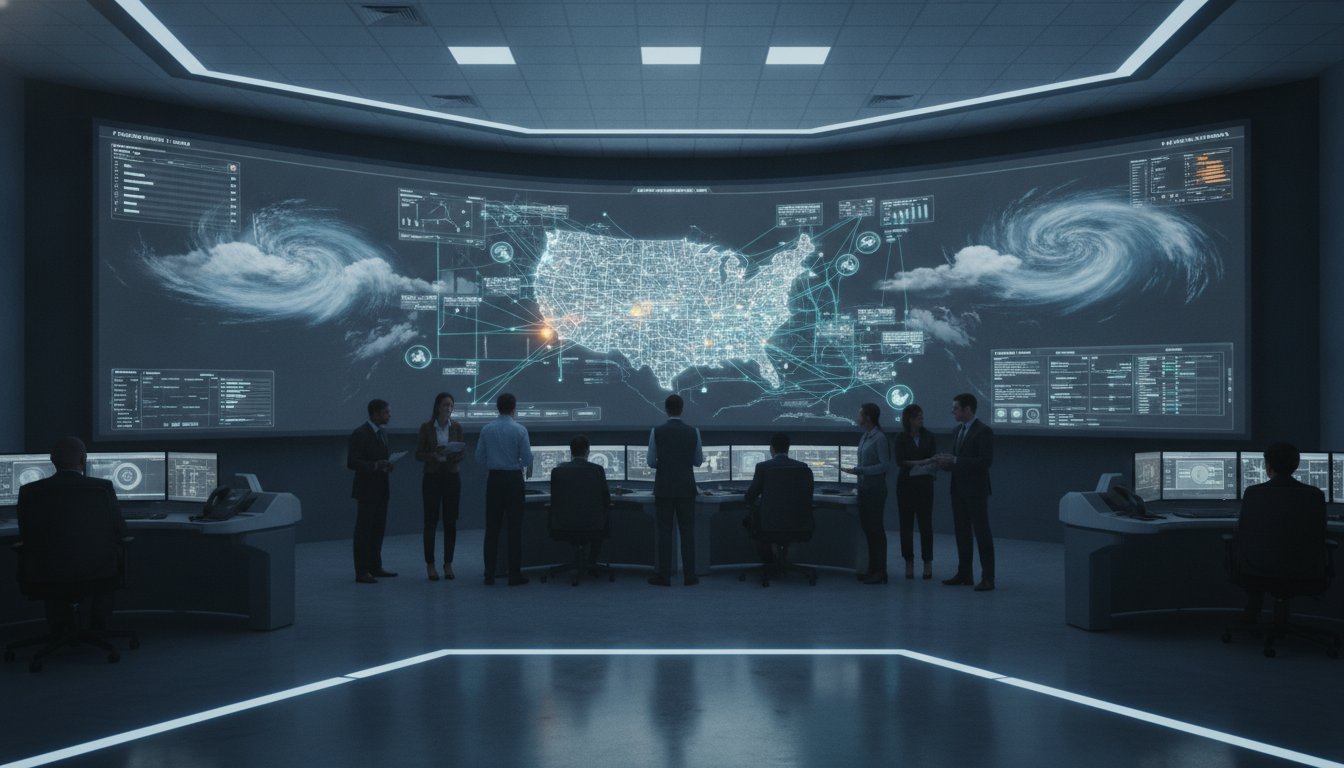
A 2024 assessment of emergency management facilities revealed that 68% of operators feel overwhelmed by the volume of manual data feeds during a critical incident. This fragmentation doesn’t just cause fatigue; it creates a dangerous gap in situational awareness when seconds matter most. Modern EOC design principles must evolve to solve this, shifting the focus from simply housing hardware to orchestrating actionable intelligence.
You understand the pressure of a 24/7 high-stakes environment where siloed information and unintegrated feeds lead to delayed response times. It’s a common struggle to find clarity amidst the noise of a complex operation. Most control rooms already have the screens. What they’re missing is the layer that decides what goes on them, and escalates automatically when something needs attention.
This article provides a framework for EOC design that prioritizes human judgment and reduces cognitive load for your team. We’ll explore how to transform your facility into a unified intelligence hub that ensures seamless coordination between the command center and field teams. By the end, you’ll have the blueprint for a resilient operation that remains steady when the stakes are at their highest.
Key Takeaways
- Distinguish between strategic command centers and tactical incident posts to ensure your facility functions as a true hub for high-level coordination.
- Implement core EOC design principles that prioritize redundant infrastructure and scalable layouts to maintain operational continuity during any crisis.
- Recognize how fragmented data silos and monitor sprawl contribute to operator fatigue and learn the methods to bridge these critical operational gaps.
- Discover how an operational intelligence layer like the vis/ability platform automates data prioritization to support faster, more accurate human decision-making.
- Explore tailored visualization strategies for utilities and transportation sectors to maintain constant situational awareness across complex, distributed networks.
What is an Emergency Operations Center? Defining the Modern EOC
An Emergency Operations Center (EOC) serves as the central command and control facility responsible for executing strategic emergency management. Integrating core EOC design principles transforms this space into a nerve center where leadership manages resource allocation, facilitates inter-agency coordination, and makes high-level policy decisions. This environment isn’t merely a space for observation; it’s a proactive hub designed to transform raw data into decisive action during high-stakes events.
Modern centers apply these principles across various mission-critical environments. While a public safety EOC focuses on disaster response, Security Operations Centers (SOCs) monitor for threats, and Network Operations Centers (NOCs) ensure infrastructure stability. Fusion Centers further refine this by integrating multi-source intelligence to identify complex risks. Each of these facilities requires a structured approach to data integration to prevent information silos from hindering the mission.
Strategic vs. Tactical Command Environments
Effective incident management requires a clear distinction between tactical and strategic roles. Tactical field units operate from an Incident Command Post (ICP), focusing on immediate, ground-level execution. Information flows from these field units to the strategic EOC hub, providing the necessary context for broader decision-making. The EOC must maintain a high-level view. It doesn’t manage the fire; it manages the resources, logistics, and regional impacts of the fire.
Maintaining this separation prevents leadership from getting bogged down in field tactics, which can obscure the overall objective. Implementing a Mission Critical Operations blueprint is essential for long-term resilience. This framework ensures the EOC remains focused on its strategic mandate while providing the field with the intelligence they need to act with certainty.
The Role of EOCs in National Safety
EOC functions are vital at every level of government, from municipal response teams to federal agencies. However, the private sector’s reliance on these centers is equally critical. Organizations in utilities and energy, transportation, and manufacturing utilize EOCs to safeguard critical infrastructure. These facilities act as a bedrock for national stability, ensuring that essential services remain operational during crises.
The primary objective for any modern center is Operational Continuity. This goal demands a design that prioritizes visibility and intelligence. Most control rooms already have the screens. What they’re missing is the layer that decides what goes on them, and escalates automatically when something needs attention. By focusing on the flow of essential information, organizations can move from a reactive state to one of clear, actionable intelligence.
Fundamental EOC Design Principles for Operational Resilience
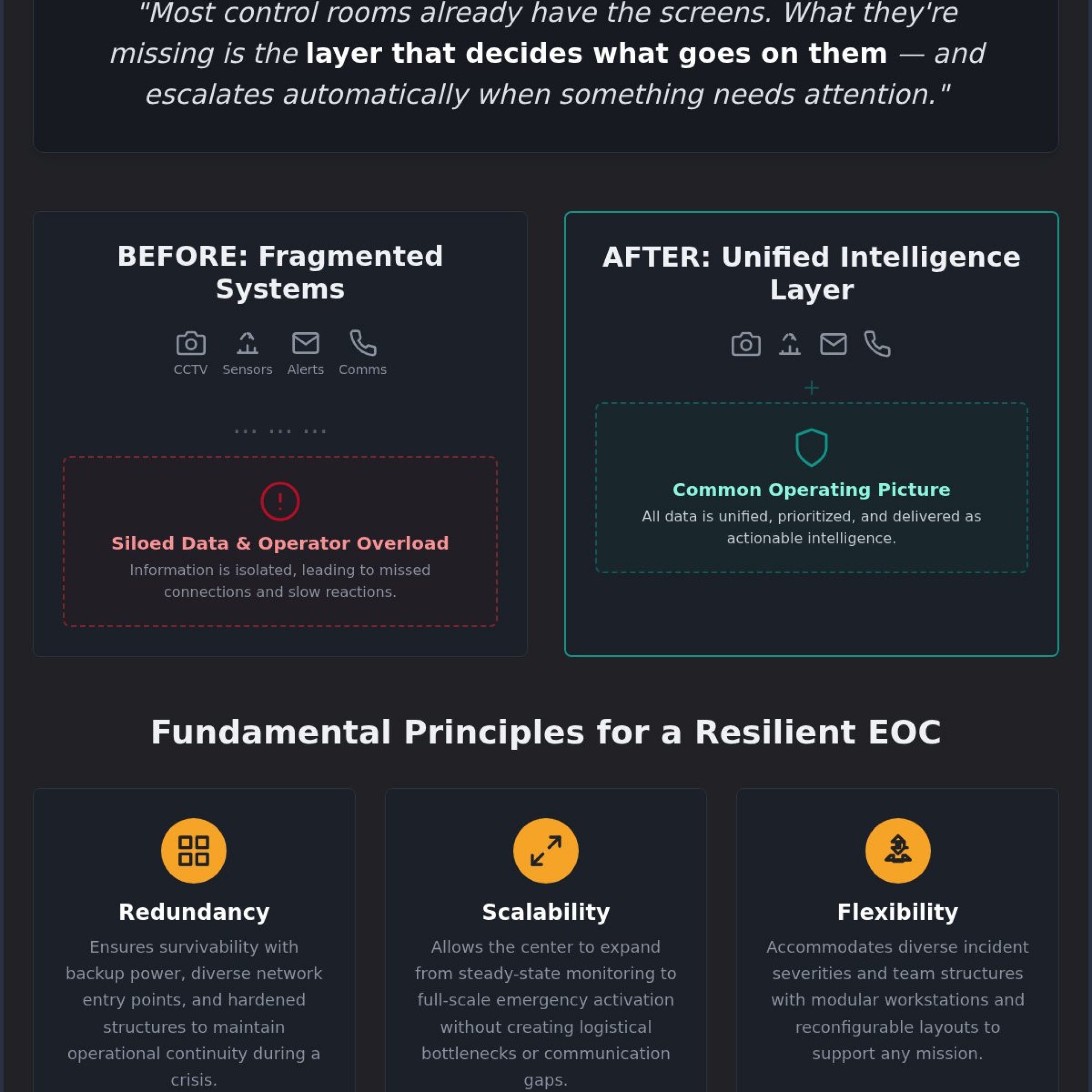
Resilience starts with survivability. Redundant infrastructure ensures the EOC remains functional when external systems fail. This involves backup power systems, diverse network entry points, and hardened structures—often utilizing specialized resinous flooring from Epoxy Solutions™—capable of withstanding the very disasters they’re meant to manage. Adopting Intelligent EOC Design Principles means aligning these physical requirements with operational frameworks like the National Incident Management System (NIMS). This alignment guarantees that the facility scales efficiently during multi-agency activations. Scalable layouts allow the center to expand from steady-state monitoring to full-scale emergency activation without creating logistical bottlenecks or communication gaps.
Operator performance is the bedrock of incident response. Design layouts must prioritize clear sightlines to primary displays while reducing physical strain. Sightlines and display placement should be calculated to minimize neck and eye fatigue during long shifts. Functional zoning is critical; it separates high-traffic coordination zones from quiet analytical areas. Effective acoustic treatments and adjustable lighting help maintain operator alertness during grueling 24/7 shifts. These elements aren’t luxuries. They’re essential tools that reduce cognitive load and prevent human error when stakes are at their highest.
Visualizing the Cybersecurity Common Operating Picture
Just as physical layouts must be optimized, the digital tools used in an EOC must adhere to high standards of usability and digital compliance; to explore how digital best practices and visibility trends have shifted over time, visit 216digital.
A modern crisis is rarely isolated to the physical world. Disasters often trigger secondary cyber-events or expose vulnerabilities in critical infrastructure networks. Effective EOC design principles now require the integration of cybersecurity data alongside physical incident feeds. What they’re missing is the layer that decides what goes on them; and escalates automatically when something needs attention.
By incorporating SIEM and SOAR data into a unified Common Operating Picture, operators gain a holistic view of organizational health. This visibility allows teams to detect network anomalies that might signal a breach during a physical emergency. If you’re planning a facility upgrade, our Control Room Design Services can help bridge the gap between physical and digital oversight. This integrated approach ensures that your intelligence layer remains the engine behind every successful operation, providing the calm and clarity needed amidst potential complexity.
The Operational Gap: Why Traditional EOC Layouts Fail
Traditional EOC design principles frequently emphasize the physical room over the digital reality of modern operations. This approach creates an operational gap where fragmented systems form data silos. When information is trapped within separate platforms, critical decision-making is delayed. Operators find themselves managing “monitor sprawl,” toggling between dozens of disconnected applications to piece together a coherent picture. This technical friction doesn’t just slow down response times; it actively obscures the truth of an unfolding crisis.
Static video walls further exacerbate the problem. In many traditional setups, screens act as “dumb” displays that require manual intervention to update. This reliance on manual data entry means that vital situational awareness is often minutes or hours behind the actual event. Without automated escalation, the center remains reactive, waiting for a human to notice a change rather than being prompted by the data itself. A resilient operation requires a shift from passive viewing to active intelligence.
The Pitfalls of Siloed Application Integration
Many centers rely on sophisticated tools like Axon or Computer-Aided Dispatch (CAD) systems, yet these tools often operate in total isolation. Fragmented situational awareness leads to conflicting situation reports (SITREPs) as different teams view different data sets. This “information blindness” occurs when operators are overwhelmed by raw data without context. Without a unifying hub to integrate these feeds, the EOC becomes a room full of noise rather than a hub of intelligence. Effective EOC design principles must prioritize the integration of these disparate streams into a single, authoritative view.
Operator Fatigue in 24/7 Environments
Human judgment is the most critical asset in any command center, but it’s also the most vulnerable to cognitive load. In high-stress, 24/7 environments, the sheer volume of unintegrated feeds causes rapid fatigue. Simply adding more screens often worsens the problem, as it increases the surface area an operator must monitor. High-stakes environments require a system that filters noise and highlights only essential, actionable intelligence to protect the decision-makers from burnout.
To bridge this gap, organizations must move beyond passive monitoring. What they’re missing is the layer that decides what goes on them, and escalates automatically when something needs attention. Transitioning to an event-driven model through the vis/ability platform ensures that the right information reaches the right person at the exact moment it’s needed, restoring clarity to the command operation.
The Intelligence Layer: Transforming Data into Decision Support
Traditional EOC design principles often stop at the physical installation of video walls and workstations. While these components are necessary, they’re insufficient for the speed of modern crisis management. Screens are not enough. What they’re missing is the layer that decides what goes on them — and escalates automatically when something needs attention. This operational intelligence layer acts as the engine that powers a resilient Emergency Operations Center, moving the facility from a state of passive monitoring to proactive oversight.
The vis/ability platform serves as this critical layer. It bridges the gap between raw data and human judgment by filtering out the noise that typically leads to operator fatigue. By implementing an intelligence-first approach to EOC design principles, organizations ensure their command centers function as unified intelligence hubs. This transition allows strategic decision-makers to focus on the moment of a pivotal decision rather than the technical complexity of gathering information. Clarity is the goal.
Event-Driven Situational Awareness
Reactive monitoring is no longer viable in high-stakes environments. Event-driven situational awareness utilizes automated triggers to change video wall layouts the moment a specific alert is received. For instance, a sudden spike in sensor data or a high-priority dispatch can instantly populate displays with relevant GIS maps and nearby camera feeds. This automation significantly reduces “time to glass,” ensuring that critical incident data is visible before an operator even realizes an escalation is occurring. The vis/ability platform orchestrates this process, providing a bedrock of absolute technical reliability when every second counts. Speed saves lives.
Unifying Disparate Tools for a Single Operating Picture
A true Common Operating Picture (COP) requires more than just displaying multiple applications side-by-side. The intelligence layer pulls data from disparate sources, including GIS, CAD, SIEM, and real-time weather feeds, and unifies them into a single, cohesive view. This unification ensures different agencies and field teams are working from the same set of facts, eliminating the confusion of conflicting reports. Integrating Incident Management Software into this ecosystem allows for seamless coordination and resource allocation. If you’re ready to bridge the gap between raw data and decisive action, contact our mission-critical design experts to start your transformation.
Designing for the Future: Sector-Specific EOC Excellence
Effective EOC design principles must adapt to the unique operational demands of specific industries. For Utilities and Energy organizations, the focus is on grid stability and the oversight of geographically distributed assets. These environments require a design that integrates SCADA data with real-time weather telemetry to predict and mitigate outages. Geospatial oversight is a cornerstone here, where mapping assets against environmental threats is a constant requirement. This specialized approach ensures that the command center remains the bedrock of service reliability.
In contrast, Transportation and Transit hubs prioritize the visualization of high-traffic corridors and fleet movements. These centers need a layout that supports rapid-fire coordination during service disruptions or safety incidents. Real-time sensor integration allows for an immediate response to infrastructure failures, keeping the network moving safely. For Public Safety and Fusion Centers, the mission centers on multi-agency intelligence sharing. These facilities must manage a high volume of incoming feeds from surveillance, dispatch, and social media to identify threats before they escalate. Regardless of the sector, the fundamental challenge remains the same. What they’re missing is the layer that decides what goes on them; and escalates automatically when something needs attention.
Mobile vis/ability and Distributed Collaboration
Distributed teams cannot be left in the dark during a crisis. Mobile vis/ability extends the reach of the command center by pushing the Common Operating Picture (COP) to tablets and smartphones in the field. This ensures that a technician at a remote substation or an officer at a perimeter sees the same critical data as the EOC commander. Secure, real-time data sharing allows distributed huddle rooms to function as seamless extensions of the main hub. This level of synchronization eliminates the lag between command decisions and field execution, allowing for a more proactive and unified response.
The Activu Advantage in Control Room Design
Activu provides a comprehensive suite of Control Room Design Services tailored to these mission-critical needs. With over 40 years of experience, we specialize in bridging the gap between raw data and human judgment through the vis/ability platform. Our approach ensures that technical tools empower individuals to act with greater certainty, even when stakes are at their highest. We move beyond simple hardware installation to provide a framework for operational intelligence. If you’re ready to build a more resilient operation, Contact Activu for a consultation. We position your command center as the quiet, powerful engine behind every successful operation.
Advancing Operational Readiness Through Intelligent Design
Resilient emergency management requires a fundamental departure from static, siloed environments. By adopting modern EOC design principles, organizations transform their command centers into proactive intelligence hubs where every data stream serves a specific mission objective. You’ve seen how integrating ergonomic layouts with automated, event-driven visualization reduces cognitive load and ensures that critical information always reaches the right decision-maker at the right time.
Activu brings over 40 years of experience in mission-critical design to every project. Trusted by Federal Government and Defense agencies, we specialize in building cybersecurity common operating pictures that safeguard infrastructure against evolving threats. What they’re missing is the layer that decides what goes on them, and escalates automatically when something needs attention.
Take the next step in securing your operational continuity. Request a Demo of the vis/ability Intelligence Layer today to see how we empower your team to act with absolute certainty. Your mission deserves the bedrock of technical reliability that only a seasoned expert can provide.
Frequently Asked Questions
What is the main purpose of an EOC?
The main purpose of an Emergency Operations Center is to provide a centralized location for strategic command and control during high-stakes incidents. It facilitates inter-agency coordination, resource allocation, and high-level policy-making. Unlike tactical field units, the EOC focuses on the broader impact of an event, ensuring that essential services maintain operational continuity. It serves as the authoritative hub where raw data is transformed into actionable intelligence for long-term response efforts.
How does an EOC differ from a Command Post?
An EOC operates at a strategic level, while an Incident Command Post (ICP) focuses on tactical execution at the scene of an emergency. The ICP manages immediate ground-level operations, such as firefighting or search and rescue. In contrast, the EOC supports the ICP by securing additional resources, managing regional logistics, and coordinating with government leaders. This separation ensures that strategic decision-makers remain focused on the mission without getting bogged down in field-level tactics.
What are the core EOC design principles for 2026?
Modern EOC design principles for 2026 prioritize digital resilience, scalability, and the integration of an operational intelligence layer. Facilities must feature redundant infrastructure to ensure survivability during disasters. Design layouts now emphasize human-centric ergonomics to reduce cognitive load during 24/7 activations. What they’re missing is the layer that decides what goes on them, and escalates automatically when something needs attention, ensuring a proactive response to emerging threats.
Why is situational awareness critical in an EOC?
Situational awareness is the bedrock of effective incident management. It provides a unified view of the entire operational landscape, allowing leaders to identify threats before they escalate. Without a clear common operating picture, agencies risk making decisions based on fragmented or conflicting data. Maintaining high levels of awareness ensures that every action is informed by real-time intelligence, reducing response times and protecting both personnel and critical infrastructure during complex, fast-moving crises.
How can an EOC reduce operator fatigue?
Reducing operator fatigue requires a combination of human-centric ergonomics and intelligent data filtering. EOC design principles should include adjustable lighting, acoustic treatments, and optimized sightlines to minimize physical strain. Technologically, platforms like vis/ability reduce cognitive load by filtering out non-essential noise and highlighting only actionable alerts. This prevents monitor sprawl and ensures that operators remain focused and analytical when stakes are at their highest, preventing burnout during extended shift rotations.
What technology is essential for a modern EOC?
A modern EOC requires high-performance video wall systems integrated with an event-driven situational awareness platform. Essential tools include geospatial mapping, real-time sensor feeds, and a cybersecurity common operating picture to monitor network health. Mobile vis/ability is also critical, extending the command center’s reach to distributed field teams. These technologies must work as a unified ecosystem, bridging the gap between raw data and human judgment to support rapid, certain action in high-stakes environments.
What does it mean for an EOC to be ‘fully activated’?
Full activation occurs when an EOC is operating at its maximum capacity, with all relevant agencies and functional sections staffed to manage a major incident. This status is triggered by events that require extensive resource coordination and policy-level intervention. During full activation, the center’s design must support increased personnel traffic and high-volume data flows without creating communication bottlenecks. Scalable technology ensures that the common operating picture remains clear and accessible to every stakeholder involved.
Can an EOC be operated remotely or virtually?
Yes, modern centers increasingly utilize hybrid or virtual models to maintain coordination across distributed teams. Secure, browser-based access to a common operating picture allows remote decision-makers to view the same intelligence as personnel within the physical room. Mobile vis/ability tools ensure that field units and leadership can collaborate in real-time from any location. This flexibility is a key component of operational continuity, ensuring the command structure remains intact even if the primary facility is inaccessible.