

Enterprise hardware costs have surged by as much as 30 percent this year, with server prices from major manufacturers rising 15 percent since early 2026. This volatile procurement environment makes justifying command center investment difficult when the conversation remains focused on physical assets. You likely feel the pressure of fragmented data silos and operator cognitive overload, yet find it nearly impossible to quantify the value of situational awareness to non-technical executives. Most control rooms already have the screens. What they’re missing is the layer that decides what goes on them, and escalates automatically when something needs attention.
True operational value emerges when you stop viewing the command center as a collection of monitors and start treating it as a unified intelligence hub. This article provides a data-backed framework to build your business case by focusing on the operational intelligence layer rather than hardware. You will discover how to achieve faster incident response times and maintain a common operating picture across distributed teams. We will examine how modernizing your software layer ensures compliance with new mandates like NERC CIP-003-9 while delivering the clarity required for high-stakes decision-making.
Key Takeaways
- Identify the financial and operational risks associated with fragmented data silos by quantifying the impact of delayed response times during critical incidents.
- Shift your ROI strategy from basic uptime metrics toward time-to-incident-visibility when justifying command center investment to non-technical stakeholders.
- Recognize why additional hardware often increases operator cognitive overload and how a dedicated intelligence layer filters noise into actionable insights.
- Audit your current operational blind spots and map critical workflows to identify where manual data entry or system switching creates dangerous delays.
- Establish a unified operating picture that connects distributed teams across any device, ensuring every operator acts with absolute technical certainty.
The Hidden Costs of Fragmented Command Center Operations
Operational efficiency often erodes when a facility functions as a collection of disconnected systems rather than a unified entity. Data exists in abundance, but it remains locked within isolated platforms. This fragmentation is the primary obstacle when justifying command center investment. When information is inaccessible, response times lag and risks escalate. Every second an operator spends toggling between disparate digital evidence platforms or video management tools is a second lost during a mission-critical event. Manual data aggregation is not just inefficient; it is a liability that creates dangerous blind spots in your situational awareness.
Most control rooms already have the screens. What they’re missing is the layer that decides what goes on them, and escalates automatically when something needs attention. Without this automation, the burden of synthesis falls entirely on the human operator. This reliance on manual oversight is where the highest operational costs are hidden. When justifying command center investment to executive leadership, the conversation must shift from buying equipment to reducing the liability of human error and delayed response. To find out more about how professional corporate video production can help illustrate these operational challenges for stakeholders, consider the impact of high-quality visual communication.
The High Price of Information Silos
Single-purpose surveillance tools provide valuable data, but they only offer a partial operating picture. They require a unifying platform to become truly effective for the entire team. Relying on unintegrated data streams means your team might miss “weak signals,” those small indicators of a developing crisis that only become visible when cross-referenced with other systems. Transitioning from manual monitoring to event-driven situational awareness ensures that the most critical information reaches the right person at the right moment. This proactive approach is essential for SOC and GSOC environments where every decision carries significant weight.
Operator Fatigue and Human Error
The phenomenon of screen fatigue is a documented threat to operational readiness. When a single operator manages too many feeds, their decision-making accuracy declines sharply. This cognitive overload is often the primary reason why operators miss incidents on the video wall. Beyond the immediate risk of a missed event, poor ergonomics and high-stress environments lead to increased operator turnover. The cost of recruiting and training new personnel far exceeds the price of modernizing the operational intelligence layer. By automating the filtering of data, you empower your team to act with greater certainty and reduce the physical and mental toll of constant surveillance in a modern Command center environment.
Defining ROI: Metrics for Mission-Critical Situational Awareness
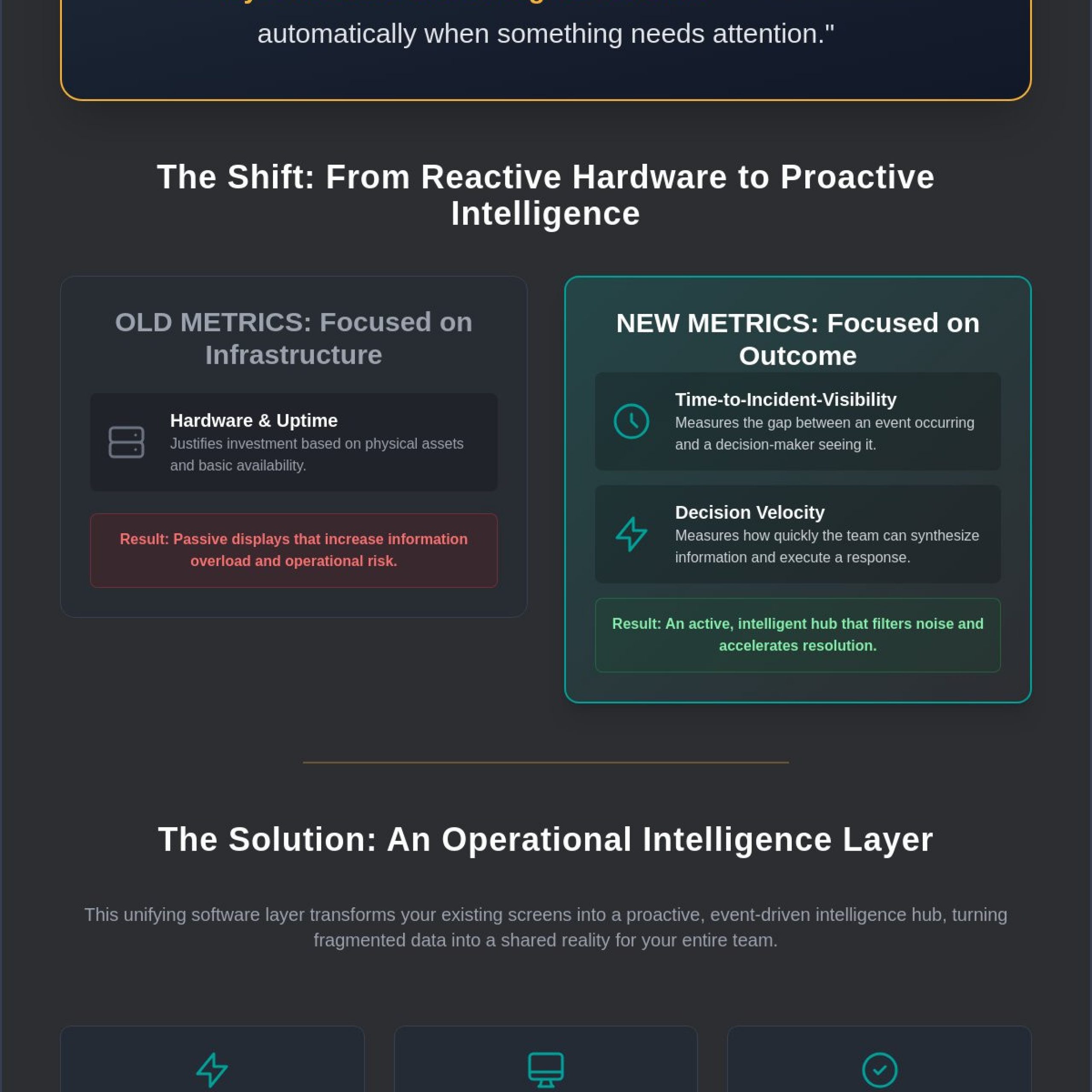
Traditional metrics for success often fail because they focus on technical availability rather than operational outcome. Uptime is a baseline requirement; however, it fails to measure the effectiveness of your team during a crisis. When justifying command center investment, you must prioritize “time-to-incident-visibility.” This metric tracks the delta between the moment an event occurs and the moment it is visualized for a decision-maker. Reducing this gap directly impacts your Mean Time to Resolve (MTTR), turning raw data into a tactical advantage that protects physical and digital assets.
Most control rooms already have the screens. What they’re missing is the layer that decides what goes on them, and escalates automatically when something needs attention. Without this intelligence, a video wall is simply a passive display that contributes to information overload. By integrating a platform like vis/ability, organizations transform their infrastructure into an active participant in incident management. This shift ensures that cross-departmental collaboration happens in real time, even across distributed teams and mobile environments.
Quantifiable Operational Metrics
Decision Velocity serves as a critical KPI for modern operations. It measures how quickly a team can synthesize information and execute a response. High Decision Velocity prevents small anomalies from cascading into full-scale failures, which is essential for maintaining grid stability or public safety. Earlier detection through automated alerting allows for more efficient resource allocation. Instead of deploying broad teams to investigate every alert, managers can target specific assets based on a validated Common Operating Picture (COP).
Regulatory and Compliance Readiness
The regulatory environment for critical infrastructure has become significantly more demanding throughout 2026. On April 1, 2026, the NERC CIP-003-9 standard became enforceable, requiring stricter oversight for low-impact cyber systems. This was followed by the July 1, 2026, enforcement of NERC CIP-012-2, which focuses on securing data exchanged between control centers. Unified visualization simplifies the auditing process for these operational industries by providing a clear, immutable trail of what was seen and when.
Maintaining operational continuity requires more than just real-time monitoring; it demands robust data logging and playback capabilities for post-incident analysis. This level of transparency is vital when building an Investment Justification (IJ) Framework for federal or state funding. If you’re ready to see how these metrics apply to your specific environment, you can speak with our design experts about building a more resilient operation.
Hardware vs. Intelligence: Why More Screens Won’t Solve Information Overload
Procurement strategies for high-stakes environments often fall into the trap of prioritizing physical assets over operational utility. There is a persistent fallacy that increasing the number of monitors directly correlates to better situational awareness. In reality, adding more glass to a wall without a corresponding increase in data synthesis only serves to heighten operator stress. When justifying command center investment, you must distinguish between the carrier of information and the intelligence that makes that information actionable. Most control rooms already have the screens. What they’re missing is the layer that decides what goes on them, and escalates automatically when something needs attention.
Relying on commercial off the shelf hardware provides the infrastructure, but it does not provide the integration required for complex decision-making. High-performance servers and displays are merely tools; they require a sophisticated software layer to function as a unified system. This distinction is critical for state and local agencies that must develop an investment justification (IJ) to secure funding for modernization projects. The value is not in the hardware itself, but in the intelligence layer that prevents critical data from being lost in the noise.
The Limitation of Passive Video Walls
A video wall becomes a liability when it functions as a passive “wall of noise.” Without intelligent content management, operators are forced to scan dozens of static feeds to identify a single anomaly. This manual process is slow and prone to error. Modern operations require dynamic layout switching driven by real-time triggers. When a sensor detects a breach or a system reports a failure, the display must automatically pivot to show the most relevant data. This transition ensures that the team remains focused on the threat rather than the technology.
The Role of the Intelligence Layer
A Framework for Justifying Your Command Center Modernization
Building a data-backed business case requires moving beyond generalities to address specific operational friction points. Justifying command center investment is about proving that your current state introduces unacceptable risk to the organization. A formal framework ensures that every stakeholder understands the gap between existing hardware and the necessary intelligence. This process moves the conversation from “nice-to-have” features to essential operational readiness.
A successful justification follows a logical progression of five critical steps. First, audit your current operational gaps to reveal where data exists but remains invisible to decision-makers. Second, map your critical workflows to pinpoint exactly where manual intervention or system-switching causes delays. Third, define the requirements for a Unified Operating Picture that serves all stakeholders, from frontline operators to executive leadership. Fourth, conduct a cost-benefit analysis that weighs the expense of proactive modernization against the catastrophic costs of reactive incident management. Finally, select a platform that scales across fixed, mobile, and distributed teams.
Auditing Your Current Situational Awareness
The audit process must be granular to be effective. Count the number of separate logins an operator requires to visualize a single incident. If your team must navigate five different platforms to correlate a sensor alert with a camera feed, the system is failing. Measure the time it takes to share a live screen feed with a remote stakeholder or a mobile unit. Often, unintegrated incident management software creates more work for the operator rather than less. Most control rooms already have the screens. What they’re missing is the layer that decides what goes on them, and escalates automatically when something needs attention.
Building the Executive Presentation
When presenting to leadership, focus on risk mitigation and liability reduction. Executives care about operational continuity and the financial impact of a missed event. Use “Before and After” scenarios to illustrate the speed of event-driven escalation versus manual synthesis. Emphasize the scalability of a software-first approach over recurring hardware refreshes. Hardware depreciates quickly, but an operational intelligence layer like vis/ability grows more valuable as you integrate more tools. This platform serves as the central hub into which all other systems flow, ensuring that your public safety or utility operations remain resilient under pressure. To begin your own operational audit, contact our strategy team for a formal consultation.
vis/ability: The Operational Intelligence Layer for Modern Command
vis/ability stands as the definitive operational intelligence layer for high-stakes environments. It acts as the central hub into which all other mission-critical tools flow, ensuring that data synthesis happens before a decision-maker ever looks at a screen. When justifying command center investment, the focus must remain on this unifying platform rather than the physical displays themselves. Most control rooms already have the screens. What they’re missing is the layer that decides what goes on them, and escalates automatically when something needs attention. By implementing vis/ability, organizations move beyond simple visualization to a state of absolute technical reliability.
This platform is the bedrock upon which critical decisions are made. It doesn’t just display data; it prioritizes essential information based on the specific needs of the operation. This proactive nature ensures that your team stays focused on the mission instead of the technology. Whether your team is managing a utility grid or a public safety response, vis/ability provides the steady reassurance that no critical alert will go unnoticed.
Unifying Disparate Data Streams
Tools like Video Management Systems (VMS) or specific SIEM feeds provide vital data, yet they often function as another silo. These platforms only provide a partial solution and require a unifying layer to create a full common operating picture. vis/ability integrates these feeds into a single environment, making them useful for the entire team regardless of their location. Event-driven triggers allow the system to change video wall layouts in real-time based on specific sensor data or alert thresholds. This ensures that the most critical information is never buried under a wall of noise. Additionally, the platform provides a robust cybersecurity common operating picture, allowing teams to monitor digital threats alongside physical security assets within the same hub.
Collaborating Beyond the Control Room
Modern operations don’t end at the walls of the dispatch center. vis/ability extends situational awareness to huddle rooms, desktops, and mobile devices. This capability ensures that field teams see exactly what the commander sees, eliminating the confusion that often occurs during radio-only communications. The “Link” feature provides a secure method for instant collaboration with external partners and emergency stakeholders. This level of technical integration transforms the command center into a mobile, deployable asset that maintains operational continuity in any environment. If you’re ready to move toward a state of clear, actionable intelligence, we invite you to contact Activu Corporation for a tailored ROI assessment based on your specific operational reality.
Secure Your Operational Future with Intelligent Visibility
Modernizing your facility requires a fundamental shift from purchasing pixels to investing in intelligence. We have identified how fragmented data silos and operator fatigue create unacceptable liabilities, and how a unified operating picture restores tactical control. Justifying command center investment in the current economic environment is no longer about the physical room; it’s about the speed and accuracy of the decisions made within it. Most control rooms already have the screens. What they’re missing is the layer that decides what goes on them, and escalates automatically when something needs attention.
With over 40 years of mission critical experience, Activu provides the bedrock for high-stakes environments. Our solutions are trusted by public safety and utilities nationwide, specifically designed to meet NERC CIP and the most stringent high-security compliance standards. Request an ROI Consultation and vis/ability Demo to see how we can transform your operations. Your team deserves the clarity to act with absolute certainty when every second counts.
Frequently Asked Questions
How do you calculate the ROI of a command center when safety is the primary goal?
Calculating ROI for safety-critical environments centers on the reduction of Mean Time to Resolve (MTTR) and the prevention of catastrophic failure. You should measure the financial impact of a single avoided outage or a localized incident that was prevented from cascading. By quantifying the delta between manual detection and automated visibility, you provide a clear financial justification for protecting lives and high-value assets.
What is the biggest mistake organizations make when justifying a new control room?
The most common error in justifying command center investment is prioritizing the physical room and display hardware over the software that drives it. Organizations often focus on the aesthetic impact of a new video wall while ignoring the fragmented data silos that hinder their operators. Most control rooms already have the screens; what they’re missing is the layer that decides what goes on them and escalates automatically when something needs attention.
Can we use our existing video wall hardware with a new intelligence platform?
Modern operational intelligence platforms are designed to be hardware-agnostic and can typically integrate with your existing displays and servers. The value lies in the software layer that unifies your disparate tools into a single operating picture. This allows you to modernize your operational capability without the immediate need for a complete, cost-prohibitive hardware refresh.
How does event-driven visualization reduce operator stress and turnover?
Event-driven visualization reduces stress by filtering out irrelevant data and presenting only what is essential for the current mission. This automation prevents the cognitive overload that leads to operator fatigue and high turnover rates. When the system handles the noise, operators can focus on their core duty: making high-stakes decisions with absolute technical certainty.
Why is a common operating picture (COP) essential for regulatory compliance?
A Common Operating Picture ensures that every action and visualization is logged, creating an immutable audit trail for regulatory bodies. This is essential for meeting the strict requirements of NERC CIP-003-9 and CIP-012-2, which became enforceable in 2026. A unified hub proves that your organization maintained situational awareness and followed established protocols during critical events.
What is the difference between a video wall processor and an operational intelligence layer?
A video wall processor is a hardware tool that manages where windows appear on a screen, whereas an operational intelligence layer is the logic that decides which information is vital. Processors are passive and require manual control. An intelligence layer like vis/ability is proactive; it uses real-time triggers to automatically change layouts and alert the team to emerging threats.
How much does a command center modernization project typically cost?
Modernization costs vary significantly based on the scale of your operation and the number of third-party integrations required. You must also account for the 2026 surge in enterprise hardware prices, where server and storage costs have risen by as much as 30 percent. A tailored assessment is necessary to determine the specific investment needed for your facility’s unique operational requirements.
How long does it take to see a return on investment after upgrading command center software?
Operational gains are often realized immediately through faster incident response times and improved compliance reporting. The reduction in “time-to-incident-visibility” provides a measurable improvement in performance from the first day the system goes live. Over the long term, the savings from reduced operator turnover and minimized incident impact continue to compound the value of the investment.