

If your operators are currently drowning in data silos while critical incidents slip through the cracks, your infrastructure has become a liability rather than an asset. Building a business case for a control room upgrade often fails because it focuses on the cost of hardware instead of the high price of operational blind spots. You understand the risk of cognitive overload; yet, quantifying the impact of fragmented feeds from tools like Axon remains a challenge for many strategic decision makers. These systems provide only a partial solution, leaving gaps in your common operating picture that delay response times and compromise mission success.
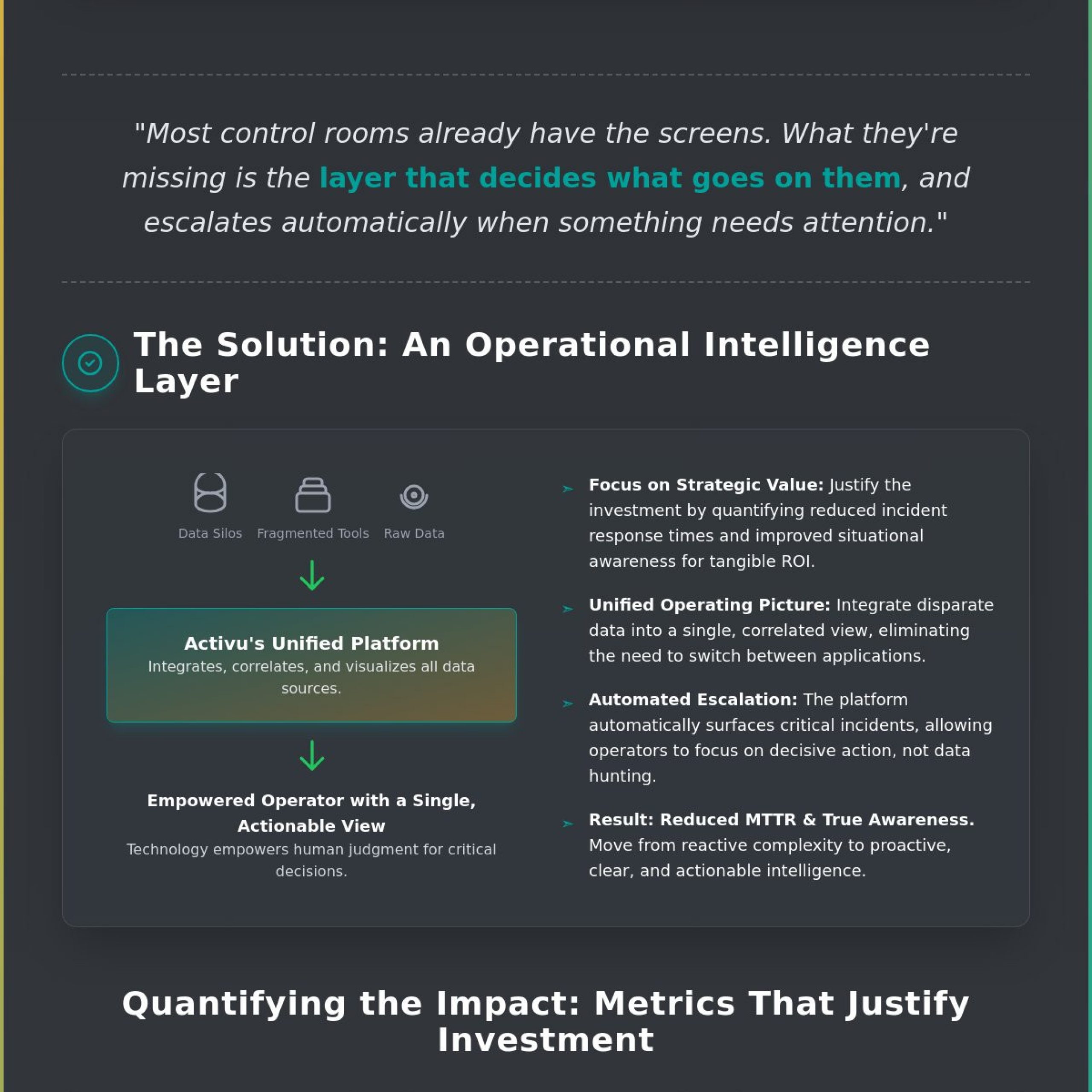
Most control rooms already have the screens. What they’re missing is the layer that decides what goes on them, and escalates automatically when something needs attention. This article provides the framework to secure executive buy-in by shifting the focus to operational intelligence and situational awareness. You will learn how to justify a unified platform that integrates disparate data into a single, actionable view, ensuring your facility meets the latest NERC CIP-003-9 and CIP-012-2 security standards effective in 2026. We examine the transition from reactive monitoring to a proactive environment where technology empowers human judgment during the most critical moments of a decision cycle.
Key Takeaways
- Learn the specific framework for building a business case for a control room upgrade that shifts the conversation from depreciating hardware to strategic operational intelligence.
- Identify why traditional upgrades often stall when executives prioritize short term costs over the long term risks of fragmented data and siloed systems.
- Understand how the operational intelligence layer serves as the critical link that automates incident escalation and unifies your existing screens.
- Discover how to quantify the value of reduced incident response times and improved situational awareness to prove tangible ROI to financial stakeholders.
- Gain a step by step guide to structuring your proposal to address executive concerns about downtime while highlighting the benefits of a unified operating picture.
The Operational Reality: Why Traditional Control Room Upgrades Stall
Executive leadership often views the command center as a static line item on a balance sheet. When you begin building a business case for a control room upgrade, you likely encounter the “if it ain’t broke” fallacy. To a Chief Financial Officer, a decade-old video wall that still lights up appears functional. On the operational floor, however, that aging hardware is often a significant bottleneck. Understanding what is a control room in a modern context requires moving past physical furniture and displays. It’s a decision-making hub where success is measured by the speed of response, not the brightness of the pixels.
Traditional upgrade requests frequently stall because they focus on technical specifications rather than operational outcomes. While your team struggles with fragmented systems and data silos, the executive level sees no immediate reason to replace equipment that hasn’t physically failed. This disconnect creates a dangerous environment where operators are expected to maintain peak performance using tools that cannot keep pace with the velocity of incoming data. Relying on raw data alone leaves your organization vulnerable to blind spots that no amount of screen real estate can fix.
Control Room Situational Awareness Problems
Operators in high-stakes environments face a constant barrage of information. Cognitive overload isn’t just a fatigue issue; it’s a structural failure. When an operator must manually jump between disconnected applications to verify a single alert, they experience the “swivel-chair” effect. This fragmentation directly increases the Mean Time to Resolution (MTTR). Most control rooms already have the screens. What they’re missing is the layer that decides what goes on them, and escalates automatically when something needs attention. Without this intelligence, operators inevitably miss critical incidents because they’re managing software instead of managing the mission.
The Cost of Operational Blind Spots
Identifying the Gaps: Beyond the Video Wall Hardware
Successful strategies for building a business case for a control room upgrade require a fundamental shift in perspective. Many organizations mistake a video wall purchase for a comprehensive situational awareness solution. Retail hardware providers sell displays and processors, but they rarely address the underlying data architecture. This results in a “checkerboard” of disconnected feeds that forces operators to manually correlate information during high-stress events. To meet the ISO 11064-1 standard, your environment must prioritize human factors and ergonomic data delivery over mere pixel density. If your current setup focuses only on the glass and not the data flow, you are likely missing the very incidents you are meant to monitor.
Most control rooms already have the screens. What they’re missing is the layer that decides what goes on them; and escalates automatically when something needs attention. This “operational intelligence layer” is the missing link between raw data and decisive action. Without it, you aren’t truly upgrading your capabilities. You’re simply buying newer versions of the same blind spots. When building a business case for a control room upgrade, the justification should center on this intelligence layer rather than just replacing depreciated monitors.
The Limitations of Siloed Tools
Many agencies utilize specialized tools like Axon to manage specific tactical feeds. While these platforms provide value, they often exist as isolated silos. They offer only a partial solution. Relying on standalone tools means your operators must still bridge the gap between video management, geospatial data, and sensor alerts manually. This fragmentation creates a lag in response times that off-the-shelf hardware cannot solve. True mission-critical resilience requires a unifying platform that treats every data source as part of a single, coherent stream rather than a series of disconnected tabs.
Defining the Common Operating Picture (COP)
A Common Operating Picture is more than a shared view. It’s a synchronized environment where every stakeholder, from the command center to the huddle room, sees the same prioritized information. The vis/ability platform functions as this central hub. It aggregates real-time data from disparate sources and pushes critical insights to mobile devices and remote teams. This ensures that field personnel and supervisors maintain the same level of situational oversight as the operators on the floor. This level of integration is what transforms a room full of monitors into a proactive command environment. If you’re ready to move beyond hardware and secure your operations, you might speak with a design consultant to evaluate your current gaps.
Quantifying the Impact: Metrics That Justify the Investment
Executive stakeholders require quantitative evidence to move beyond the status quo. When building a business case for a control room upgrade, you must redefine ROI by shifting focus from hardware longevity to operational outcomes. It isn’t about how many years a display remains powered on. It’s about how many seconds you shave off an emergency response. A successful proposal links technological investment to tangible safety and efficiency gains that resonate with the boardroom.
Human performance is a critical, yet often overlooked, metric. Operators facing cognitive overload are more likely to miss subtle anomalies, leading to catastrophic failures. By automating the prioritization of information, you reduce the mental burden on your staff. This directly impacts operator retention and reduces the costs associated with turnover and training in high-pressure environments. Most control rooms already have the screens. What they’re missing is the layer that decides what goes on them, and escalates automatically when something needs attention.
Operational Efficiency and Response Times
Manual data aggregation is a legacy process that slows decision cycles. In the context of incident management, Mean Time to Resolution (MTTR) measures the average duration from the initial alert to the final resolution of an event. Reducing MTTR is impossible when operators must hunt for data across disconnected systems. Transitioning to event-driven visualization allows your team to bypass manual searching. This automation ensures that the unified operating picture is available the moment an incident occurs, saving precious minutes that define the difference between a controlled event and a crisis.
Risk Mitigation and Compliance
Regulatory pressure provides a compelling catalyst for an upgrade. For those in utilities, compliance is a moving target. NERC CIP-003-9 becomes effective April 1, 2026, while CIP-012-2 takes effect July 1, 2026. These standards demand higher levels of security management and real-time data protection. A cybersecurity common operating picture reduces threat dwell time by surfacing anomalies immediately. Beyond compliance, the ability to generate automated audit trails and recorded SITREPs provides a layer of legal and operational protection. Avoiding the cost of a single major operational failure or a regulatory fine often pays for the entire upgrade in one event.
Structuring Your Proposal: Positioning vis/ability as the Hub
Drafting the executive summary is the most critical step in building a business case for a control room upgrade. You must lead with a strong value proposition that targets operational readiness rather than equipment depreciation. Framing the project as an “Operational Intelligence” initiative ensures that decision makers see a path toward increased capability rather than just a maintenance expense. Your proposal should outline a clear transition from reactive monitoring to a state of proactive situational awareness. This shift represents a fundamental change in how your organization manages risk and resources across the enterprise.
Most control rooms already have the screens. What they’re missing is the layer that decides what goes on them, and escalates automatically when something needs attention. This distinction is the core of your strategic argument. By positioning the upgrade as a unifying hub, you demonstrate how the system serves the entire organization. It isn’t just for the operators on the floor. It extends to huddle rooms, mobile users, and distributed teams who require immediate access to the same intelligence. This unified approach eliminates the data gaps that lead to delayed responses.
Integrating Existing Technology
A common obstacle in building a business case for a control room upgrade is the concern over sunk costs in current software. You must demonstrate that vis/ability doesn’t replace your existing tools; it makes them more effective. Through seamless application integration, you can unify disparate feeds from platforms like Axon into a single interface. While some organizations use Axon for evidence management or body cam feeds, it only provides a partial solution. Without a central hub, these feeds remain siloed and require manual intervention to correlate. By adding the intelligence layer, you leverage your existing screens to create a full common operating picture. This approach preserves your previous investments while providing the missing connectivity required for mission success.
The Human Element in Digital Context
Technology is only as effective as the human judgment it supports. The primary goal of an operational intelligence layer is to empower individuals to act with greater certainty during high stakes events. When your team shares a unified COP across command centers and mobile devices, collaboration happens in real time. This clarity reduces the cognitive load on operators, which significantly minimizes training time and human error. Decisions are made faster when the technology acts as a bridge between raw data and human action. This ensures that the right information reaches the right person at exactly the right moment. If you’re ready to define your specific requirements, contact our design team for a consultation.
Securing Approval: Moving from Raw Data to Actionable Intelligence
Securing executive approval requires more than just identifying problems; it necessitates a clear, risk-mitigated path to the solution. When building a business case for a control room upgrade, you must address the inevitable concerns regarding implementation timelines and operational downtime. Decision makers often hesitate because they fear a “rip and replace” approach will leave them blind during the transition. A well-structured proposal emphasizes a phased rollout that maintains visibility while systematically introducing new capabilities. This strategic execution ensures that your team never loses the ability to respond to critical events during the modernization process.
Most control rooms already have the screens. What they’re missing is the layer that decides what goes on them, and escalates automatically when something needs attention. Finalizing your case means demonstrating that this intelligence layer provides the operational clarity required for mission-critical resilience. You aren’t just buying software; you’re securing the ability to act with absolute certainty when every second counts. By framing the upgrade as a necessity for safety and compliance rather than a luxury, you align the project with the organization’s core mission.
The Path Forward with Professional Design
Success begins long before the first server is installed. Utilizing professional control room design services during the planning phase allows you to map your data architecture to your operational goals. Professional engineering ensures that your hardware and software are optimized to handle the specific stressors of your environment. This meticulous preparation prevents the common pitfalls of off-the-shelf installations that fail to integrate with existing legacy systems. A phased implementation strategy allows you to modernize your infrastructure without compromising current safety protocols, providing a steady transition toward a more capable command environment.
Closing the Case
Your final argument must reinforce the shift from fragmented data silos to a unified operating picture. Building a business case for a control room upgrade is ultimately an investment in the bedrock of your critical decision-making process. By prioritizing the operational intelligence layer, you transform raw data into actionable intelligence that empowers your entire organization. This clarity is the ultimate outcome of a successful upgrade, moving your team from a reactive state to one of proactive command. If you’re ready to secure your operations and move beyond the limitations of your current setup, Contact Activu to build your mission-critical blueprint today.
Advancing Toward Operational Intelligence
Success in building a business case for a control room upgrade depends on your ability to move the conversation from depreciating hardware to strategic capability. You’ve seen that the true value of an upgrade lies in the reduction of incident response times and the elimination of data silos. Most control rooms already have the screens. What they’re missing is the layer that decides what goes on them, and escalates automatically when something needs attention. By focusing on this operational intelligence layer, you transform your center from a reactive monitoring environment into a proactive command hub.
Activu has delivered technical reliability to Fortune 500 companies and government agencies since 1983. With over 40 years of experience and specialized cybersecurity common operating picture capabilities, we provide the bedrock for your most critical decisions. Our team is ready to help. We’ll assist you in translating operational gaps into a clear, actionable proposal for leadership. Contact our experts to begin building your business case and secure the future of your operations. Your team’s success starts with a unified operating picture.
Frequently Asked Questions
Why do operators miss incidents on a standard video wall?
Operators miss incidents because of cognitive overload and the lack of automated prioritization. In a standard setup, the human brain must filter thousands of data points across disconnected screens. This manual process inevitably leads to fatigue and change blindness during high stakes operations. Without a system to highlight anomalies, critical alerts often remain buried under a mountain of irrelevant raw data.
How does an operational intelligence layer differ from standard video wall software?
Standard video wall software focuses on visualization, while an operational intelligence layer focuses on active decision support. Standard tools are passive and require manual control. An intelligence layer like vis/ability is proactive, using event-driven logic to ensure only the most critical information occupies the operator’s field of view. It acts as the brain of the command center rather than just the glass.
Can I upgrade my control room intelligence without replacing all my screens?
What are the most important ROI metrics for a control room upgrade?
The most critical metrics involve Mean Time to Resolution (MTTR) and the reduction of operational blind spots. When building a business case for a control room upgrade, you should quantify the financial impact of prevented downtime and improved response coordination. These outcomes provide a more compelling justification for investment than simple hardware replacement cycles or maintenance costs.
How does vis/ability integrate with existing tools like Axon or SIEM platforms?
It serves as a unifying platform that pulls data from specialized tools into a single operating picture. While Axon or SIEM platforms provide valuable data, they often remain siloed and require manual correlation. vis/ability integrates these feeds, ensuring that tactical information is accessible to everyone from the command center to mobile field units. It makes your existing tools more useful for the entire team.
Is a business case for a control room upgrade different for public safety vs. utilities?
The fundamental need for a common operating picture is identical, though the specific regulatory drivers vary. Public safety cases often center on life safety and inter-agency collaboration. Utilities must prioritize regulatory compliance, particularly with the NERC CIP-003-9 and CIP-012-2 standards becoming effective in 2026. Both sectors benefit from shifting toward event-driven situational awareness to manage high-stakes risks.
What is the first step in building a business case for a NOC or SOC?
The first step is identifying current situational awareness problems through a thorough operational audit. Document specific instances where siloed data or fragmented systems caused a delay in incident response. This evidence forms the foundation for building a business case for a control room upgrade by highlighting existing vulnerabilities that threaten mission success. Clarity on these gaps is essential for securing executive buy-in.
How does automated escalation improve situational awareness?
Automated escalation removes the human error associated with manual monitoring of every sensor and feed. By pre-defining critical thresholds, the system ensures that vital information is pushed to the video wall and mobile devices the moment an event occurs. This ensures that decision makers act on intelligence rather than searching for raw data. It creates a state of clear, actionable intelligence when stakes are at their highest.