
Does your command center truly see the threat, or is it merely displaying the data? Operators today are buried under a deluge of incoming feeds. Between siloed applications like Axon and complex SIEM alerts, the visual layer often remains a static backdrop rather than a proactive tool. This fragmentation forces manual intervention at the exact moment when every second counts. Deploying video wall software with open API capabilities changes this dynamic by turning your display into an active participant in your operation.
Most control rooms already have the screens. What they’re missing is the layer that decides what goes on them, and escalates automatically when something needs attention. You will discover how an open API transforms static video walls into dynamic, event-driven intelligence layers that automate critical decision-making. We will examine how the vis/ability platform acts as an operational intelligence layer to unify your existing tools, eliminate cognitive load, and reduce incident response times through automated visual escalation.
Key Takeaways
- Eliminate visual silos caused by proprietary software. An open API architecture ensures your team maintains a complete common operating picture during high-stakes events.
- Integrate fragmented data streams from applications like Axon or SIEM. This unification provides the necessary visual context for rapid, informed incident response.
- Leverage video wall software with open API to implement event-driven triggers. This allows the system to prioritize essential information automatically when a crisis occurs.
- Verify technical requirements for enterprise-grade performance. High-stakes operations require RESTful standards and low-latency command execution to maintain operational readiness.
- Position the vis/ability platform as your operational intelligence layer. It serves as the central hub that empowers operators to act with greater certainty and clarity.
The Role of an Open API in Modern Control Room Orchestration
Control rooms are often defined by the volume of data they process. However, raw data without context is just noise. In high-stakes environments, the ability to orchestrate visual information determines the speed and accuracy of a response. This orchestration relies on an Application Programming Interface (API) to serve as the connective tissue between diverse data sources and the visual display. Proprietary, closed systems create silos that force operators to manually switch between applications. This manual process introduces delays. When you deploy video wall software with open API capabilities, you move away from static layouts toward a programmatic environment where the system reacts to real-time events.
Most control rooms already have the screens. What they’re missing is the layer that decides what goes on them, and escalates automatically when something needs attention. Relying on manual layout management is a liability during a crisis. An open API allows the video wall to function as a proactive member of the response team, ensuring that critical data is never buried under secondary information.
Defining Operational Intelligence vs. Basic Visualization
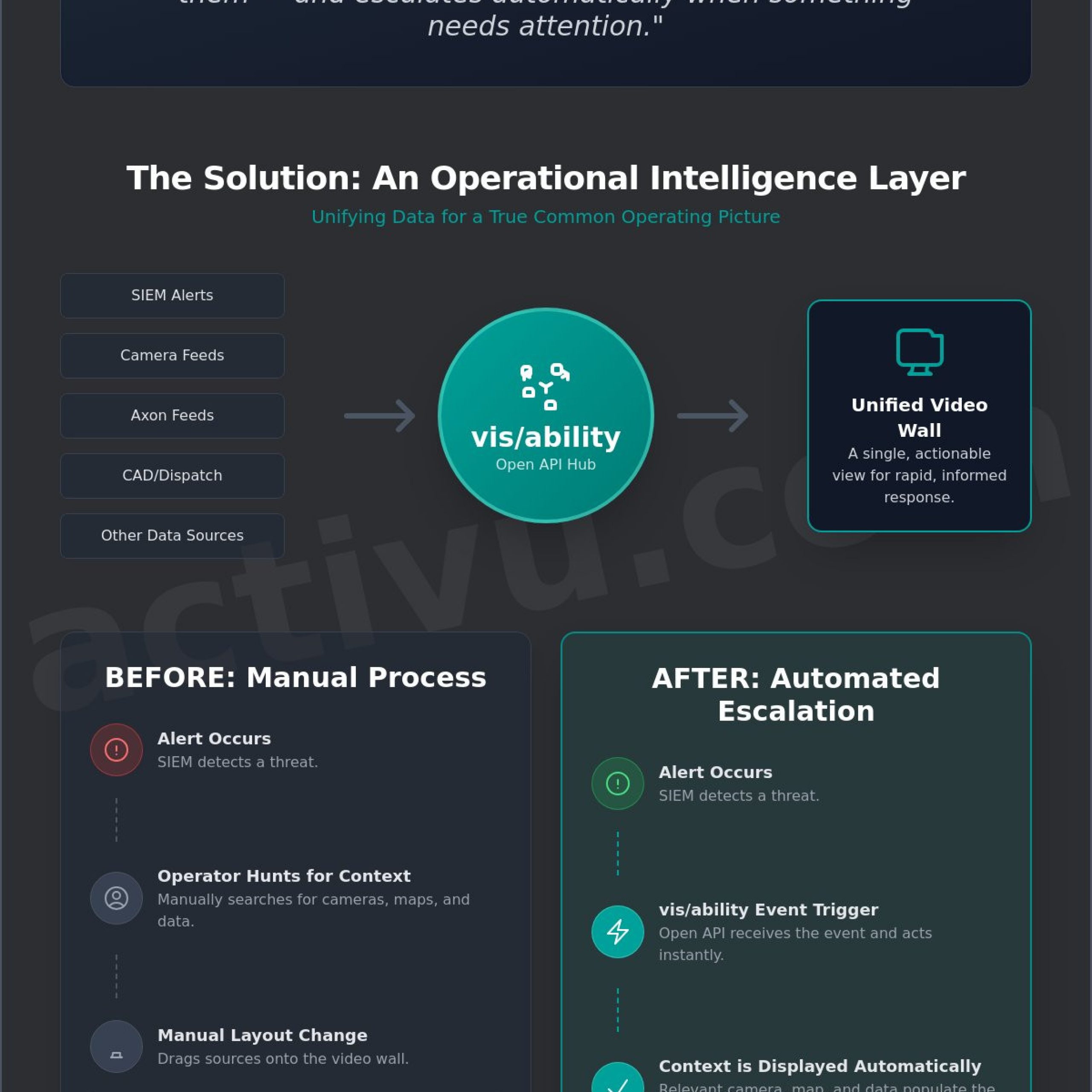
Simply displaying a camera feed or a dashboard is basic visualization. It’s passive. Modern SOCs and NOCs require operational intelligence, where the visual layer understands the context of the data it receives. A “dumb” video wall requires a human to notice a change. An intelligent layer, powered by an open API, recognizes a threshold breach in a SIEM tool and immediately populates the relevant geospatial data and camera feeds. This shift significantly reduces the cognitive load on operators. They no longer hunt for information; the information finds them when it matters most. This is why the vis/ability platform is positioned as the operational intelligence layer for modern command centers.
The Strategic Value of Integration Flexibility
Future-proofing a command center requires an architecture that accepts change. Technology evolves quickly. An open API ensures that your investment in video wall software with open API remains relevant as you integrate new AI-driven analytics or machine learning feeds. RESTful architectures simplify these integrations by using standard protocols. This flexibility allows different departments to share a Common Operating Picture. Whether it is public safety or cybersecurity, every stakeholder sees the same truth. This alignment is critical for cross-functional collaboration during large-scale incidents. By removing the barriers of closed systems, organizations ensure that their visual layer grows alongside their technical ecosystem.
Technical Requirements for Enterprise-Grade Video Wall APIs
High-stakes operations demand more than simple connectivity. They require a rigorous technical framework that ensures reliability when the pressure is highest. While hobbyist libraries or unmanaged scripts might offer basic control, they lack the stability and security protocols necessary for a 24/7 command center. Most control rooms already have the screens. What they’re missing is the layer that decides what goes on them, and escalates automatically when something needs attention. Relying on professional video wall software with open API capabilities ensures that your visual infrastructure is built on a foundation of enterprise-grade technical rigor.
Responsiveness is non-negotiable in an emergency. When a SIEM alert triggers or a Computer-Aided Dispatch (CAD) event occurs, the command execution must be instantaneous. A system that lags under the weight of hundreds of concurrent data inputs is an operational liability. Enterprise solutions are engineered to scale, managing high-volume data streams without performance degradation. This level of reliability transforms the video wall from a simple monitor into a high-performance engine for decision-making.
Standardized Protocols: REST, Webhooks, and Beyond
RESTful APIs are the industry preference for enterprise integration because they provide a stateless, scalable architecture that developers can implement with predictability. Comprehensive documentation is essential to ensure that your IT team can build and maintain these connections without constant vendor intervention. Webhooks take this functionality further by enabling the system to push real-time alerts to the visual layer the moment an event occurs. Within this framework, JSON serves as the lightweight, structured format required for the rapid data exchange between the video wall and external applications. This speed is essential to improve situational awareness with a display wall, as even a few seconds of latency can compromise a critical response.
Securing the Interface: Protecting Mission-Critical Data
Security is the primary concern when moving toward open architectures. Unlike unmanaged open-source tools, enterprise-grade video wall software with open API includes robust protection layers to prevent unauthorized access. Implementing OAuth2 for authentication, end-to-end encryption, and role-based access control (RBAC) ensures that only authorized personnel or verified systems can trigger visual changes. Audit logs are equally vital; every command sent via the API must be documented to maintain accountability and meet strict compliance standards. The vis/ability platform manages these security complexities behind the scenes, allowing you to integrate your ecosystem with confidence. If you’re planning a more resilient infrastructure, you can speak with our design team about securing your integrated command center.
Solving the Data Silo Problem: Integrating Critical Application Streams
Data silos are the silent enemy of operational readiness. Tools like Axon or SIEM provide essential data, but they often exist in isolation. An operator might see an alert in one window but lack the visual context to understand its geographic or physical impact. This fragmentation leads to high cognitive load and delayed responses during a crisis. Video wall software with open API capabilities bridges these gaps by pulling disparate data sources into a single, cohesive view. By leveraging open web standards, organizations can create interactive visualizations that turn raw data streams into actionable intelligence.
Most control rooms already have the screens. What they’re missing is the layer that decides what goes on them, and escalates automatically when something needs attention. Without this layer, even the most sophisticated data feeds remain trapped in their own applications, invisible to the team when they are needed most. The vis/ability platform serves as this operational intelligence layer, ensuring that critical information is prioritized and shared across the entire command structure.
Public Safety and Federal Integration
In public safety environments, fragmented systems are more than just an inconvenience; they are a risk. Real-Time Crime Centers (RTCC) often struggle to link 911 calls with relevant camera feeds in real-time because the underlying systems don’t communicate. When dispatch centers rely on siloed applications, operators frequently miss incidents during high-noise events. Integrating Computer-Aided Dispatch (CAD) through an API allows the visual layer to respond instantly to a call’s location. For federal government and defense operations, this level of integration is essential for maintaining a full common operating picture across multi-agency responses. This ensures that every stakeholder has the clarity needed to act with certainty.
Utilities and Energy: Managing the Grid
Monitoring grid health requires a constant stream of SCADA and IoT data. While standalone monitoring tools provide deep technical insights, they often lack the ability to trigger a wider visual escalation when a threshold is breached. This gap is particularly dangerous when managing NERC CIP compliance or preventing large-scale outages. By using video wall software with open API, utility providers can visualize grid stability and compliance metrics in real-time. This ensures that when a critical fault occurs, the utilities and energy control room immediately displays the affected sector and relevant diagnostic data. The system moves from a passive monitor to an active responder, protecting critical infrastructure through automated situational awareness.
Automating Situational Awareness through Event-Driven Triggers
Event-driven visualization represents a fundamental shift in how command centers operate. Traditional displays are static, requiring constant human monitoring to identify changes. In high-stakes environments, this passivity is an unacceptable risk. By implementing video wall software with open API, you transform your display from a silent wall into an active responder. Most control rooms already have the screens. What they’re missing is the layer that decides what goes on them, and escalates automatically when something needs attention. Threshold-based triggers, such as a server failure or a security breach, ensure that the most critical information is always front and center, regardless of the complexity of the incoming data streams.
The Escalation Workflow: From Alert to Action
The transition from an alert to an action must be seamless. When an integrated system detects a threat, it sends an API command to the visual layer, triggering an immediate layout change. The critical moment occurs when raw data transforms into actionable intelligence through automated visual prioritization. This workflow removes manual switching, allowing operators to focus on resolution. By using API logic to filter out non-essential noise, organizations reduce operator fatigue and minimize human error. You can request a demonstration to see how event-driven triggers can revolutionize your operational workflow.
Cross-Platform Collaboration: Mobile and Huddle Rooms
Operational clarity should not be confined to the main command center. An open architecture allows you to extend the reach of your video wall software with open API to mobile devices and remote huddle rooms. This ensures that every stakeholder sees the same Common Operating Picture. When the wall reacts to an event, critical data is pushed to decision-makers on any device. The vis/ability Platform serves as the central hub for this distribution, unifying your entire team under a single, reliable intelligence layer. This consistency is vital for maintaining operational readiness during complex, multi-agency responses.
vis/ability: The Operational Intelligence Layer for Integrated Operations
Success in high-stakes environments is no longer measured by the number of screens on a wall. It is measured by the clarity of the intelligence those screens provide. Standalone tools like SIEM or Axon offer critical data points, but they often lack the breadth to create a complete common operating picture. The vis/ability platform acts as the central hub, unifying these fragmented streams into a single, cohesive interface. By deploying video wall software with open API capabilities, organizations ensure that their visual layer is not just a display, but a proactive member of the operational team. Activu serves as a strategic partner, providing the technical bedrock upon which critical decisions are made with absolute certainty.
Most control rooms already have the screens. What they’re missing is the layer that decides what goes on them, and escalates automatically when something needs attention. This is the core value of an operational intelligence layer. It moves your organization away from a reactive posture toward a model of proactive readiness. When stakes are at their highest, you need a system that remains analytical and focused, acting as a steady guardian over your mission-critical data.
Unifying Your Control Room Ecosystem
Standalone applications only provide a partial solution. Without a unifying layer, operators are forced to toggle between windows, losing precious time during an incident. vis/ability fills these gaps by integrating every tool into a unified workflow. This integration is most effective when paired with expert Control Room Design Services. Planning your environment around the flow of information ensures that your hardware and software work in perfect synchronization. This holistic approach eliminates silos and ensures that essential information is always prioritized for the entire team, whether they are in the command center or on mobile devices.
Next Steps: Evaluating Your Integration Readiness
Transitioning to an automated situational awareness model requires a thorough evaluation of your existing infrastructure. Start by asking your current hardware providers about the openness of their API. Many legacy systems are closed, which limits your ability to integrate modern AI or machine learning feeds. Evaluating the throughput of your video wall software with open API is a necessary step in ensuring operational resilience, especially during a high-volume event. Reliability is the only metric that matters when lives or critical assets are on the line. If your current setup cannot handle the load, it’s time to consider a more resilient architecture. You can contact Activu to discuss your integration requirements and begin building a more visible, intelligent operation.
Advancing Toward Proactive Command and Control
Transitioning from fragmented, manual monitoring to an automated, event-driven model is the next evolution of the command center. By prioritizing essential information through an open architecture, you eliminate the cognitive load that leads to missed incidents. Deployment of video wall software with open API ensures that your visual layer remains a dynamic asset rather than a static liability. This transformation allows your team to focus on decisive action instead of data management.
Most control rooms already have the screens. What they’re missing is the layer that decides what goes on them, and escalates automatically when something needs attention. Activu provides this operational intelligence layer, offering a NERC CIP and enterprise cybersecurity compliant architecture trusted by over 1000 mission-critical control rooms worldwide. Our platform enables seamless integration with Axon, SIEM, CAD, and SCADA systems to create a unified hub for your entire operation. You can act with greater certainty when your technology works as a vigilant partner.
Request a demo of the vis/ability platform and see our open API in action
Frequently Asked Questions
What is an open API in the context of video wall software?
An open API serves as a standardized interface that allows external applications to communicate directly with your visual display system. It enables developers to write code that triggers layout changes, source routing, or alert overlays without manual operator intervention. This connectivity transforms a static display into a responsive tool that adapts to the needs of the mission in real time. It effectively turns the visual layer into a programmable asset within your technical ecosystem.
How does an open API improve incident response times?
Automated visual escalation reduces response times by eliminating the manual steps required to identify and display critical data. When an incident occurs, the video wall software with open API immediately surfaces relevant feeds, geospatial maps, and standard operating procedures. Most control rooms already have the screens. What they’re missing is the layer that decides what goes on them, and escalates automatically when something needs attention. This automation ensures that operators act on intelligence rather than searching for it.
Can I integrate my existing SIEM or CAD software with a video wall API?
Integrating CAD and SIEM tools is a primary function of an enterprise-grade API. While tools like Axon provide valuable data, they often function in silos and only offer a partial solution for situational awareness. Using an API allows you to pull these disparate streams into a unified common operating picture. This ensures that a triggered alert in your SIEM or a new call in your CAD system immediately populates the video wall with the correct context for the entire team.
What are the security risks of using an open API in a control room?
Security risks are mitigated through enterprise-grade protocols like OAuth2, end-to-end encryption, and role-based access control (RBAC). Unlike hobbyist or unmanaged open-source scripts, professional video wall software with open API is designed for high-stakes environments and complies with strict standards like NERC CIP. Detailed audit logs track every command sent via the interface. This ensures that only authorized systems and personnel can influence the visual layer, maintaining the integrity of the command center at all times.
Do I need a dedicated developer team to use a video wall API?
While a developer team can create highly customized workflows, many organizations use existing IT resources or vendor-provided integration services. The vis/ability platform is designed to be accessible, offering comprehensive documentation for RESTful standards. You don’t always need a full software department to leverage basic automation. However, complex event-driven triggers benefit from professional design services to ensure the logic aligns with your operational reality and response protocols during a crisis.
What is the difference between a video wall controller and an operational intelligence layer?
A video wall controller is hardware-focused, managing the physical routing of video signals to specific monitors. An operational intelligence layer, like vis/ability, provides the logic and context that makes that hardware useful. It acts as the central hub that processes incoming alerts and decides which information is essential for the team. This layer bridges the gap between raw video feeds and human judgment, ensuring clarity and precision during complex operations.
How does vis/ability handle event-driven automation?
vis/ability handles automation by acting as a listener for external triggers sent through its API. When a predefined threshold is reached in a connected system, such as a security breach or a power grid fault, the platform executes an immediate layout change. It prioritizes the most critical data and pushes notifications to relevant stakeholders. This event-driven approach ensures that the system reacts with the same urgency as the incident itself, providing a bedrock of reliability for decision-makers.
Is it possible to extend video wall data to mobile users via an API?
The vis/ability platform extends the common operating picture to mobile devices and remote huddle rooms through its integrated architecture. An API ensures that the same intelligence layer driving the main command center wall is also accessible to field units or executives on the move. This synchronization is vital for cross-departmental collaboration. It allows every member of the response team to view the same truth, regardless of their physical location or the device they’re using.