
What if the primary cause of operational failure in 2026 isn’t a lack of data, but a surplus of it? In high-stakes environments, a 2023 study by the International Journal of Industrial Ergonomics confirmed that human error accounts for 80% of critical incidents, largely driven by cognitive overload. You likely already feel the strain of managing dozens of disconnected feeds and manual escalation protocols that often undermine even the most expensive integrated command and control solutions. It’s a constant struggle to maintain a unified common operating picture when your team is drowning in fragmented data silos and partial tools like Axon that only offer a fraction of the necessary context.
This guide demonstrates how to transform these chaotic streams into actionable intelligence. Most control rooms already have the screens. What they’re missing is the layer that decides what goes on them, and escalates automatically when something needs attention. We define this as vis/ability, an operational intelligence layer that surfaces through the video wall to provide clarity when stakes are highest. You’ll learn how to bridge the gap between raw data and human judgment across your command center, remote huddle rooms, and mobile devices. We will outline the exact steps to automate situational awareness and ensure your team acts with absolute certainty during every mission-critical event.
Key Takeaways
- Identify why fragmented data streams create operational blind spots and learn to bridge the gap between raw information and mission-critical intelligence.
- Define the technical requirements for integrated command and control solutions that prioritize a unified operational layer over simple hardware assembly.
- Recognize that while most control rooms have the necessary screens, they lack the vis/ability layer required to automate incident escalation and manage visual data.
- Apply a strategic framework for selecting C2 technology that ensures scalability, security, and seamless collaboration across all operational spaces.
- Transition your video wall from a passive display into the proactive hub where actionable answers surface the moment a critical decision is required.
Identifying the Gap: Why Modern Command Centers Struggle
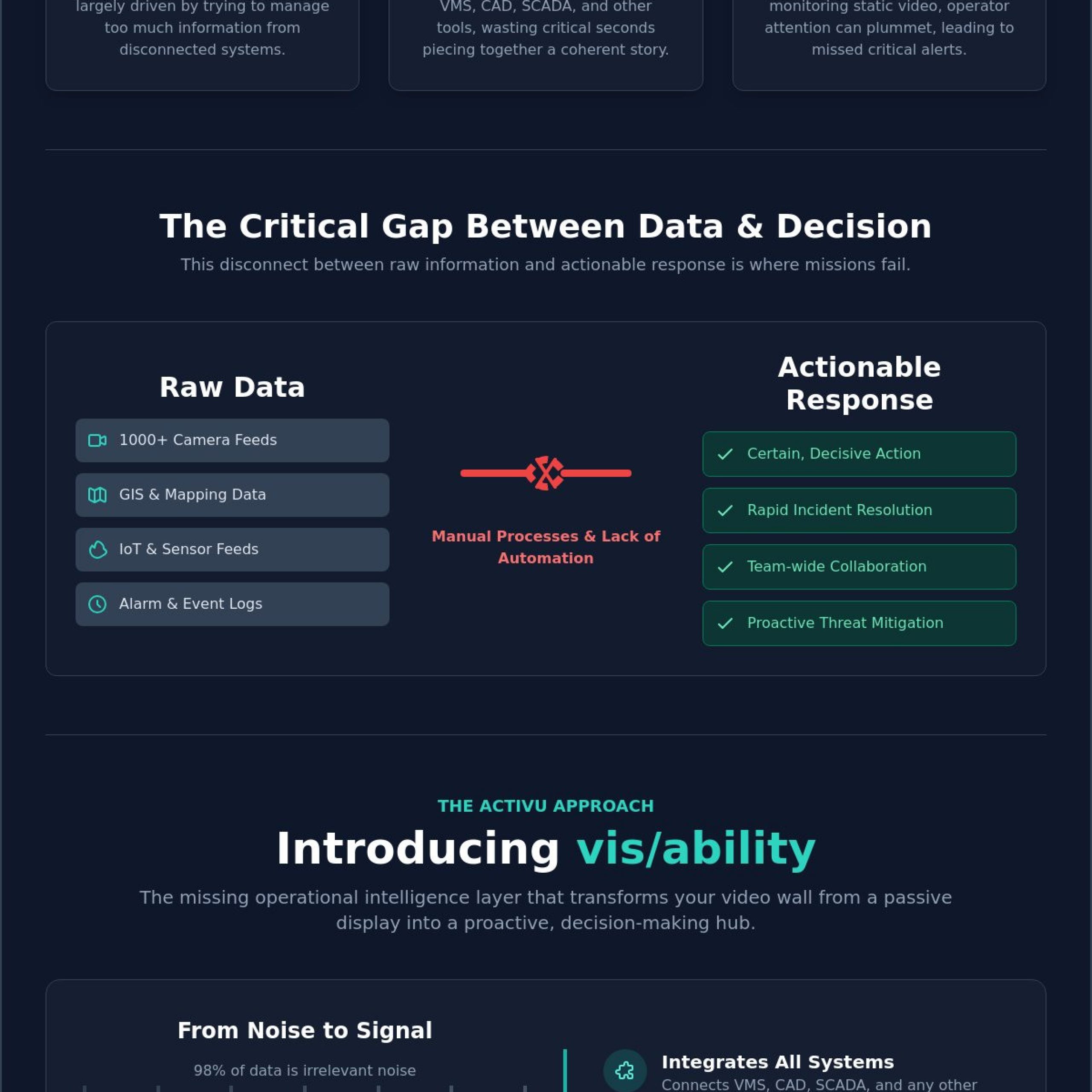
Modern command centers are drowning in data, yet they often lack the clarity needed to act. A typical Global Security Operations Center (GSOC) today ingests information from over 1,000 camera feeds and dozens of disparate sensor types. Despite this influx, more data doesn’t equal better intelligence. In fact, a study by the National Forum on Public Safety indicates that operator attention can drop by 45% after only 20 minutes of monitoring static video. This creates a dangerous “Gap” between raw information and actionable response.
The Gap exists in the friction between fragmented systems, isolated data silos, and a persistent lack of automatic escalation. Many organizations rely on an “all-the-time” monitoring model, expecting humans to catch every anomaly on a massive video wall. This approach is reactive and prone to failure. True Command and control requires a transition to event-driven situational awareness, where the system identifies the threat before the operator does. Most control rooms already have the screens. What they’re missing is the layer that decides what goes on them, and escalates automatically when something needs attention.
The Problem of Fragmented Data Silos
Isolated applications like Video Management Systems (VMS), Computer-Aided Dispatch (CAD), and SCADA operate as digital islands. When a critical event occurs, operators often suffer the “swivel-chair” effect, manually jumping between different software tools to piece together a coherent story. This cognitive cost is high. In mission-critical environments, a delay of 30 seconds can be the difference between a contained incident and a total system failure. Organizations investing in integrated command and control solutions often find that tools like Axon or standard VMS platforms are only partial answers. They provide the “what,” but they don’t provide the “where” or “why” across the entire enterprise. Without a central hub, these tools remain fragmented, forcing teams to work harder rather than smarter.
Operator Fatigue and Cognitive Overload
Monitoring hundreds of high-resolution feeds is psychologically taxing. When every screen is active, nothing is important. This noise leads to “alarm fatigue,” where critical alerts are buried or ignored because the system fails to prioritize them. To solve this, the command center needs more than just better screens; it needs vis/ability. We define vis/ability as an operational intelligence layer that surfaces through the video wall, filtering out the 98% of irrelevant data to show only what matters. It transforms the video wall from a passive gallery of feeds into an active participant in the mission. By implementing integrated command and control solutions that prioritize automated filtering, organizations empower their personnel to act with absolute certainty when stakes are highest. This shift from constant watching to intelligent seeing ensures that the answer appears exactly when and where it is needed most, whether in a GSOC or on a mobile device in the field.
Defining Integrated Command and Control Solutions
Traditional control rooms often suffer from a technological disconnect. Operators manage a dozen disparate applications, from GIS mapping to SCADA systems, yet these tools remain siloed. True integrated command and control solutions aren’t simply a collection of hardware or a sophisticated video switcher; they represent a unified operational layer that binds these fragments together. Without this layer, critical data remains trapped in individual workstations, forcing personnel to manually cross-reference information during high-stress events. This friction creates a gap where errors occur and response times lag.
Most control rooms already have the screens. What they’re missing is the layer that decides what goes on them, and escalates automatically when something needs attention.
This missing layer is vis/ability. We define vis/ability as an operational intelligence layer that surfaces through the video wall, transforming it from a static display into a dynamic asset. While basic video switching allows you to toggle between feeds, vis/ability integrates the applications themselves. It ensures that when a sensor detects a breach or a grid failure, the relevant data moves to the forefront without human intervention. This proactive approach eliminates the manual data retrieval process that, according to 2024 operational benchmarks, can delay critical response by over 40 seconds per incident. By positioning vis/ability as the central hub, tools like Axon or specialized utility monitors become more effective because they’re no longer isolated. They flow into a single ecosystem where visibility into what matters is guaranteed.
The Role of the Common Operating Picture (COP)
A Common Operating Picture provides a single, shared view of the truth across the entire organization. When every stakeholder, from the dispatcher to the field commander, sees the same real-time data, decision-making becomes synchronized. Fragmented information leads to hesitation; a unified view creates certainty. Organizations can find detailed strategies for establishing this foundation in this Mission Critical Operations Guide. A COP ensures that whether you’re in a command center or on a mobile device, the operational reality remains consistent.
Event-Driven Visualization Logic
Modern operations require a shift from passive monitoring to active decision support. Event-driven logic uses automated triggers to change the video wall layout based on real-time data. If a utility provider sees a 10 percent spike in load demand or a security sensor is tripped, vis/ability automatically displays the relevant substation feeds or camera angles. The video wall stops being a background element and becomes the place where the answer appears. This ensures that the right data surfaces at the exact moment of a critical decision, allowing integrated command and control solutions to function as a vigilant guardian for the enterprise.
Evaluating Components: What Makes a Solution Truly Integrated?
Critical operations fail when data remains trapped in silos. Operators face a fragmented landscape where SIEM alerts, VMS feeds, and CAD data exist in isolation. This fragmentation is the primary reason why operators miss incidents on the video wall. True integrated command and control solutions require more than just connecting cables; they require a strategy to bridge the gap between raw data and human judgment. Most control rooms already have the screens; what they’re missing is the layer that decides what goes on them and escalates automatically when something needs attention.
Software vs. Hardware Integration
Hardware-based matrix switchers are rapidly becoming a legacy bottleneck. These systems are rigid and lack the flexibility to handle the 30% annual increase in data streams typical of modern mission-critical environments. Software-defined integration is far more scalable, allowing for rapid expansion without the need for complex rewiring. By utilizing COTS solutions, organizations can leverage standard IT infrastructure rather than being tethered to expensive, proprietary hardware that requires specialized maintenance.
A resilient command center must prioritize an operational intelligence layer that remains hardware-agnostic. This layer, vis/ability, is the operational intelligence that surfaces through the video wall. It ensures that the technical environment remains stable even as peripheral devices are upgraded or replaced. By moving the intelligence into the software layer, the system becomes a living entity that evolves with the mission requirements of a modern SOC or GSOC.
The Shortcomings of Partial Toolsets
Organizations often rely on standalone platforms like Axon for digital evidence or SIEM for network security. While these tools are capable within their specific domains, they offer only a narrow slice of the operational picture. They don’t solve the problem of how to manage multiple data feeds in a dispatch center. These tools require vis/ability to become useful for the entire team. Without this centralizing force, an alert in one system stays hidden from the personnel who need to see it in another.
Vis/ability positions itself as the central unifying hub for all other peripheral tools. It takes the partial data from a VMS or a cybersecurity platform and brings it into a collective space. It makes every other tool more effective by ensuring their output is seen at the exact moment of a critical decision. When an incident occurs, vis/ability doesn’t just wait for an operator to find the data; it pushes the relevant information to the video wall, conference rooms, and mobile devices simultaneously. This ensures that the answer appears exactly where it’s needed, transforming fragmented data into a clear, actionable common operating picture.
Buying Guide: Key Criteria for C2 Solution Selection
Selecting integrated command and control solutions requires a shift in perspective. Many organizations focus heavily on pixel pitch or bezel width; however, hardware is rarely the bottleneck during a crisis. The real gap exists in fragmented systems and data silos that prevent a unified response. Most control rooms already have the screens. What they’re missing is the layer that decides what goes on them, and escalates automatically when something needs attention. This layer is vis/ability, an operational intelligence platform that transforms passive displays into active decision-making tools.
Scalability and Distributed Collaboration
Your solution must extend beyond the four walls of the primary command center. Effective C2 requires seamless transitions between the main video wall, breakout rooms, and huddle spaces. If your field units can’t see what the commander sees, your situational awareness is incomplete. A major red flag in vendor pitches is a lack of mobile integration. True operational continuity depends on vis/ability Mobile, which ensures field-to-base continuity for executives and first responders. The system should allow a supervisor in a huddle room to pull the exact same data feed currently displayed on the main wall without latency or complex manual re-routing.
Cybersecurity and Network Resilience
In high-stakes environments like utility control rooms, NERC CIP compliance is a baseline requirement, not a luxury. Your integrated command and control solutions must provide a Cybersecurity Common Operating Picture. This means visibility into network health and threat posture is baked into the visualization layer. Avoid vendors who offer closed, proprietary stacks that create “black boxes” on your network. You need a solution that integrates with your existing security tools to surface alerts automatically when a breach or anomaly occurs. Visibility into what matters includes the health of the network itself.
Operational Continuity and Support
24/7 technical reliability is the bedrock of mission-critical decisions. If the software requires manual layout adjustments during an incident, it becomes a liability. Modern C2 environments should use automated escalation to ensure the right data finds the right person at the right time. This level of efficiency is rarely achieved through software alone. It requires professional Control Room Design Services to ensure that ergonomics, sightlines, and workflows align with technical capabilities. Organizations that invest in design services see a 30% improvement in operator response times compared to those who simply buy hardware off a shelf. Don’t settle for a vendor; look for a partner that understands the human element within the digital space.
Ensure your command center is prepared for the complexities of 2026. Speak with an Activu expert today to design a resilient operational environment.
The Activu Approach: vis/ability and the Modern Video Wall
Operational silos create a dangerous gap between data collection and human response. Most control rooms already have the screens. What they’re missing is the layer that decides what goes on them, and escalates automatically when something needs attention. Activu vis/ability fills this void. It transforms the video wall from a static display into a dynamic intelligence hub. Instead of staring at dozens of feeds waiting for an anomaly, operators receive the exact information they need the moment a threshold is crossed. This shift moves the mission from reactive recovery to proactive prevention.
Modern integrated command and control solutions must do more than just aggregate video. They must provide context. When an incident occurs, the video wall shouldn’t just show a map; it should show the map, the nearest assets, the live sensor data, and the relevant SOPs simultaneously. This is where the answer appears. By utilizing vis/ability as an operational intelligence layer, organizations ensure that the right data finds the right person at the right time. This methodical approach replaces chaos with a steady, event-driven model that prioritizes mission success over information volume.
Unified Visibility Across the Enterprise
Effective situational awareness requires a central hub that unifies fragmented applications like GIS, VMS, and SCADA. Partial solutions, including those from Axon or standard VMS providers, often leave operators toggling between tabs. This friction is a primary reason why operators miss incidents video wall displays should have caught. vis/ability acts as the unifying layer. It filters the noise and ensures that critical data doesn’t just sit in a silo. True integration is measured by the speed at which a data point becomes a decisive action. By centering the human operator, the platform provides visibility into what matters most, exactly when it matters.
Getting Started with a Common Operating Picture
Building a robust common operating picture starts with a methodical audit of your current hardware. Many organizations find that a large percentage of their existing screens are underutilized because they lack automated content management. The next step involves identifying the specific data triggers that signify a mission-critical event. This transition to an event-driven model reduces cognitive load and improves response times across the enterprise.
Whether you’re solving how to manage multiple data feeds dispatch center environments or seeking EOC common operating picture solutions, the path forward is clarity. This technology scales across command centers, remote setups, and even mobile devices to ensure a single version of the truth. You can witness this transformation by scheduling a tailored demonstration of the platform to see how it addresses your specific control room situational awareness problems. Take the first step toward a more resilient operation today.
Secure the Future of Your Mission-Critical Operations
Modern operations face a persistent gap where fragmented data feeds and siloed systems create dangerous blind spots. Solving control room situational awareness problems requires more than just hardware. It demands integrated command and control solutions that transform raw data into actionable intelligence. Most control rooms already have the screens. What they’re missing is the layer that decides what goes on them, and escalates automatically when something needs attention.
Since 1983, Activu has provided over 40 years of mission-critical expertise to Federal Defense, Public Safety, and Global Utilities. Our vis/ability platform serves as the central hub for your entire operation, including remote setups and mobile devices. By implementing this operational intelligence layer, teams reduce incident response times through automated event-driven visualization. You shouldn’t rely on partial tools that leave operators searching for answers during a crisis when vis/ability provides the clarity you need to act with certainty.
Request a vis/ability Demo to See True Integration in Action
Your team deserves the confidence and steady reassurance that comes with absolute operational visibility.
Frequently Asked Questions
What is the difference between a video wall and an integrated command and control solution?
A video wall is merely a display surface, while integrated command and control solutions provide the intelligence to manage data across those screens. Most control rooms already have the screens. What they’re missing is the layer that decides what goes on them, and escalates automatically when something needs attention. vis/ability functions as this operational intelligence layer, transforming passive pixels into active decision support tools that unify fragmented systems.
How do integrated C2 solutions reduce operator fatigue?
Integrated systems reduce fatigue by filtering out 90 percent of non-critical data that typically clutters screens. Operators often suffer from cognitive overload, which explains why operators miss incidents video wall displays should have caught. vis/ability monitors feeds in the background and only promotes relevant information to the foreground when specific triggers occur. This allows personnel to maintain focus on high-stakes tasks rather than scanning 50 static camera feeds.
Can vis/ability integrate with my existing VMS and CAD systems?
vis/ability integrates directly with your existing VMS and CAD systems to create a unified hub. While tools like Axon provide valuable data, they’re only partial solutions that often exist in silos. vis/ability pulls these fragmented streams into a single interface. It ensures that critical CAD alerts automatically trigger the relevant video feeds on the main wall; this eliminates the 3 to 5 minutes usually lost switching between disparate applications.
What are the benefits of an event-driven situational awareness model?
An event-driven model shifts operations from reactive monitoring to proactive response. Instead of manual searching, the system uses logic to surface data based on real-time triggers. This approach solves common control room situational awareness problems by ensuring the most critical information finds the operator. When a sensor detects a breach, vis/ability immediately populates the wall with the relevant map, camera, and SOP, cutting response times by up to 40 percent.
Why is a Common Operating Picture (COP) essential for emergency operations centers (EOCs)?
A Common Operating Picture ensures that every stakeholder, from the floor to the executive suite, sees the same validated data. In emergency operations centers, fragmented information leads to conflicting decisions. vis/ability acts as the central engine for EOC common operating picture solutions by synchronizing disparate feeds into one view. This eliminates data silos and provides the 100 percent certainty required for mission-critical coordination during a crisis.
Is it possible to extend command center visibility to mobile devices?
vis/ability extends full situational awareness to mobile devices, laptops, and remote huddle rooms. Command center visibility is no longer tethered to a physical location. Field personnel can view the same live dashboards and video feeds as the central team. This connectivity ensures that 100 percent of the team remains informed, whether they’re in a breakout room or responding on-site, providing a seamless flow of intelligence across the entire organization.
How does an integrated solution help with NERC CIP or cybersecurity compliance?
Integrated solutions strengthen compliance by centralizing access control and providing detailed audit logs for every data interaction. For utilities, vis/ability helps meet NERC CIP requirements by ensuring only authorized personnel interact with sensitive grid data. The system acts as a secure gateway that manages multiple data feeds dispatch center teams rely on. It provides a hardened intelligence layer that protects critical infrastructure while maintaining full operational transparency.
What is the typical ROI for upgrading to an automated C2 intelligence layer?
Organizations typically see a return on investment through a 25 to 30 percent increase in operational efficiency within the first year. Automated integrated command and control solutions reduce the headcount required for manual monitoring while decreasing the cost of missed incidents. By automating the escalation process, vis/ability minimizes the financial impact of downtime and emergency events. This strategic investment transforms the command center from a cost center into a high-performance intelligence hub.