
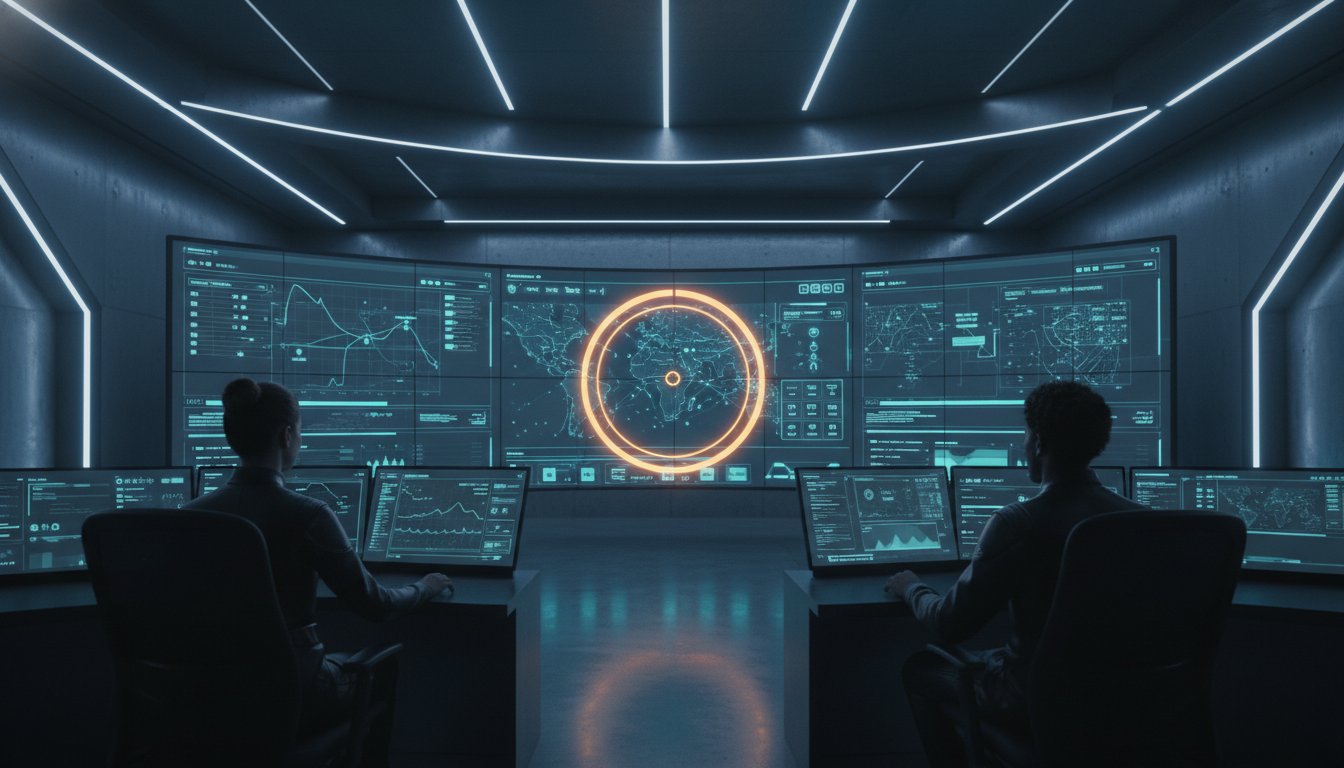
Adding more screens to your command center doesn’t improve response times; it often does the exact opposite by burying critical alerts under a mountain of visual noise. Operators in 2026 face a massive influx of data, with land-based platforms alone accounting for 39.02% of situational awareness market revenue, leading to severe cognitive fatigue. Improving situational awareness in command centers requires moving beyond simply monitoring siloed applications like Milestone or specialized CAD tools, which only provide a partial view of the operational landscape.
Most control rooms already have the screens. What they’re missing is the layer that decides what goes on them, and escalates automatically when something needs attention. You likely recognize that having the data isn’t the same as having the answer, especially when critical incidents are missed because an operator was focused on the wrong monitor. This guide demonstrates how Activu Corporation transforms fragmented data into actionable intelligence by implementing a unified operational intelligence layer. We’ll explore how the vis/ability platform integrates disparate tools to reduce cognitive load and ensure a common operating picture for both command center staff and field units.
Key Takeaways
- Identify the specific operational gaps where fragmented data feeds from siloed VMS or CAD systems create blind spots and increase operator fatigue.
- Learn the strategic framework for improving situational awareness in command centers by moving from simple data perception to full contextual comprehension.
- Understand why most control rooms already have the screens, but lack the critical layer that decides what goes on them and escalates automatically during an incident.
- Follow a five-step implementation plan to audit data silos and unify your disparate applications into a single operational intelligence layer.
- Enable seamless collaboration between command centers and field units through mobile integration that maintains a common operating picture anywhere.
The Cognitive Burden: Why Command Centers Struggle with Situational Awareness
Command centers today are inundated with an unfiltered stream of raw data that often lacks proper orchestration. Improving situational awareness in command centers is frequently hindered because operators are forced to mentally bridge the gap between disconnected systems. Instead of acting as strategic decision-makers, they spend critical minutes correlating an alert from a legacy VMS with a separate sensor feed or map. This manual synthesis creates a bottleneck in mission-critical environments. When the human becomes the integration layer, the speed of response is limited by cognitive processing power rather than the speed of the technology.
Fragmented tools provide only partial visibility into a developing crisis. While specialized platforms offer deep data in one domain, they rarely communicate with the rest of the operational stack. This lack of cohesion forces staff to toggle between interfaces to piece together a coherent story. Activu Corporation solves this by removing the requirement for manual correlation. True Situational Awareness requires a system that synthesizes these inputs before they reach the operator’s eyes, ensuring that the focus remains on the mission rather than the software.
Most control rooms already have the screens. What they’re missing is the layer that decides what goes on them, and escalates automatically when something needs attention.
The Reality of Operator Fatigue
Staring at a “wall of glass” for an entire shift induces a specific type of visual exhaustion. Operators eventually stop noticing subtle changes in visual patterns, which leads to missed incidents during high-stress events. Nuisance alarms further degrade decision-making accuracy. When a system triggers dozens of false alerts daily, the genuine signal is often ignored or delayed. In these environments, missing a critical indicator isn’t just an inefficiency; it’s a liability that threatens the safety of field units and infrastructure.
The High Cost of Fragmented Systems
Context switching is a silent killer of operational speed. Forcing an operator to navigate 5 to 10 different applications creates significant delays in information flow. Every second spent logging into a separate silo or searching for a specific feed is a second lost in incident response. Compiling a SITREP becomes a grueling manual task when data is trapped in separate repositories. This fragmentation directly threatens Operational Continuity. Without a unified view, the command center cannot maintain the resilience needed to manage complex, evolving threats with absolute certainty.
The Three Levels of Situational Awareness in Mission-Critical Environments
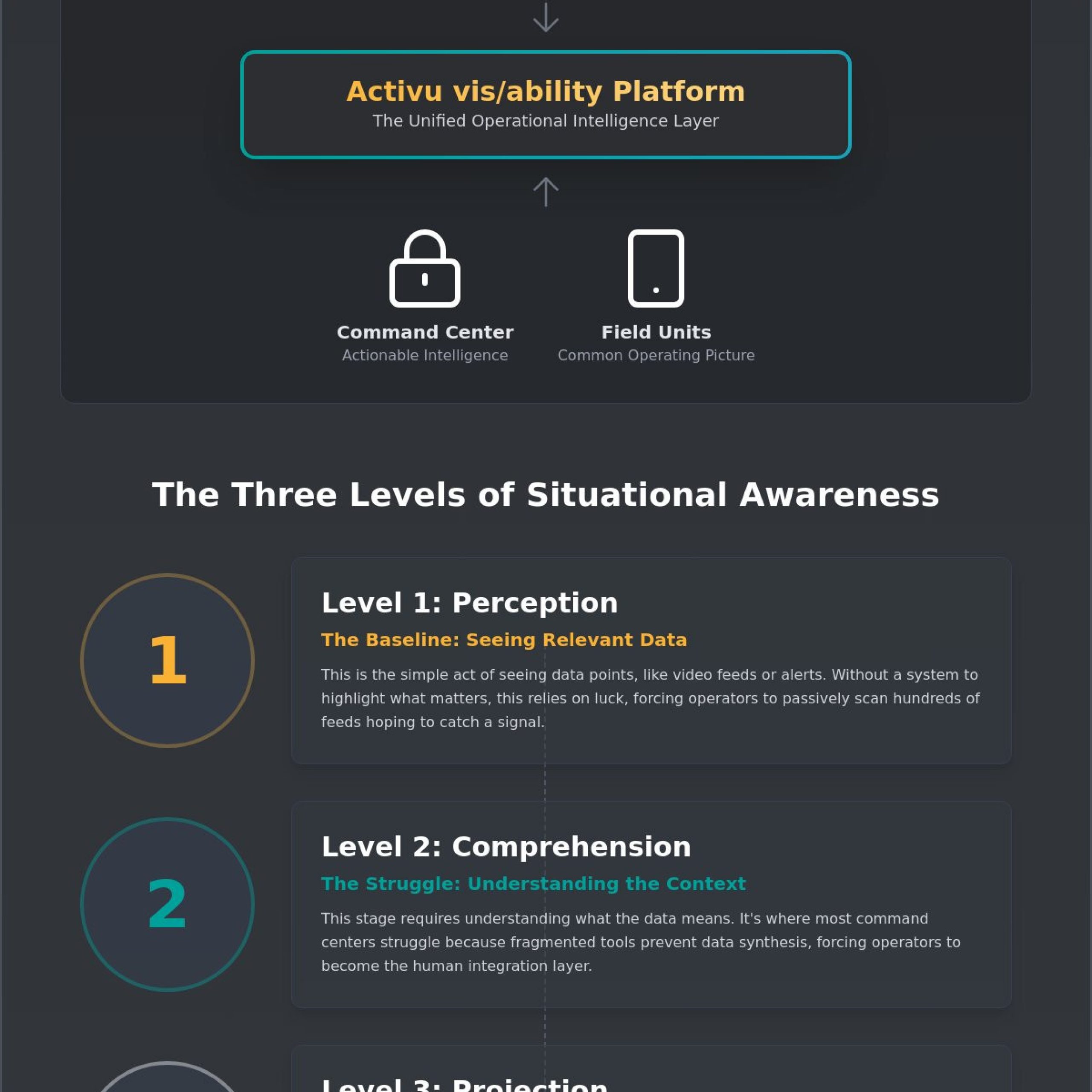
Situational awareness isn’t a single checkbox to be ticked; it’s a cognitive hierarchy that determines how effectively a team can respond to a crisis. Achieving true operational clarity requires a structured approach to data processing. Improving situational awareness in command centers depends on mastering three distinct stages: perception, comprehension, and projection. While many centers believe they’ve achieved total visibility because they’ve filled their walls with monitors, they’re often stuck at the most basic level of this hierarchy.
Level 1: Moving Beyond Raw Perception
Level 1 is the baseline of perception. It’s the simple act of seeing relevant data points in real-time. Modern Video Wall Systems are essential for establishing this baseline visibility, but seeing a video feed doesn’t mean an operator has noticed a critical indicator. There’s a profound difference between having light hit the retina and the brain registering a threat. Without a system that highlights what matters, operators are forced to scan hundreds of feeds, hoping to catch a signal before it’s too late. This passive approach relies on luck rather than a strategic process.
Levels 2 and 3: From Understanding to Action
Level 2, comprehension, is where most command centers struggle. This stage requires understanding what the perceived data actually means within the current context. Fragmented tools like Axon provide valuable data, but they only offer a partial solution. When data remains siloed in separate applications, synthesis is impossible. Operators can’t comprehend the full scope of an incident if they’re constantly toggling between different interfaces to piece together the story. Most control rooms already have the screens. What they’re missing is the layer that decides what goes on them, and escalates automatically when something needs attention.
Level 3, projection, is the pinnacle of the hierarchy. It involves predicting how a situation will evolve so the team can take proactive action. By integrating cross-platform data into a unified operational intelligence layer, command centers can move from a reactive posture to a proactive model. This transition is supported by a RAND Corporation report that emphasizes the need for synthesized information environments in high-stakes decision-making. When predictive analytics and event-driven data flow into a single hub, the command center gains the ability to see not just what is happening, but what is likely to happen next. If you’re ready to move beyond simple monitoring, you can explore how a unified intelligence layer transforms operations.
Identifying the ‘Missing Layer’ in Your Common Operating Picture
Most control rooms already have the screens. What they’re missing is the layer that decides what goes on them, and escalates automatically when something needs attention. Traditional command center designs often treat video walls as “dumb” hardware, essentially massive displays for static feeds that require constant human oversight. Improving situational awareness in command centers requires a shift from this hardware-centric view to an intelligent software approach. This missing layer is the operational intelligence platform that orchestrates data flow and ensures the right information reaches the right person at the exact moment of need.
This software environment creates a true Common Operating Picture (COP). It transforms raw data from specialized tools into a shared visual narrative. For example, emergency management platforms like Juvare or identity security tools like Okta provide essential data, but they often remain trapped on individual workstations. Without a unifying layer, these tools are isolated silos. An intelligent platform makes these existing investments more useful for the entire team by surfacing their critical alerts onto the main display and mobile devices automatically during an incident.
Fragmented Views vs. Unified Intelligence
The practice of keeping “all screens on” at all times is the enemy of situational awareness. It creates a baseline of visual noise that makes it nearly impossible to detect subtle, high-risk changes. In 2025, the North American situational awareness market reached a valuation of 11.05 billion USD, yet many organizations still operate with fragmented views that hinder decision-making. A Unified Operating Picture merges disparate data streams into a single, cohesive interface. Activu vis/ability acts as this central hub, synthesizing data from across the enterprise so that operators don’t have to hunt for information across multiple monitors.
The Role of Event-Driven Escalation
Event-driven visualization redefines how command centers function by only showing what matters, when it matters. Instead of requiring operators to stare at hundreds of camera feeds where nothing is happening, the system remains quiet until a specific trigger occurs. When a sensor or application detects an anomaly, the system automatically escalates that specific data to the video wall. This architecture directly supports Incident Management by instantly surfacing the most relevant data. By automating the “noticing” phase of situational awareness, you allow your human experts to focus entirely on the “acting” phase, significantly reducing response times when seconds are most critical.
How to Improve Situational Awareness: A 5-Step Implementation Plan
Transforming a reactive command center into a proactive intelligence hub requires a methodical approach. Improving situational awareness in command centers isn’t a matter of buying more hardware; it’s a strategic software integration process. Most control rooms already have the screens. What they’re missing is the layer that decides what goes on them, and escalates automatically when something needs attention. This five step plan moves your team from data overload to operational clarity.
- Step 1: Audit Operational Gaps. Identify where operators consistently miss incidents by reviewing logs from the past 12 months. Pinpoint the specific moments where data existed but wasn’t noticed.
- Step 2: Map Your Data Silos. List every standalone application, such as Axon or Milestone, that currently operates in isolation. These are your primary sources of context-switching delays.
- Step 3: Implement an Operational Intelligence Layer. Deploy the vis/ability platform as the central hub to unify these disparate sources into a single, cohesive environment.
- Step 4: Establish Automated Escalation Rules. Define the specific event triggers, like a cybersecurity breach or a sensor alert, that should force a change on the video wall.
- Step 5: Extend Visibility to the Field. Ensure that mobile units and huddle rooms see the exact same common operating picture as the main command center.
Auditing Operational Gaps
A rigorous post-incident review is the only way to see where situational awareness broke down during high-stress events. You must identify the blind spots created by standalone COTS solutions that don’t share data with your primary displays. This audit should analyze the effectiveness of current SITREPs and reporting workflows. If your reports are still being compiled manually from five different screens, your situational awareness is failing at the comprehension level. The goal is to find where the human integration layer is slowing down the response.
Configuring the Intelligence Layer
Once gaps are identified, you must configure “if-this-then-that” triggers for critical infrastructure. This involves integrating CAD, GIS, and cybersecurity feeds into a single pane of glass. This configuration ensures that when an incident occurs, the system doesn’t wait for an operator to find it; it surfaces the data instantly. The platform must be designed for Mission-Critical reliability, ensuring 24/7 uptime even during catastrophic events. By automating the visualization process, you reduce the cognitive burden on your staff and ensure they stay focused on decision-making. To start your transition toward a unified intelligence layer, you can contact our team to begin your operational audit.
Orchestrating Operational Intelligence with Activu vis/ability
Deploying a unified platform is the final step in moving beyond the limitations of fragmented data. Activu vis/ability serves as the operational intelligence layer that makes every other tool in your stack more effective. By synthesizing inputs from diverse sources, it removes the burden of manual integration from your staff. Most control rooms already have the screens. What they’re missing is the layer that decides what goes on them, and escalates automatically when something needs attention. Improving situational awareness in command centers is ultimately about this orchestration, ensuring that human judgment is applied to the right information at the right time.
The event-driven nature of the platform is the primary mechanism for reducing cognitive load. Instead of expecting operators to find the needle in the haystack, vis/ability surfaces the needle automatically. When a mission-critical threshold is met, the system triggers a visual escalation across the entire ecosystem. This proactive delivery of intelligence transforms the command center from a room of monitors into a dynamic engine of response, where every pixel serves a specific operational purpose.
Beyond the Video Wall: Distributed Awareness
True situational awareness cannot be confined to the four walls of a single room. The vis/ability platform extends this clarity to huddle rooms, remote laptops, and mobile devices, ensuring that decision-makers have visibility regardless of their location. The “Link” feature is particularly vital for multi-agency collaboration, allowing for seamless, secure data sharing across different jurisdictions. Public Safety agencies utilize these capabilities to maintain a common operating picture during large-scale events where field-to-base coordination is a life-saving requirement. Mobile vis/ability ensures that the officer on the street and the commander at headquarters are looking at the exact same real-time data, eliminating the ambiguity that often plagues high-stakes operations.
Starting Your Transformation
A successful transition to an intelligence-led model requires more than just software; it requires a physical and digital environment designed for peak performance. Activu’s Control Room Design Services ensure that your hardware and software are perfectly aligned to support your specific mission. This professional engineering approach accounts for ergonomics, sightlines, and technical reliability to prevent the fatigue discussed earlier. Moving from a reactive “monitor and respond” model to a proactive stance is a deliberate strategic shift. It’s the difference between being overwhelmed by data and being empowered by intelligence. To see this operational intelligence layer in action, you can request a demo of the vis/ability platform and begin your journey toward total situational clarity.
Securing the Future of Operational Intelligence
Operational success in high-stakes environments depends on the ability to filter noise and act on intelligence. Improving situational awareness in command centers requires a shift from manual data monitoring to automated orchestration. By unifying siloed applications and extending a common operating picture to mobile teams, you eliminate the cognitive fatigue that leads to missed incidents. Most control rooms already have the screens. What they’re missing is the layer that decides what goes on them, and escalates automatically when something needs attention.
Activu pioneered event-driven situational awareness software to serve as this essential bridge. Our end-to-end control room design and integration expertise is trusted by federal defense agencies and Global 500 companies to maintain clarity during crisis. It’s the engine that ensures your team is always focused on what matters most. You can schedule a personalized demo of vis/ability to unify your command center and begin your transformation. With the right operational intelligence layer, your organization can move from a state of data overload to a state of absolute certainty.
Frequently Asked Questions
What are the common causes of poor situational awareness in command centers?
Information overload and fragmented data silos are the primary drivers of poor awareness. Operators often manage 5 to 10 disconnected applications simultaneously, which forces them to act as a manual integration layer. This fragmentation leads to cognitive fatigue and delayed response times because critical signals are easily lost in a swamp of irrelevant data feeds.
How does an operational intelligence layer differ from a standard video wall controller?
A standard controller manages hardware pixels and static layouts, whereas an operational intelligence layer orchestrates mission-critical data based on real-time events. Most control rooms already have the screens. What they’re missing is the layer that decides what goes on them, and escalates automatically when something needs attention. This software-driven approach ensures the right information reaches the right person instantly.
Can vis/ability integrate with my existing VMS and CAD software?
Yes, vis/ability integrates with existing VMS platforms like Milestone and CAD systems to create a unified environment. While these specialized tools provide valuable data, they often operate in isolation and offer only a partial solution. The vis/ability platform acts as a central hub that pulls alerts from these disparate sources to form a single, actionable common operating picture.
How do you improve situational awareness for remote or mobile team members?
Improving situational awareness in command centers requires extending the same data visibility to field units through secure mobile streaming. Mobile vis/ability allows remote team members to view the exact same real-time data as the command center on their tablets or smartphones. This synchronization ensures that everyone, regardless of location, operates from a single version of the truth during an incident.
What is event-driven situational awareness and why is it important?
Event-driven situational awareness is a system architecture that only surfaces information when specific, pre-defined triggers occur. Instead of requiring operators to monitor hundreds of static feeds, the system remains quiet until a sensor or application detects an anomaly. This is important because it automates the detection phase, allowing human experts to focus entirely on taking proactive action.
How can we reduce operator fatigue in a 24/7 mission-critical environment?
Reducing fatigue requires automating the data filtering process to lower the cognitive burden on staff. When the system automatically handles the “noticing” of incidents, operators don’t have to stare at empty monitors for hours. This strategy is vital in 2026 as land-based platforms continue to account for over 39% of the situational awareness market revenue, contributing to massive data influx.
What role does visualization play in cybersecurity situational awareness?
Visualization provides a real-time, geospatial view of network threats and physical security breaches on a single interface. By integrating cybersecurity feeds into the operational intelligence layer, teams can see how a digital attack might impact physical infrastructure. This unified view enables faster containment of multi-vector threats that would otherwise be managed by separate, disconnected departments.
How do I measure the ROI of improving situational awareness in my NOC?
ROI is measured through the quantifiable reduction in Mean Time to Detect (MTTD) and Mean Time to Respond (MTTR). By improving situational awareness in command centers, organizations see faster incident resolution and a decrease in missed events. You can also measure ROI by calculating the time saved when operators no longer need to perform manual context-switching or SITREP compilation across multiple siloed apps.