
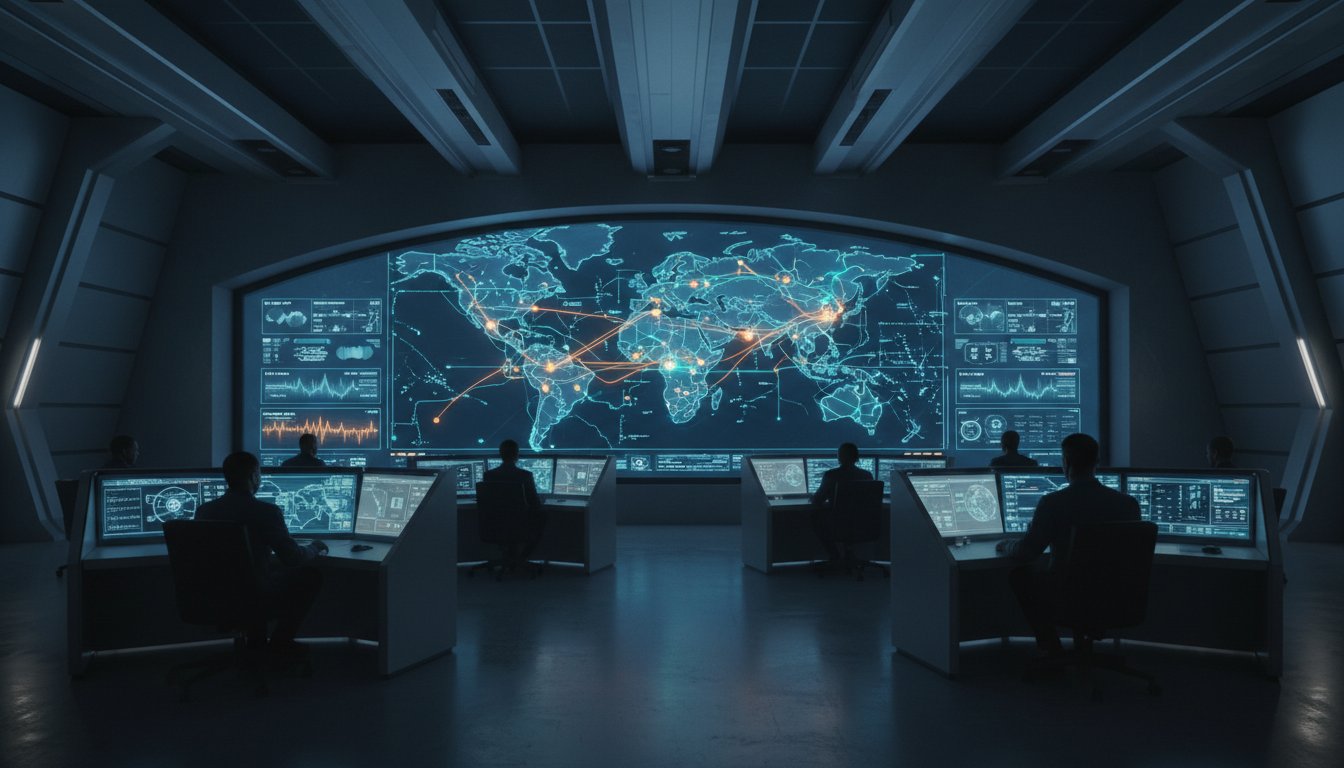
What if the primary cause of missed incidents in your command center isn’t a lack of data, but the way that data is physically and digitally presented? You understand that in a mission-critical environment, the margin for error is zero. Effective control room layout and design principles must prioritize human performance to prevent cognitive overload during a crisis. Most control rooms already have the screens. What they’re missing is the layer that decides what goes on them, and escalates automatically when something needs attention.
Activu Corporation delivers the technical expertise to transform fragmented systems into a high-performance intelligence hub. This article provides the architectural and informational blueprint required to reduce operator fatigue and accelerate incident response. We’ll examine the ergonomic standards and informational layers required to build a scalable, collaborative environment that ensures your team acts with absolute certainty when the stakes are at their highest.
Key Takeaways
- Reduce operator fatigue by aligning physical console placement with human factors engineering and optimized sightlines.
- Implement modern control room layout and design principles that prioritize an operational intelligence layer to decide what appears on your screens automatically.
- Accelerate incident response by integrating fragmented data feeds into a single, automated intelligence hub.
- Ensure operational continuity with scalable architectural strategies designed to support emerging mission-critical technologies.
- Improve collaboration between command center operators and field teams through real-time, event-driven situational awareness.
Core Principles of Mission-Critical Control Room Design
A mission-critical environment isn’t just an office with more monitors. It’s a high-stakes ecosystem where every second counts and decisions have real-world consequences. The global control room design market reached a value of $638.58 million in 2024, reflecting a growing need for spaces that can handle 24/7 operational pressure. Applying effective control room layout and design principles starts with a clear definition of the mission. A Network Operations Center (NOC) requires different sightlines and data prioritization than a Security Operations Center (SOC). Without this alignment, the physical space becomes a barrier to performance rather than an asset.
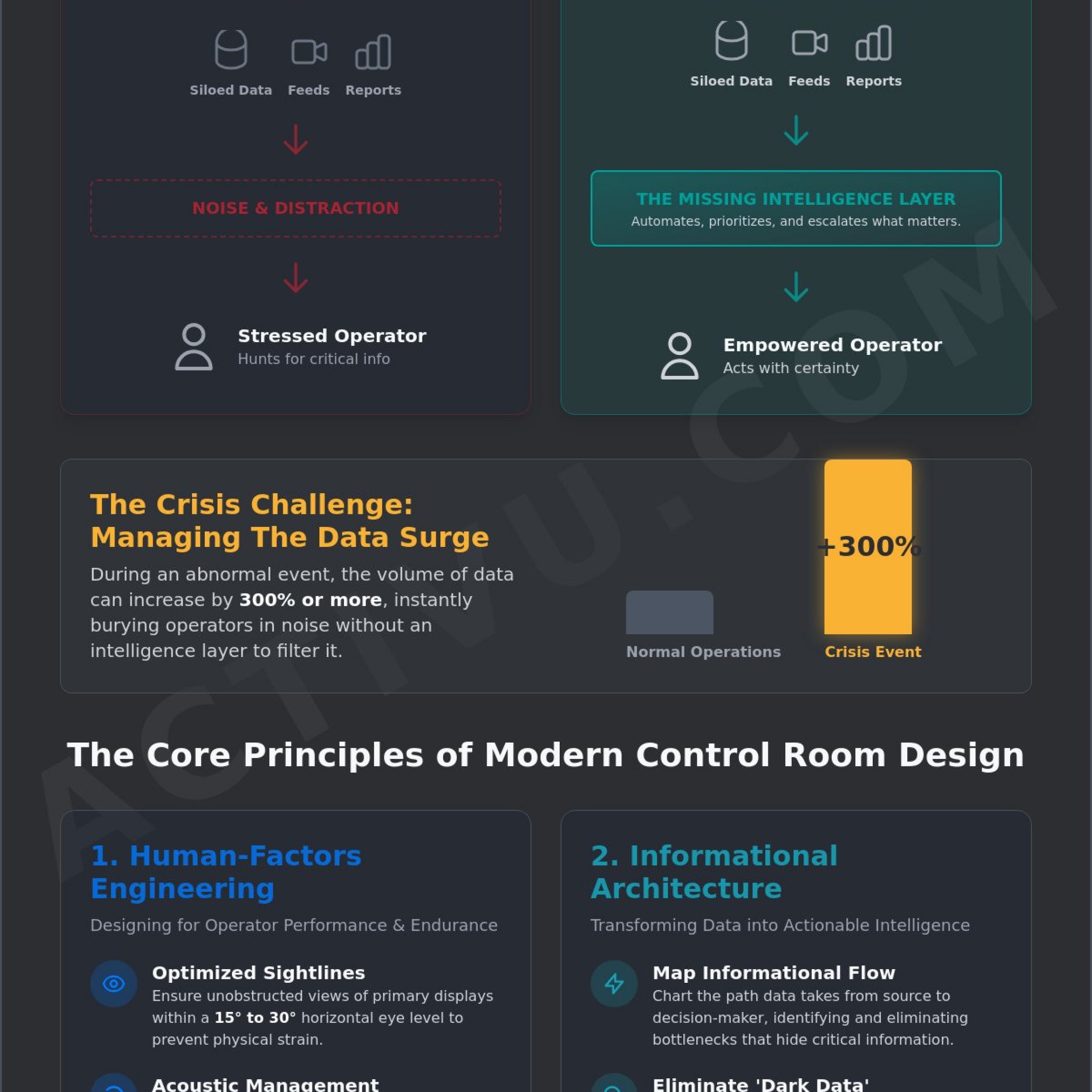
Most control rooms already have the screens. What they’re missing is the layer that decides what goes on them, and escalates automatically when something needs attention. Relying on static layouts is a recipe for failure during abnormal situations. When a crisis hits, the volume of data can increase by 300% or more, quickly burying the operator in noise. The goal of modern design is to facilitate a shift from reactive monitoring to proactive situational awareness. This ensures that the team maintains a unified operating picture, even when the environment becomes chaotic.
Defining the Mission-Critical Environment
Standard office designs focus on comfort and basic collaboration, but a Control Room requires absolute reliability and redundancy. For facilities like a SOC, NOC, or GSOC, the infrastructure must support continuous 24/7 operations without a single point of failure. Design teams must identify key stakeholders, from front-line operators to executive decision-makers, and map their specific visualization needs. This ensures the room supports the human element at every level of the command chain, providing clarity when stakes are at their highest.
Beyond the Physical: The Concept of Informational Flow
Informational flow is the path data takes from the field to the decision-maker. If this flow is blocked by fragmented systems, you encounter ‘dark data’, which is information that exists in your network but remains invisible to those who need it. Mapping this flow is just as vital as placing the furniture. In the context of layout design, situational awareness is the ability to perceive and understand critical information across the entire room at a single glance. By integrating foundational control room layout and design principles into the informational architecture, you ensure that the most important data always finds its way to the right person, eliminating the silos that prevent a coordinated response.
Human Factors Engineering and Ergonomic Standards
High-performance command centers rely on the endurance and clarity of their operators. Technical reliability is meaningless if the human element is compromised by physical strain or mental exhaustion. Adhering to established ergonomic and safety standards ensures that the environment supports decision-making rather than hindering it. The foundation of this approach is ISO 11064, which provides the framework for control room layout and design principles. The most recent update, ISO/TR 11064-10:2020, published on September 17, 2020, emphasizes the integration of human factors into the earliest stages of architectural planning. By designing for the operator first, organizations reduce the risk of critical errors caused by environmental stressors.
Acoustic management and lighting are often overlooked but remain vital to maintaining focus. Background noise should stay below 45-50 decibels to prevent cognitive interference, while adjustable, indirect lighting reduces glare on displays. Most control rooms already have the screens. What they’re missing is the layer that decides what goes on them, and escalates automatically when something needs attention. Without this intelligence, even the most ergonomic room becomes a source of stress as operators struggle to find relevant data across a sea of unprioritized pixels.
Sightlines and Primary Viewing Areas
Optimizing sightlines requires precise geometric calculations to ensure every console has an unobstructed view of the central display. Designers must account for the primary field of view, typically within 15 to 30 degrees of the operator’s horizontal eye level. For large-scale Activu Video Wall Systems, viewing distances must be calibrated so that text and data remain legible without causing neck strain. Peripheral monitoring zones should be reserved for secondary information, keeping the most critical alerts front and center to accelerate incident response times.
Reducing Operator Fatigue and Cognitive Load
Operator endurance is directly tied to the quality of console furniture. Height-adjustable consoles and 24/7 task seating allow for postural changes that prevent physical fatigue during long shifts. Strategic HMI placement is equally important for managing alert fatigue. When data feeds are unorganized, operators often miss incidents because they’re overwhelmed by low-priority noise. Incorporating dedicated huddle spaces into the control room layout and design principles allows for rapid, face-to-face collaboration when a crisis requires immediate team coordination. If you are ready to modernize your command center, you can consult with our design experts to build a space that empowers your team to act with absolute certainty.
The Informational Layout: Integrating the Intelligence Layer
Physical consoles and display panels are only part of the equation. Modern control room layout and design principles must account for the informational architecture that powers the room. Without a strategy for data orchestration, a video wall is simply a collection of monitors showing disconnected feeds. Most control rooms already have the screens. What they’re missing is the layer that decides what goes on them, and escalates automatically when something needs attention. Transitioning from a traditional monitor wall to a dynamic information wall is the key to managing the complexity of modern mission-critical operations.
Integrating fragmented systems like Video Management Software (VMS), Security Information and Event Management (SIEM), and Geographic Information Systems (GIS) into a single view is essential. While organizations often utilize niche visualization tools for specific data types, these applications typically provide only a partial solution that remains siloed from the broader operational landscape. To achieve a full common operating picture, you need a unifying layer that bridges these gaps. This follows the U.S. Department of Energy’s Guide to Good Practices, which emphasizes the need for clear, integrated information displays in control areas to prevent operator error.
Creating a Common Operating Picture (COP)
The vis/ability platform from Activu Corporation serves as the operational intelligence layer, acting as the central hub where all disparate tools converge. By breaking down data silos between departments, every team member gains visibility into what matters most at any given moment. This unified approach transforms raw data into a Common Operating Picture solution that is accessible in the command center, the huddle room, or on mobile devices in the field. It ensures that everyone is working from the same set of facts, which is vital for high-stakes coordination.
Event-Driven Visualization and Automated Escalation
Effective control room layout and design principles incorporate automation to protect operators from cognitive overload. By configuring the system to react to external triggers such as IoT sensors or security alarms, you ensure that critical incidents are never missed. Automated escalation moves beyond manual monitoring. It forces the most relevant data to the front of the display when specific thresholds are met. This ensures the right data reaches the right person at the right time, allowing the team to focus on resolution rather than searching through thousands of feeds for the source of the problem.
Best Practices for Managing Multiple Data Feeds
Managing a mission-critical environment requires a sophisticated approach to data orchestration. Command centers often ingest hundreds of disparate feeds, from high-bandwidth 4K video to low-bandwidth telemetry sensors. Without a clear strategy, these feeds create a wall of noise that obscures critical incidents. Most control rooms already have the screens. What they’re missing is the layer that decides what goes on them, and escalates automatically when something needs attention. Effective control room layout and design principles must account for the technical requirements of real-time situational awareness, specifically the “glass-to-glass” latency that ensures operators see events as they happen without delay.
During abnormal situations, the volume of incoming data can spike by 300% or more. This is when traditional layouts often fail. Applying modern control room layout and design principles helps designers integrate cybersecurity visualization alongside standard operational data to ensure a holistic view of the infrastructure. This prevents siloed responses where a physical security breach might be missed because the team is focused solely on network health. To manage this complexity, organizations need a framework that prioritizes information based on its immediate impact on the mission.
Data Prioritization Framework
A tiered approach to data prevents cognitive overload and ensures that operators respond to the most urgent threats first. This hierarchy should be baked into the software logic of the command center:
- Tier 1: Immediate life-safety or infrastructure-critical alerts, such as fire alarms or power grid failures.
- Tier 2: Active incident monitoring and resource deployment, including live dispatch feeds and field team locations.
- Tier 3: Routine status updates and historical data trending used for long-term analysis and reporting.
Extending Visibility Beyond the Room
Visibility shouldn’t be confined to the four walls of the command center. Field-to-base collaboration is essential for modern operations in sectors like public safety and transportation. By extending the common operating picture to mobile devices, huddle rooms, and executive offices, you ensure that decision-makers have access to the same intelligence regardless of their location. This mobility allows for a distributed response that’s just as coordinated as one managed from a central hub. If you need to upgrade your data management strategy, explore our vis/ability platform to see how an operational intelligence layer can streamline your workflow.
Future-Proofing Your Control Room with vis/ability
Technology moves fast. The global control room design market is projected to reach $1,069.05 million by 2032, growing at a CAGR of 16.12% from 2026. Designing for this future means moving away from a hardware-centric model that becomes obsolete as soon as new data formats emerge. You don’t just need more monitors; you need a system that scales as your operational requirements evolve. Applying forward-thinking control room layout and design principles allows your facility to remain effective for its thirty-year lifespan without requiring a total overhaul every few years. This transition to an intelligence-centric model ensures that your infrastructure supports the technologies of 2026 and beyond.
A well-designed, event-driven command center delivers a clear ROI by drastically reducing the time-to-incident awareness. When your layout is built around intelligence rather than just furniture, your team responds faster and with greater accuracy. This proactive stance prevents minor issues from escalating into catastrophic failures. Activu’s design services bridge the gap between architectural layout and operational reality. We ensure the physical space and the digital layer work in perfect harmony to protect your critical assets and personnel.
The vis/ability Advantage
Most control rooms already have the screens. What they’re missing is the layer that decides what goes on them, and escalates automatically when something needs attention. This is the vis/ability advantage. It acts as the operational intelligence layer and the central hub for all your tools, from VMS to legacy telemetry systems. By unifying these disparate applications, it eliminates the ‘chair-swivel’ effect where operators waste time jumping between different stations. vis/ability empowers people to act with certainty by providing the exact intelligence they need at the moment of decision.
Next Steps in Your Design Journey
Start your modernization journey with a thorough gap analysis of your current situational awareness capabilities. Identify exactly where data silos or poor ergonomics are slowing your response times. You can engage with the Activu’s design team to create a custom blueprint that integrates these control room layout and design principles into your specific mission. Don’t let fragmented data compromise your operations. Contact us today to request a demonstration of the vis/ability platform and see how we can transform your command center into a high-performance intelligence hub.
Modernizing Your Mission-Critical Operations
Effective command center operations depend on the seamless integration of human factors and technical intelligence. By applying modern control room layout and design principles, you move beyond basic monitor walls to create a proactive environment that eliminates cognitive overload. We’ve explored how ISO 11064 standards protect operator health and how a tiered data framework ensures that high-priority alerts always take center stage. These foundational elements transform a reactive space into a high-performance hub.
Most control rooms already have the screens. What they’re missing is the layer that decides what goes on them, and escalates automatically when something needs attention. Activu brings over 40 years of mission-critical experience to this challenge. Trusted by federal agencies and Fortune 500 utilities, our solutions reduce incident response time through automated escalation and real-time visualization. You don’t have to settle for fragmented systems and siloed data that obscure your situational awareness.
Take the next step in securing your infrastructure and empowering your team. Request a Demo of the vis/ability Operational Intelligence Layer to see how we can unify your command center operations. Building a resilient, future-proof control room is within your reach.
Frequently Asked Questions
What is the most important principle in control room layout?
The primary principle is the human-centered approach, also known as “inside-out” design. This ensures that control room layout and design principles are adapted to the operator’s cognitive and physical needs rather than forcing the staff to adapt to the room’s architecture. By prioritizing the operator’s field of view and reach, organizations ensure that the environment supports rapid decision-making during high-stress incidents.
How do ISO 11064 standards affect control room design?
ISO 11064 serves as the international standard for the ergonomic design of control centers. The technical report ISO/TR 11064-10:2020, published on September 17, 2020, provides a specific framework for integrating human factors into the design process. These standards dictate everything from console height to display legibility, ensuring the facility meets rigorous safety and performance requirements.
Why do operators miss critical incidents despite having a large video wall?
Operators miss incidents when they are overwhelmed by unprioritized data feeds. Most control rooms already have the screens. What they’re missing is the layer that decides what goes on them and escalates automatically when something needs attention. Without this intelligence layer, a video wall becomes a source of cognitive overload rather than a tool for situational awareness.
How can I reduce operator fatigue in a 24/7 command center?
Reducing fatigue requires a holistic focus on ergonomics and environmental stressors. Following EEMUA Publication 201, Edition 3, published on July 1, 2019, helps organizations manage lighting, acoustics, and workstation adjustability. Implementing 24/7 task seating and indirect lighting reduces the physical and mental strain that leads to errors during long shifts.
What is the difference between a NOC and a SOC in terms of layout?
A NOC layout typically prioritizes network connectivity and high-bandwidth telemetry for infrastructure health. A SOC focuses on threat detection and cybersecurity visualization, often requiring more secure huddle spaces for rapid, sensitive collaboration. While both require a common operating picture, the SOC layout must account for more frequent, high-intensity collaborative sessions during security breaches.
How much space is required per operator in a mission-critical environment?
Standard practice allocates between 10 and 15 square meters per operator workstation. This footprint provides enough room for large-scale ergonomic consoles, specialized task seating, and the necessary clearance for movement. Proper spacing prevents the room from feeling cramped, which is essential for maintaining a calm and clear operational environment.
Can I integrate legacy systems into a modern common operating picture?
Yes, you can unify legacy systems by implementing an operational intelligence layer like vis/ability. This platform acts as a central hub that ingests data from disparate, fragmented tools and legacy software. It transforms these siloed feeds into a unified view, making older systems useful for the entire team without requiring a total hardware replacement.
How does solar integration work with control room power requirements?
Solar integration enhances resilience by providing a sustainable, redundant power source for mission-critical infrastructure. Modern designs incorporate smart grid technologies to manage these renewable inputs, ensuring that the command center remains operational even during local grid failures. This approach improves energy efficiency and reduces the facility’s carbon footprint while bolstering overall system reliability.