
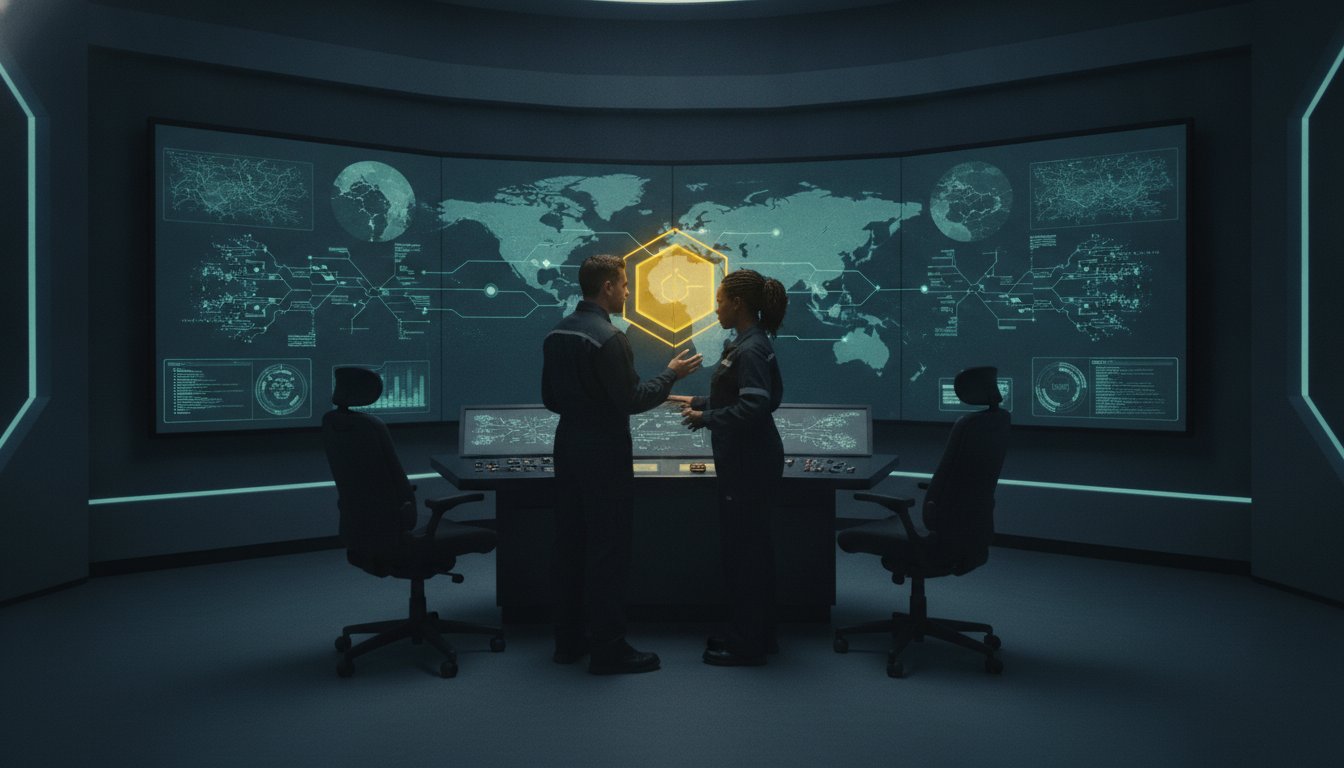
Up to 80% of serious workplace errors are linked to miscommunication during shift transitions. In mission-critical environments, this statistic represents a severe vulnerability that can lead to catastrophic operational failure. Improving shift handover communication is no longer a matter of better note-taking or longer meetings. It is about ensuring that the incoming team inherits a complete, live operating picture rather than a fragmented set of logs and siloed data points.
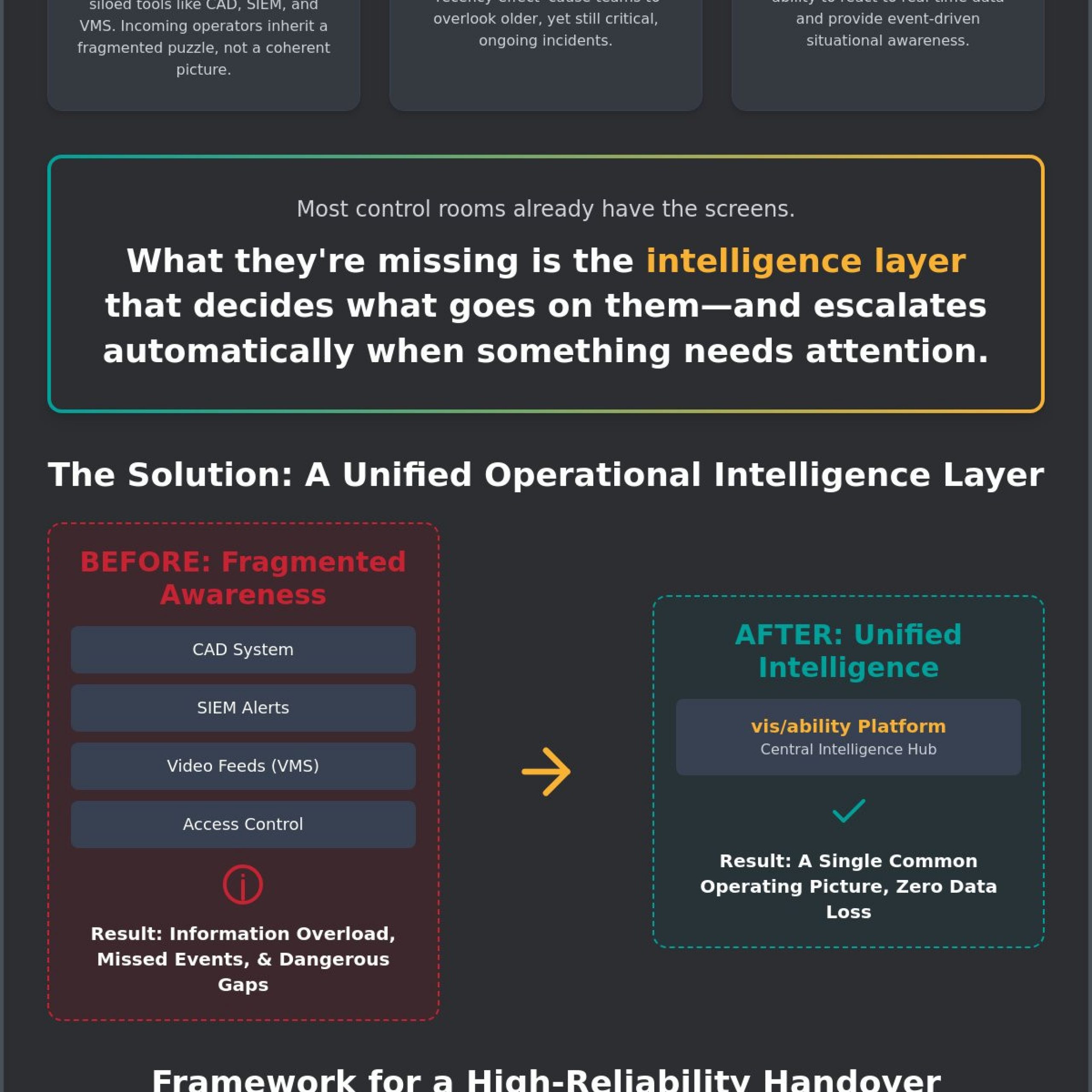
Operators frequently battle information fragmentation, where critical alerts are buried across multiple software tools and fatigue sets in just as the transition begins. This lack of a unified view between outgoing and incoming teams creates dangerous gaps in situational awareness. Most control rooms already have the screens. What they’re missing is the layer that decides what goes on them, and escalates automatically when something needs attention.
This article details how to eliminate information silos and ensure operational continuity through automated situational awareness and unified data visualization. You will learn how the vis/ability platform serves as the operational intelligence layer, reducing cognitive load for incoming operators by flagging critical events during the handover window. We will examine the shift toward event-driven intelligence that facilitates a seamless transfer of responsibility with zero data loss.
Key Takeaways
- Identify how fragmented data tools create operational blind spots and increase the risk of information loss during high-stakes shift transitions.
- Adopt a high-reliability framework for improving shift handover communication by utilizing a Common Operating Picture as the central reference for every briefing.
- Transform static video walls into an intelligent visualization layer that filters complex data and prioritizes the most critical alerts for incoming teams.
- Deploy event-driven situational awareness to ensure that automated triggers flag incidents immediately, maintaining continuity even during the busiest handover windows.
- Integrate disparate software tools into a unified operational intelligence layer to reduce operator cognitive load and facilitate a seamless transfer of responsibility.
The Hidden Risks of Fragmented Shift Handover Communication
In mission-critical environments, the window of time between shifts is the most vulnerable period of the operational day. Information loss during these transitions leads to catastrophic failures in sectors like energy utilities and public safety. Improving shift handover communication requires more than a casual briefing; it demands a systematic elimination of the blind spots created by disconnected data streams. When data is siloed, the risk of a critical oversight increases exponentially.
When CAD, SIEM, or VMS systems operate in isolation, incoming operators inherit a fragmented puzzle rather than a coherent picture. This fragmentation forces personnel to manually synthesize data from disparate sources while simultaneously managing the cognitive burden of a new shift. Human factors exacerbate these technical gaps. Operator fatigue often clouds judgment, while the recency effect causes teams to prioritize the latest alert while losing track of critical, long-term incidents that remain unresolved. This psychological bias means a significant event that started four hours ago might be overlooked simply because it isn’t the most recent notification on the screen.
Traditional logbooks, whether digital or paper, are static records of the past. They cannot provide event-driven situational awareness because they lack the ability to react to real-time data triggers. Relying on manual entries means the handover is only as good as the outgoing operator’s memory and stamina. In a high-stakes command center, this reliance on human fallibility is a point of failure that modern operations cannot afford.
The Cost of Situational Awareness Gaps
Visibility gaps translate directly into delayed incident response times. In the utility sector, these delays impact more than just service reliability; they threaten regulatory compliance. Failure to maintain a continuous record of security events can lead to significant penalties under frameworks like NERC CIP. Many organizations rely on partial solutions that offer a narrow view of a specific system. These tools fail to provide the comprehensive oversight necessary for total operational readiness, leaving the team to guess at the broader context of an unfolding crisis.
Siloed Tools vs. Operational Continuity
Operational continuity breaks down when an operator must monitor ten different screens to understand the current state of the environment. A fragmented software stack is the primary enemy of a clean handover. Every additional siloed tool increases the likelihood that a critical alert will be missed during the transition. Improving shift handover communication is impossible if the data remains trapped in proprietary silos. A unifying layer is required to aggregate these feeds into a single, manageable view, ensuring that the incoming team is immediately prepared to act with certainty. Without this integration, the transition remains a moment of high risk rather than a seamless exchange of command.
A Framework for High-Reliability Handover Processes
Improving shift handover communication requires a shift from informal conversation to a standardized technical protocol. High-reliability organizations recognize that the transition period is a structured operation, not a casual meeting. This framework relies on a three-phase approach designed to eliminate ambiguity and ensure that the incoming team is fully prepared to maintain operational continuity. Organizations focused on improving shift handover communication prioritize the reduction of human error through this rigorous methodology.
The first phase is preparation. The outgoing team must synthesize the current operational state, identifying active incidents and pending tasks. The second phase is the exchange, where the actual briefing occurs. The final phase is cross-checking, where the incoming team validates the state of the system. This “two-way responsibility” model ensures that the incoming shift isn’t just receiving information but is actively confirming its accuracy. It transforms the receiver into an active participant, closing the loop on critical data points.
Central to this process is the Common Operating Picture (COP). By using a COP as the primary reference point, teams ensure that everyone is looking at the same live data. This eliminates the “he said, she said” errors that plague manual logbooks. A clear hierarchy of information must also be established; urgent alerts that require immediate action must be visually distinguished from routine maintenance or administrative updates. This prevents critical signals from being lost in the noise of daily operations. When the incoming team can instantly identify the most pressing issues, they can allocate resources more effectively from the first minute of their shift.
Standardizing the Information Exchange
A successful Situation Report (SITREP) must be concise and actionable. It should include the current status of all major systems, a summary of incidents handled during the previous shift, and any upcoming scheduled changes. While verbal briefings are necessary for nuance, they are insufficient on their own. Mission-critical teams must support every verbal claim with real-time visual data. This ensures that the incoming team sees exactly what the outgoing team is describing. This level of precision is vital for distributed or mobile teams who may not be physically present. By integrating these feeds into a unified operational intelligence layer, organizations ensure that the handover remains consistent across every device.
Reducing Cognitive Load for the Incoming Shift
Incoming operators often step into a high-pressure environment filled with “noise.” Effective handover processes must filter out non-essential data so the team can focus on active threats. Geospatial visualization plays a critical role here. It provides immediate context by showing where an incident is occurring in relation to key assets. This spatial awareness allows operators to understand the scope of a problem in seconds rather than minutes. Operational readiness is the goal of every shift transition.
The pursuit of such operational readiness is not limited to industrial hubs; in the residential sector, Mi Conjunto provides property managers with a digital framework to manage security shifts and administrative tasks with the same level of precision and accountability.
Bridging the Visual Gap in Mission-Critical Operations
The visual environment of a command center dictates the speed of the incoming team’s response. Improving shift handover communication relies on the ability to instantly perceive the operational reality without digging through menus or toggling between windows. When the visual field is cluttered or fragmented, the transition between shifts becomes a period of high risk rather than a controlled transfer of authority.
Most control rooms already have the screens. What they’re missing is the layer that decides what goes on them, and escalates automatically when something needs attention. This intelligent visualization layer moves beyond the static video wall, transforming it from a background display into a proactive asset. It ensures that the most critical information is prioritized during the handover window, shielding incoming operators from the distraction of irrelevant data. By focusing on essential intelligence, the system creates the clarity required for immediate action.
Organizations often utilize specialized tools like Axon for specific field data or evidence management. While these platforms provide valuable insights, they remain partial solutions that exist in isolation. They require operators to perform manual data cross-referencing, which is a significant point of failure during a shift change. By integrating these feeds into a unified view, the team moves from reactive monitoring to proactive situational awareness. The system becomes the essential bridge between raw data and human judgment, allowing for a seamless transfer of responsibility.
The Limitations of Traditional Video Walls
Adding more monitors rarely solves communication problems. In fact, excessive screen real estate often leads to “wallpapering,” where operators become desensitized to the information on display. A unified operating picture serves as the single source of truth for both outgoing and incoming shifts. It replaces the clutter of disparate data streams with a focused, actionable intelligence layer that highlights only what is relevant to the current mission. Improving shift handover communication means ensuring the video wall reflects the current operational priority, not just a grid of static feeds.
Extending Visibility Beyond the Console
Operational oversight cannot be confined to a single desk or a specific room. Supervisors and remote stakeholders need access to the same live data as the operators on the floor. The vis/ability platform acts as the central hub for this integration, pushing the common operating picture to huddle rooms and mobile devices. This mobile vis/ability ensures that decision-makers remain informed and ready to act, regardless of their physical location during a shift transition. When every stakeholder sees the same data, the risk of miscommunication during handovers is virtually eliminated.
Leveraging Event-Driven Intelligence for Seamless Transitions
Event-Driven Situational Awareness represents a fundamental shift in how command centers operate. Instead of relying on manual observation, the system reacts to specific data triggers. This capability is critical for improving shift handover communication because it ensures that incident detection remains continuous, regardless of who is sitting at the console. When an incident occurs during the high-risk handover window, automated escalation protocols ensure it’s flagged immediately. Organizations that implement such structured, automated protocols can experience up to 50% fewer task-related failures.
Modern control rooms integrate SIEM, SOAR, and IoT data directly into their workflow. This integration allows for “automatic layout switching” on video walls. If a sensor detects a breach or a system failure reaches a critical severity level, the display environment changes instantly. It populates the screen with relevant maps, camera feeds, and technical diagnostics. This automation removes the need for the outgoing team to manually set up the screen for their successors. It provides the incoming shift with an immediate, high-context starting point that requires zero manual intervention.
Automating the Escalation Path
The system acts as an objective observer that never fatigues. By automatically flagging high-priority events, it reduces the dangerous reliance on an outgoing operator’s memory. Even the most diligent personnel can forget to mention a subtle alert during a complex briefing. Intelligent automation bridges this gap, maintaining operational continuity by ensuring that no critical alert remains unacknowledged. This proactive approach transforms the handover from a summary of the past into a launchpad for the next shift’s success. It ensures that the transition period doesn’t become a “dead zone” for response capabilities.
Creating a Unified Cybersecurity and Physical Picture
Threats don’t exist in vacuums. A physical security breach often coincides with a cyber-attack, yet many organizations manage SOC and NOC handovers as separate entities. True situational awareness requires a unified picture where cyber threats are visualized alongside physical security feeds. During a shift change, this combined view allows the incoming team to assess the total threat landscape in seconds. For organizations managing complex infrastructures, our SOC/NOC solutions provide the necessary depth to integrate these disparate data streams into a single, actionable operating picture.
To see how event-driven intelligence can secure your next shift change, contact our mission-critical experts today to discuss an integration strategy that fits your operational needs.
Optimizing Your Control Room with vis/ability
Success in high-stakes environments depends on the seamless flow of intelligence between teams. While previous sections detailed the frameworks and automated triggers necessary for operational continuity, the underlying technology must be capable of supporting these complex requirements. Most control rooms already have the screens. What they’re missing is the layer that decides what goes on them, and escalates automatically when something needs attention. Activu’s vis/ability platform provides this essential operational intelligence layer, serving as the bedrock for improving shift handover communication.
The platform aggregates complex data streams into a single, actionable operating picture, ensuring that incoming shifts aren’t overwhelmed by fragmented information. This capability extends visibility beyond the central console to mobile devices and remote sites, maintaining a consistent threat assessment for every stakeholder. By providing a unified view, vis/ability removes the technical barriers that often lead to miscommunication during the transfer of responsibility. It ensures that the transition is a moment of clarity rather than a source of confusion.
Activu’s control room design services further support these goals by aligning the physical environment with the digital workflow. A well-designed space facilitates the face-to-face exchange of information while the software maintains the integrity of the data. This combination of physical and digital optimization creates a resilient operational environment where information loss is virtually impossible.
Unifying Disparate Systems
Many organizations utilize tools like Axon or Juvare for specific operational needs. While these systems are valuable, they provide only a partial solution and often exist as isolated silos. vis/ability integrates these tools without replacing them, functioning as a platform-agnostic hub that makes all existing data feeds more useful for the entire team. This integration eliminates the need for manual data cross-referencing, which is a primary cause of error during shift changes. Ultimately, vis/ability empowers individuals to act with greater certainty by providing the full context of every incident.
Next Steps for Operational Excellence
Improving shift handover communication requires a holistic approach that combines sophisticated software with intentional environment design. We encourage you to conduct a thorough review of your current handover technology against your actual operational needs. You can explore Activu’s design services to develop a custom blueprint for your command center. To see the vis/ability platform in action and learn how it can secure your operations, contact us today for a tailored demonstration.
Securing the Future of Mission-Critical Continuity
Operational readiness depends on the integrity of the transition between shifts. The risks of data fragmentation and operator fatigue are too high to ignore in environments where every second counts. Improving shift handover communication requires a transition from manual, static processes to an intelligent, event-driven framework. By unifying disparate systems into a single operational intelligence layer, you eliminate the blind spots that threaten continuity.
Activu brings over 40 years of control room engineering expertise to the most demanding sectors. Our solutions are trusted by federal defense agencies and national utilities to maintain clarity when stakes are at their highest. We provide the event-driven situational awareness necessary to scale intelligence from the NOC directly to mobile devices in the field. This ensures that the incoming team is never forced to guess at the current state of operations.
Most control rooms already have the screens. What they’re missing is the layer that decides what goes on them, and escalates automatically when something needs attention. Take the next step toward a more resilient command center.
Request a vis/ability Demo to See Your Operations in a New Light
Your mission deserves a foundation of absolute technical reliability.
Frequently Asked Questions
What are the most common causes of shift handover failure?
Fragmented data across siloed tools and a reliance on verbal-only briefings are the primary drivers of handover failure. Up to 80% of serious workplace errors are linked to miscommunication during shift transitions. When operators must check multiple screens to piece together the current state, critical alerts fall through the cracks. Improving shift handover communication requires eliminating these technical gaps and human biases.
How can I automate my shift handover report?
Automation is achieved through event-driven situational awareness that reacts to real-time data triggers. Instead of manually compiling logs, the system aggregates relevant alerts and visual feeds into a standardized layout. This ensures that the incoming team receives a high-context briefing that’s automatically populated by the most critical incidents. It removes the burden of administrative work from the outgoing operator.
Why is situational awareness critical during a shift change?
Situational awareness is critical because it bridges the gap between raw data and human judgment during a period of high vulnerability. Most control rooms already have the screens. What they’re missing is the layer that decides what goes on them, and escalates automatically when something needs attention. This clarity allows the incoming shift to assume command with full knowledge of active threats.
What is the difference between a logbook and a common operating picture?
A logbook is a static, historical record that relies on an operator’s memory and manual input. In contrast, a Common Operating Picture (COP) is a live, dynamic visualization of the current environment. A COP provides a single source of truth by integrating real-time data from disparate systems. This ensures that both outgoing and incoming shifts are working with identical, up-to-the-second information.
Can mobile tools improve shift handover for field teams?
Mobile vis/ability ensures that supervisors and field teams remain connected to the central command center’s intelligence. By extending the COP to laptops and mobile devices, remote stakeholders see the exact same data as operators on the floor. This eliminates the confusion often caused by relaying information over voice-only channels. It facilitates a faster, more accurate transfer of responsibility for distributed teams.
How does event-driven intelligence reduce operator fatigue?
Event-driven intelligence reduces fatigue by filtering out noise and highlighting only the most essential information. Instead of scanning a dozen static monitors, operators are presented with specific, high-priority alerts that require action. This reduction in cognitive load is vital for improving shift handover communication, as it ensures that the team remains focused and analytical when stakes are at their highest.
What role does video wall design play in shift communication?
Video wall design must move beyond simply adding more monitors, which often leads to desensitization. Effective design prioritizes an intelligent visualization layer that manages information hierarchy. This ensures that critical incidents are visually prominent, while routine data remains in the background. A well-designed video wall acts as a silent partner that guides the incoming team’s attention to where it’s needed most.
How do I manage multiple data feeds in a dispatch center during handover?
Managing multiple feeds requires a unifying operational intelligence layer that aggregates CAD, VMS, and SIEM data into a single view. This eliminates the need for manual cross-referencing, which is a major source of error during handovers. By integrating these disparate feeds, the system provides a comprehensive threat assessment that allows the incoming shift to act with immediate certainty and operational readiness.