

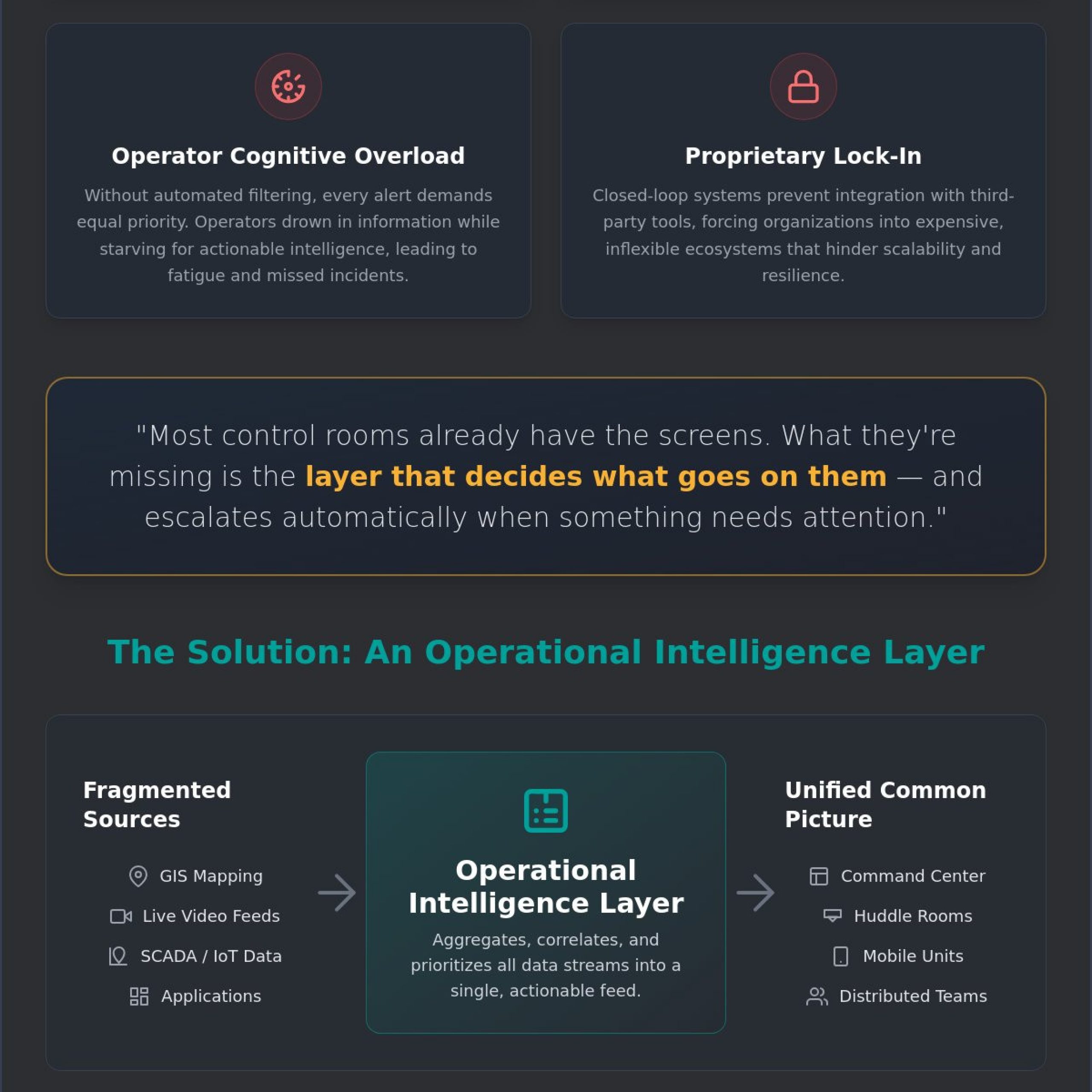
Why do operators still miss critical incidents while surrounded by high-definition video walls and real-time data feeds? The reality of modern control room technology integration challenges isn’t a lack of hardware; it’s the friction between disconnected systems. Even with 4K resolution as the baseline standard for new deployments, high-fidelity pixels don’t equate to actionable intelligence. Most control rooms already have the screens. What they’re missing is the layer that decides what goes on them, and escalates automatically when something needs attention.
You understand the weight of managing fragmented data streams and the cognitive overload that occurs when every alert demands equal priority. While tools like Axon provide essential evidence, they often remain siloed, offering only a partial view of the mission. This article provides a strategic framework to resolve these gaps, moving your operation toward a unified operating picture where visibility is never in question. We’ll examine how to implement a dedicated operational intelligence layer that automates the escalation of critical data. By the end of this guide, you’ll know how to synchronize your command center, huddle rooms, and mobile units into a single, proactive force that eliminates response latency and empowers every decision maker with absolute clarity.
Key Takeaways
- Identify the primary control room technology integration challenges that lead to data fragmentation and prevent a clear common operating picture.
- Eliminate operator fatigue by automating data correlation, ensuring personnel focus on critical response rather than navigating disconnected software silos.
- Deploy an operational intelligence layer to unify existing screens and hardware into a single, cohesive platform for distributed teams.
- Transition to event-driven situational awareness where the system automatically prioritizes and escalates the most vital information during high-stakes incidents.
- Build a resilient architecture using scalable standards that allow your integration framework to grow alongside your mission requirements.
The Complexity Crisis: Why Control Room Integration Fails
Successful operations depend on the precise synthesis of hardware, software, and data streams into a single, unified operating picture. In a modern control room, integration is often misunderstood as a purely physical task involving cables and displays. This narrow focus on the physical layer is why many organizations struggle with control room technology integration challenges. When integration ignores the underlying data logic, the result is a “Wall of Noise.” Adding more feeds without a filtering mechanism actually decreases clarity, leaving operators to drown in information while starving for intelligence. True integration isn’t about the number of pixels on a wall; it’s about the intelligence that governs how those pixels serve the mission.
Traditional AV-centric approaches prioritize signal routing over operational outcomes. They ensure a video feed reaches a screen but fail to consider if that feed is relevant to the current mission. This disconnect creates technical silos where critical systems exist in isolation. For example, platforms like Axon provide vital evidence management, yet they often lack the connectivity to automatically trigger alerts on a main display or mobile device. These tools provide valuable data, but they only offer a partial solution. Without a unifying platform like vis/ability to correlate these feeds, a true Common Operating Picture (COP) remains impossible to achieve.
The Problem of Fragmented Data Streams
Operators today must navigate an explosion of incompatible data formats. SCADA telemetry, GIS mapping, real-time video, and IoT sensor arrays frequently run on separate infrastructures. When an incident occurs, personnel are forced to switch manually between these systems, creating critical delays that can compromise safety and response efficacy. Data fragmentation is the primary barrier to 2026 operational readiness. This friction prevents the seamless flow of information from the field to the command center; it stalls the decision-making process when seconds matter most.
In industrial settings, solving these fragmentation issues often involves the creation of digital twins. ThinkDigits provides an AI-driven platform that synchronizes disparate data sources into a unified digital model for more effective oversight.
The High Cost of Proprietary Lock-in
Relying on closed-loop systems introduces significant long-term risk. Proprietary architectures often refuse to communicate with third-party tools, forcing organizations into expensive, inflexible ecosystems. These silos increase maintenance costs and prevent the rapid scalability required for modern emergency response or utility management. In contrast, leveraging Commercial Off-the-Shelf (COTS) solutions within a flexible integration framework ensures that the control room remains adaptable. By moving away from proprietary limitations, agencies can build a resilient architecture that solves long-term control room technology integration challenges while evolving alongside emerging threats and technological shifts.
Breaking Down Technical Silos and Data Fragmentation
Signal management is not operational intelligence. While many providers focus on HDMI extension or physical matrix switching, these components only address the transport of a signal rather than the utility of the data itself. Solving modern control room technology integration challenges requires a shift from the physical layer to the application layer. Hardware is the skeleton, but the software layer provides the nervous system that makes data actionable. Standalone platforms like Axon or specialized SIEM tools provide critical information, but they operate within their own boundaries. They offer a partial solution that lacks the global context needed for a full common operating picture. Without a unifying hub, your team is forced to monitor fragmented interfaces, which leads to the “Wall of Noise” that obscures critical incidents.
The vis/ability platform serves as this operational intelligence layer. It aggregates disparate tools, including web applications, desktop software, and live video, into a single interface. Most control rooms already have the screens. What they’re missing is the layer that decides what goes on them, and escalates automatically when something needs attention. This approach ensures that your existing investments in specialized tools become more valuable by placing their data in a broader operational context.
Standardizing Protocols for Mission-Critical Reliability
Organizations must move toward standardized protocols like HEVC and SRT to achieve mission-critical reliability. These standards allow for high-bitrate encoding and low-latency visualization across existing network infrastructures. Transitioning to IP-based transmissions, specifically AVoIP, offers the scalability that traditional hardware-centric systems lack. This transition allows for the integration of legacy systems into a modern digital framework without a total rip-and-replace. By adopting these protocols, you ensure that high-stakes environments maintain absolute technical reliability even as data volumes increase.
Managing Application Integration at Scale
The Human Element: Cognitive Overload and Operator Fatigue
Mission success rests on the clarity of the operator, yet fragmented technology often makes clarity impossible. When systems don’t communicate, operators are forced to act as “human middleware.” They must manually correlate a video feed from one screen with a sensor alert on another, while simultaneously checking a third interface for geospatial context. This manual data correlation is a primary driver of control room technology integration challenges. It places a staggering cognitive load on personnel, pushing them toward a psychological limit where critical incidents are missed simply because the “Wall of Noise” has become impenetrable. In high-stakes environments, the friction caused by uncoordinated screens directly translates into increased response times and compromised safety.
Most control rooms already have the screens. What they’re missing is the layer that decides what goes on them, and escalates automatically when something needs attention. Without this operational intelligence layer, even the most sophisticated video wall is just a collection of disconnected pixels. Tools like Axon or specialized SIEM platforms provide valuable data, but they only offer a partial solution. They lack the global view required to prioritize information for the human at the console. Protecting operator focus requires a system that filters noise and highlights only the data relevant to the immediate mission.
Reducing the Mental Burden of Data Correlation
Automated data filtering is the bedrock of operational readiness. By implementing event-driven alerts, the system ensures that operators only see information when it requires action. This proactive approach prevents cognitive fatigue by removing the need for constant, passive monitoring of static feeds. Our SOC/NOC/GSOC solutions focus on this exact challenge, transforming raw data into actionable intelligence. When the technology handles the correlation, the human is free to focus on judgment and decision-making, ensuring that every action is taken with absolute certainty.
The Role of Ergonomics in Integrated Systems
Physical console design is important, but software ergonomics matter more for modern decision-making. A “single pane of glass” remains the ideal, yet most integrations fail to achieve it because they simply crowd more windows onto a single monitor. True software ergonomics involves a unified UI/UX that streamlines complex workflows. By utilizing the vis/ability platform, organizations can replace fragmented interfaces with a cohesive operating environment. This integration reduces stress by providing a structured flow of information, ensuring that critical data is never buried under layers of unnecessary complexity during a crisis.
Engineering Resilience: Selecting Integration Standards That Last
Operational continuity depends on a foundation that remains stable as technology evolves. Many organizations face significant control room technology integration challenges because they rely on custom-coded scripts to link disparate hardware. These bespoke solutions are inherently fragile. They create technical debt that hinders future upgrades and leaves the command center vulnerable during system refreshes. Resilience requires a shift toward Commercial Off-the-Shelf (COTS) solutions. These platforms offer the reliability of a mature product ecosystem, ensuring that your bedrock remains solid while individual tools or data feeds change. Scalability must be a day-one priority, not an afterthought, to ensure the integration architecture supports distributed teams across command centers and mobile units.
Most control rooms already have the screens. What they’re missing is the layer that decides what goes on them, and escalates automatically when something needs attention. This operational intelligence layer acts as the bridge between raw data and human judgment. It allows for the seamless addition of new sensors or software without requiring a complete overhaul of the existing infrastructure. By prioritizing COTS-based platforms, agencies gain the speed-to-deployment necessary for modern mission-critical environments, where waiting months for a custom integration is not an option.
COTS vs. Custom-Built: A Strategic Comparison
Custom-built integrations often fail because they lack the rigorous testing and documentation found in established platforms. While a custom script might solve a specific problem today, it frequently breaks when a third-party application updates its API. COTS solutions mitigate this risk by providing a standardized framework for application integration. These platforms are designed to be hardware-agnostic, allowing you to leverage current investments while maintaining a path for future growth. You can learn more about these strategies through the vis/ability platform, which highlights how standardized architectures outperform custom alternatives in longevity and performance.
Visualizing the Cybersecurity Common Operating Picture
Modern resilience also means integrating network health into the standard operating picture. Cybersecurity threats are no longer isolated IT issues; they are operational risks that require visibility on the main video wall. Integrating SIEM and SOAR data into a Cybersecurity Common Operating Picture allows for a coordinated response between IT and operations teams. The challenge lies in visualizing complex threat intelligence without overwhelming non-technical operators. An effective integration layer translates technical logs into clear, actionable visual indicators. This ensures that when a network anomaly occurs, the right personnel are alerted instantly, allowing for rapid mitigation before the mission is compromised. Reach out to our experts to discuss your control room design and ensure your integration standards are built for the long term.
Transitioning to an Event-Driven Common Operating Picture
The ultimate goal of any command center modernization is to move beyond reactive monitoring. Achieving this shift requires resolving the fundamental control room technology integration challenges that keep data siloed and static. Most control rooms already have the screens. What they’re missing is the layer that decides what goes on them, and escalates automatically when something needs attention. Transitioning to event-driven situational awareness represents the pinnacle of integration. It transforms the environment from a passive display of feeds into a proactive engine of intelligence. In this model, the technology serves as the essential bridge between raw sensor data and the human judgment required to act with certainty. Reactive operations wait for a human to notice a problem; proactive operations use vis/ability to ensure the problem is highlighted before it becomes a crisis.
The Mechanism of Automated Escalation
Automated escalation removes the burden of constant vigilance from the operator. For instance, when a SCADA system detects a critical threshold breach in a utility grid, the integration layer should instantly push the relevant camera feeds and geospatial data to the main video wall. This “follow-me” data concept ensures that field commanders and mobile units receive the same high-priority intelligence simultaneously. Our Public Safety solutions demonstrate how this automation functions in Real-Time Crime Centers (RTCCs), where seconds saved in data correlation save lives. By automating the visual response to specific events, you ensure that the most vital information always finds the right eyes at the right time, regardless of their location or device.
Building Your Blueprint for 2026
Modernizing your operation begins with a rigorous audit of current integration gaps. Identify the “pain-point” silos where data is trapped or where operators are forced to act as manual middleware. This audit should evaluate how information flows during high-stress incidents and where technical friction causes response latency. The focus should be on selecting an operational intelligence layer that is hardware-agnostic and built on COTS standards to ensure long-term flexibility. This platform must grow with your needs, scaling from a single command center to a distributed network of huddle rooms and mobile units. Move from fragmented systems to a unified, intelligent operation that provides calm and clarity amidst potential complexity. We invite you to contact us for a strategic design consultation to begin building your blueprint for a resilient, event-driven future.
Securing the Future of Your Mission-Critical Environment
Overcoming control room technology integration challenges requires a fundamental shift in how your organization views data. It’s no longer enough to simply manage signals. You must manage intelligence. By replacing fragmented technical silos with a unified operational intelligence layer, you empower your team to move beyond the “Wall of Noise.” Most control rooms already have the screens. What they’re missing is the layer that decides what goes on them, and escalates automatically when something needs attention.
Activu has been a pioneer in mission-critical visualization since 1983. We’re trusted by Federal Defense agencies and Global Fortune 500 companies to provide the bedrock for their most critical decisions. Our vis/ability platform delivers event-driven awareness across all sectors, ensuring that your operators remain focused and analytical when the stakes are at their highest. You can achieve absolute technical reliability by adopting a framework that prioritizes actionable data over raw feeds. Take the first step toward a more resilient, proactive command center today.
Request a Strategic Consultation for Your Control Room Integration
Frequently Asked Questions
What are the most common control room technology integration challenges?
The most common control room technology integration challenges include fragmented data streams, incompatible software protocols, and technical debt from custom-coded scripts. These obstacles prevent the creation of a unified operating picture, forcing operators to bridge the gap between disconnected systems manually. Addressing these challenges requires moving beyond physical signal routing toward a software-centric architecture that prioritizes data logic and operational outcomes.
How does data fragmentation affect situational awareness?
Data fragmentation creates a “Wall of Noise” where critical information is buried under a flood of irrelevant feeds. When SCADA, GIS, and video data exist in silos, operators cannot see the relationship between events in real time. This lack of context is one of the most persistent control room technology integration challenges, making it difficult for command staff to coordinate a proactive response during high-stakes incidents.
Why do operators miss critical incidents even with a video wall?
Operators miss incidents because of cognitive overload caused by monitoring uncoordinated screens. A video wall without an intelligence layer requires personnel to act as manual middleware, scanning dozens of feeds for anomalies while managing high-stress tasks. Most control rooms already have the screens. What they’re missing is the layer that decides what goes on them, and escalates automatically when something needs attention.
What is the difference between AV integration and operational intelligence?
AV integration focuses on the physical transport of signals, ensuring a video feed reaches a display via cables or IP extenders. Operational intelligence goes beyond hardware to manage the logic and utility of the data itself. It filters information based on mission relevance and automates the display of critical alerts, transforming a passive viewing environment into a proactive decision-making hub.
Can COTS solutions meet the security requirements of a federal control room?
Commercial Off-the-Shelf (COTS) solutions are designed to meet rigorous federal security standards while offering greater flexibility than custom-built alternatives. By utilizing established platforms like vis/ability, federal agencies can implement a Cybersecurity Common Operating Picture that visualizes threat intelligence. These solutions provide the technical reliability required for high-stakes environments without the fragility of bespoke code.
How does event-driven visualization improve incident response times?
Event-driven visualization improves response times by automatically highlighting critical data the moment a threshold is breached. Instead of waiting for an operator to notice an anomaly on a static feed, the system triggers an immediate visual escalation. This ensures that relevant camera feeds and sensor data are prioritized on the video wall, allowing for faster, more informed decision-making during a crisis.
What is the “operational intelligence layer” in a command center?
The operational intelligence layer is the software-centric hub that unifies all disparate tools, applications, and data feeds into a single interface. It acts as the nervous system of the control room, correlating information from sources like Axon or SCADA systems. This layer provides the essential bridge between raw data and human judgment, ensuring that personnel act with greater certainty.
How can I integrate mobile users into my control room operating picture?
Integrating mobile users requires a platform that supports “follow-me” data, ensuring the same intelligence reaches the field as the command center. By using a software layer that is device-agnostic, you can push real-time alerts and video feeds to mobile devices and remote huddle rooms. This seamless collaboration eliminates information silos and ensures every team member operates from a unified operating picture.