
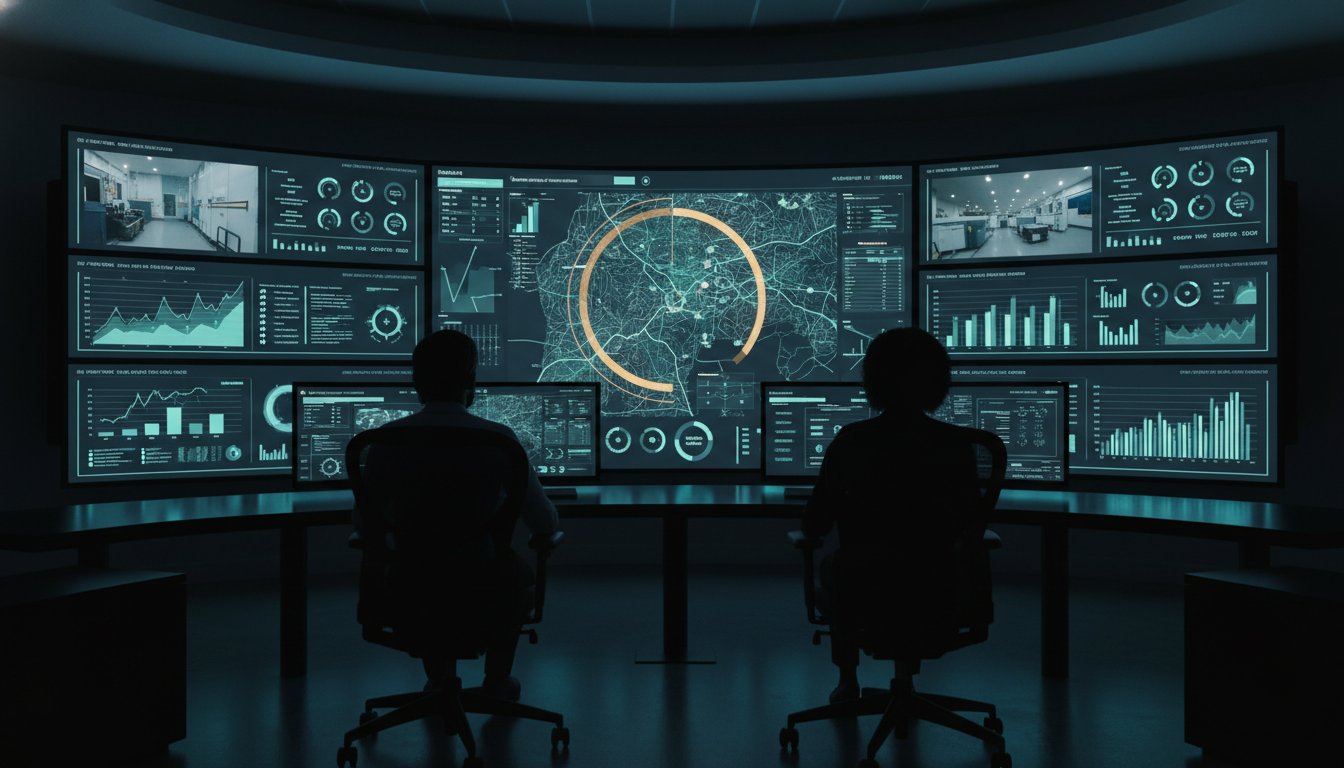
If your operators are monitoring dozens of feeds yet still missing the one critical incident that matters, you aren’t facing a data shortage. You’re facing a visibility crisis. In high-stakes environments, the transition from raw data to actionable intelligence is often blocked by siloed systems and a barrage of irrelevant alerts. This constant cognitive overload doesn’t just slow down response times; it drives operator fatigue and high turnover. Improving operator effectiveness with technology isn’t about adding more pixels to the wall. It’s about ensuring those pixels provide the clarity needed to make life-saving decisions.
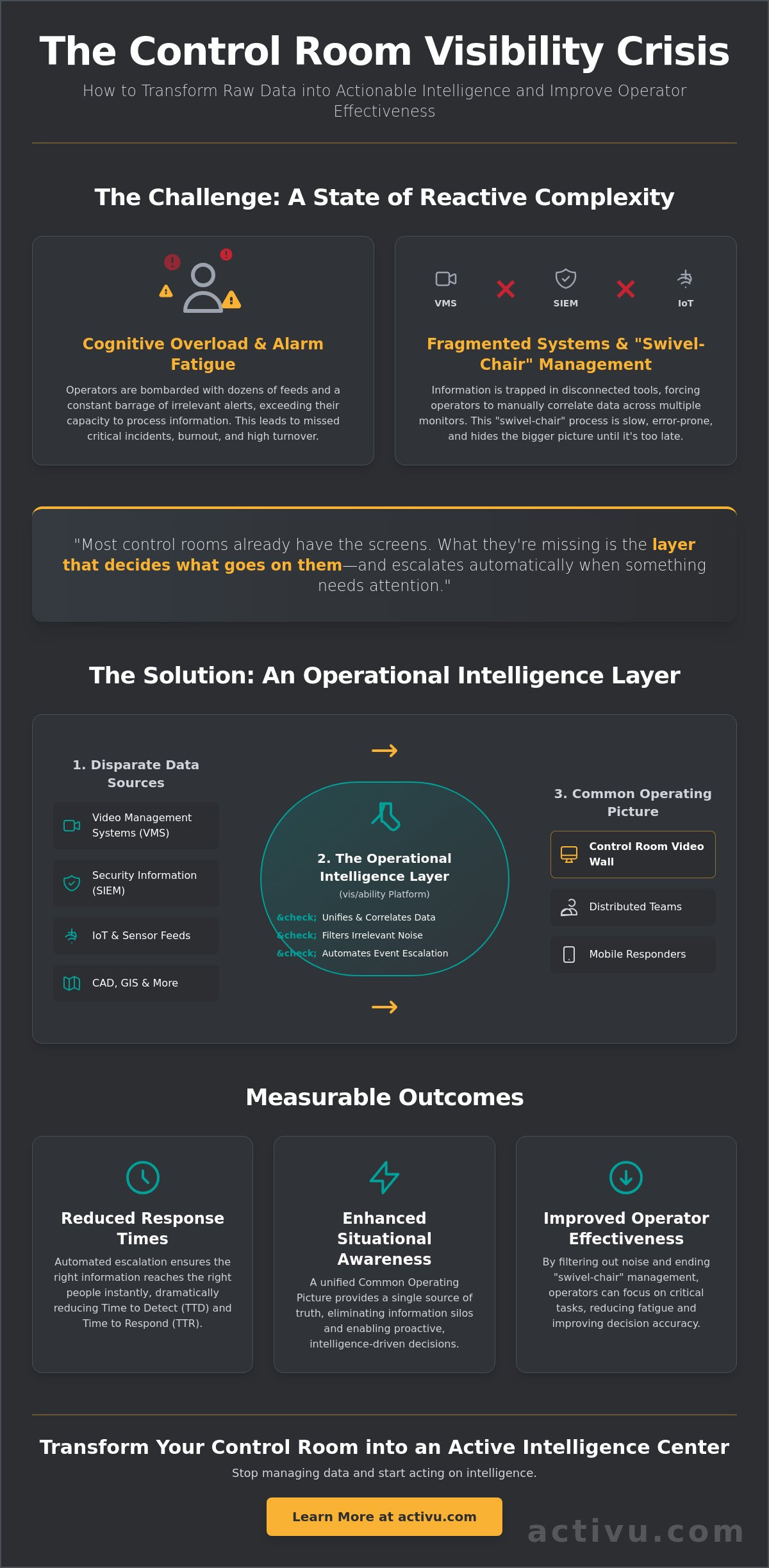
Most control rooms already have the screens. What they’re missing is the layer that decides what goes on them, and escalates automatically when something needs attention. By implementing a dedicated operational intelligence layer, you can transform fragmented tools into a unified platform. This article explores how to reduce Time to Detect (TTD) and foster seamless collaboration by surfacing only the information that requires immediate human judgment. You’ll learn how to move from a state of reactive complexity to a proactive, mission-focused operation.
Key Takeaways
- Identify the root causes of cognitive overload and eliminate the “swivel-chair” management that compromises decision accuracy in high-stakes environments.
- Learn why improving operator effectiveness with technology depends on a central intelligence layer that automates event escalation and filters out irrelevant data.
- Unify fragmented VMS, SIEM, and IoT feeds into a single common operating picture to ensure your team acts on intelligence rather than raw data.
- Extend visibility beyond the video wall by providing distributed teams and mobile responders with the same real-time situational awareness used in the command center.
- Follow a structured roadmap to upgrade legacy systems into a unified hub that drives measurable ROI through reduced response times.
Identifying the Barriers to Operational Intelligence
Operational intelligence remains elusive for many organizations because they confuse data volume with situational awareness. In public safety and utility sectors, the reliance on “swivel-chair” management forces operators to manually correlate data across disconnected monitors. This manual process is the primary enemy of decision accuracy. When an operator must physically turn from a VMS feed to a CAD system while tracking a SIEM alert, the risk of missing a critical cue increases. Improving operator effectiveness with technology requires addressing these physical and mental friction points before they lead to operational failure.
Many facilities invest heavily in massive displays, yet these often become passive wallpapers rather than active tools. Without a strategic framework, traditional video walls simply mirror the desktop’s chaos. They show everything, which means they highlight nothing. This lack of prioritization is a major barrier to effective mission-critical operations. Even with the latest hardware, if the system doesn’t filter for relevance, the operator is left to drown in a sea of static data.
The Real Cost of Cognitive Overload
Cognitive overload in a high-stakes environment is the point where the volume of incoming data exceeds the brain’s ability to process and act upon it. As information density rises, the human mind naturally begins to filter. It doesn’t always filter the right things. This leads to alarm fatigue, where operators become desensitized to alerts because the vast majority are non-actionable noise. In 24/7 environments, this fatigue is a leading cause of turnover and delayed response times. Adhering to standards like ISA-101, which suggests a grayscale-first approach to reduce visual noise, is a start, but it doesn’t solve the underlying data explosion.
Fragmented Systems and Information Silos
Information silos prevent the creation of a true Common Operating Picture (COP). When intelligence is trapped within specific applications, teams lose the ability to see the “big picture” during a crisis. Switching between unrelated applications creates a context switch tax that drains mental energy. For organizations focused on Mission Critical Operations, these silos aren’t just an inconvenience; they are a liability. They hide emerging threats until it’s too late to intervene. Improving operator effectiveness with technology isn’t about buying more tools, but about unifying the ones you already own into a single, coherent stream of intelligence.
Building an Operational Intelligence Layer
Building a resilient command center requires more than just high-resolution hardware. It requires orchestration. Most control rooms already have the screens. What they’re missing is the layer that decides what goes on them, and escalates automatically when something needs attention. This distinction is the core of improving operator effectiveness with technology. Without this logical layer, a video wall is simply a collection of monitors rather than a dynamic tool for decision-making. It remains a passive display that relies entirely on human vigilance to find a needle in a digital haystack.
Many organizations attempt to solve this by using platform-specific tools like Axon. While these applications provide valuable video data, they offer only a partial solution. They operate within their own silos and require a unifying layer to create a full common operating picture. An intelligence layer sits above these individual tools. It pulls data from every disparate source to provide a single, verified truth. This allows your team to focus on the mission instead of the mechanics of the software.
Defining the Operational Intelligence Layer
An operational intelligence layer is the software bridge between raw data and decisive action. It acts as a sophisticated filter. In the context of the Fourth Industrial Revolution and the workplace, the primary challenge isn’t finding data, but prioritizing it. The vis/ability platform serves as this central hub. It ensures that critical information surfaces exactly when it’s needed while suppressing the background noise that causes cognitive fatigue. This software layer transforms the environment from a static viewing room into an active intelligence center where the most important information always has the right of way.
Automated Escalation and Event-Driven Responses
Manual monitoring is no longer a viable strategy for modern data volumes. A modern Security Operations Center (SOC) cannot expect human eyes to catch every anomaly across hundreds of feeds simultaneously. Event-driven situational awareness changes the paradigm by using automation to trigger visual changes based on external events. When an IoT sensor detects a perimeter breach or a cybersecurity alert hits a critical threshold, the intelligence layer automatically modifies the video wall. It brings the relevant camera feeds, geospatial data, and response protocols to the forefront instantly. This shift from reactive searching to proactive notification is how teams maintain control during high-velocity events. If you’re looking to streamline your operations, you can explore the vis/ability platform to see how event-driven logic empowers your staff to act with greater certainty.
Unifying Disparate Data Streams for a Common Operating Picture
Operational success depends on the speed at which raw data becomes actionable intelligence. In complex environments like a dispatch center or a utility grid, data arrives from a dozen different directions. You might have video from an Axon system, emergency management data from Juvare, and real-time sensor alerts from various IoT devices. While these tools are powerful in their specific domains, using them in isolation creates a fragmented reality. Operators are forced to mentally stitch together information from different screens, which is where critical errors occur. Improving operator effectiveness with technology is impossible if the technology itself remains siloed.
True situational awareness requires a single, cohesive view. When you integrate Video Management Systems (VMS), Security Information and Event Management (SIEM), and physical security sensors, you remove the guesswork from the equation. An intelligence layer acts as the unifying platform, pulling these disparate streams into a common operating picture. This ensures that every team member, regardless of their location, sees the same tactical reality at the same time. This transition from fragmented data to a unified view is the bedrock of modern command and control.
Connecting Fragmented Applications
The challenge for many organizations is that their most critical software wasn’t designed to talk to other systems. Specialized tools like Axon provide deep functionality for video evidence, but they only provide a partial solution. They lack the breadth needed for a full response. By utilizing a Commercial Off-the-Shelf (COTS) framework within an intelligence layer, you can bring these non-integrated applications into a single interactive view. This doesn’t replace your existing tools; it makes them more effective by placing their data in context with the rest of your operation. For instance, an alert in Juvare can automatically trigger the nearest camera feed and display the relevant building floor plan, all without operator intervention.
Visualizing Threat Intelligence for Faster Response
In the Federal and Defense sectors, the line between cybersecurity and physical security has blurred. A threat to the network is often a precursor to a threat on the ground. A unified operating picture allows you to map cybersecurity threats onto a physical view of your facilities. This integration enables a faster, more coordinated response to multi-vector attacks. When evaluating your integration capabilities, consider this checklist:
- Cross-Platform Compatibility: Can the system ingest data from any web-based or legacy application?
- Low Latency: Does the unified view update in real-time without lagging behind the source feeds?
- Scalability: Can you add new data streams as your operational needs evolve?
- Bi-Directional Control: Can operators interact with the source applications directly from the unified interface?
By checking these boxes, you ensure that your technology serves as a force multiplier rather than a source of distraction. Improving operator effectiveness with technology requires this level of technical cohesion to turn overwhelming data into decisive action.
Extending Effectiveness Beyond the Control Room
Improving operator effectiveness with technology requires a strategy that reaches beyond the physical walls of the Network Operations Center (NOC). A critical incident doesn’t stay confined to a single room; neither should the intelligence used to manage it. When field teams and remote stakeholders operate on disparate information, response times suffer and communication errors multiply. True operational readiness depends on a unified flow of data that follows the mission, whether that mission is in a command center or a remote huddle room.
Most control rooms already have the screens. What they’re missing is the layer that decides what goes on them, and escalates automatically when something needs attention. This intelligence layer ensures that the right data reaches the right person at the right time, regardless of their device. It moves beyond the physical workstation to provide a persistent common operating picture for everyone involved in the response, creating a bridge between raw data and human judgment.
Collaborative Awareness for Distributed Teams
During a crisis, verbal descriptions of visual data often lead to misunderstandings. Shared views eliminate this friction by allowing distributed teams to see exactly what the lead operator sees. The vis/ability platform facilitates this by extending the operational intelligence layer to any authorized browser or mobile device. This level of synchronization ensures that decision-makers in a huddle room are looking at the same real-time feeds as the technicians on the front lines. Huddle rooms serve as the tactical bridge between high-level strategy and granular execution. When a situation escalates, leaders need a dedicated space where they can analyze the intelligence layer without distracting the main floor operators. Technology that allows for the seamless transfer of content from the video wall to these smaller rooms ensures that no detail is lost in transition.
Enabling Mobile Situational Awareness in the Field
In the Transportation and Public Safety sectors, mobility is a requirement for survival. Field responders need more than just a radio; they need the same geospatial oversight available to the dispatch center. Enabling mobile situational awareness empowers the human element within a digital context. It allows responders to act with greater certainty because they possess the full context of the event. When a field supervisor can view live camera feeds and incident maps on a tablet, they move from a state of uncertainty to a state of clear, actionable intelligence. This mobile access provides several critical advantages:
- Reduced Communication Overhead: Field teams no longer need to request verbal updates for visual information.
- Enhanced Safety: Responders can view hazard data and perimeter layouts before entering a scene.
- Accelerated Decision Cycles: On-site supervisors can authorize actions based on the same data seen by headquarters.
To see how your team can maintain visibility across any distance, contact our experts for a strategic consultation.
Implementing Technology for Operational Excellence
Transitioning from a legacy environment to a modern command center requires a roadmap that prioritizes intelligence over infrastructure. Upgrading your facility isn’t merely a hardware refresh; it’s a strategic shift toward an automated, event-driven model. Most control rooms already have the screens. What they’re missing is the layer that decides what goes on them, and escalates automatically when something needs attention. Improving operator effectiveness with technology involves deploying this software layer to act as the cognitive filter for your entire team, ensuring that high-stakes decisions are based on the most relevant data available.
A scalable architecture is vital in mission-critical environments where data volumes grow exponentially. Your visualization platform must be able to ingest new feeds, from cybersecurity logs to advanced geospatial data, without requiring a complete system overhaul. This flexibility ensures that your operation remains resilient as threats evolve and technology advances. For organizations in energy retail, leveraging AI-powered business intelligence from intraQ can further enhance this resilience by turning complex datasets into clear, actionable insights. Implementing a unified platform creates a foundation for long-term operational excellence, moving your team away from reactive “firefighting” toward a state of proactive oversight.
Measuring Improvements in Response Times
Choosing a Scalable Visualization Partner
Selecting the right partner is as important as the technology itself. You need a platform that doesn’t just display data but orchestrates it across your entire enterprise. A true partner provides more than software; they offer comprehensive Control Room Design Services and proactive support to ensure your facility is optimized for human performance. Your chosen platform should be a unifying hub that makes every other tool in your stack more valuable. If you’re ready to move beyond fragmented data and achieve total situational awareness, you should contact Activu for a tailored assessment of your operational needs. Our experts will help you design a framework that empowers your operators to act with absolute certainty when it matters most.
Achieving Operational Readiness through Intelligence
Operational excellence demands more than just adding data feeds or larger displays. It requires a fundamental shift in how information is filtered and presented to the human at the center of the operation. By implementing an operational intelligence layer, you replace the friction of fragmented systems with a unified, event-driven framework. This strategy is the definitive path for improving operator effectiveness with technology, ensuring that critical incidents are met with immediate, informed action rather than hesitation.
Most control rooms already have the screens. What they’re missing is the layer that decides what goes on them, and escalates automatically when something needs attention. Activu has pioneered mission-critical visualization since 1983, providing the technical bedrock for Global 1000 companies and federal agencies. Our platform offers seamless integration with your existing VMS, SIEM, and CAD systems, transforming siloed tools into a single, proactive hub that extends from the command center to the field.
Take the first step toward absolute situational awareness and reduced response times. Request a Demo of the vis/ability Platform today to see how you can empower your team to act with total certainty. Your mission deserves the clarity that only a dedicated intelligence layer can provide.
Frequently Asked Questions
How does technology specifically reduce operator cognitive overload?
Technology reduces cognitive overload by filtering out non-essential data and surfacing only actionable intelligence. Instead of forcing operators to monitor every feed simultaneously, the system uses event-driven logic to highlight anomalies. This allows the human element to focus on strategy and judgment rather than searching through a barrage of irrelevant alerts. By automating the prioritization of information, you eliminate the mental fatigue caused by constant visual noise.
What is the difference between a video wall and an operational intelligence layer?
A video wall is the physical display hardware, while the operational intelligence layer is the logic that orchestrates it. Most control rooms already have the screens. What they’re missing is the layer that decides what goes on them, and escalates automatically when something needs attention. Without this software layer, a video wall remains a passive display that requires constant human vigilance to remain useful during a crisis.
Can we integrate our existing third-party software like Axon into a common operating picture?
You can integrate specialized tools like Axon, but they only provide a partial solution when used in isolation. These applications often operate as silos, requiring operators to switch contexts and applications to see the full picture. The vis/ability platform acts as the central hub that pulls data from Axon, SIEM, and CAD systems into a single common operating picture. This unification ensures that all data points are viewed in their proper tactical context.
How do event-driven displays improve response times during a critical incident?
Event-driven displays eliminate the delay inherent in manual incident detection. When a sensor or software alert triggers an event, the system automatically brings the relevant data, such as camera feeds and floor plans, to the forefront of the display. This proactive notification significantly reduces the Time to Detect (TTD) during high-velocity incidents. It ensures that operators are never forced to hunt for information while a critical situation is unfolding.
Is it possible to share control room views with remote or mobile team members?
Remote sharing is a core capability of the vis/ability platform, allowing for seamless collaboration across distributed teams. Authorized users can access the same real-time common operating picture on mobile devices or in remote huddle rooms via a secure browser. This ensures that field responders and stakeholders are always synchronized with the command center. It removes the communication gaps that occur when teams rely on verbal descriptions of visual data.
What are the most important KPIs to track when improving operator effectiveness?
The most critical KPIs are Mean Time to Detect (MTTD) and Mean Time to Resolve (MTTR). Improving operator effectiveness with technology is measured by how quickly a system can surface an incident and how efficiently the team can close it. Tracking these metrics provides a clear view of operational readiness and the ROI of your technology integration. Automated systems consistently outperform manual monitoring by reducing the time spent on data correlation.
Why do traditional monitoring methods often lead to missed incidents?
Traditional methods fail because they rely on “swivel-chair” management and manual correlation across disconnected screens. When data is fragmented, operators often miss the subtle cues that precede a major incident. The sheer volume of information in a 24/7 environment makes it impossible for human eyes to catch every anomaly. Without an automated layer to prioritize critical alerts, important information is easily lost in the background noise.
How does an intelligence layer help with NERC CIP compliance in utilities?
An intelligence layer supports NERC CIP compliance by providing a unified view of both physical and cybersecurity oversight. It allows utilities to document incident responses and maintain strict access control over sensitive operational data. By integrating SIEM alerts with physical security feeds, the system ensures a comprehensive approach to asset protection. This level of oversight is essential for meeting the rigorous documentation and monitoring requirements of the utility sector.