

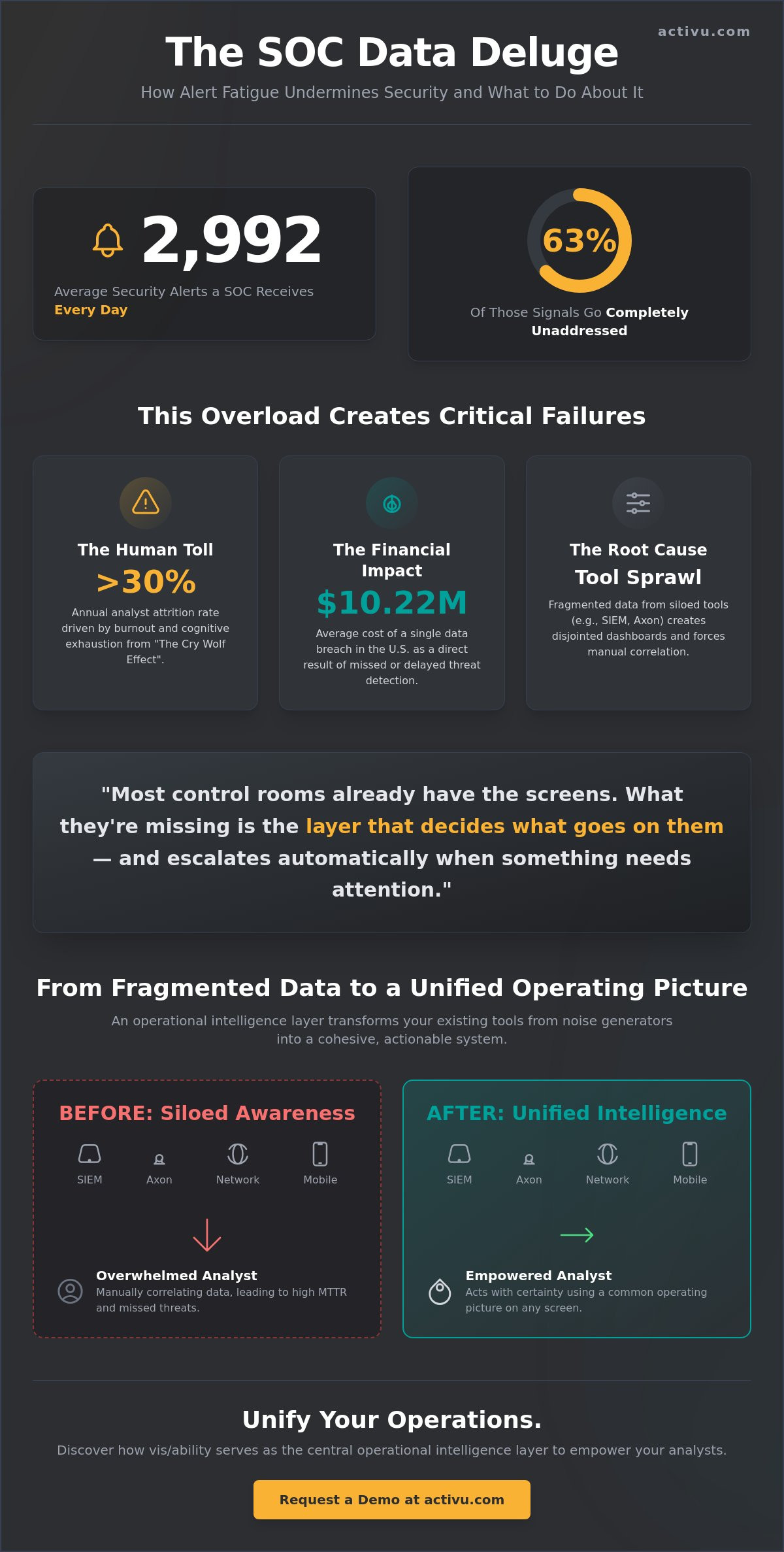
Security Operations Centers receive an average of 2,992 alerts every day, yet a staggering 63% of those signals go completely unaddressed. This volume isn’t just a data problem; it’s a structural failure that leaves critical threats hidden within a sea of false positives. You know the cost of this friction: high analyst burnout and an attrition rate that has exceeded 30% annually for three consecutive years. Implementing effective strategies for managing alert fatigue in a SOC is no longer optional when the average cost of a U.S. data breach has reached $10.22 million. Most control rooms already have the screens. What they’re missing is the layer that decides what goes on them, and escalates automatically when something needs attention.
We understand that fragmented data silos and tools like Axon often provide only a partial solution, forcing your team to manually correlate disparate feeds during high-stakes incidents. This article demonstrates how to transform overwhelming noise into actionable intelligence through strategic triage and automated visualization. We’ll explore a framework for operational clarity that reduces your mean time to respond (MTTR) by establishing a unified view of network health. You’ll learn how an operational intelligence layer empowers your analysts to act with certainty, ensuring that the most vital information is always prioritized when it matters most.
Key Takeaways
- Identify how the “Cry Wolf” phenomenon leads to operator desensitization and missed incidents in complex security environments.
- Apply precise strategies for managing alert fatigue in a SOC to reduce mean time to respond and improve analyst retention.
- Understand why fragmented data feeds require a unifying layer to create a functional common operating picture for the entire organization.
- Learn to implement the layer that decides what appears on your screens, and escalates automatically when an incident requires immediate attention.
- Discover how the vis/ability platform serves as the central operational intelligence layer to unify disparate security tools and empower analysts to act with absolute certainty.
The Cognitive Cost of Alert Fatigue in Modern SOC Environments
Constant vigilance in a Security Operations Center (SOC) often creates a dangerous state of desensitization. This psychological state, known as alert fatigue, occurs when operators encounter a high frequency of security notifications, leading to slower response times or the total dismissal of critical warnings. High-stakes command centers experience the “Cry Wolf” phenomenon. When 99% of alerts are false positives or low-priority noise, the human brain naturally begins to deprioritize all incoming signals. This cognitive overload directly impacts decision-making speed. As the volume of telemetry increases, the ability of an analyst to extract meaning from that data decreases.
Effective strategies for managing alert fatigue in a SOC must address the fundamental gap between raw telemetry and human judgment. Raw data is not intelligence. Without context, an alert is merely a distraction. When analysts spend their shifts navigating a deluge of unprioritized notifications, they lose the capacity for the deep, focused investigation required to catch sophisticated adversaries. The pressure to maintain a high tempo of operations while sifting through irrelevant data creates a baseline of stress that compromises the entire security posture.
Root Causes: Tool Sprawl and Data Proliferation
Modern SOCs often attempt to solve visibility gaps by adding specialized tools. While platforms like Axon or Okta provide valuable data, they often function as fragmented silos. They offer only a partial solution to the broader security picture and require a unifying layer to be truly effective. Legacy SIEMs frequently fail to provide the necessary contextualized threat intelligence, forcing analysts to manually toggle between interfaces to verify a single event. This tool sprawl creates “siloed awareness.” Teams may see the data, but they lack a unified perspective. This increases the likelihood that a coordinated attack will slip through the cracks while operators are distracted by disjointed dashboards.
The Impact on Operational Continuity and Retention
The cost of this inefficiency extends beyond immediate security risks. Alert fatigue is a primary driver of the high attrition rates seen in the industry today, where analyst turnover often exceeds 30% annually. When skilled professionals spend their days performing repetitive, low-value triage, burnout is inevitable. The financial and reputational consequences of a single missed critical incident can be catastrophic, often reaching millions of dollars in recovery costs. Maintaining operational continuity requires more than just hiring more staff; it requires better tools that protect the human element from cognitive exhaustion. Most control rooms already have the screens. What they’re missing is the layer that decides what goes on them, and escalates automatically when something needs attention. Implementing these strategies for managing alert fatigue in a SOC is the only way to ensure long-term resilience and analyst retention.
A Strategic Framework for Alert Triage and Normalization
Organizations cannot achieve operational clarity by reacting to every digital ping. Implementing effective strategies for managing alert fatigue in a SOC begins with establishing a concrete baseline of normal network behavior. Without this reference point, your sensors cannot distinguish between a standard data backup and a malicious exfiltration attempt. Normalization ensures that your team only engages when an event deviates from the established norm, preserving cognitive resources for genuine threats.
A multi-tier severity system is the foundation of this framework. Severity must correlate directly with operational impact rather than technical novelty. This requires deduplication logic to prevent redundant notifications from multiple sensors. If a single firewall event triggers five different alerts across your stack, your analysts are performing manual data entry instead of incident response. Regular audits of alert rules are mandatory. Pruning low-value or redundant triggers every quarter ensures that your detection logic evolves alongside your network architecture. Research into an AI-Assisted SIEM Framework suggests that automating these initial triage steps is essential for maintaining a high tempo of operations without overwhelming the human element.
Step 1: Audit Your Telemetry and Sensor Accuracy
Analyze your current toolset to identify which sensors generate the highest volume of false positives. Tuning detection thresholds to match the specific risk profile of your industry is vital. For example, a utility provider requires different sensitivity levels than a financial institution. Incorporate direct feedback from Tier 1 analysts during this tuning process. They are the first to see the noise and are best positioned to identify which “high-priority” alerts consistently lead to dead ends. This collaborative approach ensures your technical configurations reflect operational reality.
Step 2: Establish Severity Tiers and Response Playbooks
Define clear distinctions between “Critical” and “Informational” alerts based on your mission-critical priorities. A critical alert should represent a direct threat to operational continuity, while informational alerts serve as forensic data for later review. Map these tiers to pre-defined response protocols to accelerate execution. These playbooks must be instantly accessible through a common operating picture to ensure that every team member, regardless of their location, follows the same verified procedure.
Most control rooms already have the screens. What they’re missing is the layer that decides what goes on them, and escalates automatically when something needs attention. By moving beyond fragmented data feeds, you can create a unified environment where intelligence dictates action.
Beyond SIEM: Why Data Integration Alone Fails the Operator
Security Information and Event Management (SIEM) and Security Orchestration, Automation, and Response (SOAR) platforms are foundational to the modern security stack. They ingest massive quantities of data and execute basic automation scripts, yet they frequently fail to provide true situational awareness. These tools focus on processing data in the background, often leaving the operator to struggle with dashboard blindness. Monitoring dozens of unprioritized screens creates a state of cognitive paralysis. When every tool claims priority, nothing is prioritized. This is why data integration alone cannot solve the human problem of operational oversight.
Siloed tools like Axon or identity management platforms provide only a partial view of the threat landscape. They operate in isolation, forcing analysts to manually correlate events across disparate interfaces. This fragmentation is a primary reason why many traditional strategies for managing alert fatigue in a SOC fall short. They optimize the data pipeline but neglect the presentation layer where critical decisions occur. Understanding Alert Fatigue from an Industry Perspective highlights that the sheer volume of these uncoordinated signals leads to the very desensitization that allows breaches to go undetected. To fix this, organizations must move beyond ingestion and toward an Operational Intelligence Layer.
The Missing Layer in the Control Room
Most control rooms already have the screens. What they’re missing is the layer that decides what goes on them, and escalates automatically when something needs attention. This layer differentiates between raw data ingestion and event-driven visualization. It doesn’t just collect information; it interprets the urgency of that information based on the current operational context. By automating the visual environment, this layer empowers the human element. It ensures that analysts aren’t searching for the needle in the haystack; instead, the needle is presented to them the moment it’s identified.
Bridging the Gap Between Data and Decision
Fragmented systems inevitably slow down the moment of a pivotal decision. When a high-severity alert triggers, analysts shouldn’t have to navigate multiple browser tabs or siloed applications to understand the scope of the threat. They need a system that filters noise and presents a unified perspective. This is where vis/ability functions as the central hub for your entire operation. It unifies your existing tools into a cohesive common operating picture, making them useful for the entire team regardless of their location. By serving as the operational intelligence layer, it bridges the gap between raw data and human judgment, allowing your team to act with absolute certainty when stakes are highest.
Implementing Automated Escalation and Situational Awareness
Shifting from reactive monitoring to proactive, event-driven operations is the only way to maintain control over a modern threat landscape. When an incident occurs, the environment itself must adapt without human intervention. Automated escalation ensures that the response sequence begins the moment a sensor triggers, removing the friction of manual triage. This transition is a core component of advanced strategies for managing alert fatigue in a SOC, as it replaces repetitive manual tasks with high-speed, logic-driven execution. Most control rooms already have the screens. What they’re missing is the layer that decides what goes on them, and escalates automatically when something needs attention.
Effective automation pushes critical data to the right person at the right time. It eliminates the need for analysts to hunt for information across fragmented tools. Instead, the system prioritizes and presents the necessary intelligence based on pre-defined severity thresholds. This process ensures that high-stakes decisions are supported by immediate, relevant context, allowing teams to act with absolute certainty when every second counts. To simplify this process further, you can discover WOXAI, an AI-driven platform designed to unify over 300 tools into a single operating system.
Mapping Alerts to Visual Workflows
Visual workflows translate digital logic into physical situational awareness. A ‘Critical’ alert should do more than trigger a notification; it should automatically reconfigure the video wall to display a specific, relevant layout. If a sensor detects unauthorized access in a remote facility, the video wall should immediately show live camera feeds, floor plans, and the specific data stream that triggered the event. Seeing these correlated streams side-by-side allows for instant verification and faster containment. For organizations looking to optimize these dynamic environments, specialized control room design services provide the architectural foundation required to support such complex, event-driven workflows.
Extending Visibility to Mobile and Remote Teams
Operational clarity cannot be confined to the four walls of a command center. Distributed teams must maintain a common operating picture to coordinate effective responses. Automated escalation logic should include push notifications that extend to mobile vis/ability tools, ensuring that field supervisors and remote analysts see the same data as the central SOC. In public safety or utility operations, this mobile reach is vital for protecting personnel and assets during a crisis. By synchronizing the visual environment across all devices, you ensure that the entire organization moves as a single, informed unit. To see how event-driven automation can transform your operations, request a demonstration of the vis/ability platform.
vis/ability: The Operational Intelligence Layer for High-Stakes SOCs
vis/ability is the central hub where all security and operational tools converge. It functions as the operational intelligence layer, transforming raw data into high-fidelity visual intelligence. By automating the visual environment, the platform ensures that the most critical information is prioritized without manual intervention. This approach is fundamental to advanced strategies for managing alert fatigue in a SOC, as it removes the burden of constant manual monitoring from the analyst. It serves as the bedrock upon which critical decisions are made, providing a sense of calm and clarity amidst potential complexity.
Most control rooms already have the screens. What they’re missing is the layer that decides what goes on them, and escalates automatically when something needs attention. vis/ability provides this layer, acting as the quiet, powerful engine behind successful operations. It moves the SOC beyond simple data integration and into a state of proactive situational awareness. This logical progression creates a sense of inevitability and trust, leading the reader from a state of complexity to a state of clear, actionable intelligence.
Unifying Your Cybersecurity Posture
Standalone SIEM and SOAR tools provide essential data ingestion, but they often offer limited, siloed views that require manual correlation. Some organizations use tools like Axon, but these typically provide only a partial solution. They lack the unifying layer needed to create a full common operating picture. vis/ability fills these specific gaps by integrating disparate feeds from every corner of your infrastructure into a single, unified interface. It doesn’t matter if data is coming from network sensors, physical security cameras, or identity management platforms; the system correlates it into a coherent narrative.
This platform makes your existing tools more useful for the entire team. It doesn’t matter if they’re stationed in the command center, a huddle room, or using mobile vis/ability devices. This unification drastically reduces cognitive load. Operators no longer need to toggle between fragmented systems to understand a threat. Instead, vis/ability presents the essential bridge between raw data and human judgment, allowing for a more structured flow of command operations. It ensures that the human element remains focused and analytical when stakes are at their highest.
Real-Time Collaboration and Response
High-stakes operations require seamless coordination between the SOC and field units. The event-driven nature of the vis/ability platform ensures that no critical alert is missed, even when analysts are managing multiple high-priority incidents. When a threshold is met, the system automatically pushes the relevant visual context to all stakeholders simultaneously. This synchronization empowers individuals to act with greater certainty, bridging the gap between digital detection and physical response.
The platform’s methodical communication rhythm mimics a well-oiled process. It begins by identifying a high-level challenge, moves through the technological methodology of the solution, and concludes with definitive clarity. This ensures that the core message of operational efficiency is never lost in unnecessary complexity. To secure your perimeter and empower your team, contact Activu to design your intelligent SOC environment. Establishing this level of operational readiness is the definitive step toward long-term resilience and mission success.
Elevating Operational Intelligence for the Modern SOC
Transforming a high-stakes environment requires moving beyond the simple collection of raw data. We’ve explored how establishing baseline behaviors and implementing automated escalation are vital strategies for managing alert fatigue in a SOC. These frameworks protect your analysts from cognitive exhaustion while ensuring that critical threats never go unnoticed. Most control rooms already have the screens. What they’re missing is the layer that decides what goes on them, and escalates automatically when something needs attention.
Activu’s vis/ability platform serves as this essential operational intelligence layer. Trusted by Federal Defense and Global Fortune 500 companies, it provides event-driven situational awareness that escalates automatically based on your mission priorities. The platform offers seamless integration with your existing SIEM and SOAR tools, unifying fragmented data into a single, actionable common operating picture. You can restore order to your command center and empower your team to act with absolute certainty. Request a Demo of the vis/ability Platform today to experience the clarity of a truly integrated operation.
Frequently Asked Questions
What is the primary cause of alert fatigue in a SOC?
The primary cause is the relentless influx of low-fidelity notifications that lack operational context. When security tools generate thousands of alerts daily, analysts become desensitized due to the “Cry Wolf” effect. This overload is compounded by fragmented systems that force teams to manually correlate data. Without effective strategies for managing alert fatigue in a SOC, critical signals remain buried under a mountain of false positives.
How can I measure the impact of alert fatigue on my security team?
Measure impact through KPIs such as Mean Time to Respond (MTTR) and the percentage of unaddressed alerts. High analyst attrition rates and increased error rates during peak alert periods also serve as clear indicators of cognitive exhaustion. If your team is ignoring over 60% of incoming signals, the noise level has compromised your security posture. Monitoring these metrics identifies where the human element is failing due to system inefficiency.
Can SOAR platforms completely eliminate alert fatigue?
SOAR platforms automate background workflows but can’t eliminate fatigue because they don’t address the visual presentation of data. While they handle repetitive tasks, operators still face dashboard blindness when monitoring the remaining high-stakes events. Most control rooms already have the screens. What they’re missing is the layer that decides what goes on them, and escalates automatically when something needs attention. True fatigue reduction requires an operational intelligence layer that unifies these tools.
How does automated visualization help reduce operator cognitive load?
Automated visualization reduces cognitive load by filtering out irrelevant data and only presenting what’s necessary for the current incident. Instead of scanning multiple monitors for changes, the system reconfigures the environment to highlight critical alerts. This ensures that analysts don’t waste mental energy searching for information. It allows them to focus entirely on analysis and decision-making during high-stakes operations.
What is an operational intelligence layer in the context of a SOC?
An operational intelligence layer is a central hub, like the vis/ability platform, that unifies all security and operational tools into a single interface. It sits above your SIEM, SOAR, and physical security feeds to act as the primary bridge between raw data and human judgment. This layer automates the prioritization of information, ensuring that your team maintains a full common operating picture across all devices and locations.
How do I prioritize alerts when managing multiple data feeds?
Prioritization requires establishing a baseline of normal network behavior and implementing a multi-tier severity system. You must map alerts to their potential operational impact rather than just their technical category. By applying deduplication logic and regular rule audits, you ensure that only high-value triggers reach the analyst. This structured approach is among the most effective strategies for managing alert fatigue in a SOC with complex data environments.
What role does video wall design play in managing alert overload?
Video wall design should be dynamic and event-driven rather than static. A well-designed system uses automated triggers to change layouts based on the severity of incoming alerts. This prevents operators from becoming desensitized to a wall of data that never changes. By pushing correlated data streams side-by-side during an incident, the video wall becomes an active tool for situational awareness rather than a passive display.
Why do operators miss critical incidents despite having multiple monitors?
Operators miss incidents because of siloed awareness and the physical limits of human attention. Having more screens often increases the chance of missing a signal if the data is fragmented across too many interfaces. Without a unifying platform to correlate these feeds, the brain can’t process disjointed information fast enough during a crisis. The solution isn’t more monitors; it’s a system that intelligently decides which data deserves the operator’s focus.