
A massive video wall is often the most visible part of an operations center, but it’s seldom the reason a mission succeeds or fails. In high-stakes environments, the real bottleneck remains the cognitive overload that occurs when teams manually bridge fragmented data silos while seconds tick away. Many agencies struggle with information arriving too late to be actionable, or find that remote teams lack the visibility needed to coordinate effectively. This article identifies the critical features for command center software that transform these disconnected streams into a unified operating picture. Most control rooms already have the screens. What they’re missing is the layer that decides what goes on them, and escalates automatically when something needs attention.
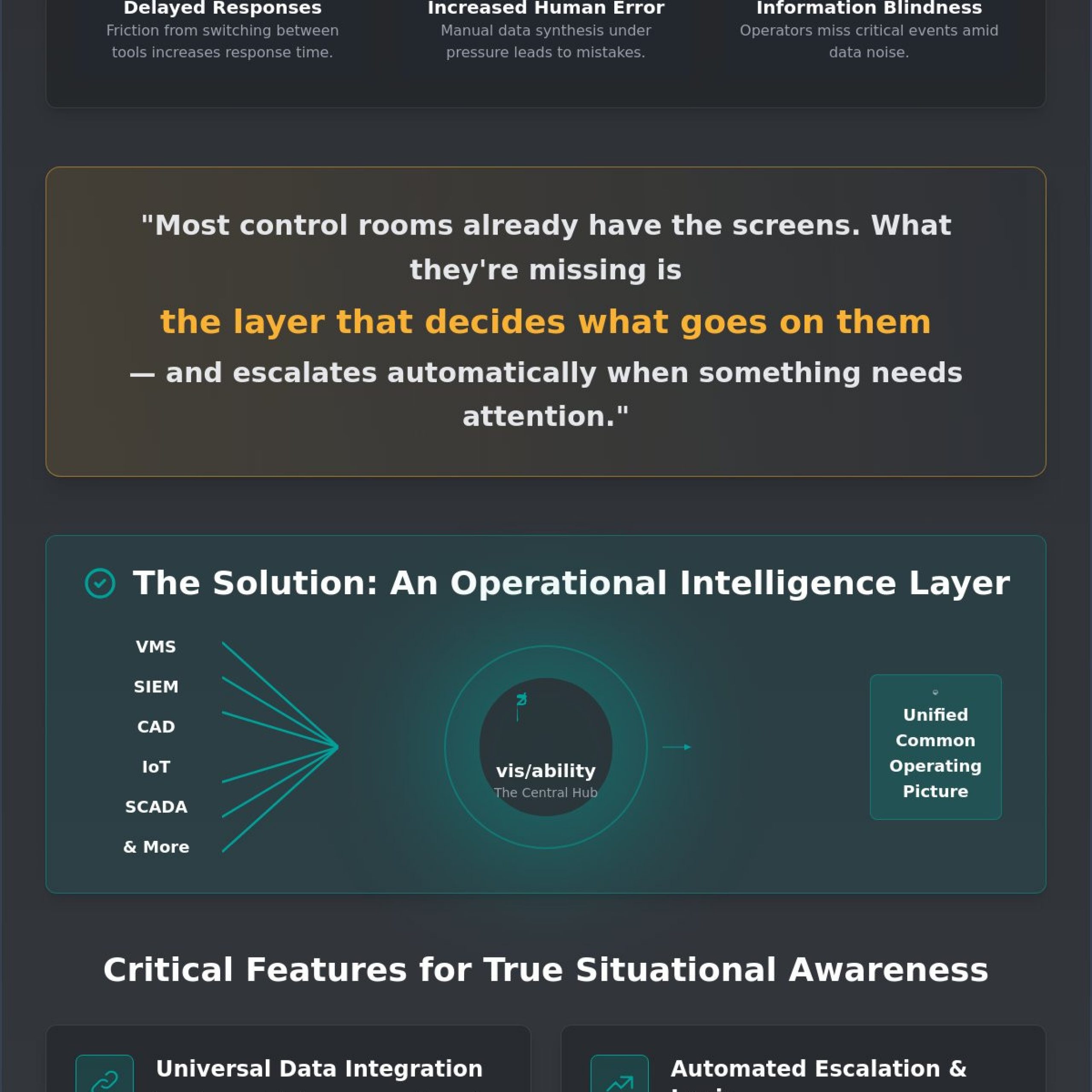
Relying on isolated tools like Axon often provides only a partial solution, leaving gaps in your common operating picture. To achieve true situational awareness, you need an operational intelligence layer that serves as a central hub for all data feeds. We’ll preview how vis/ability unifies your existing tools into a single platform, ensuring that critical events are prioritized for everyone from the command center to mobile units. You’ll learn how to implement automated escalation and deep application integration to reduce response times and empower your team to act with absolute certainty.
Key Takeaways
- Shift from passive observation to active situational awareness by identifying the silos that isolate your critical data.
- Pinpoint the critical features for command center software that allow your team to ingest any digital source and manage content dynamically.
- Most control rooms already have the screens; what they’re missing is the layer that decides what goes on them and escalates automatically when something needs attention.
- Extend your common operating picture to mobile users and huddle rooms to ensure seamless collaboration during urgent operations.
- Use a structured decision framework to ensure your software meets essential cybersecurity standards and scales with your operational needs.
The Shift from Passive Monitoring to Active Situational Awareness
Modern operations face a fundamental challenge: data is abundant, but intelligence is scarce. This “Data Silo Crisis” occurs when critical systems like Video Management Software (VMS), Computer-Aided Dispatch (CAD), and Security Information and Event Management (SIEM) remain isolated. In a high-stakes command center, true situational awareness requires three distinct stages: the ability to perceive raw data, the capacity to comprehend its significance, and the foresight to project future outcomes. When these systems don’t communicate, operators are forced to perform this synthesis manually, often under extreme pressure.
Passive monitoring relies on the hope that a human operator will notice a subtle change across dozens of screens. This approach is inherently flawed. Research into operator fatigue suggests that human attention spans drop significantly after just twenty minutes of watching video monitors. Traditional video wall management often treats every feed with equal weight, leading to “information blindness.” Modern event-driven software architectures solve this by moving away from passive observation. Instead, they focus on identifying the critical features for command center software that prioritize information based on real-world triggers.
The Limitations of Fragmented Monitoring Tools
Specialized tools like Axon provide essential data for law enforcement and public safety, yet they often exist as islands of information. When an operator must switch between several different software interfaces to understand a single incident, the cognitive cost is immense. This friction delays response times and increases the likelihood of human error. Without a unifying platform, these tools only offer a partial solution. They lack the context needed for the entire team to act in unison. Effective operations require an operational intelligence layer to synthesize these inputs into a single, cohesive narrative.
Defining the Common Operating Picture (COP)
A Common Operating Picture (COP) is the bedrock of effective response. It ensures that every stakeholder, from the dispatcher to the field unit, sees the same reality at the same time. This visibility bridges the gaps between disparate departments and agencies, fostering a culture of proactive coordination. Most control rooms already have the screens; what they’re missing is the layer that decides what goes on them and escalates automatically when something needs attention. By integrating incident management software into a centralized hub like vis/ability, organizations can transform fragmented data into a clear, actionable roadmap. This shift ensures that the most critical features for command center software are working to reduce noise and highlight the path to a successful resolution.
Essential Software Features for Real-Time Operational Intelligence
Identifying the critical features for command center software involves looking past hardware specifications to the underlying logic that drives decision-making. True operational intelligence requires a platform that doesn’t just display pixels but understands the context of the data it receives. Most control rooms already have the screens. What they’re missing is the layer that decides what goes on them, and escalates automatically when something needs attention. This intelligence layer must manage dynamic content, ensuring the layout of a video wall or a mobile device shifts instantly based on the severity of an unfolding event. When a critical threshold is met, the software should automatically reprioritize the view, pushing the most relevant data to the forefront without manual intervention.
Universal Application and Data Integration
Geospatial Visualization and Mapping
Context is often geographic. Software that layers real-time assets onto interactive maps provides immediate tactical awareness. By integrating weather patterns, traffic flow, and threat intelligence into a unified map, operators can see how external factors impact their specific assets. This capability is especially vital for public safety and transportation sectors, where the location of personnel and hardware dictates the speed of a response. Visualizing these elements on a single pane of glass reduces the time spent toggling between applications. If you’re looking to modernize your facility, consider how vis/ability can unify these disparate feeds into a single source of truth.
The Intelligence Layer: Automated Escalation and Priority Logic
A sophisticated command center is defined not by the resolution of its displays, but by the intelligence of the software layer managing them. Most control rooms already have the screens. What they’re missing is the layer that decides what goes on them — and escalates automatically when something needs attention. This automated escalation is among the most critical features for command center software, as it shifts the burden of detection from the operator to the system. By utilizing event-driven logic, the platform “listens” to incoming data streams for specific triggers, such as a perimeter breach or a sudden spike in network latency, and reacts in real time.
When an incident occurs, the system shouldn’t just alert the team; it should transform the environment. Automated layout switching ensures that the video wall immediately displays the most relevant cameras, maps, and data feeds associated with the event. This rule-based approach filters out the noise of everyday operations, escalating only verified anomalies. This logic is rooted in the foundational principles of C2 systems, where the integration of the physical and information domains is essential for maintaining control during complex operations.
Moving from Reactive to Proactive Operations
Traditional workflows are often reactive, waiting for a human to notice a problem before a response begins. Automation flips this script, allowing the software to identify threats before a human operator can process the visual information. This capability significantly reduces the mean time to detect (MTTD), which is vital for maintaining mission critical resilience. When the software handles the initial detection and data gathering, the team can focus entirely on the resolution phase of the operation.
Reducing Operator Cognitive Load
In a crisis, too much information is just as dangerous as too little. Information prioritization is a feature that hides non-essential data, creating a calm, focused environment where only pivotal views are visible. The software layer manages data density, ensuring that operators aren’t overwhelmed by hundreds of irrelevant feeds. This system doesn’t replace human judgment; instead, it guides it. By presenting the right information at the right time, the operational intelligence layer empowers individuals to make decisions with greater certainty and speed.
Collaboration and Mobility: Extending Visibility Beyond the NOC
The physical boundaries of a Network Operations Center (NOC) can become a liability during a dynamic crisis. If your situational awareness is locked behind the doors of a single room, your field teams are operating in the dark. A distributed architecture that supports remote and mobile users is among the most critical features for command center software. It ensures the common operating picture remains consistent, whether viewed on a massive display wall or a handheld tablet. Secure information sharing allows leadership to push pivotal views to huddle rooms or field devices instantly. This capability eliminates the need for verbal descriptions of visual data, which often lead to misunderstandings during high-pressure events.
Most control rooms already have the screens. What they’re missing is the layer that decides what goes on them, and escalates automatically when something needs attention. By implementing an operational intelligence layer, organizations can synchronize decision-making across the entire enterprise. This platform acts as a central hub, ensuring that the same data used by analysts in the command center is available to responders on the front lines. Cross-platform compatibility is essential here; the software must automatically adjust data density and layouts to remain legible on smaller screens without requiring manual reconfiguration by the user.
Bridging the Gap Between the Field and Command
Mobile integration prevents the dangerous information lag that occurs when field data has to be manually described over radio or uploaded after the fact. Field responders can feed live video and photos back to the central video wall, providing the command team with eyes on the ground in seconds. This is particularly vital in transportation and utility management, where the physical state of infrastructure changes rapidly. Tools like Axon are helpful for capturing specific evidence, but they provide only a partial solution. They lack the unifying platform necessary to share that intelligence with every stakeholder in real time, creating a gap that only a dedicated operational intelligence layer can fill.
Distributed Collaboration for Crisis Management
During large-scale emergencies, the ability to create virtual command centers is essential for resilience. Distributed teams can synchronize their actions through a shared view that remains encrypted and secure, ensuring that even if the primary facility is compromised, the mission continues from secondary locations. Maintaining operational security through secure, encrypted links is non-negotiable when sharing sensitive tactical data across public or private networks. This level of connectivity allows for a truly unified response, where geography no longer limits the effectiveness of the command team.
Explore how Mobile vis/ability extends your reach beyond the command center.
Evaluating Command Center Software: A Decision Framework
Selecting a platform requires a rigorous assessment of how technology supports human judgment during high-stress operations. The most critical features for command center software center on long-term operational viability and technical reliability. Scalability is non-negotiable. As data volumes increase, the software must grow without performance degradation or the need for a complete system overhaul. Security remains equally paramount. In regulated environments, compliance with standards such as NERC CIP for utilities or CJIS for law enforcement is the baseline for any deployment. A failure in cybersecurity is a failure in the mission itself.
Ease of use often determines the success of a rollout. Operators shouldn’t be fighting the interface when lives or infrastructure are on the line. A well-designed system allows an operator to learn the core functions in hours, not weeks. Reliable vendor support and comprehensive design services ensure the software is integrated correctly into the physical and digital architecture of the room. This end-to-end engineering approach prevents the technical debt that often plagues fragmented systems and ensures your team has a bedrock of technical reliability.
Integrating with Existing COTS Solutions
Modern operations rely on a variety of commercial off the shelf (COTS) tools. The software you choose must act as a unifying layer that makes these existing tools more effective for the entire team. Selecting an open, integrated platform prevents vendor lock-in and allows for the seamless addition of new technologies as they emerge. By framing your software as an operational intelligence layer, you ensure every tool in your stack contributes to a single, actionable truth rather than creating another isolated silo.
The Final Step: Moving Toward vis/ability
Fragmented data streams and siloed visibility are the primary obstacles to an efficient response. Most control rooms already have the screens. What they’re missing is the layer that decides what goes on them, and escalates automatically when something needs attention. Activu’s vis/ability platform provides this essential logic, serving as the central hub for SOC, NOC, and GSOC environments. It transforms raw data into the actionable intelligence your team needs to act with certainty. To begin your transition from passive monitoring to active situational awareness, contact Activu for a professional situational awareness assessment.
Modernizing Your Operational Intelligence Layer
Achieving a unified operating picture requires more than just high-resolution hardware. It demands a sophisticated software architecture that bridges the gap between raw data and human action. We’ve examined how the critical features for command center software, such as universal integration, geospatial mapping, and mobile collaboration, are essential for maintaining control in high-stakes environments. Most control rooms already have the screens. What they’re missing is the layer that decides what goes on them, and escalates automatically when something needs attention.
Activu brings over 40 years of mission-critical experience to your operation, providing event-driven automation that significantly reduces the mean time to detect (MTTD). Our solutions are trusted by Federal Defense and Global Fortune 500 companies to provide the bedrock upon which vital decisions are made. By prioritizing essential information and automating the escalation of critical events, you can ensure your team acts with absolute certainty even in the most complex scenarios.
See how vis/ability transforms your command center operations.
Your transition to a more proactive and resilient command center is within reach. With the right intelligence layer in place, you can finally turn fragmented data streams into a powerful engine for operational success.
Frequently Asked Questions
What is the most important feature for command center software?
Automated information prioritization is the most vital capability for any high-stakes environment. One of the critical features for command center software is the logic that filters out non-essential data during a crisis. This ensures operators focus on pivotal information rather than being overwhelmed by hundreds of static feeds. Without this prioritization, the risk of missing a critical incident increases as data volume grows.
How does command center software reduce operator fatigue?
The software reduces fatigue by managing data density and eliminating the need for constant, passive monitoring. By utilizing event-driven logic, the system only promotes relevant data to the forefront when a specific trigger occurs. This proactive approach prevents cognitive overload, allowing the team to remain focused and analytical when stakes are at their highest. It transforms the control room from a high-stress environment into a center of clear, actionable intelligence.
Can command center software integrate with my existing security cameras and sensors?
A professional operational intelligence layer must act as a universal hub for all existing digital sources. It ingests data from Video Management Systems, CAD, and IoT sensors regardless of their native protocols. This level of application integration makes your existing tools more useful for the entire team. It ensures that specialized tools provide a full common operating picture rather than remaining as isolated data silos.
What is the difference between a video wall controller and command center software?
Is it possible to extend the common operating picture to mobile users?
Distributed architecture is essential for modern operations. Mobile vis/ability allows field responders and remote stakeholders to access the same real-time data as the central command center. This connectivity ensures that everyone sees the same reality simultaneously, whether they are in a huddle room or on a mobile device. It eliminates information lag and ensures that field-generated data feeds back into the central hub instantly.
How does event-driven visualization improve incident response times?
Event-driven visualization significantly reduces the mean time to detect (MTTD) by automating the initial stages of an incident. When a sensor or alarm is triggered, the software automatically switches the video wall layout to show the most relevant cameras and maps. This immediate visibility allows operators to skip the manual search for information. They can move directly to the resolution phase with greater certainty and speed.
What cybersecurity standards should command center software meet?
The software must comply with rigorous industry standards to protect sensitive operational data. Depending on your sector, this includes meeting NERC CIP for utilities, CJIS for public safety, or NIST SP 800-171 Revision 3 for government contractors. A cybersecurity common operating picture should visualize network health alongside physical security. This ensures that your digital infrastructure is as resilient as your physical assets.
Why do I need an “intelligence layer” if I already have monitoring tools?
Monitoring tools provide raw data, but they don’t provide context or prioritization. An intelligence layer unifies these fragmented streams into a single, cohesive view for the entire team. It acts as the essential bridge between raw data and human judgment. By automating the escalation of critical events, it ensures that your team isn’t just watching data, but is empowered to act on it.