
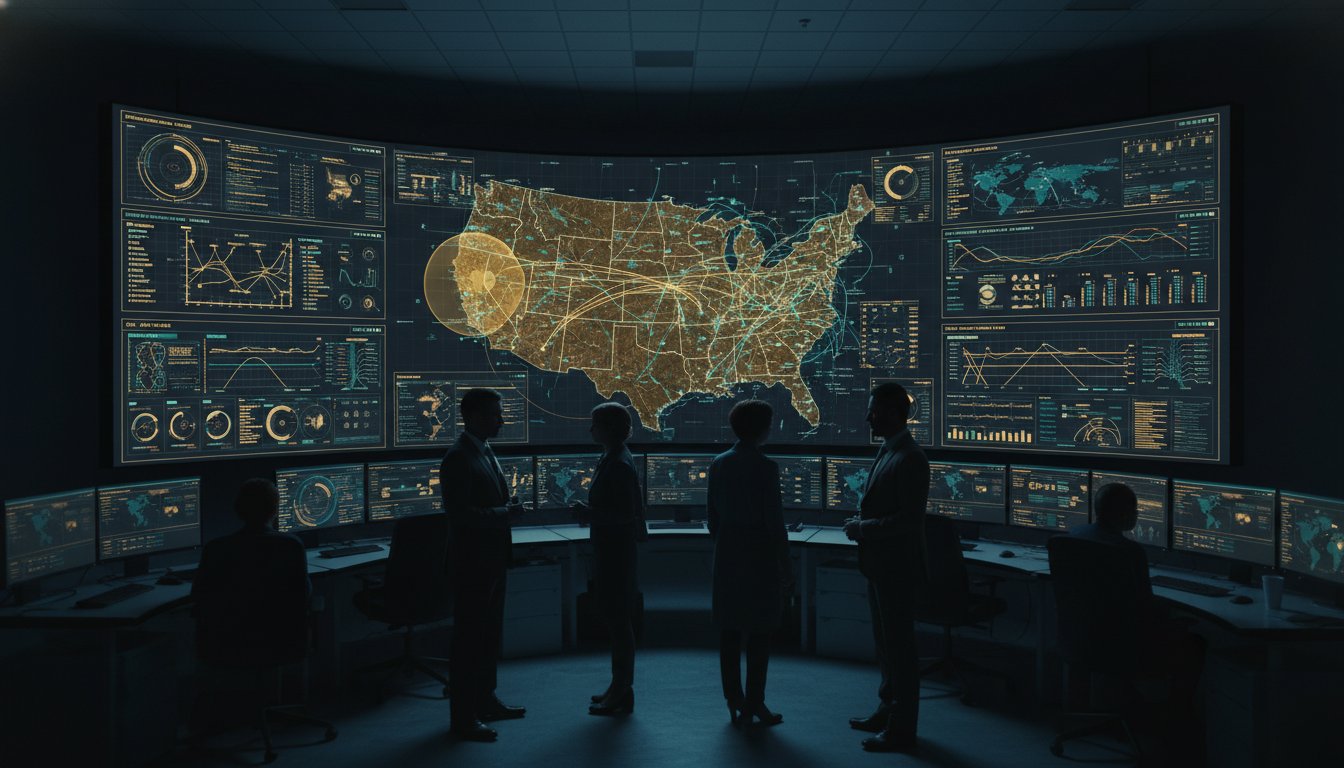
Procuring a TAA compliant video wall controller is often treated as a simple checkbox exercise to satisfy the $183,000 threshold mandated by the March 13, 2026, FAR updates. However, hardware compliance alone doesn’t solve the fragmented data feeds and cybersecurity gaps that compromise modern command centers. You’ve likely seen operators struggle with siloed information while facing the constant threat of procurement rejection or unmanaged vulnerabilities in unmanaged processors.
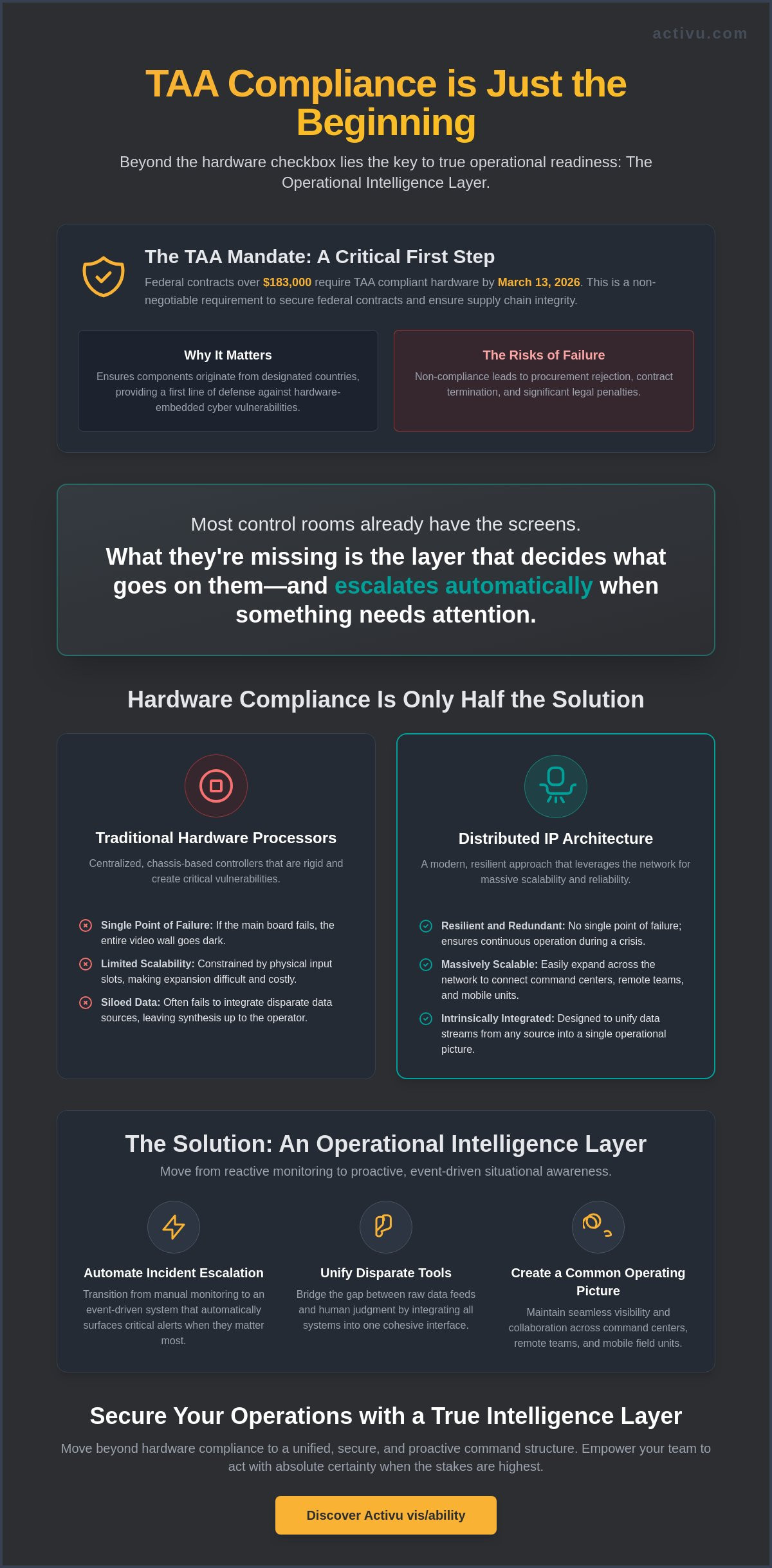
Most control rooms already have the screens. What they’re missing is the layer that decides what goes on them, and escalates automatically when something needs attention. We understand that technical reliability is the bedrock of mission-critical decisions. This article explains how TAA compliance serves as the necessary foundation for a secure, unified operating picture. You’ll learn how to move beyond basic hardware to an operational intelligence layer that automates incident escalation and empowers your team to act with absolute certainty when stakes are at their highest.
Key Takeaways
- Secure federal contract eligibility by identifying the specific requirements for a TAA compliant video wall controller within GSA schedules.
- Discover how to bridge the gap between raw data feeds and human judgment by implementing a dedicated operational intelligence layer.
- Transition from manual monitoring to event-driven situational awareness that automatically surfaces critical alerts when they matter most.
- Protect mission-critical infrastructure by aligning hardware compliance with advanced cybersecurity protocols and platform integration.
- Build a cohesive common operating picture that maintains visibility across command centers, remote teams, and mobile field units.
Navigating Federal Procurement: The Strategic Role of TAA Compliance
Federal procurement is a landscape defined by strict regulatory oversight and high-stakes requirements. For agencies managing a NOC, SOC, or EOC, the choice of a TAA compliant video wall controller is a matter of legal necessity and national security. Procurement officers must ensure that every component in the visualization chain originates from a designated country to maintain the integrity of GSA schedule contracts. Failure to verify these origins can lead to immediate procurement rejection, contract termination, or significant legal penalties.
The Trade Agreements Act of 1979 serves as the primary filter for these acquisitions. It mandates that products meet specific substantial transformation requirements within the United States or other approved nations. This vetted supply chain acts as a critical first line of defense against cyber vulnerabilities often embedded in hardware from non-compliant regions. In modern government operations, the focus has shifted toward event-driven situational awareness, where the reliability of the hardware is the baseline for all subsequent intelligence gathering.
The Legal Framework of the Trade Agreements Act
Compliance with TAA is mandatory for most federal supply contracts exceeding the $183,000 threshold as updated in early 2026. It requires that a product is either manufactured in the U.S. or a designated country, such as those within the WTO Government Procurement Agreement. For systems as complex as a TAA compliant video wall controller, this ensures that core processing units and firmware are not sourced from high-risk territories. This alignment is vital for federal government and defense operations where the supply chain itself is a potential vector for interference. A secure supply chain is the bedrock of operational readiness.
Why Hardware Compliance is Only the Starting Point
Treating TAA as a simple checklist item creates a dangerous sense of false security. While compliant hardware prevents procurement rejection, it doesn’t solve the underlying problem of fragmented data feeds and siloed intelligence. Many organizations find that even with vetted hardware, operators still miss critical incidents because the data remains disconnected across multiple screens and platforms. The cost of operational failure in high-stakes environments is measured in lost time and compromised safety.
Most control rooms already have the screens. What they’re missing is the layer that decides what goes on them, and escalates automatically when something needs attention. Relying on a standalone processor leaves the burden of synthesis on the operator. In a mission-critical environment, that delay between raw data and human judgment is where operational failure occurs. True readiness requires moving beyond hardware to an operational intelligence layer that unifies disparate tools into a single, proactive command structure.
Evaluating TAA Compliant Video Wall Controllers for Mission-Critical Use
Selecting a TAA compliant video wall controller requires looking beyond the sticker on the box. In a federal SOC or NOC, reliability is a binary state. Either the system works during a crisis, or it fails. Traditional hardware processors often rely on a centralized chassis. While these provide high-speed switching, they create a single point of failure. If the main board goes down, the entire wall goes dark. Modern distributed IP architectures offer a more resilient path. They allow for massive scalability across the network, ensuring that data moves freely between command centers and mobile units without the constraints of physical input slots.
Legal compliance is non-negotiable for government contractors. The Federal Acquisition Regulation (FAR) 52.225-5 defines the strict standards for U.S.-made end products and designated countries. Meeting these standards is the entry fee for federal work. However, some vendors provide basic HDMI controllers that carry the TAA label but lack the processing power for 24/7 operations. These tools often fail to handle the density of data required for modern situational awareness. Most control rooms already have the screens. What they’re missing is the layer that decides what goes on them, and escalates automatically when something needs attention.
Hardware Processors vs. Distributed IP Architecture
Traditional chassis-based controllers are often rigid and difficult to upgrade. They create operational silos where data is trapped in a specific room. In contrast, distributed IP solutions turn the network into a flexible matrix. This shift eliminates vendor lock-in and allows for rapid expansion. While technologies like Axon provide critical data for public safety, they only offer a partial solution. Without a unifying platform like vis/ability, that data remains siloed in a single application rather than becoming part of a common operating picture. Learn how to optimize your SOC and NOC environments for maximum uptime.
Performance Metrics for Command and Control
Latency is the enemy of effective decision-making. A high-performance TAA compliant video wall controller must process multiple 4K data streams with zero perceptible delay. This includes everything from real-time geospatial oversight to complex cybersecurity feeds. High-resolution visualization does more than provide clarity; it reduces operator fatigue. When information is presented logically and clearly, teams act with greater certainty. The goal is to turn raw data into actionable intelligence through a structured, high-performance visualization hub.
Beyond the Hardware: The Operational Intelligence Layer
Fragmented data feeds represent one of the most persistent control room situational awareness problems. While a TAA compliant video wall controller ensures your hardware meets federal standards, it does not inherently manage the chaos of competing information streams. Agencies often find themselves with high-end displays that show everything but highlight nothing. This data overload forces operators to manually scan dozen of feeds, which leads to fatigue and delayed response times. Most control rooms already have the screens. What they’re missing is the layer that decides what goes on them, and escalates automatically when something needs attention.
Operational intelligence is the bridge between raw data and human judgment. It transforms a collection of monitors into a unified platform for mission success. Unlike basic connectivity vendors such as SIIG, which focus on the physical plumbing of cables and adapters, a true command solution requires a sophisticated brain to manage the content. By implementing an operational intelligence layer, organizations can ensure that their TAA compliant video wall controller serves as more than just a signal router. It becomes the central hub where geospatial oversight, cybersecurity alerts, and live video converge into a single common operating picture.
Unifying Siloed Data Streams
Modern operations rely on specialized tools that often fail to communicate with one another. For example, platforms like Axon provide indispensable field data for public safety, yet they often remain siloed within their own interfaces. Without a unifying platform like vis/ability, operators must constantly toggle between applications to piece together a complete narrative. This fragmentation is a primary reason why operators miss incidents on the video wall. Adhering to the ergonomic benchmarks in ISO 11064-1:2022 provides the physical framework for success, but the software layer provides the actual clarity needed to act.
Automating Escalation and Response
True situational awareness is event-driven rather than reactive. Instead of waiting for an operator to notice a change on a distant screen, the operational intelligence layer identifies critical triggers in real time. When a specific threshold is met, the system automatically promotes the relevant data to the center of the video wall and alerts the entire team. This automated escalation ensures that critical incidents are never buried under routine monitoring tasks. It extends visibility to mobile users and distributed teams, ensuring that the same intelligence available in the command center reaches decision-makers in the field. This proactive posture is what separates a functioning control room from a high-performance operation.
Security and Reliability in Government Control Rooms
Cybersecurity in a SOC or NOC begins with the hardware supply chain. A TAA compliant video wall controller ensures that the foundation of your visualization system is free from the backdoors and vulnerabilities associated with non-designated countries. This isn’t just about meeting a GSA requirement. It’s about maintaining a defensible cybersecurity posture where every pixel shown on the wall is transmitted through a trusted, verified path. When these controllers are integrated with SIEM and SOAR platforms, they allow for real-time visualization of threat intelligence. This capability reduces the time between detection and mitigation, which is critical during active network intrusions. By hardening the visualization layer, agencies protect the very tools they use to defend the rest of their infrastructure.
Maintaining compliance with NERC CIP standards is a baseline requirement for utility and energy control rooms. A TAA compliant video wall controller integrated into a secure network ensures that visualization assets don’t become a weak point in the security perimeter. This technical reliability provides the calm and clarity needed when stakes are at their highest. It allows operators to focus on the data rather than the stability of the tools they’re using to view it. Secure visualization is the bedrock upon which critical decisions are made during a crisis.
Visualizing the Cybersecurity Common Operating Picture
Creating a unified view of network health requires more than just high-resolution screens. Tools like Axon provide valuable field data, but they only offer a partial solution for a comprehensive security posture. vis/ability acts as the operational intelligence layer that pulls these disparate tools into a single hub. It prioritizes essential information and reduces cognitive overload for SOC analysts. By visualizing threat intelligence in a structured format, teams can identify patterns that would be lost in a sea of raw data. This prioritized approach ensures that the most dangerous threats receive immediate human attention, bridging the gap between digital indicators and human action.
Network Reliability and Mission Continuity
Reliability is paramount in sectors where mission success depends on constant oversight. Most control rooms already have the screens. What they’re missing is the layer that decides what goes on them, and escalates automatically when something needs attention. Using Commercial Off-the-Shelf (COTS) hardware within a managed framework provides the resilience needed for 24/7 operations. This ensures that the video wall remains operational even during severe system stress or hardware failure. Maintaining Operational Continuity is the standard by which all mission-critical systems must be judged. This approach allows agencies to leverage the cost-effectiveness of standard hardware while maintaining the specialized oversight required for government resilience.
Explore how to optimize your SOC for maximum security and operational clarity.
Activu vis/ability: Secure Visualization for Defense and Government
Activu serves as the bedrock for high-stakes operations. While many vendors focus on the mechanical design of display tiles, Activu prioritizes the intelligence that drives them. Organizations in the Federal Government and Defense sectors require more than a standalone hardware box. They need a partner that understands the nuances of government procurement and secure engineering. Activu engineering ensures that every TAA compliant video wall controller meets the rigorous substantial transformation standards required for GSA schedules and mission-critical defense contracts.
Most control rooms already have the screens. What they’re missing is the layer that decides what goes on them, and escalates automatically when something needs attention. This is the core of the vis/ability platform. It functions as the operational intelligence layer, unifying disparate tools into a single, cohesive common operating picture. By integrating professional control room design services with TAA-compliant technology, Activu eliminates the silos that lead to missed incidents and operational delays.
A Proven Record in Mission-Critical Operations
Since 1983, Activu has supported the world’s most demanding command centers. Leading agencies in Public Safety and Utilities choose Activu because the platform empowers their teams to act with absolute certainty. While tools like Axon provide essential field data, they only offer a partial view of the operational landscape. Activu fills this gap by acting as the central hub into which all other tools flow. This approach prioritizes the human element, ensuring that operators aren’t overwhelmed by data but are instead guided by actionable intelligence. Technical reliability is the foundation of every decision made in an Activu-powered environment.
Next Steps for Secure Situational Awareness
Transitioning from a reactive posture to a proactive, event-driven operation begins with a strategic assessment. A control room redesign isn’t just about replacing old hardware with a new TAA compliant video wall controller. It’s about implementing a software layer that manages the complexity of modern data streams. Activu’s experts work with your team to design a visualization environment that scales from the command center to mobile devices. This ensures that your unified operating picture remains consistent across distributed teams. Take the first step toward operational clarity and Contact Activu for a Secure Visualization Assessment to see how the vis/ability platform can transform your mission success.
Advancing Toward Operational Intelligence and Resilience
Securing mission-critical infrastructure requires more than just meeting a procurement threshold. While a TAA compliant video wall controller provides the necessary hardware foundation, true operational readiness depends on how that hardware is managed. Successful command centers move beyond fragmented data feeds by implementing a unifying operational intelligence layer. This transition ensures that your team maintains a clear common operating picture across all distributed environments.
Most control rooms already have the screens. What they’re missing is the layer that decides what goes on them, and escalates automatically when something needs attention. Activu has been the bedrock of high-stakes operations since 1983, providing specialized cybersecurity COP integration for Federal Defense and Public Safety agencies. By aligning vetted hardware with intelligent software, you empower your operators to act with absolute certainty when the stakes are highest.
Take the next step toward a secure and proactive command environment. Request a vis/ability Demo for Your Command Center today. Your mission deserves the clarity and reliability of a resilient visualization platform.
Frequently Asked Questions
What makes a video wall controller TAA compliant?
A video wall controller achieves TAA compliance when it is manufactured or substantially transformed within the United States or a designated country. This transformation must result in a new article of commerce with a distinct name, character, or use. Simply assembling components from non-designated countries like China or Russia does not meet the requirement. Compliance ensures the hardware aligns with the Trade Agreements Act of 1979 and is eligible for federal procurement.
Can I use non-TAA compliant controllers in a government facility?
Federal agencies generally cannot procure non-compliant hardware for supply contracts exceeding the $183,000 threshold established in the March 2026 FAR updates. Using non-compliant equipment in GSA schedule contracts risks immediate procurement rejection and potential legal penalties. While some exceptions exist for small purchases, mission-critical environments require vetted hardware to maintain contract integrity and operational security across the entire command structure.
How does TAA compliance affect cybersecurity in the control room?
TAA compliance acts as a critical filter for cybersecurity by ensuring a vetted and transparent supply chain. By excluding hardware from high-risk regions, agencies reduce the likelihood of embedded backdoors or malicious firmware at the hardware level. This trusted foundation is essential when building a cybersecurity common operating picture. It ensures that the primary visualization tools are not themselves a vulnerability within the secure perimeter of a SOC or NOC.
What is the difference between a TAA compliant processor and a standard COTS controller?
A TAA compliant video wall controller refers specifically to the legal origin of the hardware, while a standard COTS (Commercial Off-the-Shelf) controller refers to its availability as a non-developmental item. Many high-performance systems are both COTS and TAA compliant. The distinction matters because standard COTS hardware without TAA certification cannot be used in most federal procurements, regardless of its technical specifications or processing power.
Does vis/ability work with any TAA compliant video wall hardware?
Yes, vis/ability is designed as a hardware-agnostic operational intelligence layer that integrates with various TAA compliant video wall hardware. It serves as the central hub that unifies different displays and processors into a single operating picture. Most control rooms already have the screens. What they’re missing is the layer that decides what goes on them, and escalates automatically when something needs attention.
Why do operators often miss incidents on compliant video walls?
Operators miss incidents primarily due to cognitive overload and fragmented data feeds rather than hardware failure. Even a compliant video wall can become a wall of noise if it lacks an intelligence layer to prioritize essential information. Without event-driven situational awareness, critical alerts are often buried under routine monitoring tasks. True visibility requires a platform that identifies triggers and surfaces them automatically to the entire team, whether they are in the room or mobile.
How do I verify if a video wall controller is truly TAA compliant?
Verification requires reviewing the manufacturer’s formal TAA certification and checking the product’s status on GSA Advantage or Multiple Award Schedule contracts. Procurement officers should request documentation confirming the location of substantial transformation. It’s also helpful to consult the Federal Acquisition Regulation (FAR) Subpart 25.4 for the most current list of designated countries. Relying on simple marketing labels is often insufficient for high-stakes federal audits and mission-critical installations.