
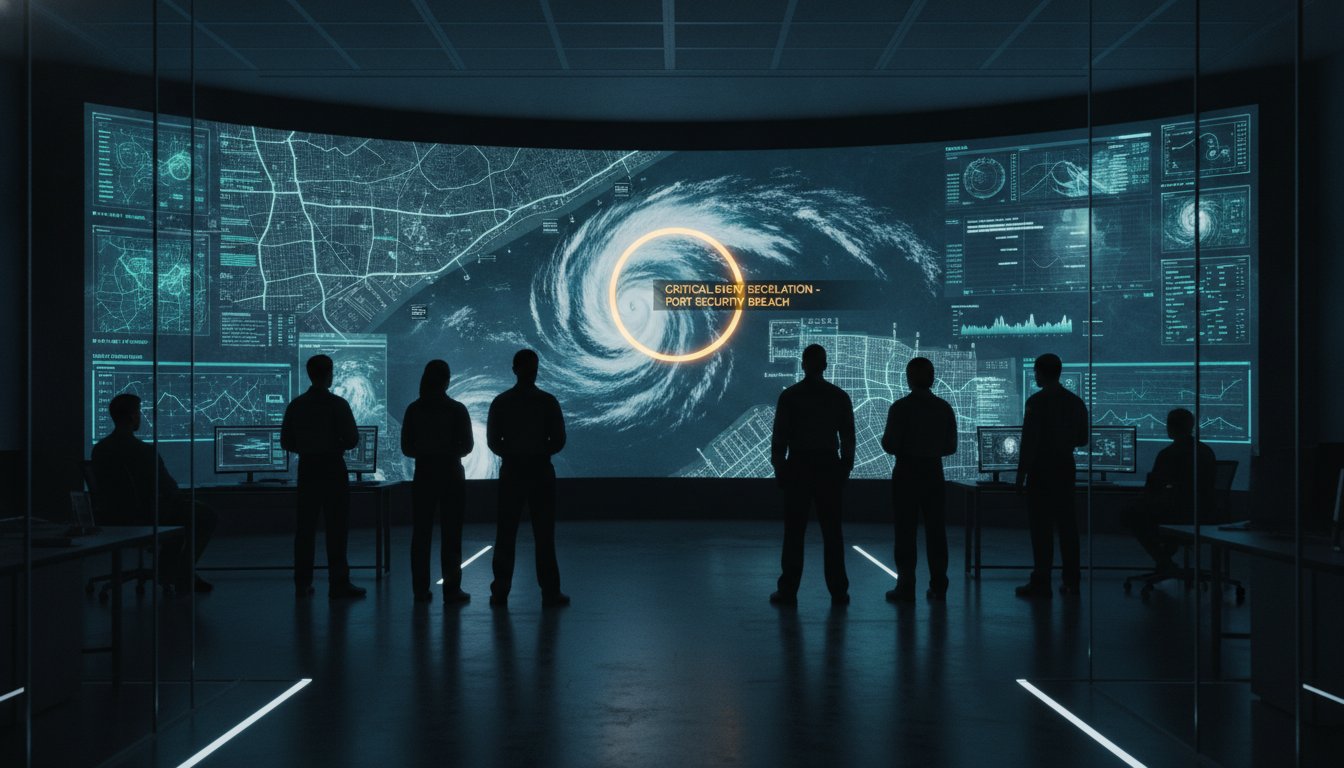
What if the primary obstacle to effective emergency response isn’t a lack of data, but an excess of it? In high-stakes environments, more data often leads to less clarity. You likely manage an array of siloed applications, from GIS feeds to weather modeling, yet your team still struggles to maintain a single version of the truth. When critical incidents occur, the manual effort required to monitor these fragmented streams creates a dangerous lag in response time. It’s frustrating to realize that despite having the latest EOC technology, your operators might still miss the one alert that matters most. Most control rooms already have the screens. What they’re missing is the layer that decides what goes on them, and escalates automatically when something needs attention.
This article explores how to transform your facility into a proactive hub using an operational intelligence layer. You’ll discover how to move beyond partial data tools to achieve a unified common operating picture. We’ll outline a strategy for the coming years that prioritizes automated escalation and seamless collaboration. This approach ensures your team remains focused and analytical when the stakes are at their highest. By the end of this guide, you’ll understand how to turn raw data into a decisive advantage for your entire mission-critical team.
Key Takeaways
- Understand why the transition from static command centers to digital-first data hubs is essential for managing modern geospatial and sensor data.
- Identify the critical distinction between the hardware display layer and the intelligence layer within your EOC technology stack to ensure operational readiness.
- Learn how event-driven situational awareness prevents information overload by automatically escalating critical alerts before they’re missed by human operators.
- Discover a framework for building a unified common operating picture that integrates fragmented tools into a single, actionable interface for remote and mobile teams.
- Move beyond partial solutions to implement an operational intelligence layer that provides clarity and steady reassurance during high-stakes incidents.
The Evolution of EOC Technology: From Static Rooms to Data Hubs
Historically, an Emergency Operations Center (EOC) functioned as a physical bunker designed for radio communication and paper maps. This model focused on physical proximity to coordinate response efforts. Today, the operational environment has fundamentally shifted toward a data-driven reality. The modern center is a digital nexus where geospatial intelligence, real-time sensor data, and infrastructure telemetry converge. This shift requires more than just faster hardware. It demands a sophisticated approach to how information is filtered and presented during a crisis.
Traditional setups often rely on what we call “TV-on-the-wall” configurations. These legacy systems fail because they demand operators scan dozens of static screens to identify anomalies. In a high-pressure environment, this leads to cognitive fatigue and missed incidents. Most control rooms already have the screens. What they’re missing is the layer that decides what goes on them, and escalates automatically when something needs attention. Without this intelligence, a video wall remains a source of distraction rather than a tool for clarity.
Meeting NIMS Standards with Modern Interoperability
FEMA’s National Incident Management System (NIMS) and the Incident Command System (ICS) now emphasize higher levels of data interoperability. Modern EOC technology must facilitate seamless transitions between activation levels. This means moving from steady-state monitoring to full-scale emergency response without losing data integrity. Standardized data formats are the bedrock of multi-agency coordination. Ensuring resilience through redundant, cloud-integrated systems allows the mission to continue even if the physical facility is compromised.
The Rise of the Virtual and Hybrid EOC
Physical proximity is no longer a prerequisite for effective incident management. The rise of hybrid operations means that subject matter experts and decision-makers are often distributed across different locations. The primary challenge in this model is maintaining a single version of the truth. Remote stakeholders require secure, browser-based access to the same intelligence as the command team on-site. Without a unifying platform, information becomes siloed, leading to fragmented responses and delayed action.
While many agencies use standalone video tools, these often function as partial solutions that don’t integrate the full scope of operational data. To achieve true situational awareness, organizations need an operational intelligence layer. The vis/ability platform serves as this central hub, aggregating disparate data sources into a unified interface. It transforms fragmented feeds into a cohesive common operating picture, empowering individuals to act with greater certainty regardless of their physical location.
Core Components of a Modern EOC Technology Stack
Effective incident management relies on a synchronized technology stack. This stack must be more than a collection of independent tools; it must function as a single, integrated ecosystem. While the physical room provides the space, the technology provides the capability. We categorize these components into two distinct layers: the display layer and the intelligence layer. Understanding the interaction between these layers is the key to modernizing your EOC technology to handle the data volumes of the coming years.
The Display Layer: Beyond Simple Video Walls
The display layer is the physical foundation of the command center. In 24/7 mission-critical environments, technical reliability is non-negotiable. High-performance video wall systems must offer bezel-less clarity and ergonomic control room design to minimize operator fatigue during extended activations. These systems are required to integrate a massive variety of inputs, from ultra-high-definition 4K video to legacy VGA feeds from aging infrastructure sensors. However, a video wall without a management system is merely a collection of pixels. It requires a brain to make the visual data actionable for the entire team.
The Intelligence Layer: Introducing vis/ability
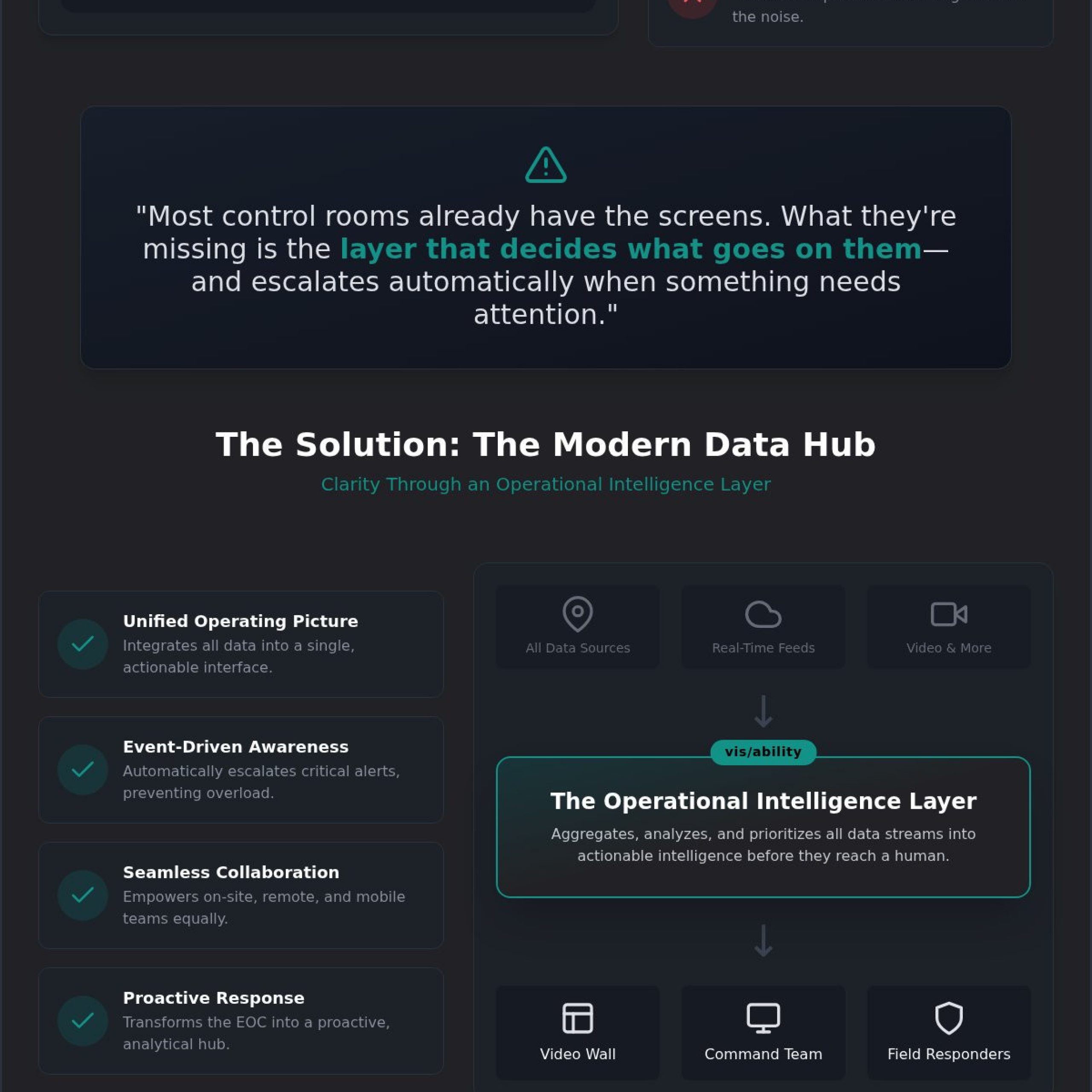
The intelligence layer is where raw data becomes actionable intelligence. Most control rooms already have the screens. What they’re missing is the layer that decides what goes on them, and escalates automatically when something needs attention. The vis/ability platform serves as this operational intelligence layer. It aggregates siloed applications into a unified view, shifting the center from manual wall management to automated, rules-based escalation. This ensures that when a critical event occurs, the right information is pushed to the right screens instantly without human intervention.
This software layer is what enables a true Common Operating Picture (COP). A COP is a single display of relevant information shared by more than one organization. It facilitates collaborative planning and assists all echelons in achieving situational awareness. Some organizations rely on standalone field camera platforms or social media monitoring tools, but these only provide a partial solution. They lack the ability to correlate field video with GIS data or infrastructure status in real-time. A true common operating picture requires a unifying layer to bridge these specific gaps. If you’re looking to optimize your stack, contact our engineering team for a consultation on modernizing your EOC technology.
Solving the Information Overload Crisis in Emergency Operations
Operators in high-stakes environments face a paradox: more information often yields less insight. Monitoring dozens of static screens is a recipe for cognitive failure. The human brain is simply not wired to track multiple moving variables across fragmented displays for hours on end. When a crisis hits, the sheer volume of “noise” from irrelevant feeds can obscure the critical signal, leading to dangerous delays in response. This reactive posture is a primary reason why operators miss incidents on the video wall. Effective EOC technology must solve this by filtering data before it reaches the human eye.
Most control rooms already have the screens. What they’re missing is the layer that decides what goes on them, and escalates automatically when something needs attention. Without this intelligence, the facility remains a collection of monitors rather than a unified command tool.
Why Siloed Data Feeds Fail Incident Commanders
In many centers, data is trapped in separate browser tabs or proprietary software. This “swivel-chair” operation forces incident commanders to mentally stitch together a tactical picture during the most stressful moments of an event. Fragmented systems prevent a holistic understanding of an incident’s trajectory, making it nearly impossible to predict the next phase of a crisis. For instance, in transportation networks or utility grids, a delay in correlating sensor data with field reports can result in catastrophic service interruptions. While some agencies utilize Axon for body-worn camera feeds, it remains a partial solution. It provides a view of the ground but lacks the overarching context provided by integrating diverse data streams into a unified intelligence layer.
Event-Driven Escalation: Filtering the Signal from the Noise
True operational readiness requires moving beyond manual monitoring toward automated oversight. Event-driven situational awareness uses predefined rules to automatically change the video wall layout the moment an incident occurs. If a cybersecurity sensor detects a breach or a CAD alert reaches a specific severity, the system immediately visualizes the relevant data for the entire team. This automation significantly reduces the mental load on dispatchers and EOC staff, allowing them to focus on strategy rather than searching for information. Event-driven visualization serves as the essential bridge between raw data and human judgment. It ensures that the most critical information is prioritized when every second counts. By implementing the vis/ability platform as the operational intelligence layer, organizations transform their existing infrastructure into a proactive hub that empowers decision-makers to act with absolute certainty.
Building a Unified Common Operating Picture (COP)
A Common Operating Picture (COP) is the tactical foundation of any successful response. It requires the seamless integration of GIS mapping, CAD dispatch data, social media monitoring, and real-time IoT sensors into a single, cohesive interface. Without this synthesis, incident commanders are left to manually correlate data during high-velocity events. Standalone tools like Axon provide valuable body-worn camera footage, but they offer only a partial solution. They lack the context of infrastructure sensors or wide-area telemetry. Achieving a true common operating picture requires a platform that bridges these disparate streams.
Most control rooms already have the screens. What they’re missing is the layer that decides what goes on them, and escalates automatically when something needs attention. Implementing EOC technology that is vendor-agnostic is a mission requirement. You shouldn’t be locked into a single ecosystem that limits your ability to integrate new data sources. An effective intelligence layer aggregates these siloed tools, making them useful for the entire team. This includes maintaining a cybersecurity common operating picture alongside physical security monitoring. In an era where physical and digital threats often overlap, having a unified view of both domains is essential for total operational readiness.
Integrating Third-Party Platforms and Sensors
Modern centers must ingest diverse telemetry, from real-time weather patterns to traffic flow sensors. Standalone data tools often provide deep insights but fail to communicate with the rest of the stack. A unifying intelligence layer solves this by acting as the central nervous system for your operation. It ensures that when a sensor detects a flood or a fire, the relevant GIS layers and camera feeds are instantly prioritized. This automated synchronization moves the center from a reactive state to a position of proactive control.
Extending the COP to Field and Mobile Units
Visibility cannot stop at the walls of the command center. Effective incident management requires that field units see exactly what the EOC sees. Through mobile vis/ability, ground teams receive the visual ground truth directly on their tablets or smartphones. This capability significantly reduces radio traffic, as teams no longer need to describe what they are seeing or ask for verbal updates. For sensitive federal government operations, these streams remain encrypted and secure, ensuring that intelligence is shared only with authorized personnel. If your organization needs to synchronize distributed teams, learn more about our operational intelligence layer.
Implementing the Operational Intelligence Layer with Activu
Modernizing your command center is a strategic imperative. Fragmented systems and manual monitoring are no longer sufficient for the complexities of modern incident management. By adopting an operational intelligence layer, you move beyond the limitations of traditional EOC technology. Activu Corporation’s vis/ability platform serves as the logical conclusion of this evolution, transforming your environment into a proactive hub. Most control rooms already have the screens. What they’re missing is the layer that decides what goes on them, and escalates automatically when something needs attention.
Successful activation requires more than software alone. It requires a physical environment optimized for high-stakes decision-making. Professional control room design services ensure that your hardware and software work in perfect synchronization. This holistic approach addresses ergonomics, lighting, and signal routing to support long-term operational success. While partial solutions like Axon provide ground-level video, they lack the capacity to unify your entire technical stack. Activu Corporation fills this gap by acting as the central engine that makes every other tool more effective.
The vis/ability Advantage: Purpose-Built for Mission-Critical
The platform excels by automating the prioritization of essential information. When an incident occurs, vis/ability escalates the relevant data feeds to the appropriate screens without operator intervention. This reduces cognitive load and empowers individuals to act with greater certainty, knowing they have the visual ground truth at the moment of decision. Activu Corporation has a proven history of supporting these high-stakes environments, particularly within the utilities and energy sectors, where technical reliability is the bedrock of public safety. The software ensures that critical alerts aren’t buried in a sea of irrelevant data, providing calm and clarity when it’s needed most.
Next Steps: From Planning to Activation
The transition to a unified operation begins with a thorough gap analysis of your current EOC technology. Identifying where data silos exist and where manual processes create delays is the first step toward modernization. Professional engineering plays a vital role here, ensuring that new integrations optimize situational awareness rather than adding to the noise. Moving from reactive screen watching to proactive operational intelligence is a methodical process that yields immediate results in safety and efficiency. If you’re ready to see how this intelligence layer can transform your command center, contact us today for a tailored demonstration of the vis/ability platform.
Securing Operational Readiness for the Next Generation of Response
The transition from a static emergency center to a proactive data hub requires a fundamental shift in how you process information. We’ve explored how an operational intelligence layer transforms fragmented data into a unified, actionable common operating picture. By prioritizing event-driven automation, your team can move away from reactive monitoring and toward decisive, high-certainty action. Most control rooms already have the screens. What they’re missing is the layer that decides what goes on them, and escalates automatically when something needs attention.
Modern EOC technology must empower every stakeholder, whether they’re in the command center or the field. Activu’s vis/ability platform serves as this critical bridge. It’s utilized by top-tier public safety and federal agencies to eliminate monitoring gaps and ensure vital intelligence is always visible. You can achieve total operational readiness through seamless mobile collaboration and intelligent data integration. This approach turns raw data into a decisive advantage when stakes are highest.
Take the next step in evolving your facility into a proactive hub. Request a Demo of the vis/ability Operational Intelligence Layer to see how we provide clarity amidst complexity. Your mission deserves a reliable foundation.
Frequently Asked Questions
What is the most important technology for an Emergency Operations Center?
The operational intelligence layer is the most critical component of a modern center. While hardware provides the physical canvas, software determines the speed and accuracy of your response. Most control rooms already have the screens. What they’re missing is the layer that decides what goes on them, and escalates automatically when something needs attention. This intelligence ensures that your EOC technology acts as a proactive tool rather than just a passive display.
How does EOC technology improve situational awareness during a crisis?
Modern platforms improve situational awareness by aggregating fragmented data into a unified interface. Instead of searching through separate browser tabs, operators see a consolidated view of CAD, GIS, and sensor feeds. This synthesis allows for a faster understanding of an incident’s trajectory. It removes the guesswork from high-stakes environments, ensuring that every stakeholder acts based on the same verified ground truth during a crisis.
Can modern EOC software integrate with our existing legacy CAD and GIS systems?
Yes, effective platforms are designed to be vendor-agnostic to ensure seamless integration with legacy systems. The vis/ability platform acts as a central hub that ingests data from your existing CAD, GIS, and IoT sensors. It doesn’t replace your current tools; it makes them more useful by unifying their outputs. This approach prevents vendor lock-in and allows agencies to modernize their EOC technology without discarding prior infrastructure investments.
What is the difference between a video wall and a common operating picture (COP)?
A video wall is the physical display hardware, while a Common Operating Picture (COP) is the unified tactical reality shown on those screens. The video wall serves as the canvas, but the COP is the result of intelligent data integration. Tools like Axon provide a partial view of the ground, but a true COP requires a software layer to synchronize that footage with broader operational data for the entire team.
How do we prevent operator fatigue and information overload in the EOC?
Automated escalation is the primary defense against operator fatigue and information overload. By setting rules-based triggers, the system only visualizes data when it reaches a specific threshold of importance. Operators no longer need to manually monitor dozens of static screens for hours. This focus reduces cognitive load, allowing the command team to remain analytical and decisive when the stakes are at their highest.
Is it possible to share the EOC video wall feed with remote or mobile users?
Extending the command center’s view to remote stakeholders is entirely possible through secure, browser-based platforms. Mobile vis/ability ensures that field units see exactly what the EOC sees on their tablets or smartphones. This synchronization reduces radio traffic and eliminates the need for verbal descriptions of visual data. It creates a seamless collaboration environment where the ground truth is shared instantly across all activated locations and devices.
What are the cybersecurity requirements for modern EOC technology?
Modern systems must prioritize encrypted data streams and secure access protocols to protect sensitive operations. Cybersecurity requirements include maintaining a common operating picture of the network itself alongside physical threats. This dual oversight ensures that the data hub remains resilient against breaches. For federal and public safety agencies, these protections are foundational, ensuring that critical intelligence is only accessible to authorized personnel during an active incident.
How does event-driven visualization differ from traditional monitoring?
Traditional monitoring is a reactive process that relies on human operators to spot anomalies across multiple displays. Event-driven visualization is proactive; it uses predefined triggers to change the video wall layout automatically when an incident occurs. This shift ensures that the most relevant information is prioritized instantly. It removes the lag between an event’s start and the team’s awareness, providing the clarity needed for a rapid, coordinated response.