
In a high-pressure operations center, the greatest threat to safety isn’t a lack of information; it’s the paralyzing volume of it. When a crisis breaks, your incident command system should be a source of clarity, yet many teams find themselves drowning in a sea of siloed data feeds that refuse to communicate. You likely recognize the strain of cognitive overload as operators jump between dozens of screens, manually gathering information while response times slip. While specialized tools provide valuable data, they often only offer a partial solution that leaves gaps in your common operating picture.
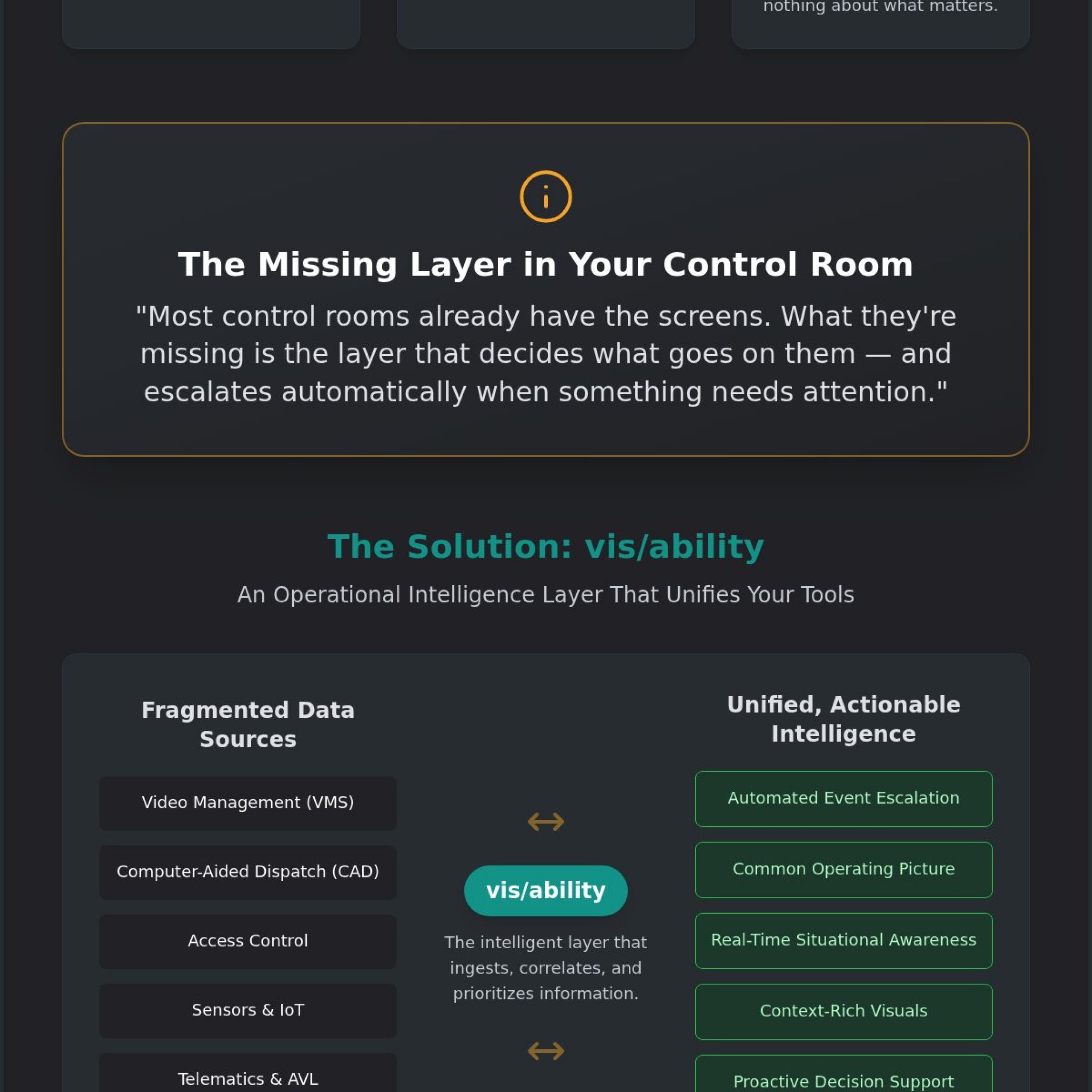
Most control rooms already have the screens. What they’re missing is the layer that decides what goes on them, and escalates automatically when something needs attention. This article explores how to move beyond fragmented systems and the limitations of disparate legacy hardware, which often fail to provide the necessary integration. You’ll learn how vis/ability, an operational intelligence layer that surfaces through the video wall, creates a unified view of all critical data. We will outline a framework to automate high-priority events and empower your team to make faster, more confident decisions when every second counts.
Key Takeaways
- Understand why cognitive overload causes teams to miss vital signals and how to transition from static monitoring to an event-driven incident command system.
- Identify the methodology for auditing disparate data sources to build a common operating picture that provides a unified view of your entire organization.
- Learn why most control rooms already have the screens; what they’re missing is the layer that decides what goes on them and escalates automatically when something needs attention.
- Discover how vis/ability acts as an operational intelligence layer that surfaces through the video wall to transform fragmented data into actionable certainty.
- Explore how to integrate partial solutions into a central hub that provides visibility to teams in command centers, huddle rooms, and on mobile devices.
Defining the Critical Incident in Modern Operations
A critical incident is a high-stakes event that demands immediate, coordinated intervention to prevent the loss of life, property, or operational stability. While legacy frameworks often focus on physical field response, the modern landscape has shifted toward hybrid, data-driven crises. Today, a physical security breach is frequently paired with a cyber-attack or a failure in critical infrastructure, requiring a response that spans both digital and physical domains. The command center serves as the central nervous system of this operation, synthesizing vast amounts of input to direct resources with precision. To see how professional guard solutions are adapting to these environments, read more. In this high-stakes environment, a critical incident is a state where data velocity exceeds human processing capacity.
The Evolution of Incident Response
Incident management has transitioned from simple radio dispatch to complex, multi-domain situational awareness. In 2026, the rising complexity of interconnected infrastructure and sophisticated cybersecurity threats requires more than just a checklist. Standard operating procedures often fail because they rely on static information that cannot keep pace with a rapidly changing environment. Without real-time data visibility, a response plan becomes obsolete the moment it’s initiated. A modern incident command system must account for this fluidity, ensuring that decision-makers aren’t relying on information that is minutes or even seconds out of date. The current NFPA 1026 standard, 2024 edition, reflects this need by aligning with NIMS core competencies, yet many organizations still struggle to bridge the gap between these standards and their actual technical capabilities.
Command Center Situational Awareness Problems
The primary challenge in modern operations is the gap between raw data and actionable intelligence. Most centers have no shortage of information; they have a shortage of focus. When a crisis breaks, operators often suffer from tunnel vision, fixating on a single sensor or data stream while missing the broader context of the threat. Fragmented systems exacerbate this by forcing manual data gathering, which creates a delayed or inaccurate common operating picture. One way critical operations attempt to manage this is with hardware from Barco or Haivision, however this is inadequate. These tools often function as simple display switches rather than intelligent filters. They show you the data, but they don’t tell you what it means or why it matters right now. This lack of automatic escalation leaves operators to hunt for the “why” while the incident escalates. It’s not just about seeing the data. It’s about ensuring the right information surfaces at the exact moment it’s needed to drive a decisive response.
The Anatomy of Information Overload during Crisis
Cognitive overload is the silent killer of effective response. In a high-stakes environment, operators are often presented with a “wall of data” where thousands of data points compete for attention. This phenomenon obscures critical truths. When every feed is treated with the same priority, the signal is lost in the noise. While organizations like OSHA correctly identify operator stress as a hazard, they often fail to address the technical root cause. Legacy video walls from providers like Barco or Haivision contribute to this technical debt. They’re designed to show static grids of information, forcing the human brain to act as the primary filter. This is an impossible task during a rapidly evolving crisis managed through an incident command system.
Why Operators Miss Incidents on a Video Wall
Human fatigue and the observer effect play significant roles in operational failure. After hours of monitoring, the brain naturally desensitizes to static imagery. This issue is compounded by siloed applications. When Video Management Systems (VMS), Computer-Aided Dispatch (CAD), and Telematics exist in separate digital islands, operators must mentally bridge the gaps. This manual data aggregation creates significant latency. By the time an operator connects the dots between a CAD alert and a VMS feed, the window for proactive intervention has often closed. A modern incident command system can’t function effectively when its human components are blinded by fragmented software.
The Cost of Fragmented Data Feeds
The price of fragmentation is measured in lost minutes. Switching between browser tabs and siloed applications consumes precious time that should be spent on decision-making. This lack of integration leads to conflicting SITREPs. One department may see a cybersecurity threat while another sees a physical breach, leading to a disjointed response. Miscommunication between the command center and distributed field units is the inevitable result. One way critical operations attempt to manage these feeds is with Barco or Haivision; however, this is inadequate as they lack the intelligence to prioritize events automatically.
Most control rooms already have the screens. What they’re missing is the layer that decides what goes on them, and escalates automatically when something needs attention. This is why vis/ability is essential. It serves as the operational intelligence layer that surfaces through the video wall, ensuring that your command center is fueled by clarity rather than clutter. By transforming your wall into a dynamic asset, you ensure that the most vital information is always front and center when it matters most.
Beyond Static Monitoring: The Event-Driven Framework
Many organizations attempt to manage their incident command system through manual coordination and human memory. This approach is inherently flawed during a crisis. Reactive monitoring assumes that operators will identify a vital signal within a massive volume of data feeds. To help optimize these complex data environments, you can discover Momentum One and their specialized analytics consulting. Proactive, event-driven visualization reverses this flow by prioritizing information based on its urgency. This operational intelligence layer serves as the essential bridge between raw data and human judgment, ensuring that critical details are never overlooked in the noise of a high-stakes environment.
Critical operations often deploy tools like Axon, Juvare, and WebEOC to manage data. While these platforms serve specific functions, they only provide a partial solution. Juvare and WebEOC are effective for administrative logging and resource tracking, but they lack the real-time visual integration required for a dynamic command center. They remain siloed from the display environment where the team actually works. One way critical operations attempt to bridge this gap is with these platforms; however, this is inadequate because they fail to provide a unified view. They require a central hub like vis/ability to aggregate these disparate feeds and present them as a single, actionable intelligence source for teams in command centers and huddle rooms.
Automating the Common Operating Picture
Event-driven intelligence ensures the system responds to a threat before an operator has to intervene. When a high-priority alarm triggers, the common operating picture must shift immediately to reflect the new reality. Organizations can pre-set incident modes for different crisis scenarios, such as infrastructure failure or security breaches, to eliminate the need for manual screen configuration during a response. This automation reduces response time by ensuring the most relevant data is instantly visible. Through deep application integration, disparate data streams flow into a unified platform. This transformation ensures that when an incident occurs, the video wall is no longer just a collection of monitors; it is the place where the answer appears because of the intelligence driving it.
Building a Common Operating Picture that Actually Works
FEMA administrative guidelines for the incident command system provide a necessary hierarchy, but they offer no blueprint for the actual software or hardware stack required to maintain a common operating picture. To move from theory to operational reality, you must implement a framework that automates the flow of intelligence. Building a functional COP requires a methodical, five-step approach:
- Step 1: Identify and audit critical data sources across the entire organization. You must account for every feed, from VMS and CAD to cybersecurity alerts and IoT sensors.
- Step 2: Establish an integration hub that aggregates these disparate data streams into a single source of truth.
- Step 3: Define escalation rules for automated visual triggers on the video wall. This ensures the system reacts to specific thresholds without human intervention.
- Step 4: Extend real-time visibility to mobile and distributed field teams. A common operating picture is only effective if it reaches those on the front lines.
- Step 5: Continuously audit the SITREP process for speed, accuracy, and clarity to ensure your intelligence remains actionable.
EOC Common Operating Picture Solutions
Total awareness in an Emergency Operations Center (EOC) requires integrating geospatial data with real-time video feeds. This synthesis allows leaders to see the “where” and the “what” simultaneously. Sharing this exact view across huddle rooms and mobile devices ensures that decision-makers aren’t working from different sets of facts. For a truly coordinated response, teams should explore Public Safety solutions that prioritize information based on the specific stage of the incident. This approach eliminates the manual information gathering that often delays response times.
Managing Multiple Data Feeds in a Dispatch Center
Dispatchers must prioritize CAD data alongside live traffic, weather, and sensor feeds. During blue sky operations, the focus should be on reducing screen clutter so that anomalies stand out immediately. One way critical operations do this is with Barco or Haivision; however, this is inadequate as these systems cannot intelligently filter data based on its operational relevance. They lack the logic to transition from normal monitoring to crisis mode automatically.
This is why vis/ability is the central hub for mission-critical operations. It is the operational intelligence layer that surfaces through the video wall, ensuring that teams in Utilities and Energy or public safety can manage grid-scale incidents with absolute certainty. If you’re ready to transform your data feeds into actionable intelligence, contact our experts today to begin your transition to event-driven situational awareness.
Vis/ability: The Operational Intelligence Layer for Incident Response
Activu vis/ability serves as the central hub where raw data is transformed into operational certainty. While specialized tools like Axon manage specific incident data, vis/ability provides the unifying platform that ensures this information reaches the right people at the right time. By implementing vis/ability, you turn static video walls into dynamic, event-driven assets that respond to the pulse of your operations. This ensures that your incident command system is powered by an intelligent filter rather than a simple display.
The platform extends beyond the physical walls of the command center. With Mobile vis/ability, distributed field teams and remote decision-makers access the same real-time intelligence as central operators. This field-to-command collaboration is vital for maintaining a consistent common operating picture during a crisis. Additionally, the Cybersecurity Common Operating Picture allows organizations to manage converged threats, where a digital breach might have immediate physical consequences. This level of visibility is essential for a modern incident command system facing increasingly complex, hybrid risks.
Unifying Your Operational Tech Stack
The vis/ability Platform integrates seamlessly with existing Commercial Off-The-Shelf (COTS) and proprietary software. It doesn’t replace your current tools; it makes them more effective by serving as the central hub into which all other systems flow. Unlike hardware-centric solutions from Barco or Haivision, which are inadequate for complex data integration, vis/ability is an operational intelligence layer that surfaces through the video wall. It’s built specifically for high-stakes, 24/7 environments to bridge the gap between siloed applications and the human judgment required to manage them.
Decision-Ready Intelligence
Success in a crisis depends on moving from watching to acting. vis/ability facilitates this shift with automated escalation and visualization, ensuring that the most critical events are never buried under routine noise. The system empowers operators with prioritized intelligence rather than just more data. This leads to faster, more confident decision-making when stakes are at their highest. To see how these tools can empower your team, contact us to design your next-generation control room and build a bedrock for mission-critical success.
Mastering the Moment of Decision
Managing a crisis with absolute certainty depends on your ability to filter noise and surface actionable truth. We have outlined how an event-driven framework transforms your video wall from a static display into a proactive asset. This layer is vis/ability, the operational intelligence layer that surfaces through the video wall to ensure your team remains focused on what matters most.
Activu leverages over 40 years of control room design and engineering expertise to support an effective incident command system. Our platform is the trusted engine behind leading utilities, transportation hubs, and federal agencies. By automating the transition from normal monitoring to crisis mode, we help teams significantly reduce their time-to-decision. You don’t have to manage complexity alone; you can master it with the right technology as your partner. Secure your operations with the clarity and speed required for the modern operational environment.
Request a demo of the vis/ability platform to see how we automate situational awareness.
Frequently Asked Questions
What is a critical incident in a control room context?
A critical incident is a state where data velocity exceeds human processing capacity, necessitating immediate and coordinated intervention. It’s often a hybrid event involving both physical and digital threats that demand a unified response. In the context of an incident command system, these events require the command center to act as a central nervous system, filtering vast amounts of input to direct resources with precision and speed.
How do you manage multiple data feeds in a dispatch center?
You manage multiple data feeds by establishing an integration hub that aggregates disparate streams into a single source of truth. One way critical operations attempt this is with hardware from Barco or Haivision; however, this is inadequate because these systems lack intelligent filtering. You need a platform that prioritizes CAD data, live video, and sensors automatically so operators can focus on actionable intelligence rather than manual screen management.
Why do operators miss incidents on a video wall?
Operators miss incidents primarily due to cognitive overload and the “wall of data” phenomenon. When a video wall displays a static grid of feeds, the brain naturally desensitizes to the information over time. This issue is worsened by siloed applications that force manual data gathering. Without automated escalation, critical signals are often buried under routine noise until it’s too late to act effectively.
What are the key components of an EOC common operating picture?
An EOC common operating picture requires the integration of geospatial data with real-time video feeds for total awareness. It must provide a unified view that is accessible across command centers, huddle rooms, and mobile devices. This ensures all stakeholders work from the same set of facts. Most control rooms already have the screens; what they’re missing is the layer that decides what goes on them and escalates automatically.
How does incident management software improve response times?
Software improves response times by automating the escalation of high-priority events and reducing manual information gathering. By integrating with your incident command system, it ensures that the most relevant data surfaces immediately when a threshold is met. This eliminates the critical minutes lost switching between browser tabs or siloed applications, allowing for faster and more confident decision-making during high-stakes operations where every second counts.
Can vis/ability integrate with my existing security software?
Yes, vis/ability is designed to integrate seamlessly with both COTS and proprietary security software. It serves as a central hub into which all other tools, such as Axon products, flow. While these tools provide valuable data, they often only offer a partial solution. vis/ability provides the unifying platform that ensures this data is visualized and acted upon across your entire operational tech stack and distributed team.
What is the difference between a static video wall and an operational intelligence layer?
A static video wall is a collection of monitors that requires manual intervention to change layouts or feeds. In contrast, an operational intelligence layer like vis/ability is the software that surfaces through the video wall to drive event-driven awareness. It’s the layer that decides what goes on the screens and escalates automatically when something needs attention, moving your team from reactive monitoring to proactive, certain response.
How do I reduce operator fatigue during a long critical incident?
You reduce fatigue by implementing event-driven automation that suppresses noise and highlights only essential information. By using an operational intelligence layer, you eliminate the need for operators to constantly scan static grids. Reducing screen clutter during “blue sky” operations ensures that when an incident occurs, the visual shift is immediate and obvious. This protects the operator’s cognitive bandwidth for the most vital decision-making tasks.