
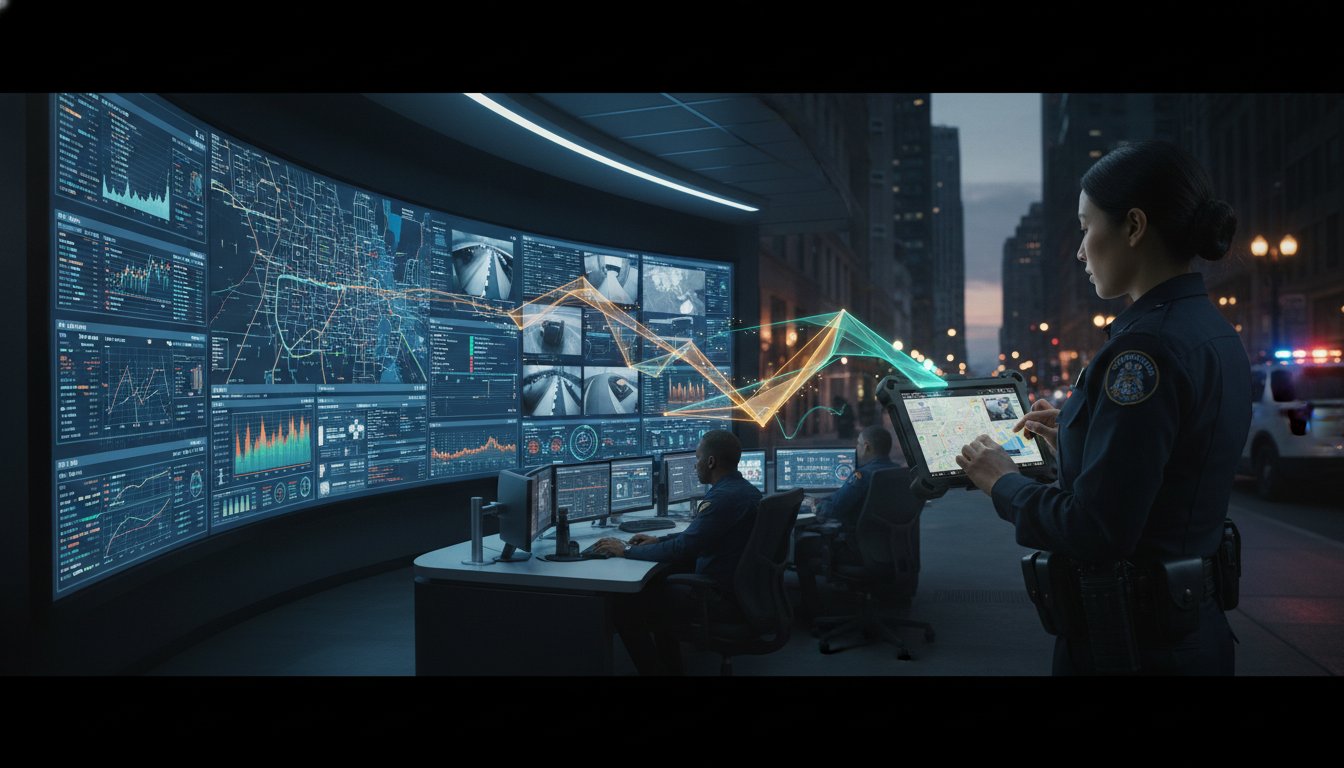
Having eyes on every sensor across your jurisdiction means very little if the agent standing on the street corner remains blind to the evolving threat. You likely manage a sophisticated array of cameras, yet vital visual data often remains trapped within the command center. When field teams rely on verbal descriptions or delayed screenshots, response times lag and security risks escalate. Fragmented data sources and high latency create a dangerous disconnect between those monitoring an incident and those tasked with resolving it. Effective control room to mobile video sharing isn’t a luxury; it’s a requirement for operational readiness.
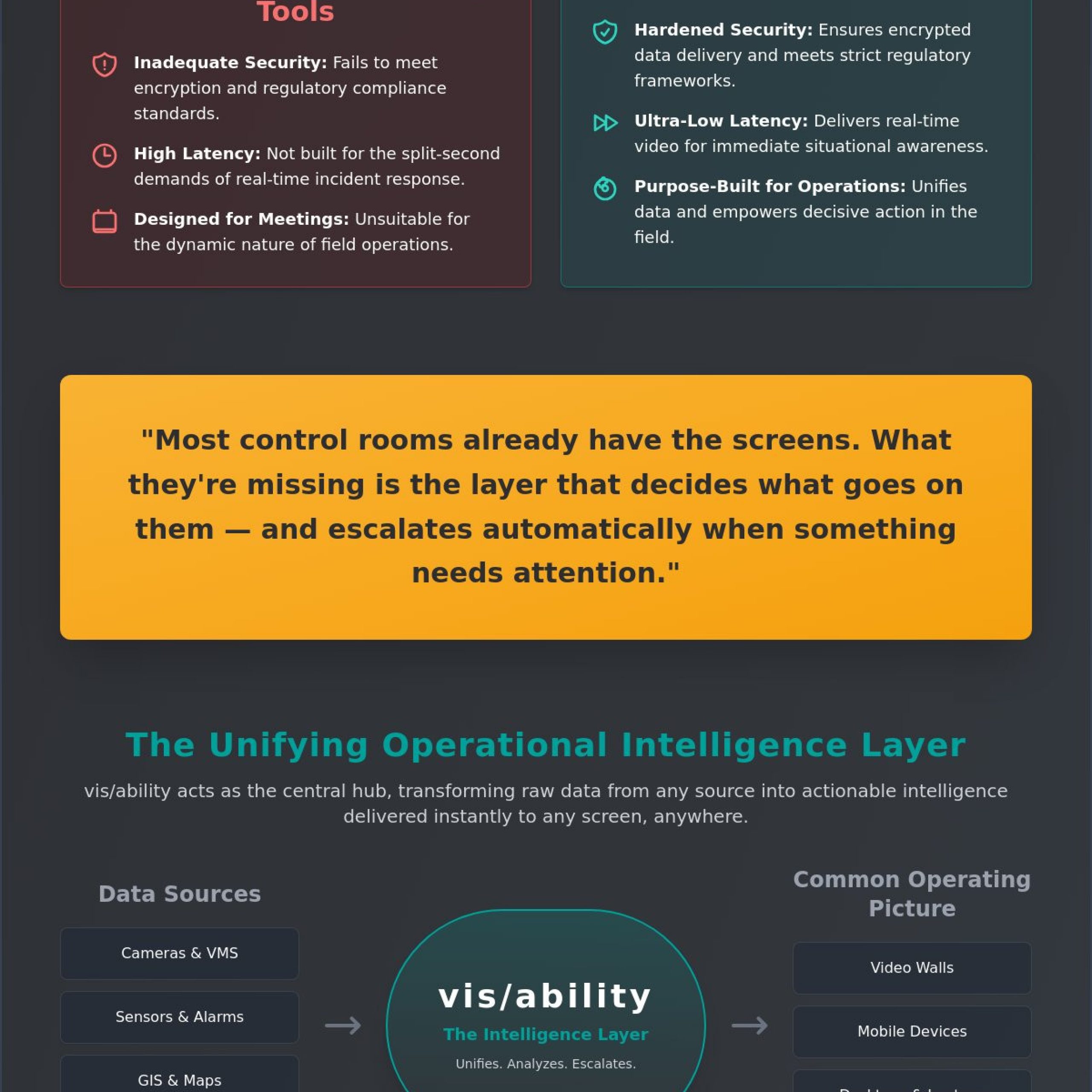
Most control rooms already have the screens. What they’re missing is the layer that decides what goes on them, and it escalates automatically when something needs attention. You’ll learn how to bridge the gap between your command center and distributed teams by transforming raw video into actionable mobile intelligence. We will explore how vis/ability functions as a unified operational intelligence layer, acting as the central hub that creates a common operating picture and empowers every agent to act with absolute certainty.
Key Takeaways
- Identify the operational risks of verbal-only communication and learn how to bridge the gap between centralized command and distributed field units.
- Understand why consumer-grade sharing tools fail mission-critical security standards and how dedicated control room to mobile video sharing ensures low-latency, encrypted data delivery.
- Discover the transition from manual screen mirroring to event-driven awareness, where automated escalation ensures the right intelligence reaches the right person at the right time.
- Explore cross-functional applications that provide field technicians and public safety officers with real-time visual overlays and integrated data feeds.
- Learn how to position vis/ability as your operational intelligence layer to unify existing hardware and software into a single, cohesive common operating picture.
The Operational Gap: Why Control Room Intelligence Often Stops at the Walls
The modern command center often functions as a high-tech island. Operators sit surrounded by massive video walls, monitoring live feeds, sensor data, and geospatial overlays. They possess a comprehensive view of the operational environment. However, this intelligence frequently stops at the physical walls of the room. When a critical incident occurs, the personnel responsible for resolving it in the field are often the ones with the least amount of visual information. This disconnect creates a significant operational gap that compromises safety and slows down response times.
Relying on verbal descriptions to convey complex visual data is inherently flawed. It introduces the “broken telephone” effect, where critical details are lost or misinterpreted during transmission. In high-stakes environments like a SOC or GSOC, a few seconds of confusion can lead to catastrophic outcomes. Operators often miss incidents because field data remains siloed in disparate systems that don’t communicate with the central display. Without a cohesive strategy for control room to mobile video sharing, the command center remains a spectator rather than a director of field operations.
The Risk of Fragmented Situational Awareness
Data silos are the primary enemy of effective situational awareness. When information is trapped in separate applications, it’s impossible to build a unified common operating picture. Field units often resort to using consumer-grade messaging apps to share photos or video clips. This practice introduces massive security risks and fails to meet mission-critical standards for data integrity and latency. Standard office collaboration tools are designed for scheduled meetings; they aren’t built for the split-second demands of emergency response. Transitioning from reactive monitoring to proactive field empowerment requires a fundamental shift in how data moves. You must be able to distribute vision instantly to ensure field agents don’t make life-altering decisions based on second-hand information.
The Limitations of Static Video Walls
Traditional video wall systems focus on the “big picture” within the room. While these displays are impressive, they are often passive and static. Most control rooms already have the screens. What they’re missing is the layer that decides what goes on them, and escalates automatically when something needs attention. A video wall that cannot extend its reach to a mobile device is simply an expensive piece of furniture during a crisis. Managing multiple data feeds in a high-pressure environment is an immense cognitive load for any operator. When an incident escalates, the manual process of identifying the right feed and trying to describe it over a radio is too slow. True operational readiness depends on the ability to push filtered intelligence from the operational intelligence layer directly to the palm of a field agent’s hand.
Why Consumer Video Sharing Tools Fail Mission-Critical Standards
General office collaboration tools are designed for the boardroom, not the front line. While standard screen sharing might suffice for a weekly status meeting, it lacks the technical rigor required for high-stakes environments. Organizations that attempt to use consumer-grade software for control room to mobile video sharing often discover these tools cannot handle the data complexity or the security demands of a mission-critical operation. When an incident escalates, the gap between a “utility” and a “hardened platform” becomes a liability that compromises safety.
Security and Regulatory Compliance
Maintaining data integrity across public and private networks is a non-negotiable requirement for critical infrastructure. Standard enterprise software often fails to provide the end-to-end encryption and administrative oversight necessary to meet federal and industrial standards. The energy and transportation sectors operate under strict regulatory frameworks like NERC CIP, which demand absolute control over who views sensitive feeds. Unlike office apps that offer “all or nothing” sharing, a professional operational intelligence layer provides granular permission controls. This ensures that sensitive visual data is only accessible to authorized personnel, protecting the organization from both external threats and internal compliance failures.
Technical Reliability Under Pressure
In a crisis, time is the most valuable resource. A five-second delay in a video feed is not merely a nuisance; it is a catastrophic failure in an emergency response scenario. Operators and field agents require low-latency streaming to make split-second decisions with confidence. Consumer tools often struggle with bandwidth management, potentially crashing field mobile networks when high-resolution feeds are pushed to multiple devices simultaneously. Reliable control room to mobile video sharing must be scalable and resilient, capable of supporting an entire task force without degrading performance.
The nationwide public safety broadband network provides a robust foundation for communication, but the software layer must be equally capable. Professional platforms prioritize essential information, ensuring that even when field conditions are less than optimal, the most critical data reaches the agent. Most control rooms already have the screens. What they’re missing is the layer that decides what goes on them and escalates automatically when something needs attention. You can explore how to secure your operations by reviewing our operational intelligence layer capabilities to see how we bridge these technical gaps.
Beyond Screen Mirroring: The Role of Automated Escalation and Context
Effective control room to mobile video sharing requires more than a simple mirror of the operator’s display. In high-pressure environments, manual sharing methods are insufficient. These legacy approaches ignore the reality of operator fatigue and the sheer volume of data processed in a modern command center. True operational readiness depends on a shift from reactive, manual “pushing” of feeds to proactive, event-driven situational awareness. Without this shift, field agents remain vulnerable to information gaps that occur during the most critical moments of an incident.
Most control rooms already have the screens. What they’re missing is the layer that decides what goes on them, and escalates automatically when something needs attention. This intelligence layer acts as a vital filter, ensuring field agents receive only the most relevant visual data. By integrating metadata and data overlays directly onto mobile feeds, teams gain instant context that a raw video stream cannot provide on its own. This technical bridge ensures that the person on the ground understands not just what they are seeing, but why it matters to the mission at hand.
The Operational Intelligence Layer
We define vis/ability as the central hub into which all other operational tools flow. It is the operational intelligence layer that unifies the command center, huddle rooms, and mobile devices into a single, cohesive ecosystem. Automation within this layer reduces the cognitive load on operators, preventing the siloed data gaps that lead to missed incidents. This platform makes your existing tools more useful for the entire team, providing a unified operating picture that spans from the massive video wall to the agent’s smartphone. It ensures that critical intelligence is never confined to a single physical location.
Escalation and Event-Driven Responses
The transition to event-driven situational awareness means the system identifies critical moments before a human operator even reacts. By setting specific triggers, the platform automatically pushes relevant video and data to mobile devices based on sensor alerts or AI detection. This ensures that field agents are never left waiting for an update during a rapidly evolving incident. Technical best practices, such as those outlined in the Video Quality in Public Safety report by NIST and DHS, emphasize the need for enhanced awareness that bridges the field and command center. Organizations looking to refine these processes can examine specialized Incident Management Software for Mission-Critical Environments to see how automated workflows transform raw data into decisive action.
Cross-Functional Applications: From Field Response to Executive Oversight
Operational intelligence is only as valuable as its reach. When critical data remains trapped in the command center, the people responsible for executing field operations are forced to work with incomplete information. Implementing control room to mobile video sharing transforms the command center from a reactive monitoring post into a proactive hub that empowers every tier of the organization. Whether it’s a police officer approaching a high-risk scene or a utility technician managing a remote substation, the ability to see exactly what the dispatcher sees changes the nature of the response.
Most control rooms already have the screens. What they’re missing is the layer that decides what goes on them, and escalates automatically when something needs attention. This automated intelligence ensures that the right visual data reaches the right person without manual intervention from a distracted operator. By extending the reach of the video wall to mobile devices, organizations create a seamless flow of information that bridges the gap between strategic oversight and tactical execution.
Public Safety and First Response
In the public safety sector, seconds matter. Officers on patrol benefit immensely from visual pre-arrival intelligence gathered from Real-Time Crime Center (RTCC) feeds. Many agencies utilize proprietary body-worn camera platforms to document field activity, but these tools often provide only a partial view of the operational landscape. They lack the necessary integration to combine fixed infrastructure cameras, drone feeds, and CAD data into a unified common operating picture. To achieve true situational awareness, you need a unifying operational intelligence layer that pulls these disparate sources into a single, mobile-accessible view. You can explore our specialized public safety solutions to see how this integration enhances officer safety and incident resolution.
Critical Infrastructure and Utilities
Managing distributed assets across vast geographic areas requires remote visual oversight that traditional SCADA systems alone cannot provide. Field teams use Mobile vis/ability to verify hardware status in real-time, often overlaying live video with weather data and sensor telemetry. This allows technicians to confirm a fault or assess damage before they even step out of their vehicle. This level of visibility is the bedrock of operational readiness in the energy sector. For a comprehensive look at how these systems manage complex environments, refer to our Operational Industries Guide.
The applications extend into transportation and cybersecurity as well. Transit dispatchers coordinate with trackside personnel through shared visual feeds to clear obstructions faster. During a network breach, SOC operators push a curated view of the threat landscape to executive mobile devices, providing the clarity needed for high-stakes strategic decisions. If you’re ready to unify your command center and field operations, contact our team today to discuss an integration strategy.
vis/ability: Unifying the Command Center and the Field
The transition from raw data to actionable intelligence requires a platform built for the highest stakes. While individual sensors and cameras provide the raw material of oversight, they don’t inherently provide clarity. Most control rooms already have the screens. What they’re missing is the layer that decides what goes on them, and escalates automatically when something needs attention. The vis/ability platform serves as this critical operational intelligence layer, transforming fragmented data into a decisive advantage for the entire team. By prioritizing essential information, it ensures that human judgment is supported by the right context at the right moment.
Operational readiness depends on the ability to extend the command center’s reach without compromising security or speed. True control room to mobile video sharing isn’t just about moving pixels; it’s about moving certainty. The architecture of vis/ability is designed to be the bedrock upon which critical decisions are made, providing a steady flow of intelligence that maintains its integrity from the central video wall to the field agent’s handheld device. This human-centric approach empowers individuals to act with greater confidence, even when complexity is at its peak.
The Power of Seamless Integration
Modern operations rely on a diverse stack of Commercial Off-The-Shelf (COTS) hardware and specialized software. For a SOC or NOC to be truly mobile-ready, it must function as a unified hub where SIEM, SOAR, CAD, and geospatial data converge. vis/ability integrates these disparate tools into a single, authoritative operating picture. This integration eliminates the silos that typically cause operators to miss incidents. Instead of jumping between screens, your team interacts with a filtered, prioritized view of the mission. This technical reliability ensures that control room to mobile video sharing remains a powerful tool for collaboration rather than a source of information overload.
Next Steps for Operational Readiness
Achieving total situational awareness requires an honest evaluation of your current mobile sharing capabilities. Many organizations find that their existing tools provide only a partial solution, leaving dangerous gaps in the common operating picture during high-pressure events. Moving toward an event-driven visualization model allows your system to identify and escalate critical data automatically. This proactive posture reduces response times and ensures that field units are never left operating in the dark.
- Audit your current latency and security protocols for field data sharing.
- Identify which data silos currently prevent a unified view of incidents.
- Establish automated triggers to push critical video feeds to mobile teams instantly.
The bridge between raw data and human judgment is a well-oiled operational process supported by the right technology. If you’re ready to transform your command center into a truly mobile-enabled hub, it’s time to see the platform in action. Request a demo of the vis/ability platform today to discover how we provide the clarity and safety your mission demands.
Securing the Future of Field Operations
Operational success depends on the seamless flow of intelligence from the command center to the tactical edge. You’ve seen how bridging the data gap requires more than just hardware; it requires an automated intelligence layer that filters noise and prioritizes the most critical feeds. Most control rooms already have the screens. What they’re missing is the layer that decides what goes on them, and it escalates automatically when something needs attention. By implementing hardened control room to mobile video sharing, your organization moves from reactive monitoring to proactive incident resolution.
Our platform is trusted by federal government and defense agencies to maintain NERC CIP and mission-critical security compliance. This technical foundation reduces incident response times by ensuring field agents receive visual context without delay. Transitioning to a unified common operating picture is the only way to ensure your team remains effective when stakes are at their highest. You can achieve total visibility and empower your agents to act with absolute certainty during every mission.
See how vis/ability extends your control room to the field
Frequently Asked Questions
How does control room to mobile video sharing improve response times?
It shortens the decision-making cycle by delivering immediate visual context directly to the person on the ground. When field units see exactly what the command center sees, they can bypass the delays of verbal clarification and act with greater certainty. This direct line of sight ensures that tactical responses are based on real-time visual data rather than second-hand descriptions.
Is it secure to share mission-critical video feeds with field mobile devices?
Yes, provided the platform is built for mission-critical environments rather than general consumer use. Secure control room to mobile video sharing utilizes end-to-end encryption and administrative permission controls to protect sensitive feeds. This ensures that data remains compliant with federal standards and NERC CIP regulations while moving across public or private networks.
Can I share data overlays and SCADA information alongside video to mobile?
Yes, the platform unifies video with real-time SCADA telemetry, weather maps, and geospatial metadata. This provides field technicians with the technical context needed to assess remote assets or infrastructure damage safely. Delivering these overlays alongside the video ensures that mobile users have a complete common operating picture without switching between multiple apps.
What is the difference between standard screen mirroring and an operational intelligence layer?
Mirroring is a passive duplication of a screen, whereas an operational intelligence layer is a proactive filter. Most control rooms already have the screens. What they’re missing is the layer that decides what goes on them, and escalates automatically when something needs attention. This automated layer ensures that mobile agents only receive the intelligence that’s relevant to their specific role and location.
Do I need to replace my existing video wall hardware to enable mobile sharing?
No, you don’t need to replace your current displays or video wall hardware. The vis/ability platform is a software-based operational intelligence layer that integrates with your existing COTS hardware. It enhances your current infrastructure by providing the connectivity and automation needed to extend your command center’s reach to any mobile device.
How does event-driven visualization reduce operator cognitive overload?
It automatically identifies and escalates critical incidents, which prevents operators from having to monitor hundreds of passive feeds. By using sensor data and AI analytics to trigger alerts, the system highlights only the most relevant information. This ensures that both operators and field agents remain focused on the mission rather than struggling with data overload.
Does mobile video sharing work on low-bandwidth field networks?
Yes, the system utilizes adaptive bitrates and intelligent bandwidth management to maintain feed stability on field networks. It prioritizes the most critical visual data to ensure field agents receive clear intelligence even in areas with limited connectivity. This technical reliability is a core component of effective control room to mobile video sharing during remote or high-stakes operations.
Can vis/ability integrate with my existing VMS, CAD, and incident management systems?
Yes, vis/ability is designed to be the central hub for your existing software ecosystem, including VMS, CAD, and body-worn camera platforms. It unifies these disparate tools into a single interface, making them more useful for the entire team. By integrating these systems into one operational layer, you eliminate the data silos that often lead to missed incidents.