
71% of SOC analysts report experiencing burnout due to alert fatigue and the relentless cycle of manual, repetitive work. You likely see the results in your own command center; high-performing talent departing in less than 18 months and critical incidents obscured by a flood of nearly 1,000 daily alerts. Strategies for minimizing operator burnout in a SOC must move beyond adding more tools that only increase the noise. The constant “swivel-chair” navigation between fragmented systems creates a cognitive load that even the most elite teams cannot sustain indefinitely.
Most control rooms already have the screens. What they’re missing is the layer that decides what goes on them, and escalates automatically when something needs attention. This article demonstrates how to transform fragmented data into actionable intelligence to reduce cognitive load and retain your security talent. We will explore how a unified operational intelligence layer provides the clarity needed for faster incident response, moving your operations from a state of reactive complexity to proactive control.
Key Takeaways
- Identify why unsustainable alert volumes create a mathematical impossibility for human processing and lead to elite talent attrition.
- Understand the “swivel-chair” effect and how fragmented data silos prevent a true common operating picture.
- Learn why standalone SIEM and SOAR tools often fail at minimizing operator burnout in a SOC without a unifying visual layer to prioritize noise.
- Discover how event-driven visualization transforms passive monitors into a proactive decision-support system that highlights critical incidents automatically.
- Shift from reactive manual monitoring to a centralized operational intelligence layer that ensures essential information reaches the team wherever they are.
The Hidden Cost of Cognitive Overload in the SOC
Cognitive overload happens when the volume of incoming data exceeds the human brain’s capacity to process and act upon it. In a high-stakes Security Operations Center, this isn’t a abstract psychological theory; it’s a daily operational failure. Security teams now face an average of 960 alerts per day, while some large enterprises manage upwards of 4,000. For even the most elite analysts, this volume creates a mathematical impossibility. When every alert demands immediate attention, the resulting friction slows down critical decision-making. Leaders must prioritize minimizing operator burnout in a SOC by addressing this fundamental imbalance before it compromises the entire security posture.
The Reality of Alert Fatigue
Analysts spend approximately 27% of their shift investigating false positives. This repetitive cycle triggers alarm fatigue, a state where the sensory system becomes desensitized to the very signals it’s designed to detect. While many attempt to “tune” their SIEM to reduce volume, it remains a partial solution that lacks the nuance of mission-critical operations. The greatest risk is the “normalization of deviance.” Operators begin to ignore persistent alarms under the assumption they’re false, creating a dangerous blind spot where a breach can hide in plain sight among the noise.
Impact on Operational Continuity
High turnover is the most visible symptom of an overloaded SOC. With average tenures now shrinking below 18 months, the financial burden of replacement is staggering, often costing between 50% and 200% of an analyst’s annual salary. Beyond the budget, the loss of institutional knowledge creates severe security gaps. New personnel require months to understand the specific environment and workflows. Maintaining operational continuity during high-stress incident cycles becomes nearly impossible when the team is in a constant state of flux, leaving the organization in a perpetual state of onboarding rather than optimization.
The Fragmentation Crisis: Why Siloed Data Feeds Exhaust Operators
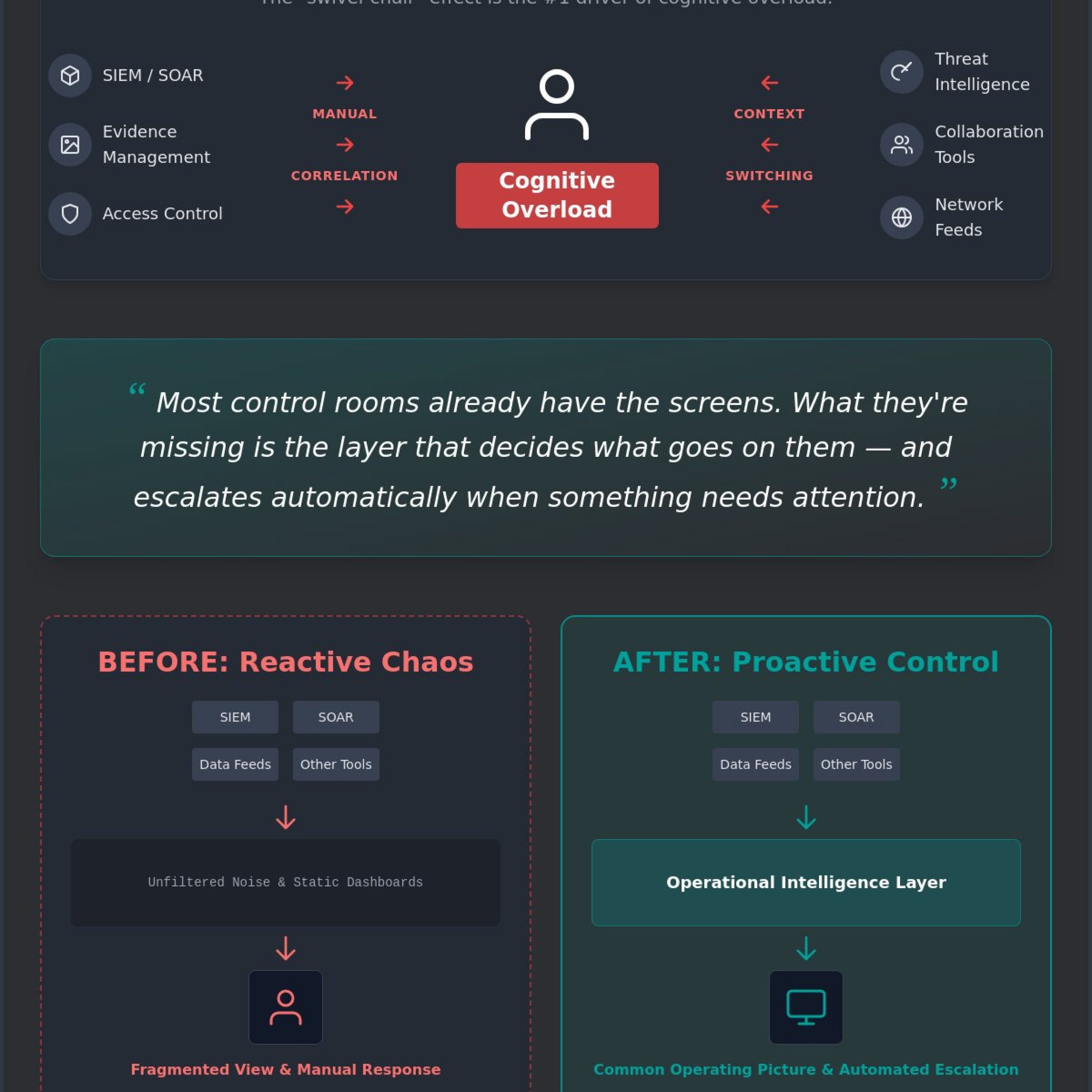
The fragmentation crisis is a primary driver of fatigue. Analysts often find themselves in a “swivel-chair” environment, physically and mentally pivoting between dozens of disconnected browser tabs and applications. This manual data correlation is a heavy mental tax. It forces operators to act as the integration layer themselves, piecing together a story from disparate feeds. This process is slow. It’s prone to error. Most importantly, it prevents the establishment of a true Common Operating Picture (COP). Without a unified view, the team cannot achieve the situational awareness required for high-stakes decisions.
Context switching creates a significant structural vulnerability rather than a minor inconvenience. When an operator’s attention is fractured across multiple platforms, the likelihood of missing a subtle indicator of a breach increases exponentially. Adding more hardware is a common reaction to this problem, but it often backfires. More monitors frequently increase confusion rather than clarity. When an operator’s field of vision is crowded with static dashboards, the brain struggles to filter relevant signals from background noise. This contributes to a state of constant high-alert that is unsustainable for long-term performance. Minimizing operator burnout in a SOC requires a shift from simply displaying data to intelligently prioritizing it.
The Problem with Application Silos
Specialized tools provide deep data but often exist in isolation. For instance, some organizations utilize Axon for digital evidence management. While Axon is powerful for its specific use case, it provides only a partial solution. It lacks the context of facility-wide security feeds and requires a unifying layer to create a full common operating picture. Critical data remains hidden in sub-menus, requiring manual retrieval during an active crisis. This fragmentation delays decision-making when seconds matter most. Minimizing operator burnout in a SOC depends on breaking these silos to ensure data is accessible, not just available.
Visual Complexity and Environmental Stress
Effective control room design must account for the human element. Information hierarchy is a mission-critical requirement. If a video wall displays everything at once, it displays nothing effectively. This leads to visual exhaustion and missed incidents. Operators shouldn’t have to hunt for what matters. Prioritizing essential information reduces the constant scanning that wears down an analyst’s focus. To improve your team’s efficiency, consult with our experts to refine your operational layout.
Beyond Standalone Tools: Why SIEM and SOAR Alone Fail to Prevent Burnout
Many organizations invest heavily in SIEM and SOAR platforms, assuming these tools will solve the alert crisis by themselves. While these systems are necessary for data ingestion and basic orchestration, they often fall short in minimizing operator burnout in a SOC. SIEM dashboards frequently transform into “data graveyards.” They present vast amounts of information that analysts eventually stop monitoring because the signal-to-noise ratio is too low. When an interface is cluttered with thousands of low-fidelity events, the human brain naturally begins to filter out even the critical signals.
SOAR playbooks introduce a different set of challenges. They are designed for predictable, linear responses, yet mission-critical incidents rarely follow a script. Research suggests that playbook-driven automation can leave up to 60% of alerts uninvestigated because they don’t fit into pre-defined logic. When a playbook can’t account for a specific nuance, it creates a bottleneck. Without a unified visual interface, the analyst must still manually verify automated findings across several other platforms. This lack of an operational intelligence layer means the primary burden of correlation remains on the human operator, leading to fatigue and missed details.
The Integration Gap
Automated alerts often lack the visual context required for rapid assessment. They provide a notification but don’t show the “where” or the “how” in real-time. This leads to investigative dead ends where analysts spend time searching for supporting evidence rather than acting on it. True resolution requires deep application integration to bridge the distance between detection and response. Most control rooms already have the screens. What they’re missing is the layer that decides what goes on them, and escalates automatically when something needs attention. Standalone tools also fail to support the modern, distributed workforce. If the common operating picture is locked within a specific software client, mobile or huddle-room teams remain in the dark during a crisis.
Human-Centric Automation
Effective automation shouldn’t be a “black box” that hides its logic from the team. It should be event-driven. This means the system identifies a critical event and immediately surfaces the relevant data to the entire team across the video wall and mobile devices. Technology must empower human judgment rather than attempt to replace it. A successful strategy focuses on the moment of a pivotal decision. It ensures that the essential information is visible exactly when it’s needed, allowing operators to act with absolute certainty and reducing the stress of manual data retrieval.
Strategies for Minimizing Operator Burnout Through Event-Driven Visualization
Operational fatigue often stems from the requirement that analysts must always be watching. This passive monitoring model is fundamentally broken. Effective strategies for minimizing operator burnout in a SOC revolve around event-driven visualization. Instead of asking humans to scan static dashboards for anomalies, the system should push critical data to the forefront only when an incident occurs. This shift ensures that the cognitive load remains low during baseline operations, preserving mental energy for the high-stakes moments that demand human judgment.
Most control rooms already have the screens. What they’re missing is the layer that decides what goes on them, and escalates automatically when something needs attention. By implementing this operational intelligence layer, organizations can create a unified operating picture that scales even across complex federal government and defense sectors. Prioritizing essential information ensures that operators only see what is relevant to the current threat, effectively silencing the background noise that leads to exhaustion.
Automating the Visual Hierarchy
Visual hierarchy shouldn’t be a manual task for an already stressed operator. Systems can be configured to trigger specific visual layouts based on incident severity. When a high-priority breach is detected, the platform automatically de-prioritizes non-essential feeds, such as routine facility cameras or low-level logs. This event-driven intelligence reduces the constant need for manual “checks.” It allows the team to trust that the most important information will find them, rather than forcing them to hunt for it across dozens of applications. Unlike simple training improvements, which fail to solve a fundamentally broken information delivery system, automated hierarchy addresses the root cause of visual fatigue.
Extending Visibility Beyond the SOC
Burnout is often exacerbated by information bottlenecks. When executives or other stakeholders need updates, they often distract the core team with requests for status reports. Using mobile situational awareness keeps these stakeholders informed without interrupting the analysts. Enabling remote collaboration also reduces the physical pressure on on-site teams. Distributed visibility ensures that experts can contribute from a huddle room or a mobile device, preventing the command center from becoming a single point of failure during a prolonged incident.
To see how your team can achieve this level of clarity, explore the vis/ability platform today.
Implementing an Operational Intelligence Layer with vis/ability
Transitioning to an operational intelligence layer requires a shift in how information is prioritized and delivered. vis/ability acts as the central hub where all mission-critical tools flow, creating a unified environment for high-stakes decision-making. By establishing a cybersecurity common operating picture, the platform enables real-time threat visualization that transcends the limitations of individual dashboards. This approach is fundamental to minimizing operator burnout in a SOC. It allows the team to focus on the threat itself rather than the mechanics of finding the data.
Most control rooms already have the screens. What they’re missing is the layer that decides what goes on them, and escalates automatically when something needs attention. vis/ability provides this missing link. It transforms the video wall from a passive display into a proactive decision-support system. Analysts don’t need to manually manage their workspace during a crisis. Instead, the platform intelligently surfaces relevant feeds based on the nature of the event. This ensures the team remains focused and analytical when stakes are at their highest.
The vis/ability Advantage
The platform aggregates real-time data and video streams into a single, manageable interface. It ensures seamless integration with existing tools such as SIEM and SOAR. While organizations often use specialized platforms like Axon to manage specific data types, these tools only offer a partial view of the operational landscape. vis/ability fills this gap by acting as the unifying layer that makes these tools useful for the entire team. It reduces cognitive load by automating the “what” and “where” of data display, allowing operators to act with greater certainty.
Next Steps for SOC Leaders
Optimizing your command center starts with a thorough audit of current operator pain points and existing data silos. Leaders must evaluate how an event-driven model can improve incident management and reduce the mental tax on their elite talent. Moving away from reactive monitoring is an operational necessity for long-term resilience. Contact Activu for a tailored control room design consultation to learn how your organization can achieve mission-critical clarity and retain its most valuable security assets.
Restoring Operational Clarity and Elite Performance
Maintaining a high-performance Security Operations Center requires more than just the latest ingestion tools. It demands a fundamental shift in how analysts interact with data. By prioritizing essential information and eliminating the manual navigation of fragmented systems, organizations achieve faster incident response and improved staff retention. Strategies for minimizing operator burnout in a SOC must center on reducing the cognitive load that leads to alert fatigue and turnover.
Most control rooms already have the screens. What they’re missing is the layer that decides what goes on them, and escalates automatically when something needs attention. Activu brings over 40 years of experience in mission-critical environments to solve this exact challenge. Our proven event-driven situational awareness platform and custom design services for national-scale operations provide the bedrock for decisive action. Transitioning to an operational intelligence layer ensures your team remains focused and analytical when the stakes are at their highest.
Request a demo of vis/ability to see how we reduce SOC cognitive load. Your elite talent deserves an environment built for clarity and sustained success.
Frequently Asked Questions
Is operator burnout inevitable in a high-volume SOC environment?
Burnout is not an inevitable byproduct of high data volume; it is the result of broken information delivery systems. When humans are forced to act as the manual integration layer for fragmented tools, exhaustion is certain. By implementing event-driven visualization, organizations can shift from passive monitoring to proactive response. This strategy is essential for minimizing operator burnout in a SOC by ensuring mental energy is reserved for critical decision-making rather than data retrieval.
Can better video wall design actually reduce analyst stress?
Effective video wall design significantly reduces stress by establishing a clear information hierarchy. When a display is cluttered with static, irrelevant feeds, the brain enters a state of perpetual high-alert that leads to visual fatigue. A proactive decision-support system de-clutters the environment, surfacing only the data relevant to the current threat. This structured flow, combined with a professionally optimized soundscape—for which you can check out Evolve Acoustics—provides a sense of calm and clarity, allowing analysts to remain focused during high-stakes operations.
How much does alert fatigue contribute to security breaches?
Alert fatigue is a primary driver of breaches because it leads to the “normalization of deviance.” When analysts are overwhelmed by nearly 1,000 daily alerts, they may begin to ignore persistent alarms under the assumption they are false positives. This creates a dangerous blind spot where a sophisticated breach can hide in plain sight among the noise, significantly increasing the mean time to detect and remediate a threat.
What is the difference between a SIEM dashboard and a Common Operating Picture?
A SIEM dashboard typically serves as a technical log or “data graveyard” that requires manual interpretation and constant checking. In contrast, a Common Operating Picture is a unified visual layer that correlates data from all mission-critical tools into a single, actionable view. While a SIEM shows raw logs, a platform like vis/ability provides the operational reality, allowing the entire team to act with greater certainty and intelligence.
How can I measure the ROI of reducing operator burnout?
ROI is measured through reduced turnover costs and improved Mean Time to Remediation (MTTR). Replacing a burned-out analyst can cost between 50% and 200% of their annual salary. By minimizing operator burnout in a SOC, organizations preserve institutional knowledge and eliminate the security gaps caused by constant onboarding. Improved operational continuity directly translates to lower organizational risk and more efficient resource allocation within the command center.
Can vis/ability integrate with our existing cybersecurity tools?
vis/ability is designed to act as the central hub for all existing tools, including SIEM, SOAR, and specialized platforms like Axon. While these individual tools provide deep data, they often exist in silos that exhaust operators. vis/ability integrates these disparate feeds into a unified operational intelligence layer, making them useful for the entire team whether they are in the command center, a huddle room, or using mobile devices.
What happens to situational awareness when analysts are working remotely?
Situational awareness often fractures in remote environments because critical data is locked within specific software clients or physical locations. vis/ability solves this by extending the common operating picture to mobile devices and remote workstations. This distributed visibility ensures that remote analysts and stakeholders stay informed without distracting the core team, preventing information bottlenecks and maintaining absolute technical reliability during time-sensitive critical incidents.
Is an event-driven visualization model difficult to implement?
Implementing an event-driven model is a streamlined process because it leverages your existing infrastructure. Most control rooms already have the screens. What they’re missing is the layer that decides what goes on them and escalates automatically when something needs attention. Activu provides the technical expertise and design services needed to integrate this operational intelligence layer without disrupting ongoing mission-critical activities, moving your team from reactive complexity to proactive control.