
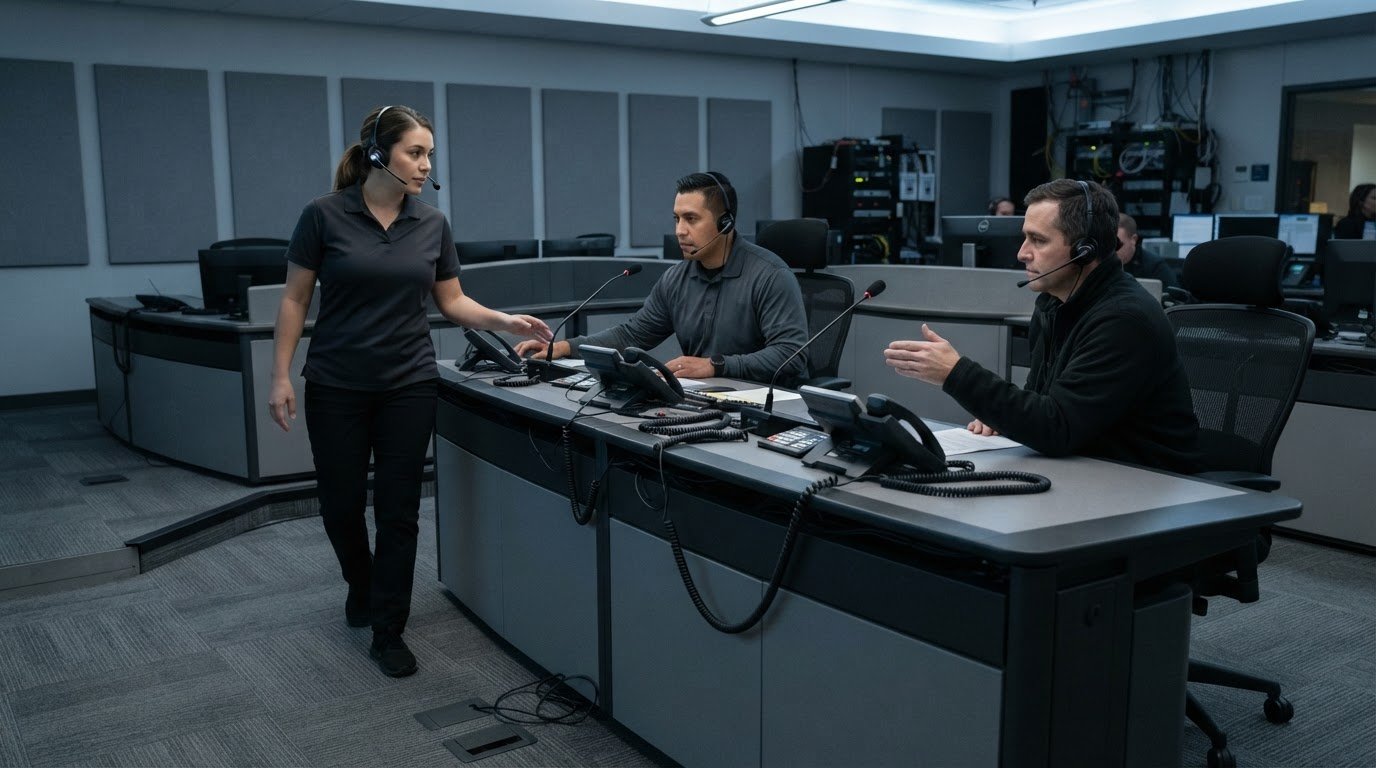
A control room stays resilient when its people can sustain critical operations, understand changing conditions, and coordinate decisions through disruption. Strong control room operational resilience combines adaptable room design, reliable access to information, clear team roles, and practiced response plans. A business impact assessment helps leaders identify which operations must continue and where disruption could have the greatest effect.
Operators already know that readiness depends on more than keeping equipment online. Fragmented systems, competing data feeds, and unclear escalation paths can slow decisions precisely when teams need a shared view of events. This article explains how to strengthen resilience by aligning the operational environment with the people and processes that use it.
You’ll learn how resilient design supports sustained performance, how real-time visibility helps teams prioritize essential information, and how coordinated communication connects response teams. The article also covers emergency exercises and business impact assessment, explaining how each helps a control room adapt, respond, and recover with greater clarity.
Key Takeaways
- Plan room layouts, infrastructure, and technology to adapt as operational needs change.
- Prioritize which information operators need at their workstations and which teams need to share.
- Build clear communication paths and response roles so teams can coordinate when primary systems fail.
- Use realistic exercises to test emergency protocols and strengthen team readiness.
- Assess resilience by identifying essential operations, potential disruptions, and the capabilities needed to sustain or restore service.
Resilient design and long-term adaptability
Resilient control room design aligns the workspace, infrastructure, and operator tasks. Start by identifying what must remain accessible during disruption and how the room may need to adapt.
Control rooms may operate 24 hours a day, 7 days a week, 365 days a year. Ergonomic choices can support sustained performance across shifts. Set console height and monitor placement for the tasks operators perform; protect shared-display sightlines; and manage glare, acoustics, chair clearance, circulation, and equipment access. For example, a poorly placed monitor can force operators to turn away from a shared display during an active incident. Adjustable work surfaces can give operators the ability to stand or change posture. Plan power, data, cable pathways, and rack space for maintenance and future additions. Control rooms are typically expected to remain in operation for up to thirty years, while limited spatial, technical, or organizational reserves can bring them to their limits after ten to fifteen years.
A design survey should gather input from the people who use, maintain, and manage the room. Include operators from different shifts, supervisors, technical staff, and continuity leads. Ask participants to map routine tasks, identify obstructed sightlines or difficult equipment access, and describe how they would work during a disruption. Compare responses by role, then prioritize recurring issues. This connects room planning to actual workflows rather than assumptions.
Resilience strategies reflect each sector’s processes and hazards. Energy and utilities teams may prioritize continuity across distributed assets; transportation teams may focus on coordinating changing network conditions; manufacturing teams may prioritize process visibility and production continuity. Link design decisions to the operating priorities of each facility. For manufacturing environments, manufacturing process control is one relevant operational context.
Applicable Standards and Regulations
Standards and regulations are frameworks for planning, operating, or protecting a control room. ISO 11064 is an international standard referenced in holistic control room planning, while U.S. requirements depend on the sector and facility. Separate design guidance from regulatory obligations: identify the applicable operating context, then document how room layout and procedures support its needs. This distinction helps teams avoid treating one design reference as a universal U.S. rule.
Business Continuity and Disaster Recovery
Business continuity and disaster recovery plans define how essential operations continue or resume after disruption. Prepare a crisis plan that guides the response team from the outset while allowing adjustments for different events. Identify priority data, backup access, alternate work locations, and recovery responsibilities. Cloud-based or off-site backups can support restoration of operational data. Organizations with multiple sites can also consider geographically distributed control rooms. Include war room planning in continuity and disaster recovery plans.
Cybersecurity Risks and Mitigations
Cybersecurity risks include unauthorized access, compromised accounts, and malicious software that disrupts operational systems or information. Reduce exposure by limiting access to operational tools, assigning clear permissions, and restricting access to what each role needs. Maintain backup copies of operational data and define how teams will communicate if digital systems become unavailable. Include cybersecurity scenarios in continuity planning so operators know which information remains trustworthy and how to escalate concerns without delaying response.
System visibility and real-time information
Organizations may monitor thousands of signals, assets, and systems across distributed locations. Yet fragmented feeds, disconnected applications, and team silos can obscure connections between events. Operators need to distinguish routine changes from developing incidents, then identify which information requires action. For example, a utility alarm is easier to interpret alongside related system status and field video. A shared operational view helps teams assess those sources together.
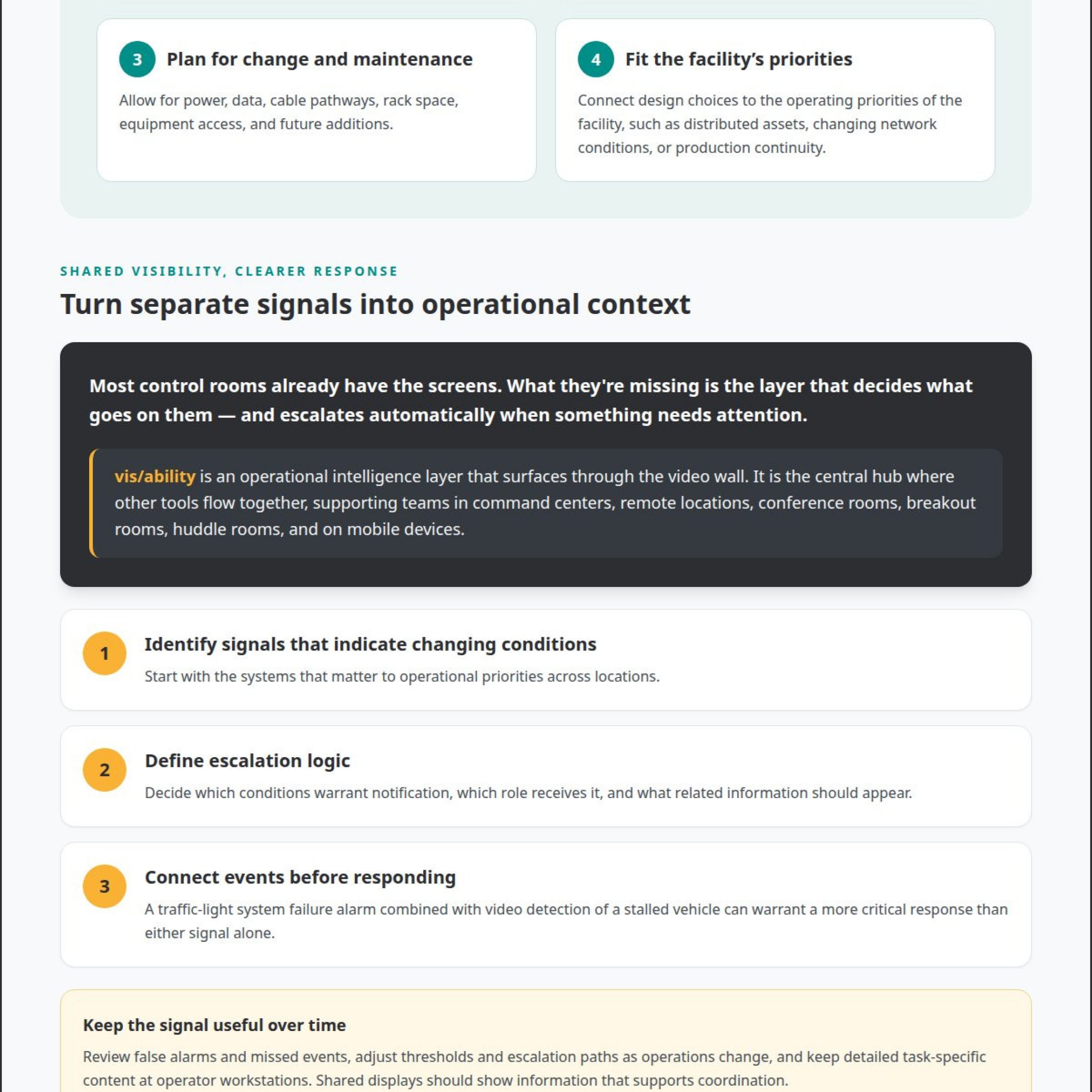
Most control rooms already have screens. What they need is a layer that determines what appears on them and escalates events that require attention. Without clear escalation logic, an alert can remain buried among routine updates. Define which conditions warrant notification, which role receives it, and what related information should appear. This makes automated monitoring a decision aid rather than another stream of competing signals.
Build monitoring around operational priorities. First, identify the systems that indicate changing conditions. Next, decide which signals require immediate attention and which belong in routine review. Then connect related events so operators can assess context instead of reacting to isolated alerts. For example, a traffic-light system failure alarm combined with video detection of a stalled vehicle can warrant a more critical response than either signal alone. Review false alarms and missed events, and adjust thresholds and escalation paths as operations change.
Video management system integration can bring camera feeds into a wider operational view. Integrated visualization helps operators move between relevant footage and other system information without losing incident context. Plan how sources should appear across displays, even when technologies, resolutions, and aspect ratios differ. Keep detailed, task-specific content at operator workstations, and reserve shared displays for information that supports team coordination. The goal is fast interpretation, not maximum screen density.
Display content also needs a clear visual hierarchy. Use consistent labels and layouts to distinguish alarms, system status, and supporting context. Color-detection software can identify changes across application screens, helping teams notice a status shift that might otherwise blend into routine content. Pair each signal with a defined escalation path. Operators should know what changed, which system produced the change, and who must respond.
Visibility also depends on power continuity. Uninterruptible power supplies and backup generators can keep systems online during power outages. Map which control room functions rely on each power source, then include those dependencies in continuity planning. If a camera feed or monitoring application fails, operators need a clear view of the affected system and its status. Test the transition between normal and backup power as part of operational readiness.
Application integration can connect separate feeds and present relevant information in context. Teams assessing how their systems should work together can use application integration for control rooms to create a unified operational view.
Cross-team collaboration and response coordination
During an incident, control room operators, supervisors, field personnel, and technical specialists need clear responsibilities. Coordination improves when each role knows who can assess an alert, authorize an action, and communicate the outcome. For example, a power-system alarm may require an operator to notify a supervisor while a field team assesses local conditions. A defined handoff helps prevent teams from acting on different assumptions.
Map the response around decisions, not just departments. Identify who owns each operational decision, which teams provide supporting information, and when responsibility transfers. A transportation incident, for instance, may involve dispatch, maintenance, and public safety teams. Record who leads each phase and how the next team acknowledges the handoff. Clear ownership reduces delays when pressure rises.
Build communication redundancy into response plans. Backup communication channels can keep teams connected when a primary system fails. Define which channel carries urgent instructions, which records decisions, and how staff switch channels during an outage. A radio failure, for example, should trigger an agreed alternative rather than an improvised search for contact details. Keep current contact paths accessible to control room staff and response leads.
Plan war room operations as part of disaster recovery and business continuity. Identify when the response team assembles, who convenes it, and what information it needs to make decisions. A facility disruption may require operations, IT, security, and leadership to coordinate from a shared location. Establish a process for logging decisions and distributing updates to teams outside the room. This helps remote staff act on the same direction.
Room conditions can also affect coordination. A visual briefing area should let participants see relevant information without blocking sightlines or interrupting operator work. Consider lighting, acoustics, seating, and access paths when arranging a response space. For example, glare on a shared display can make a map difficult to interpret, while excess noise can obscure a verbal handoff. Keep the setup useful for routine collaboration and urgent briefings.
Use concise communication protocols to reduce ambiguity. A useful incident update states the event, location, current impact, action underway, and support required. Teams can then distinguish confirmed information from pending assessment. During a utility outage, for example, a field report should identify the affected area and the operational action requested. Supervisors can relay the update without changing its meaning.
Review coordination after exercises and real events. Ask whether teams received instructions through the expected channel, whether decision ownership stayed clear, and where handoffs stalled. Record specific changes, such as revising a contact path or clarifying who authorizes a site response. Assign each change to a role and revisit it during the next exercise. This turns operational experience into practical improvements for the response network.
Emergency training and simulation exercises
Control room operators often form the first line of response during critical events. Regular protocol training and simulation exercises help teams practice timely decisions before an incident tests them. Scenarios should reflect actual workflows, such as a system alarm that requires verification, escalation, and coordination with a field team. Assign an observer to record decisions and communication gaps in each exercise.
Staffing, training, and fatigue-management practices strengthen resilience by protecting clear ownership across shifts. Maintain coverage for essential roles, use structured handoffs, and train operators on the protocols they’ll need during an incident. Include rest breaks and comfortable workstations in shift planning, since fatigue or discomfort can affect attention. A handoff should identify active incidents, unresolved alerts, and the next required action.
Design each exercise around a defined operational objective. A power disruption, for example, can test whether operators recognize the event, identify affected systems, and follow the continuity plan. Add a second development, such as losing a primary communication channel, to test the backup procedure. Keep the scenario realistic enough to expose gaps without confusing participants about the exercise’s boundaries.
Manage the exercise carefully. Give participants the information they would normally receive, then introduce updates as the scenario develops. Observers should record when teams detect the event, who receives escalation, how decisions are communicated, and whether staff follow assigned roles. These observations show where procedures work and where unclear instructions, delayed handoffs, or missing information affect response.
Organizations should test resilience plans through tabletop discussions and operational simulations. A tabletop can reveal unclear decision authority, while a live exercise can test how teams use actual communication channels and system views. Measure performance against the plan’s objectives, including escalation accuracy, handoff completeness, access to critical information, and recovery actions. Use the findings to revise procedures, then test the changes in a later exercise.
After each simulation, hold a structured review while participants remember the sequence clearly. Compare the intended response with what operators and supporting teams actually did. Document specific findings, such as an outdated contact path or a step that requires supervisor approval. Assign each corrective action to a role, track completion, and include the change in the next exercise.
Training can also adapt to operator experience. AI may support workforce development by tailoring learning paths, while supervisors remain responsible for evaluating readiness. In a simulated alarm response, for example, a learning system could suggest practice in verifying information. Treat those suggestions as support for human judgment, not instructions. This keeps training focused on operator capability and accountable decisions.
Resilience improves when exercises test people, procedures, and systems together. Repeat scenarios that expose unresolved weaknesses, and vary conditions so teams don’t rely on memorized sequences. A final review should confirm whether response roles were clear, backup communications worked, and recovery steps matched the plan. Use the findings to keep procedures aligned with actual operations.
How do you assess control room operational resilience?
Assess resilience by examining how well a control room anticipates disruption, prevents escalation, sustains essential work, and recovers. Start with a specific operating scenario, such as a failed system feed or unavailable work area. Trace how operators detect the change, decide what matters, and keep essential decisions moving. This reveals whether procedures, people, and technology work together under pressure.
Build the assessment around the operation’s priorities. Identify which functions must continue, what information supports them, and which roles own key decisions. For a control room supporting distributed assets, assess how operators recognize an emerging issue at one location and coordinate action across the network. A strong assessment makes dependencies visible, including communications, data access, staffing, and alternate work arrangements.
- Anticipation: Can operators recognize changing conditions and identify emerging risks?
- Prevention: Do teams reassess processes and act before a developing issue becomes critical?
- Response: Can staff locate trusted information, escalate concerns, and coordinate decisions?
- Continuity: Can essential work continue if a system, site, or communication channel fails?
- Recovery: Can teams restore operations, confirm information integrity, and resume normal workflows?
Use evidence from exercises, incidents, and routine operations. Review alert histories to find missed or delayed escalations. Compare incident logs with operator handoffs to identify where context was lost. In a simulated communications outage, for example, observe whether teams switch to the designated backup channel and maintain a clear record of decisions. These observations show how plans perform in real workflows.
Pair each finding with an owner and a corrective action. If a handoff repeatedly omits the status of an unresolved alert, revise the handoff template and test it during the next exercise. If operators cannot access a required data source during a disruption, identify the dependency and define another way to obtain the information. Track whether the change addresses the original gap.
Review control room operational resilience as conditions change. New systems, evolving risks, staffing changes, and revised operating priorities can affect existing assumptions. Reassess after a significant operational change, a major exercise, or an incident that exposes a weakness. Compare findings over time to see whether response roles, information access, continuity arrangements, and recovery actions are improving.
For a clearer view of how connected operational information can support assessment, explore vis/ability for control rooms.
Activu Corporation: Video Wall Systems
Activu Corporation helps control room teams address fragmented systems, information silos, and missing automatic escalation. Most control rooms already have screens. What they need is a layer that determines what appears on them and escalates events that require attention.
The vis/ability Platform acts as an operational intelligence layer that brings relevant information onto the video wall. It connects operational tools in a central hub, helping teams see information in context. The video wall becomes one place where that shared picture appears, supporting coordinated decisions instead of adding another disconnected feed. Teams can collaborate across command centers, remote locations, conference rooms, breakout rooms, huddle rooms, and mobile devices.
Consider Activu when operators need a unified view across systems and locations. Explore how the vis/ability Platform can support your control room, or contact Activu Corporation to discuss your operational needs.
Turn readiness findings into operational action
Resilience grows when teams turn assessment findings into deliberate design and operating decisions. Use the next planning cycle to decide which capability needs attention first, then align people, information, and workflows around that priority. This gives control room operational resilience a practical direction: each improvement should help operators make a clearer decision or coordinate a more effective response.
Activu Corporation offers Video Wall Systems, the vis/ability Platform, and Event-Driven Situational Awareness to support control room operations. These offerings help organizations bring operational information into a coordinated view and direct attention to events that need a response.
Start a conversation about the resilience challenges your team is working to address. Contact Activu Corporation to discuss resilience, and identify a clear next step for your operations.
Frequently Asked Questions
What is operational resilience in a control room?
Control room operational resilience is the ability to sustain essential decisions and operations during disruption, then restore normal workflows. It includes anticipating threats, adapting procedures, and recovering access to critical information. For example, if an operator workstation becomes unavailable, the team needs a clear way to maintain incident oversight and transfer the affected work. Resilience is demonstrated through operational capability under changing conditions, not simply through documented plans.
What are the key components of a resilient control room?
A resilient control room depends on capable people, clear decision authority, dependable information, adaptable processes, and infrastructure that supports continuity. These elements must work together. For example, a fallback procedure has limited value if operators don’t know when to activate it or supervisors can’t identify who owns the response. Assess how each capability depends on the others, then address weak handoffs, unclear responsibilities, and single points of operational failure.
How should control rooms prepare for power, network, and equipment failures?
Prepare by documenting failure indicators, decision authority, and the steps for safely resuming each affected function. For a network disruption, distinguish an unavailable connection from a failed application, and flag information that may no longer be current. For equipment faults, define how operators isolate the affected component and report its status. Test each scenario so staff can recognize failure, avoid relying on outdated information, and follow an approved recovery path.
What are the costs and benefits of investing in control room resilience?
Investing in adaptable layouts, reliable infrastructure, integrated visibility, clear response roles, and realistic exercises can help sustain critical operations, coordinate timely decisions, and restore service after disruption.