

Research shows that monitoring tasks can drive operator mental workload scores to a staggering 82.38 on the NASA-TLX scale, a level that makes critical errors almost inevitable. Many organizations believe they’re avoiding common control room design mistakes by investing in ergonomic consoles or the latest displays, yet their teams remain buried under a mountain of disconnected data. You’ve likely seen it yourself; operators toggling between dozens of browser tabs while missing a silent alarm because their attention was fractured across siloed systems.
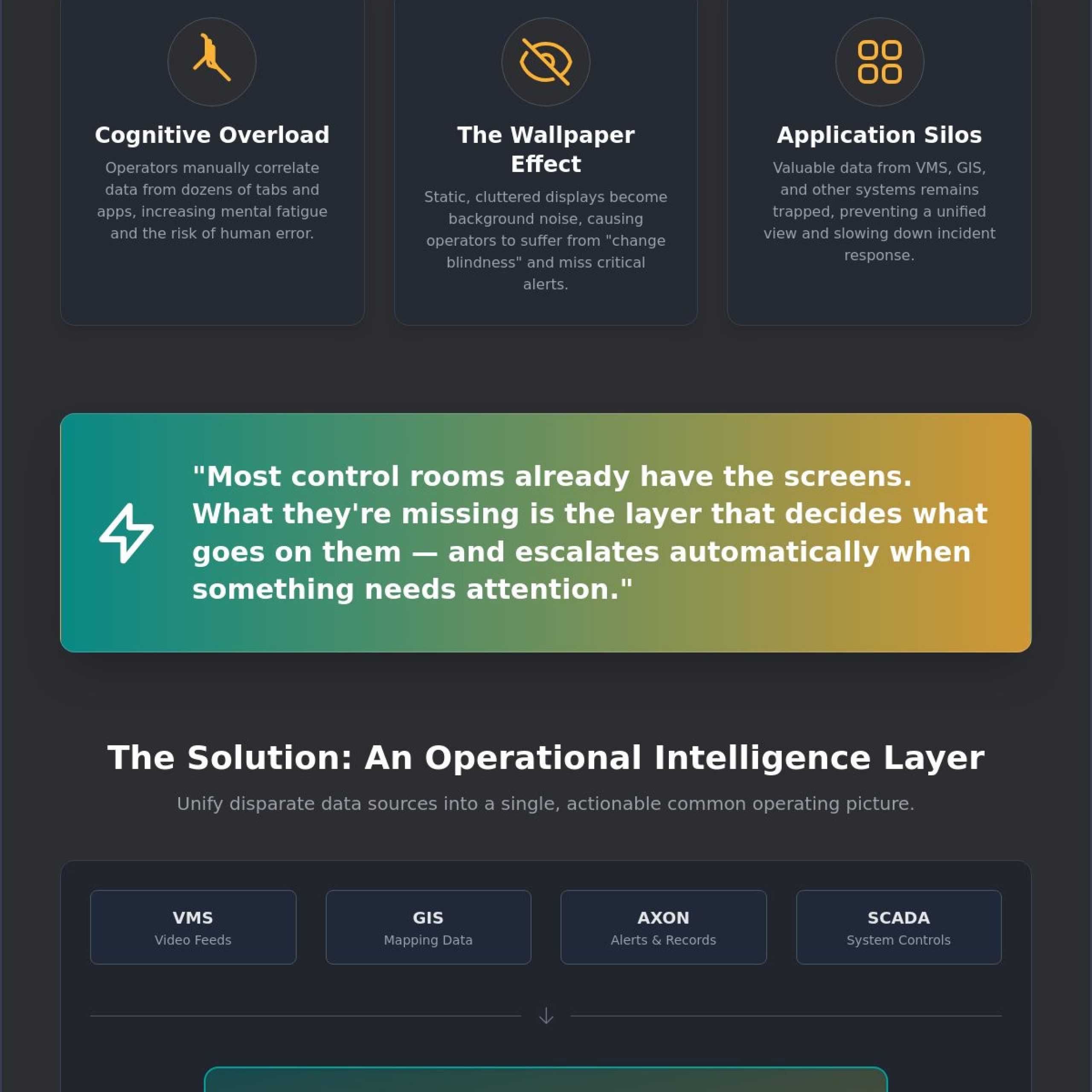
Most control rooms already have the screens. What they’re missing is the layer that decides what goes on them, and escalates automatically when something needs attention. While specialized tools like Axon provide valuable data, they only offer a partial view of the mission and require a unifying hub to be truly effective. This guide explains how to move beyond physical layout to implement the vis/ability operational intelligence layer. You’ll learn to build a future-proof environment that reduces response times through event-driven automation and creates a true common operating picture.
Key Takeaways
- Shift focus from display specifications to data utility to ensure high-resolution screens enhance situational awareness rather than creating visual noise.
- Eliminate the cognitive burden caused by fragmented data feeds and the inefficient process of manually correlating siloed tools during a crisis.
- Learn how to improve response times by avoiding common control room design mistakes like static layouts that lead to operator fatigue and missed alerts.
- Transition to a proactive operational posture by using automation to surface relevant data the moment a critical event is detected.
- Establish a unified common operating picture by deploying an operational intelligence layer that serves as the central hub for all mission-critical systems.
The Hardware-First Fallacy: Why Screens Don’t Equal Situational Awareness
Design teams often fall into the trap of prioritizing display specifications over operational utility. This hardware-first fallacy assumes that more pixels naturally lead to better decisions. In reality, avoiding common control room design mistakes requires a shift from hardware procurement to data orchestration. A modern control room serves as the central nervous system of an organization, but if that system is flooded with unrefined data, it becomes a liability. High-resolution screens can actually decrease situational awareness by overwhelming the operator’s cognitive capacity with irrelevant details. True effectiveness comes from the operational intelligence layer that manages this flow.
The Difference Between Visibility and Visual Intelligence
Visibility is simply the ability to see raw data feeds. Visual intelligence is the capacity to extract actionable insight from those feeds in real time. Organizations often integrate powerful tools like Axon to manage alerts, but these systems only provide a partial solution. They represent a silo of information that requires a unifying layer to create a full common operating picture. Without this, operators suffer from data drowning. Research in nuclear power plants noted that over 50% of alarms were redundant, which actively decreases situational awareness rather than improving it.
Why Operators Miss Incidents on Expensive Video Walls
It’s a documented psychological phenomenon called change blindness. When a display remains static for hours, the human brain begins to treat it as background noise. This wallpaper effect is a major risk in high-stakes environments. Visual fatigue, defined as the degradation of an operator’s ability to perceive critical changes due to prolonged exposure to static or cluttered information, is a primary cause of delayed incident response. When every screen is active but nothing is prioritized, the most critical alerts go unnoticed.
Success in a command center isn’t measured by the number of monitors on the wall. It’s measured by the speed of the decision-making process. Most control rooms already have the screens. What they’re missing is the layer that decides what goes on them, and escalates automatically when something needs attention. By focusing on the intelligence behind the glass, agencies can move from a reactive state to a proactive one, ensuring that every pixel serves a tactical purpose.
Cognitive Overload: The Hidden Cost of Fragmented Data Feeds
A command center’s efficiency is often sabotaged by the very tools designed to help it. Operators don’t just monitor screens; they navigate a labyrinth of disconnected software. This digital fragmentation creates the Alt-Tab problem, where a user must manually switch between a Video Management System (VMS), a Geographic Information System (GIS), and various communication platforms to understand a single event. When avoiding common control room design mistakes, organizations must look beyond the physical furniture to the cognitive strain of these digital silos. Every second spent toggling between applications is a second lost in the decision-making cycle.
NASA research into the ergonomic aspects of control rooms highlights that mental workload increases exponentially when users must mentally correlate data from different sources. During a critical incident, the requirement to manually piece together context from disparate feeds leads to rapid mental fatigue. This burden doesn’t just slow down response times; it introduces a high risk of human error. Fragmented systems ensure that data remains trapped in silos, making it nearly impossible for a team to maintain a consistent understanding of a developing crisis.
Most control rooms already have the screens. What they’re missing is the layer that decides what goes on them, and escalates automatically when something needs attention. Without this intelligence, the video wall is simply a collection of pixels rather than a strategic asset.
The Problem with Application Silos
Disparate tools like VMS, GIS, and cybersecurity monitors often function as isolated islands of information. While some organizations use platforms like Axon to manage specific data sets, these tools only provide a partial solution. They lack the inherent ability to communicate with other mission-critical systems, forcing operators to bridge the gap manually. This siloed approach is dangerous during active threats where speed is the primary metric of success. True application integration through vis/ability eliminates this friction by pulling data into a single, cohesive interface.
Designing for the Human Element
Modern design must prioritize information based on its tactical value rather than its source. Instead of displaying every available feed, a smart system uses automated filtering to present only what’s relevant to the current mission. This reduces the mental effort required to process information and allows the team to maintain focus on high-level strategy. The ideal result is a Unified Operating Picture, a single source of truth that empowers the entire team to act with certainty. If you want to see how this looks in practice, you can explore our public safety solutions to understand the impact of integrated intelligence.
Static Layouts vs. Dynamic Reality: Overcoming the Wallpaper Effect
The most dangerous display in a command center is one that never changes. When a video wall shows the same grid of camera feeds and dashboards for an entire shift, it triggers a psychological phenomenon known as the “Wallpaper Effect.” Operators subconsciously stop processing the information because their brains have categorized the static images as background noise. Avoiding common control room design mistakes requires a fundamental shift from static presets to dynamic, event-driven visualization. If the display doesn’t adapt to the severity of the situation, it isn’t providing situational awareness; it’s just consuming power.
Static displays breed complacency. When a monitor shows the same feed for eight hours, it effectively disappears from the operator’s conscious mind. This lack of movement is a primary reason why critical incidents are often missed on expensive video walls. Avoiding common control room design mistakes involves recognizing that human attention is a finite resource that must be protected. A layout that works during a routine afternoon is rarely the layout needed during a multi-agency response. Most control rooms already have the screens. What they’re missing is the layer that decides what goes on them, and escalates automatically when something needs attention.
Why Fixed Content Fails in Mission-Critical Environments
Traditional design often relies on “preset” layouts that are configured once and rarely updated. These fixed views force operators to look at irrelevant data simply because it was part of the original design. This consumes valuable screen real estate and forces the human eye to hunt for the signal amidst the noise. In high-stakes SOC and NOC control rooms, this wasted space translates directly to delayed response times. Modern operations require smart escalation, where the system itself recognizes a change in status and reconfigures the visual environment to match the new reality.
Transitioning to Event-Driven Situational Awareness
An intelligent command center operates on the principle of exception-based monitoring. Instead of displaying every available feed, the system remains in a “quiet” state until a trigger occurs. This trigger, whether it’s a cybersecurity breach, a physical intrusion, or a technical failure, should dictate exactly what appears on the video wall. This event-driven approach ensures that the team’s focus is immediately directed to the point of impact. By automating the transition of layouts based on live data, organizations can ensure that their most critical information is always front and center. You can learn more about implementing these systems by exploring the vis/ability platform, which serves as the central hub for this dynamic orchestration.
Building for Proactive Response: Designing an Event-Driven Workflow
Architecture defines capability. Avoiding common control room design mistakes requires a shift in focus from the physical arrangement of furniture to the logical arrangement of information. If the design doesn’t account for how data moves from a sensor to a decision-maker, the facility remains trapped in a reactive loop. Maintaining the physical infrastructure of these sites is equally critical; for example, many facility managers explore Direct Sales of Industrial Cleaning Hardware to ensure high-level areas are kept safe and clear of debris.
Most control rooms already have the screens. What they’re missing is the layer that decides what goes on them, and escalates automatically when something needs attention. Without this orchestration, the most advanced display technology is merely a passive observer of events.
Automating Incident Escalation
True operational readiness depends on the ability to filter noise. By implementing automated escalation logic, organizations ensure that data is pushed to the video wall only when specific tactical thresholds are met. This approach significantly reduces the mean time to detect critical incidents by removing the requirement for constant human oversight of every feed. Event-driven intelligence serves as the essential bridge between raw data and human judgment. It ensures that operators only see what requires their immediate intervention. This methodology is central to effective incident management software integration, where the platform identifies anomalies and prepares the visual environment for the team before they even realize a threat exists.
Extending the Room: Mobile and Distributed Collaboration
Designing for the physical room alone is a critical error. In modern operations, the command center is not a destination but a hub. The common operating picture must be accessible to stakeholders regardless of their location. Whether a commander is in a huddle room or a field unit is on a mobile device, they require the same high-level intelligence as those at the main consoles. The vis/ability platform extends this visibility beyond the video wall, allowing for seamless collaboration across distributed teams. This ensures that field units don’t operate on partial information while the command center has the full picture. Prioritizing this distributed access is a crucial step in avoiding common control room design mistakes and ensuring mission success.
To optimize your operational workflow and eliminate data silos, contact our design experts for a technical consultation.
The Operational Intelligence Layer: Implementing vis/ability
The culmination of modern command center strategy lies in the deployment of a software-defined intelligence layer. Avoiding common control room design mistakes requires moving beyond the physical shell to address the digital fragmentation that slows down critical decision-making. While organizations often rely on various Commercial Off-The-Shelf (COTS) solutions, these tools frequently operate in isolation. vis/ability transforms these disparate feeds into a unified, actionable environment. It serves as the central hub where raw data becomes operational intelligence, allowing teams to act with absolute certainty when stakes are highest.
Most control rooms already have the screens. What they’re missing is the layer that decides what goes on them, and escalates automatically when something needs attention. Without this orchestration, even the most expensive hardware remains a passive display rather than a tactical asset.
Unifying Your Tech Stack
In high-stakes sectors like Utilities and Energy, the ability to see across different domains is vital for grid stability and safety. vis/ability integrates data from Video Management Systems (VMS), Security Information and Event Management (SIEM) platforms, and diverse IoT sensors into a single view. This vendor-neutral approach ensures that you aren’t locked into a single ecosystem or limited by proprietary hardware. While some organizations utilize tools like Axon, those platforms typically only address a specific data subset. vis/ability fills this gap by providing the necessary integration to create a complete common operating picture, ensuring that the right information reaches the right person at the right time.
Achieving Operational Continuity
Resilience is a core requirement for mission-critical facilities. True operational continuity depends on software that maintains a consistent view across multiple sites and devices, even during system failures. vis/ability ensures that if a local system fails, the common operating picture remains accessible from other locations or mobile units. This distributed architecture prevents the “single point of failure” risk inherent in hardware-centric designs. By centralizing oversight, the platform provides a cybersecurity common operating picture that monitors both physical and digital threats simultaneously. This holistic view is essential for protecting complex infrastructure in an era of converging risks.
The transition from a reactive, hardware-heavy room to a proactive, intelligence-driven command center is a strategic necessity. A future-proof design doesn’t just look better; it acts faster. To begin the process of modernizing your facility and eliminating operational silos, Contact Activu for expert control room design services. Our team provides the technical bedrock for your most critical decisions, ensuring clarity amidst potential complexity.
Advancing Beyond the Physical Command Center
Operational excellence requires a fundamental shift in how we perceive the command environment. Avoiding common control room design mistakes means moving past hardware procurement to prioritize the flow of actionable intelligence. Organizations reclaim the speed necessary for high-stakes decision-making by eliminating the cognitive drag of fragmented applications and replacing static displays with event-driven automation. Understanding data in time to act is far more critical than simply displaying it.
Most control rooms already have the screens. What they’re missing is the layer that decides what goes on them, and escalates automatically when something needs attention. Trusted by Global 500 companies and federal agencies, vis/ability provides this essential layer. It offers seamless integration with Axon, Okta, and major VMS platforms to ensure your team acts on a single source of truth. Implementing event-driven automation can reduce response times by up to 50%, transforming your center from a reactive monitoring station into a proactive engine of clarity.
Secure your operations and empower your personnel today. Request a Demo of the vis/ability Operational Intelligence Layer to see how we bridge the gap between raw data and human judgment. Your team deserves the confidence that only true visibility provides.
Frequently Asked Questions
What are the most common control room situational awareness problems?
The primary obstacles to situational awareness are data fragmentation and cognitive overload. Operators often find themselves manually correlating information from siloed tools like VMS, GIS, and CAD systems. This digital friction delays decision-making and increases the likelihood of human error during high-stakes events. By avoiding common control room design mistakes like hardware-centric planning, organizations can focus on streamlining these information flows for better clarity.
How do I manage multiple data feeds in a dispatch center without overloading operators?
Managing multiple feeds requires a software-defined layer that prioritizes information based on tactical relevance. Most control rooms already have the screens. What they’re missing is the layer that decides what goes on them, and escalates automatically when something needs attention. This approach prevents operators from being buried under redundant data while ensuring that critical anomalies are surfaced immediately without manual intervention.
What is the best common operating picture solution for an EOC?
An effective Emergency Operations Center (EOC) requires a vendor-neutral platform that integrates disparate data sources into a single, unified view. While specialized tools like Axon provide essential data, they only offer a partial solution and require a unifying layer to create a full common operating picture. vis/ability acts as this central hub, ensuring that all stakeholders have access to the same real-time intelligence across the facility and distributed sites.
Why do operators miss critical incidents even with a large video wall?
Operators often miss incidents due to the “Wallpaper Effect,” where the brain begins to treat static or unchanging displays as background noise. Large video walls that show the same grid of feeds for hours lead to a psychological phenomenon called change blindness. Transitioning to event-driven visualization ensures that the display reconfigures itself to highlight critical changes, effectively breaking this complacency and directing attention to the threat.
How does control room design impact operator fatigue?
Control room design directly impacts fatigue through both physical ergonomics and cognitive load. While adjustable consoles and professional lighting solutions from Ergovanta are important for the physical workspace, the mental effort required to navigate dozens of software applications is a primary driver of exhaustion. Avoiding common control room design mistakes involves simplifying the user interface and automating routine monitoring tasks, which preserves the operator’s mental energy for high-level analysis and crisis management.
What is an event-driven situational awareness platform?
This platform is a software-defined layer that uses automated triggers to manage the display of information. Instead of relying on manual presets, the system monitors underlying data feeds and pushes relevant visuals to the video wall the moment a threshold is met. This proactive logic ensures that the visual environment adapts to the severity of a situation, providing immediate context for incident response without requiring operator input.
How can I integrate mobile users into my control room design?
Integration is achieved by deploying an operational intelligence layer that extends the common operating picture to any device. vis/ability allows field units and remote stakeholders to view the same real-time data as the command center on mobile devices or huddle room screens. This ensures operational continuity and prevents information silos between the command hub and those on the front lines of a mission-critical incident.
What is the difference between a video wall processor and an operational intelligence layer?
A video wall processor is a hardware device that manages pixel distribution and physical windowing on a display. In contrast, an operational intelligence layer is a software-defined platform that manages the data itself. While the processor handles where a window sits, the intelligence layer decides which data is relevant and automates the escalation of critical information based on live operational triggers.