
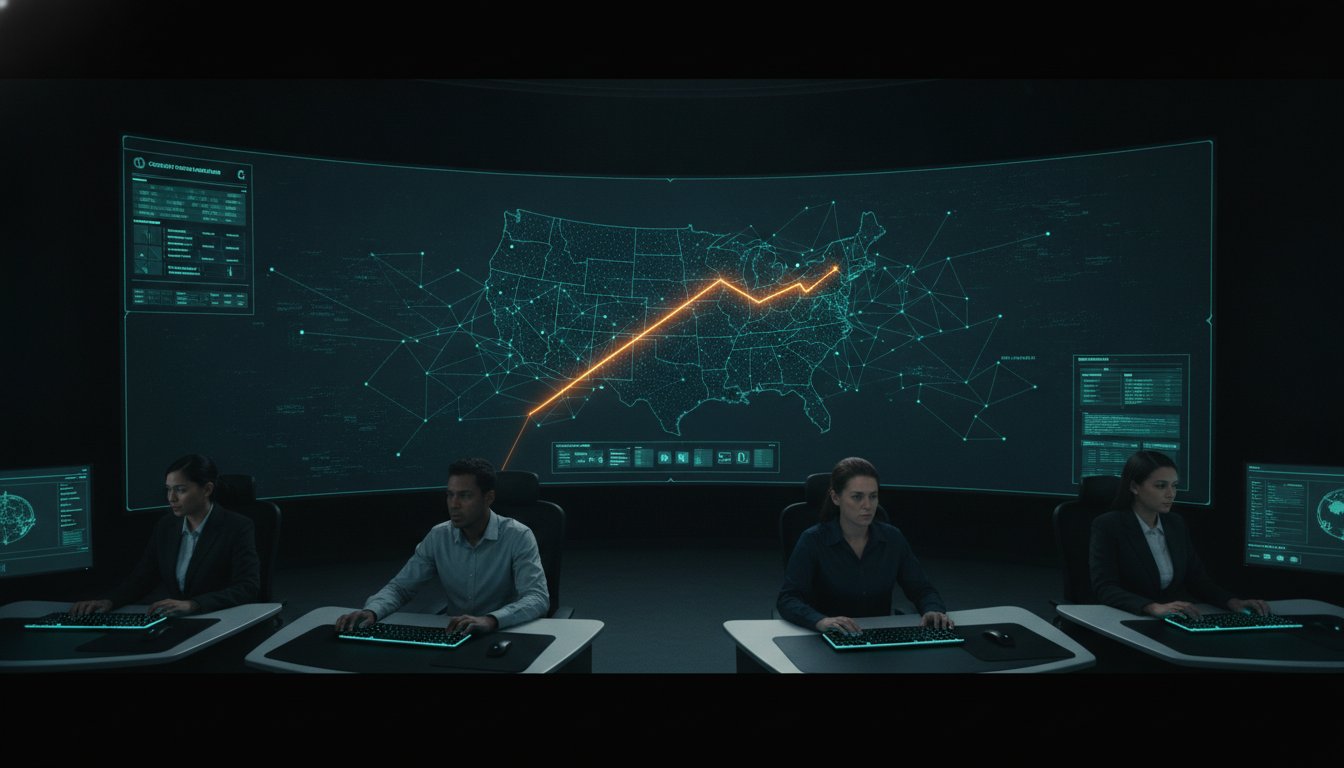
While the global average cost of a data breach has dipped to $4.44 million in 2026, the average time to identify and contain an incident remains a staggering 241 days. This persistent delay suggests that traditional metrics often mask deep-seated operational vulnerabilities. You recognize that measuring SOC effectiveness and KPIs involves more than tracking simple timestamps; it requires a rigorous evaluation of how your team maintains situational awareness under pressure. Siloed data feeds and operator fatigue frequently compromise the very systems designed to protect your mission-critical assets.
Most control rooms already have the screens. What they’re missing is the layer that decides what goes on them, and escalates automatically when something needs attention. This article provides a framework for measuring decision-making speed and accuracy in high-stakes environments. We will examine how the vis/ability platform acts as the operational intelligence layer, transforming fragmented data into a unified common operating picture. By focusing on these outcomes, you can justify critical technology investments and ensure your command center remains a reliable bedrock for decisive action.
Key Takeaways
- Traditional time-based metrics often obscure deeper operational gaps. You’ll learn to prioritize response accuracy and situational awareness as the primary benchmarks for success.
- Most control rooms already have the screens but lack the logic to manage them. Discover how an operational intelligence layer acts as the central hub for all your mission-critical data feeds.
- This guide provides a structured framework for measuring SOC effectiveness and KPIs that focuses on the speed and quality of human judgment during a crisis.
- Siloed data sources and alert fatigue are significant risks to operational readiness. Learn how a Cybersecurity Common Operating Picture provides the clarity needed to act with absolute certainty.
- Event-driven automation eliminates the bottlenecks of manual monitoring. You’ll see how automated triggers can maintain visibility across your entire team, whether they’re in the command center or on mobile devices.
The Limitations of Traditional SOC Metrics in High-Stakes Environments
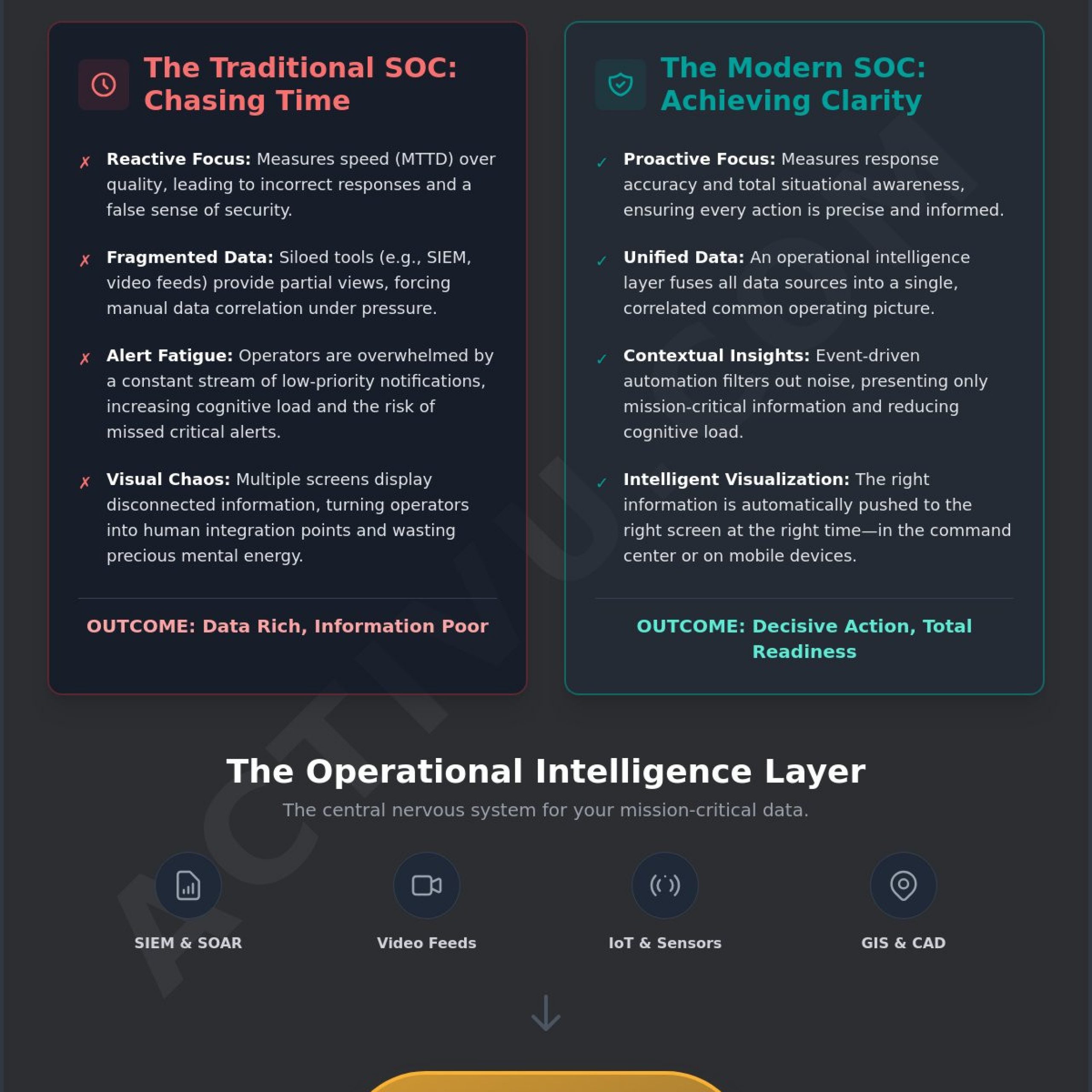
Traditional metrics like Mean Time to Detect (MTTD) often provide a false sense of security. While speed is essential, it frequently masks deep operational inefficiencies that surface only during a crisis. A rapid detection that leads to an incorrect or incomplete response is not a victory; it is a liability. In a high-stakes Security Operations Center (SOC), the focus must shift toward decision quality. Measuring SOC effectiveness and KPIs requires looking past the stopwatch to see if the team actually understood the threat context.
Alert fatigue remains a primary driver of operational failure. When operators face a constant stream of low-priority notifications, their cognitive load increases exponentially. This mental exhaustion leads to missed critical alerts and slower reaction times. Most organizations measure alert volume, but they fail to measure the cognitive cost of that volume. If your analysts are drowning in raw data, their ability to make accurate, high-pressure decisions vanishes. This gap between technical data collection and human comprehension is where most breaches escalate.
Fragmented data sources create siloed views that hinder a coordinated response. For instance, integrated technologies like Axon provide valuable data, but they only offer a partial perspective. They lack the context of the broader digital and physical environment. Without a unifying layer, operators must manually correlate data across multiple screens. This manual process introduces significant delays and human error, leaving the organization vulnerable despite having expensive tools in place.
The “Data Rich, Information Poor” Paradox
More screens do not guarantee better awareness. Many command centers suffer from fragmented visualization where critical information is spread across disconnected displays. This fragmentation forces operators to act as the integration point, consuming precious mental energy that should be spent on strategy. Most control rooms already have the screens. What they’re missing is the layer that decides what goes on them, and escalates automatically when something needs attention. Traditional metrics fail here because they don’t account for the cost of missed incidents caused by this visual chaos.
Moving from Reactive Speed to Proactive Accuracy
Technical resolution is not the same as operational success. While “Time to Contain” is a common metric, it’s often a lagging indicator of team capability rather than a predictor of future performance. Measuring SOC effectiveness and KPIs effectively means evaluating how quickly a team achieves total situational awareness. Proactive accuracy depends on a unified operating picture that filters out noise. True resilience comes from the ability to see the full picture before a crisis escalates, ensuring that every action taken is precise and informed.
Defining the Operational Intelligence Layer: A New Benchmark for Success
Effective security operations rely on more than just high-performance hardware. Data from the SANS Institute SOC survey highlights that many organizations struggle to turn raw alerts into actionable intelligence, often because they lack a central nervous system for their data. Measuring SOC effectiveness and KPIs requires a shift in focus from the volume of data collected to the quality of insights delivered to the operator. Most control rooms already have the screens. What they’re missing is the layer that decides what goes on them, and escalates automatically when something needs attention.
This operational intelligence layer serves as the essential bridge between raw technical telemetry and human judgment. It doesn’t just display data; it interprets the context of an event to ensure that the most critical information is prioritized during a crisis. By framing vis/ability as this unifying platform, organizations can move away from fragmented views and toward a state of total operational readiness. It is the bedrock upon which mission-critical decisions are made, providing the calm and clarity needed to navigate complex threat landscapes.
What is an Operational Intelligence Layer?
An operational intelligence layer is a sophisticated platform that aggregates real-time data from disparate sources into a single, coherent view. While a standard video wall simply displays whatever feed is manually selected, a true common operating picture uses logic to prioritize information. vis/ability acts as this hub, pulling from cybersecurity tools, physical security sensors, and geospatial data. It transforms raw telemetry into situational awareness, making other tools more useful for the entire team. This distinction is critical for mission-critical resilience. Without this layer, analysts spend more time navigating interfaces than neutralizing threats.
The Strategic Advantage of Automated Escalation
Automated escalation removes the burden of manual monitoring from the operator. When a critical event occurs, event-driven situational awareness triggers specific visual layouts across the entire organization. This ensures that every team member, whether in a command center, a huddle room, or on a mobile device, sees exactly what they need at the moment of impact. By automating visual priority, you reduce the risk of human error and operator fatigue during high-stress incidents. Organizations can then use the vis/ability platform to measure the effectiveness of their automated response compared to manual workflows, providing a concrete metric for operational maturity. This level of integration creates a standardized environment where KPIs are based on successful outcomes rather than just activity levels.
Measuring Situational Awareness and Response Accuracy
Speed without accuracy is a liability in high-stakes environments. While detection times provide a baseline, they fail to account for the quality of the subsequent decision-making process. Industry lessons on measuring SOC effectiveness suggest that the most resilient organizations prioritize response accuracy over raw speed. When measuring SOC effectiveness and KPIs, leadership must evaluate the time it takes to achieve total team alignment. This metric tracks the interval between an initial alert and the moment every stakeholder, from the command center to mobile responders, shares a unified understanding of the threat.
Situational awareness is not a vague concept; it is a quantifiable performance metric. It represents the state where an operator possesses the necessary context to act with absolute certainty. In a distributed environment, the effectiveness score of a SOC depends heavily on how well information flows to remote teams. Fragmented systems often delay this alignment, as operators struggle to communicate complex data through static reports or verbal descriptions. Most control rooms already have the screens. What they’re missing is the layer that decides what goes on them, and escalates automatically when something needs attention.
Quantifying Decision-Making Speed
Intelligence latency is the gap between the arrival of raw data and the execution of a human action. This latency often stems from the necessity of manual application switching. When analysts must jump between a SIEM, a geospatial tool, and a video management system like Axon, they lose critical seconds. The vis/ability platform eliminates this friction by consolidating these feeds into a single operational intelligence layer. Organizations can track the success rate of incidents managed through a common operating picture (COP) to prove that unified visualization directly correlates with faster, more accurate resolutions.
Reducing Operator Fatigue and Cognitive Overload
The noise-to-signal ratio at the operator console is a primary indicator of long-term performance. If an analyst is bombarded with irrelevant data, their ability to identify a critical anomaly diminishes. Visual prioritization ensures that only the most pertinent information reaches the operator’s field of view during an escalation. Cognitive load in a 24/7 mission-critical environment represents the finite mental capacity of an operator to filter irrelevant data while attempting to resolve escalating crises. By measuring the reduction in “swivel-chair” operations, SOC managers can demonstrate how an intelligence layer preserves the mental acuity of their team, ensuring they remain sharp when stakes are at their highest.
Optimizing the Common Operating Picture for KPI Achievement
Success in a mission-critical environment depends on the seamless alignment of physical infrastructure and digital intelligence. Measuring SOC effectiveness and KPIs requires an understanding that the control room is more than a collection of monitors; it’s a dynamic decision-making engine. When your physical space and visual data are siloed, response times suffer and dwell time increases. A well-designed Cybersecurity Common Operating Picture reduces this friction by unifying SIEM, SOAR, and physical security feeds into a single visual plane. This integration ensures that high-priority business risk goals remain at the forefront of every operation.
Most control rooms already have the screens. What they’re missing is the layer that decides what goes on them, and escalates automatically when something needs attention. Without this operational intelligence layer, analysts are left to navigate a chaotic environment of disconnected hardware. Standalone hardware retail solutions often fail mission-critical requirements because they lack the software logic to prioritize essential information. While organizations may use tools like Axon for specific data feeds, these systems only provide a partial solution. They require a unifying layer to create a full common operating picture that supports the entire team.
Building a Unified Visual Framework
Application integration builds the foundation of a resilient user experience. By merging disparate data sources, you eliminate the cognitive load associated with manual data correlation. This unified framework allows for more precise measurement of team performance during real-world crises. For organizations looking to bridge the gap between current capabilities and peak performance, our Control Room Design Services provide the expertise needed to optimize KPI tracking through intentional layout and technology placement. This approach ensures that your video wall content directly supports your most critical operational outcomes.
Extending Visibility to Mobile and Remote Stakeholders
Operational effectiveness shouldn’t be confined to the walls of a command center. In distributed operations, the speed of resolution depends on the ability to share a unified operating picture with decision-makers in the field. Mobile vis/ability extends the reach of your SOC, providing remote stakeholders with the same level of situational awareness as those in the main hub. This extension is vital for reducing the mean time to resolve (MTTR). It ensures that experts can contribute to the mission regardless of their physical location. By integrating mobile devices into the central hub, you create a more agile and responsive organization. If you’re ready to unify your distributed teams, contact us today to discuss your operational goals.
Scaling SOC Effectiveness with Event-Driven Automation
Scaling operations requires a departure from manual monitoring. Human analysts cannot maintain peak vigilance across hundreds of disparate telemetry streams. Event-driven situational awareness solves this by replacing constant observation with intelligent logic. By setting specific triggers, your environment reacts to threats in real time. This shift is essential for measuring SOC effectiveness and KPIs in a way that reflects actual resilience. vis/ability serves as the central hub for this orchestration, ensuring that your operational intelligence layer remains the engine of your defense.
Decision-centric models prioritize the human element. They recognize that while automation can triage alerts, only a human can navigate the nuance of a high-stakes crisis. The future of measuring SOC effectiveness and KPIs lies in how well your tools empower that human judgment. vis/ability provides the bedrock for this empowerment, making every other tool in your stack more effective. It’s the unifying platform that ensures your team acts with certainty when every second counts. To complement this, Managed MXDR services UK can provide the expert-led oversight and specialized analysis required to maintain peak operational readiness.
Implementing Automated Visual Escalation
Defining critical events is the first step toward automation. These events represent breaches of predefined operational thresholds that require immediate attention. When these thresholds are met, the system orchestrates a response across your entire visual infrastructure. This approach significantly reduces missed signals that often occur during manual triage. Most control rooms already have the screens. What they’re missing is the layer that decides what goes on them, and escalates automatically when something needs attention. By automating this visual priority, you ensure that the most important telemetry is never buried under routine noise.
The Path to Continuous Operational Improvement
True effectiveness comes from iterative refinement. By analyzing historical situational data, leadership can identify where decision-making stalled or where information gaps existed. These insights allow you to refine response playbooks and align performance with Operational Continuity goals. This transition from a data-centric to a decision-centric model ensures that your SOC is measured by its ability to protect the mission. To see this technology in action, schedule a demo of the vis/ability platform and begin measuring the outcomes that truly matter.
Advancing Toward Decision-Centric Security Operations
Transitioning from a reactive posture to proactive resilience requires a fundamental shift in how you evaluate performance. Measuring SOC effectiveness and KPIs must go beyond the stopwatch to account for the speed and accuracy of human judgment. By prioritizing situational awareness and reducing the noise that leads to operator fatigue, you ensure that your command center functions as a high-performance engine rather than a bottleneck. Most control rooms already have the screens. What they’re missing is the layer that decides what goes on them, and escalates automatically when something needs attention.
The vis/ability platform serves as this critical operational intelligence layer, unifying fragmented data into a clear common operating picture. Trusted by Federal Defense and Public Safety agencies, our technology provides event-driven situational awareness that scales with your team while reducing cognitive load by prioritizing essential information. This framework allows your analysts to act with absolute confidence during real-world crises. See how vis/ability transforms SOC effectiveness; Request a Demo. Build your operations on a bedrock of technical reliability and mission-ready clarity.
Frequently Asked Questions
What are the most important KPIs for a modern Security Operations Center (SOC)?
The most important KPIs focus on decision quality and the speed of human alignment rather than raw data volume. Measuring SOC effectiveness and KPIs in 2026 requires tracking “Intelligence Latency,” which is the time between data arrival and actionable human response. You should also measure the “Accuracy of Response” to ensure that rapid detections don’t result in incorrect containment actions. These outcome-based metrics provide a more reliable bedrock for evaluating operational readiness than traditional volume-based counts.
How does situational awareness impact Mean Time to Respond (MTTR)?
Situational awareness reduces the Mean Time to Respond (MTTR) by eliminating the period of confusion that typically follows a critical alert. When every stakeholder shares a unified understanding of the threat context, they can execute playbooks with absolute certainty. This alignment removes the need for manual data correlation across siloed systems. By streamlining the flow of essential information, you ensure that the transition from detection to resolution is methodical and steady.
Can I measure SOC effectiveness without expensive automated tools?
What is the difference between a SOC metric and a SOC KPI?
SOC metrics are raw data points that track activity, whereas KPIs are strategic indicators that measure performance against specific mission goals. For example, the number of alerts processed is a metric, but the percentage of incidents resolved within the first hour of detection is a KPI. Measuring SOC effectiveness and KPIs requires you to distinguish between these two to ensure your reporting reflects actual operational success rather than just technical busywork.
How do I reduce operator fatigue in a high-volume alert environment?
Reducing operator fatigue requires implementing visual prioritization to filter out irrelevant background noise during high-volume periods. When you automate the “visual priority” of the command center, you allow analysts to focus their finite cognitive capacity on critical anomalies. This approach prevents the mental exhaustion that leads to missed signals. By ensuring that only essential information reaches the console, you maintain the sharp focus required for mission-critical decision-making.
Why do traditional SOC metrics often fail during a critical incident?
Traditional metrics like MTTD often fail because they ignore the human element and the cognitive load of the operator. Speed looks good on paper, but it doesn’t account for the “Data Rich, Information Poor” paradox where analysts have plenty of data but no clear intelligence. During a real-world crisis, these time-based metrics don’t reflect whether the team actually understood the threat or if they were simply reacting to fragmented, siloed alerts.
How can a common operating picture improve team collaboration?
A common operating picture improves collaboration by providing a single, unified decision-making hub for both local and remote stakeholders. It ensures that everyone, from the dispatch center to the field responder, sees the same visual context in real time. This synchronization eliminates communication bottlenecks and ensures that distributed teams act as a cohesive unit. Mobile vis/ability extends this reach, allowing experts to contribute to the mission regardless of their physical location.
Is it possible to automate SOC effectiveness reporting?
Yes, it is possible to automate reporting by using an operational intelligence layer that captures historical situational data. This technology tracks every trigger and visual layout change during an incident, providing a definitive record of the response process. These automated logs allow leadership to refine SOC response playbooks based on objective data rather than subjective memory. This continuous improvement cycle ensures that your operational continuity remains the bedrock of your security strategy.