
A high-resolution display means nothing if your operators are drowning in data they can’t prioritize during a crisis. This video wall buying guide 2026 addresses the reality that in high-stakes environments, the gap between raw information and actionable intelligence leads to operator fatigue and delayed response times. You might use platforms like Axon, but these tools often provide only a partial view, leaving teams to struggle with siloed data that doesn’t communicate. Most control rooms already have the screens. What they’re missing is the layer that decides what goes on them; it escalates automatically when something needs attention.
You likely recognize that simply adding more pixels won’t prevent critical incidents from being missed. We’ll show you how to move beyond hardware to implement a unified operational intelligence layer that automates data escalation. This article details how to build a common operating picture that reduces cognitive load and ensures your team acts with absolute certainty when the stakes are at their highest.
Key Takeaways
- Define the specific requirements for mission-critical visualization that separate 24/7 command centers from standard commercial signage.
- Leverage this video wall buying guide 2026 to select hardware with the redundancy and longevity required for high-stakes environments.
- Unify fragmented data feeds into a single operational intelligence layer to prevent information overload and missed incidents.
- Design your control room around the human element to reduce operator fatigue and improve situational awareness through optimized sightlines.
- Protect your long-term investment by adopting a hardware-agnostic platform that scales across your entire organization without constant hardware replacements.
Beyond the Screen: Defining Mission-Critical Requirements for 2026
Many organizations treat a video wall purchase like a standard IT procurement of digital signage. This mistake creates a dangerous gap in operational readiness. In a command center, a screen that fails or a data feed that remains static during a crisis isn’t just a technical glitch; it’s an operational failure. This video wall buying guide 2026 focuses on the transition from passive viewing to active, event-driven intelligence. You need a system that doesn’t just display information but prioritizes it based on the severity of the situation.
Most control rooms already have the screens. What they’re missing is the layer that decides what goes on them, and escalates automatically when something needs attention. Without this intelligence, operators suffer from information overload, staring at dozens of feeds while the one critical incident remains buried in a corner. Moving beyond reactive monitoring requires a platform that unifies siloed data into a single, actionable common operating picture. This approach eliminates blind spots that lead to costly downtime in utility grids or safety lapses in transportation hubs.
The Difference Between Signage and Situational Awareness
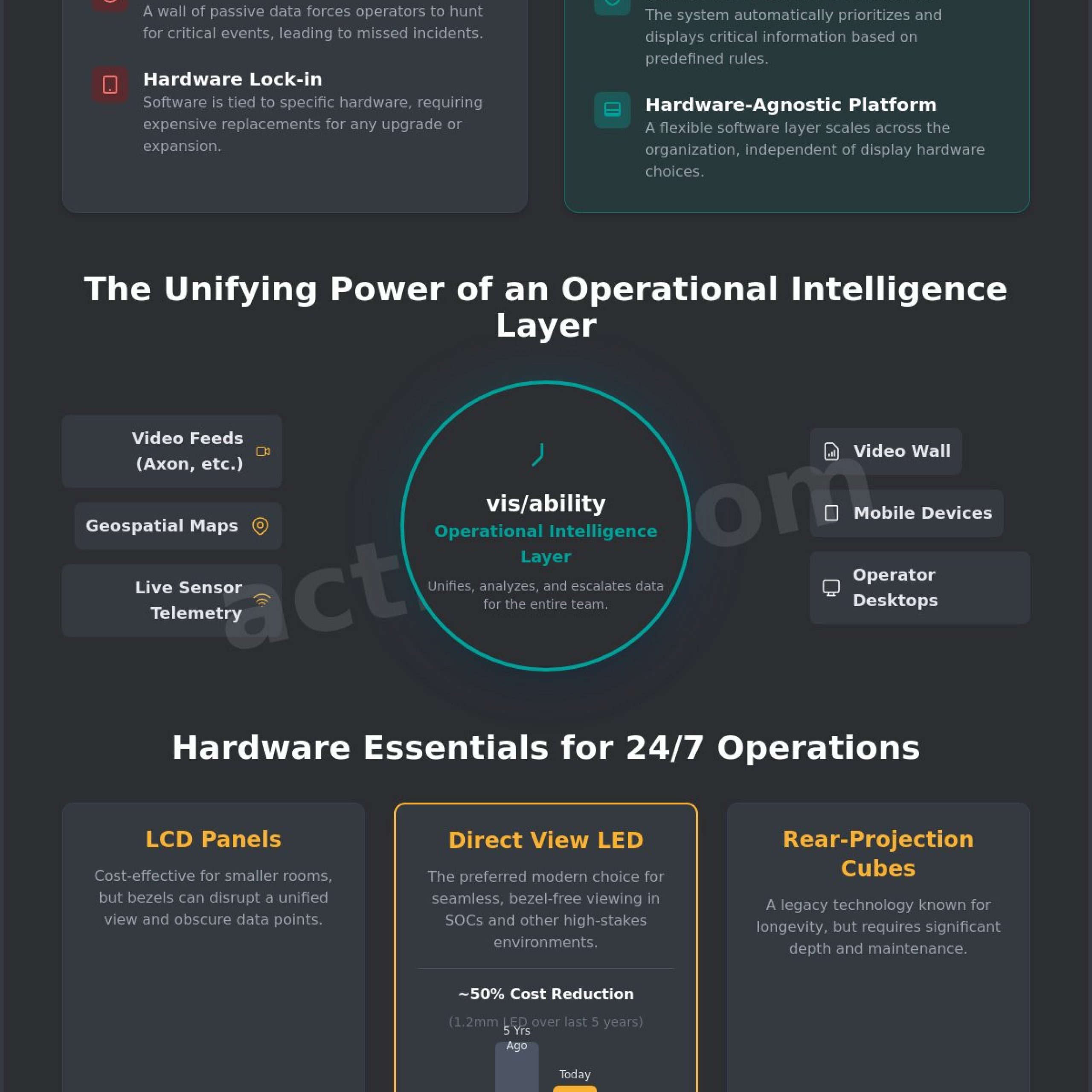
Passive data display is sufficient for a lobby, but it fails in a 24/7 command environment. Retail-grade hardware lacks the thermal management and component redundancy required for continuous operation. When evaluating Video Wall Technology, the focus must be on active intelligence. While some teams use tools like Axon to manage video, these platforms often provide only a partial solution. They lack the overarching operational intelligence layer needed to integrate disparate data types, such as geospatial maps and live sensor telemetry, into a cohesive view that empowers quick decision-making.
High-Stakes Environments: NOC, SOC, and EOC Needs
Different sectors demand specific visualization protocols to maintain compliance and safety. In Public Safety, the video wall must act as the central hub for real-time dispatch and emergency response. For Utilities, the system is a critical component of NERC CIP compliance, requiring strict control over who sees sensitive grid data and when they see it. Organizations in Transportation rely on high data density to manage vast networks of tunnels, tracks, or runways. A standard display cannot handle the complex resolution requirements of a Global Security Operations Center (GSOC). You need a system that scales and adapts as the threat landscape evolves, ensuring that your video wall buying guide 2026 investment remains relevant for years to come.
Hardware Essentials: Resolution, Redundancy, and Longevity
Selecting the right hardware for a command center requires a focus on technical specifications that guarantee 24/7 uptime. While consumer-grade displays prioritize aesthetics, mission-critical hardware must prioritize Mean Time Between Failure (MTBF) and thermal management. In windowless environments like a Network Operations Center (NOC), heat buildup can quickly degrade internal components. This video wall buying guide 2026 highlights the necessity of choosing industrial-grade displays and controllers designed to operate in high-density data environments without performance throttling.
Precision mapping and forensic video analysis demand high resolution and color accuracy. Modern standards like 4K and High Dynamic Range (HDR) are no longer luxury features; they are essential for identifying minute details in complex geospatial data. Most control rooms already have the screens. What they’re missing is the layer that decides what goes on them, and escalates automatically when something needs attention. This intelligence layer ensures that the high-resolution hardware you invest in is actually showing the data that matters most during a critical incident.
Display Technology: LCD vs. LED vs. Rear-Projection
The choice between display types often comes down to viewing distance and bezel requirements. LCD panels are cost-effective for smaller rooms, but their bezels can disrupt sightlines and obscure critical data points. Direct View LED offers a seamless experience, and with the 50% decrease in the cost of 1.2mm LED over the last five years, it has become the preferred choice for many Security Operations Centers. For indoor applications, a pixel pitch of 1.8mm to 2.5mm is ideal for a viewing distance of approximately 3 meters, while 2.5mm to 2.9mm is suitable for 5 meters. Emerging Chip on Board (COB) technology provides additional durability, protecting the fine-pitch pixels from accidental damage during maintenance.
Redundancy and System Resilience
Hardware failure is not an option when lives or infrastructure are at stake. True mission-critical systems utilize redundant power supplies and controllers to eliminate single points of failure. If a primary controller goes dark, failover protocols must trigger instantly to maintain the common operating picture. Hot-swappable components allow technicians to perform repairs without shutting down the entire wall. Unlike basic cloud-based software that may ignore hardware-level resilience, a robust system integrates secure, low-latency network architecture. This ensures that video distribution remains stable even during high-bandwidth events. If you’re planning a new facility, our control room design services can help you architect a resilient hardware foundation that supports your operational goals.
The Operational Intelligence Layer: Managing Complex Data Feeds
Fragmented systems are the primary driver of failure in modern command centers. When data feeds from SIEM, SOAR, and CAD remain isolated, operators cannot form a cohesive picture of an unfolding crisis. This video wall buying guide 2026 emphasizes that effective visualization is no longer about static window arrangements. Most control rooms already have the screens. What they’re missing is the layer that decides what goes on them, and escalates automatically when something needs attention. Without this intelligence, teams are left to manually sift through noise while critical incidents escalate in the background.
Moving beyond manual layouts requires a shift toward event-driven visualization. In high-stakes environments, the transition from raw data to actionable intelligence must be instantaneous. This methodology ensures that the most relevant information is always front and center, allowing your team to act with absolute certainty. By integrating disparate data streams into a single view, you eliminate the cognitive load that leads to operator fatigue and delayed response times.
Unifying Siloed Data Streams
Many organizations rely on specific tools like Axon for video management or Okta for identity security. While these platforms are useful, they only provide a partial solution for a command center. They lack the cross-platform synthesis required to create a full common operating picture. vis/ability serves as the operational intelligence layer, acting as the central hub where all other tools flow. It bridges the gap between legacy COTS applications and modern web-based feeds, ensuring that data from every corner of the enterprise is accessible to the entire team. This unification makes previously siloed tools useful for everyone, from the SOC operator to the executive decision-maker.
Automated Escalation and Event-Driven Logic
Manual layout management is a relic of the past that slows down operations. In a crisis, an operator shouldn’t be hunting for the right window or resizing a map. Event-driven logic allows the system to respond to specific triggers automatically. If a security sensor detects a breach or a network alert exceeds a defined threshold, the system pushes that specific feed to the center of the wall. This approach reduces noise by highlighting only the essential information needed to act. This intelligence isn’t confined to the main command center. Through mobile devices and huddle rooms, the same critical data follows your team wherever they are, ensuring situational awareness remains intact across the entire organization.
Control Room Design: Mitigating Operator Fatigue
The operator remains the most critical component of any command center. Their ability to synthesize complex data and act during a crisis defines the success of the mission. Designing for the human element requires more than just picking a large display. This video wall buying guide 2026 emphasizes that poor ergonomics and excessive cognitive load are the primary causes of operator burnout. When an operator is forced to scan dozens of static screens for hours, “monitor staring” sets in, and the likelihood of missing a subtle but critical indicator increases.
Most control rooms already have the screens. What they’re missing is the layer that decides what goes on them, and escalates automatically when something needs attention. By implementing an operational intelligence layer, you remove the burden of manual monitoring. Automated layouts ensure that operators only see high-priority data when it requires their judgment. This targeted approach preserves mental bandwidth for decision-making rather than data hunting, effectively reducing the fatigue associated with information overload.
Sightlines and Viewing Angles
Adhering to the DISCAS standard (V202.01:2016) is essential for ensuring that content is legible without causing physical strain. For indoor environments, a viewing distance of 3 meters is optimal for a 1.8mm to 2.5mm pixel pitch. If the room layout requires a 5-meter distance, a 2.5mm to 2.9mm pitch is more appropriate. Proper display height and tilt are necessary to avoid neck strain, while managed ambient lighting reduces eye fatigue during long shifts. These technical details ensure that the 4K clarity you’ve invested in translates to actual situational awareness rather than just visual noise.
Designing for Collaboration
Effective control rooms bridge the gap between individual workstations and the collective view. Operators need the ability to “push” critical content from their local console to the main wall to alert the entire team. This interactive workflow turns the video wall into a dynamic tool for collaboration rather than a passive backdrop. Integrating audio and communication tools directly into the visual stream ensures that the team remains unified during high-pressure events. If your current facility is struggling with these ergonomic challenges, our control room design services can help you optimize your environment for maximum operational efficiency.
Future-Proofing Your Operations with vis/ability
The final stage of any video wall buying guide 2026 must address the longevity of the investment. Hardware will eventually reach its end-of-life; however, your operational intelligence should never be tied to a specific display manufacturer. Selecting a hardware-agnostic software layer ensures that your command center remains functional as you upgrade from LCD to fine-pitch LED or integrate future display technologies. This approach allows for seamless scalability, enabling you to add new data feeds and additional users without the need to replace your existing core infrastructure.
Most control rooms already have the screens. What they’re missing is the layer that decides what goes on them, and escalates automatically when something needs attention. By shifting your focus from the display to the intelligence layer, you transform your video wall from a static monitor into a dynamic asset. This transition is vital for maintaining a robust Cybersecurity Common Operating Picture, where the speed of data visualization directly impacts your ability to neutralize threats before they compromise the network.
The vis/ability Advantage
The vis/ability platform serves as the bedrock of mission-critical resilience. It empowers distributed teams to maintain a unified view of operations, whether they are stationed in the primary command center or working from remote huddle rooms. By integrating advanced analytics, the platform moves beyond simple monitoring to provide predictive situational awareness. This capability allows operators to anticipate challenges rather than merely reacting to them. Through Mobile vis/ability, this clarity extends to field personnel, ensuring that every stakeholder has access to the same high-priority intelligence on their mobile devices during a pivotal decision moment.
Planning Your 2026 Implementation
Successful implementation begins with an honest assessment of your current operational gaps. You must identify where data silos exist and where information overload is currently slowing down response times. Early-stage planning ensures that your hardware choices support your long-term intelligence goals rather than limiting them. This methodical progression from identifying pain points to deploying an automated solution creates a state of clear, actionable intelligence for your entire organization. Ready to unify your operations and eliminate the blind spots in your command center? Contact Activu for a consultation to begin designing an intelligence-centric environment tailored to your mission.
Transitioning to Event-Driven Intelligence
Transitioning from passive displays to an active intelligence hub is the defining operational challenge for modern command centers. This video wall buying guide 2026 has outlined why hardware resilience and ergonomic precision are necessary foundations, yet they aren’t the complete solution. Most control rooms already have the screens. What they’re missing is the layer that decides what goes on them; it escalates automatically when something needs attention. Without this automated prioritization, your team remains vulnerable to information overload and delayed response times.
With over 40 years of mission-critical experience, Activu provides the hardware-agnostic intelligence layer trusted by Federal Defense and global SOCs. We empower your organization to move beyond fragmented feeds and achieve a truly unified common operating picture. By integrating our vis/ability platform, you eliminate the blind spots that lead to missed incidents and operator burnout. Request a demo of the vis/ability platform to unify your operations and secure the bedrock of your critical decision-making process. Your team deserves the clarity and reliability required to act with absolute certainty.
Frequently Asked Questions
What is the difference between a commercial video wall and a mission-critical one?
Mission-critical video walls are designed for 24/7 duty cycles and feature redundant components that commercial signage lacks. While commercial displays prioritize aesthetics for marketing, mission-critical systems focus on technical reliability, thermal management, and long-term durability in windowless environments. This video wall buying guide 2026 emphasizes that a true operational system must provide consistent performance without throttling to ensure data is visible during every second of a crisis.
How do I manage multiple data feeds in a dispatch or network operations center?
Managing multiple data feeds requires an operational intelligence layer that unifies siloed streams into a single common operating picture. Instead of forcing operators to toggle between CAD, SIEM, and live video, the system integrates these tools into a central hub. This approach eliminates the friction of fragmented systems. It allows the entire team to view real-time data across command centers and mobile devices simultaneously without manual switching.
Why do operators miss critical incidents even with a large video wall?
Operators miss incidents because of cognitive overload and “monitor staring” caused by stagnant, unprioritized data. When a video wall displays dozens of feeds without automated prioritization, the human brain struggles to identify subtle, critical changes. This is why operators miss incidents video wall installations were meant to prevent; they simply have too much noise and not enough actionable intelligence to guide their focus during long shifts.
What are the common situational awareness problems in an EOC?
Control room situational awareness problems in an EOC typically stem from siloed data and manual communication gaps. During a large-scale emergency, information arrives from multiple agencies and platforms that don’t talk to each other. Without a unifying platform, decision-makers are left with a fragmented view. This leads to slower response times and potential errors in resource allocation when the stakes are at their highest.
How can I integrate cybersecurity data into my physical security operations center?
Integrating cybersecurity data is achieved by using vis/ability as the unifying hub for all digital and physical feeds. By bringing threat intelligence from SIEM and SOAR platforms into the same view as your perimeter cameras, you create a Cybersecurity Common Operating Picture. This integration ensures that a digital breach and a physical intrusion are managed as a single, coordinated incident, providing total visibility across the enterprise.
Is cloud-based video wall software secure for government or utility use?
Security for government or utility use depends on whether the software meets strict compliance standards like NERC CIP or CJIS. While basic cloud players exist, mission-critical environments require secure, low-latency distribution that can operate on-prem or in hybrid configurations. You should check for end-to-end encryption and robust access controls to ensure that sensitive operational data remains protected from unauthorized exposure or cyber threats.
Can I use existing screens with a new operational intelligence layer?
You can leverage your current hardware when upgrading your operational capabilities through a hardware-agnostic platform. Most control rooms already have the screens. What they’re missing is the layer that decides what goes on them, and escalates automatically when something needs attention. This approach allows you to implement vis/ability without the immediate expense of replacing every display panel, focusing your budget on the intelligence that drives results.
How does automated escalation work on a video wall?
Automated escalation works through event-driven triggers that respond to specific data thresholds or sensor alerts. When an integrated tool like a CAD system or a network monitor detects a high-priority event, the intelligence layer automatically changes the video wall layout. This ensures that the most critical information is pushed to the center of the wall instantly. It removes the need for manual intervention during the initial moments of a crisis.