
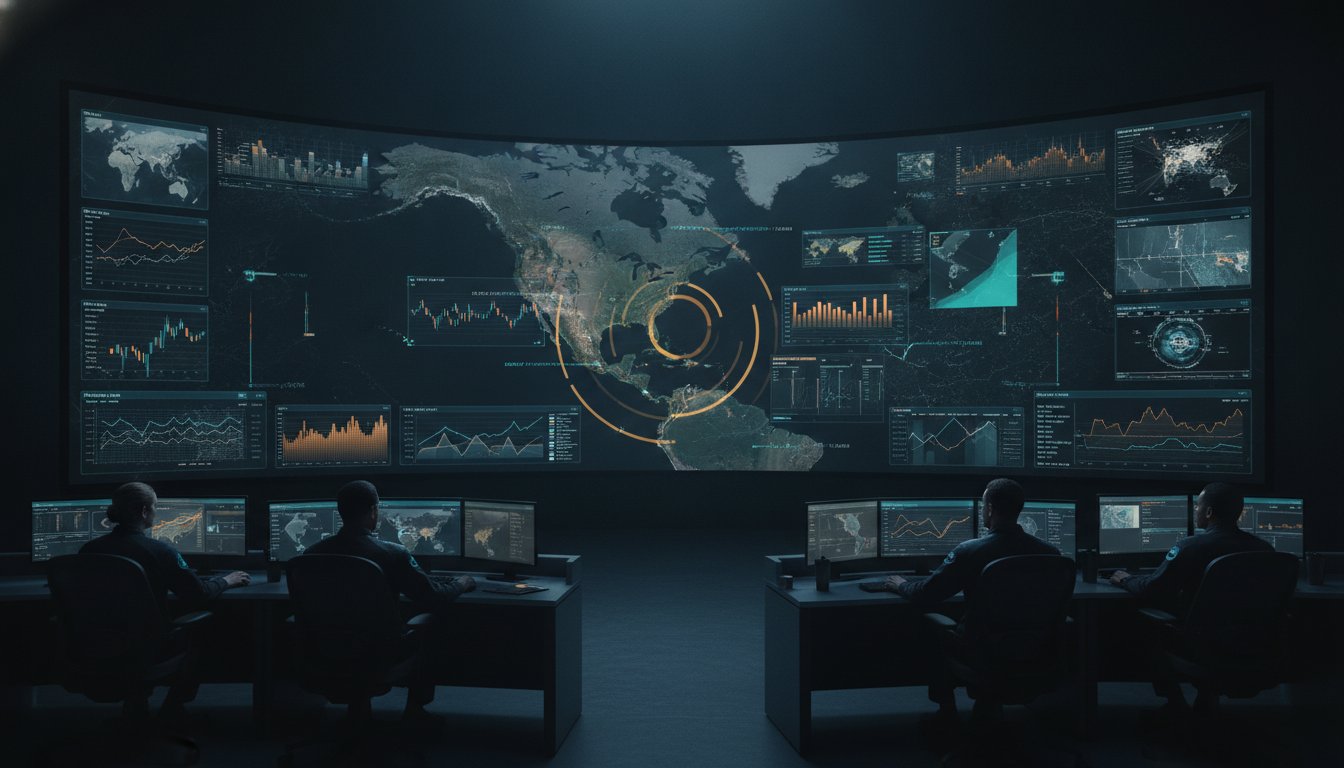
A 4K video wall is only as effective as the intelligence layer managing its pixels. Without automated escalation, high resolution simply creates higher-definition noise for an already overwhelmed team. You’ve likely experienced the frustration: operators staring at a massive, bezel-free dvLED array yet still missing a critical incident because the relevant data was buried in a fragmented system. Meeting modern 4k video wall requirements involves more than just selecting DisplayPort 2.1 cables or HDMI 2.2 specifications. It requires a fundamental shift from viewing hardware as the solution to treating it as a canvas for actionable intelligence.
Most control rooms already have the screens. What they’re missing is the layer that decides what goes on them, and escalates automatically when something needs attention. Relying on partial solutions like Axon often leaves gaps in your common operating picture, as these tools provide only a narrow slice of the necessary data. By implementing vis/ability as your operational intelligence layer, you transform fragmented systems into a unified platform. This guide examines the technical and operational framework needed to reduce response times and future-proof your infrastructure through event-driven visualization.
Key Takeaways
- Move beyond the resolution trap by understanding that 4K displays only provide value when paired with an operational intelligence layer that filters noise from essential data.
- Master the technical 4k video wall requirements, including the precise mathematical relationship between pixel pitch and operator viewing distance to ensure visual clarity.
- Identify the missing software layer that decides what appears on your screens and automatically escalates critical incidents when they require immediate attention.
- Reduce operator fatigue by replacing fragmented displays with a unified operating picture that prioritizes high-stakes information during urgent operations.
- Transform siloed tools into a cohesive ecosystem by using vis/ability as the central hub that integrates all data feeds for the entire team.
The 4K Resolution Trap: Why Hardware Alone Fails Mission-Critical Teams
4K UHD resolution provides a canvas of 3840×2160 pixels. For a mission-critical team, these 8.3 million pixels represent extreme data density rather than just visual clarity. Many organizations assume that purchasing high-resolution panels satisfies their 4k video wall requirements. This is a tactical error. Increasing resolution without implementing intelligent filtering leads directly to cognitive overload. Operators find themselves staring at more data than they can humanly process, which results in the “Pain of Fragmented Visibility.” A high-density video wall that lacks a management strategy becomes a wall of high-definition noise. A human-centric operating picture must prioritize essential data over raw pixel counts to be effective.
The Difference Between Consumer 4K and Mission-Critical UHD
Consumer displays focus on aesthetics and entertainment. They are not engineered for the rigors of a 24/7 environment. Standalone hardware retail solutions fail in a NOC because they lack the necessary thermal management and industrial-grade components. Mission-critical UHD requires professional-grade panel longevity. While LCD panels might last 50,000 hours, dvLED technology is rated for over 100,000 hours of continuous use. Reliability is the bedrock of operational readiness. Professional systems also ensure color accuracy, which is vital when operators must distinguish between subtle geospatial indicators on a map during a crisis.
Siloed Data: The Hidden Barrier to Situational Awareness
Modern command centers often suffer from information silos. Operators must monitor multiple data feeds across fragmented systems, which creates significant situational awareness problems. In a dispatch center, managing separate feeds for weather, traffic, and emergency response leads to critical delays. Low-resolution displays often obscure the fine details of complex maps, making it impossible to see the full context of an unfolding event. Operators miss incidents when the resolution of the display doesn’t match the complexity of the data it’s supposed to show.
Most control rooms already have the screens. What they’re missing is the layer that decides what goes on them; and escalates automatically when something needs attention. Tools like Axon offer valuable data, but they only provide a partial solution. Without a unifying platform like the vis/ability operational intelligence layer, these tools remain disconnected. True situational awareness requires a system that bridges the gap between raw data and human judgment, ensuring that the right information reaches the right person at the right time. Engineering for 2026 means moving beyond hardware specs to focus on how 4k video wall requirements support the people making high-stakes decisions.
Core Hardware Requirements: Pixel Pitch, Bezels, and Viewing Distance
Engineering a 4K environment demands a rigorous alignment of spatial geometry and hardware capability. Professional 4k video wall requirements focus on the interaction between high-density displays and the human eye within a physical space. Operators in high-stakes environments must perceive every detail without visual artifacts or physical strain. This technical necessity drives the shift from traditional consumer-grade thinking toward industrial hardware designed for 24/7 reliability. For organizations planning a new facility, our control room design services align these technical specifications with operational goals.
Calculating Optimal Viewing Distance for 4K Density
Control room floor plans must account for the relationship between screen resolution and operator proximity. 4K density permits operators to sit significantly closer to the wall than traditional 1080p systems without perceiving individual pixels. This proximity supports “huddle” scenarios where small teams analyze complex geospatial data or intricate sensor feeds. A standard framework suggests a viewing distance of 1.5 to 2.5 times the diagonal screen size for maximum clarity. Pixel pitch serves as the ultimate benchmark for visual fidelity, defined as the distance from the center of one pixel to the center of the next in millimeters. Fine pixel pitch ensures that critical text and symbols remain legible even under intense scrutiny.
Display Technology: Choosing Between LCD, LED, and Rear-Projection
The transition from LCD to Direct View LED (dvLED) marks a significant evolution in mission-critical spaces. While LCD panels remain common, their bezels create visible grid lines that fragment a common operating picture. Even an extreme narrow bezel of 0.88mm can bisect a critical line of text. dvLED technology eliminates this issue entirely, providing a seamless, bezel-free canvas. Durability also varies significantly between these technologies. dvLED displays are rated for over 100,000 hours of continuous use, nearly double the 50,000 to 60,000-hour lifespan of traditional LCD panels. This longevity reduces the total cost of ownership and ensures the bedrock of your operations remains stable.
Visual comfort is just as important as durability. High dynamic range (HDR) capabilities help reduce operator eye strain by providing superior contrast and more natural lighting levels. In high-light environments, non-reflective surfaces are mandatory to prevent glare from overhead lighting. Beyond the panels themselves, you must consider the thermal and power infrastructure. A 4K display array generates substantial heat and requires dedicated cooling systems to prevent hardware failure. Robust power distribution and high-bandwidth signal paths are the invisible but essential components that meet 4k video wall requirements and keep the system running during urgent operations.
The Missing Layer: Processing, Bandwidth, and Signal Distribution
Most control rooms already have the screens. What they’re missing is the layer that decides what goes on them; and escalates automatically when something needs attention. While hardware specs are easy to quantify, the signal distribution architecture often becomes the bottleneck in high-stakes environments. Meeting 4k video wall requirements necessitates a move away from traditional matrix switchers toward high-bandwidth IP-based distribution. Systems like SDVoE offer uncompressed quality with near-zero latency, but they require significant network overhead. Conversely, standards like H.264 and H.265 provide the compression needed for wider distribution, though they introduce processing complexity that must be managed at the software level.
IPTV encoders play a critical role in this ecosystem. They convert disparate data feeds into a unified stream that the video wall can ingest and display without lag. These 4k video wall requirements extend beyond the physical display to the underlying network infrastructure. Streaming 4K content across distributed teams presents significant bitrate challenges. A single 4K stream can consume 15 to 25 Mbps even with efficient compression. Without a strategic management layer, multiple high-resolution feeds will saturate your network and cause critical delays during an incident response. This is why the processing layer must be as robust as the displays themselves.
Secure Reliable Transport (SRT) and HEVC in 2026
HEVC (H.265) is now mandatory for effective 4K bandwidth management. It provides roughly double the data compression of its predecessor while maintaining the same level of video quality. To maintain feed integrity across unpredictable networks, Secure Reliable Transport (SRT) acts as a safeguard against packet loss and jitter. This technical stack ensures that your common operating picture remains stable whether viewed on a main wall or a mobile device. For those building these systems, understanding a Commercial Off-the-Shelf (COTS) guide is essential for choosing hardware that supports these advanced protocols without proprietary lock-in.
The Operational Intelligence Layer: Beyond Simple Switching
True operational readiness comes from the intelligence layer, not just the pixels. The vis/ability platform serves as the central hub for all data aggregation. It doesn’t just switch video sources; it integrates directly with SIEM and SOAR data to provide a cybersecurity common operating picture. While tools like Axon provide valuable data, they only offer a partial solution. You need a unifying layer to create a full common operating picture that makes other tools useful for the entire team. This enables event-driven situational awareness where the system recognizes a threat and automatically escalates the relevant visual data to the front of the room. This automation removes the burden of manual monitoring, allowing operators to act with greater certainty when stakes are at their highest.

Operational Design: Reducing Operator Fatigue in 4K Environments
High-resolution displays often create a “more data, more stress” paradox. When organizations meet 4k video wall requirements by simply adding more pixels, they risk burying their operators in visual noise. Reducing cognitive overload requires a design that filters data before it reaches the human eye. Operators shouldn’t have to hunt for critical indicators across a massive canvas. Instead, the system must present a clear, actionable picture that supports rapid decision-making during high-stakes operations. Professional control room design ensures that the expanded resolution serves the operator rather than overwhelming them.
Human-Centric Visualization Frameworks
Visualization strategies must prioritize essential information over raw data streams. A common mistake in mission-critical environments is filling every available pixel with a window. This leads to rapid operator fatigue and increases the likelihood of missing a pivotal incident. More pixels should never equal more windows. Effective design uses the expanded resolution to improve the legibility of complex geospatial data and intricate sensor feeds. This approach ensures that the human element remains at the center of the digital context. You can find detailed planning strategies for these environments in our Mission Critical Operations Center blueprint.
Automating the Common Operating Picture (COP)
Most control rooms already have the screens. What they’re missing is the layer that decides what goes on them, and escalates automatically when something needs attention. Relying on manual intervention to update video wall layouts during a crisis is a recipe for failure. Event-triggered layouts ensure that when a sensor detects an anomaly, the relevant visual data immediately takes precedence. This is a core requirement for a Cybersecurity Common Operating Picture, where threats evolve faster than human reaction time. Technical tools must empower individuals to act with greater certainty by removing the burden of manual system management.
Specific tools like Axon provide valuable data, but they only offer a partial solution. Without a unifying operational intelligence layer, these tools remain siloed and force operators to toggle between fragmented interfaces. The vis/ability platform serves as the central hub into which all other tools flow. It creates a seamless, unified operating picture that makes other tools useful for the entire team. Ergonomic requirements for console furniture also play a role. Because 4K allows for closer viewing distances, consoles must support proper focal lengths and adjustable heights to maintain operator readiness during long shifts. To see how this layer transforms your operation, explore the vis/ability platform.
Implementing a Future-Proof 4K System with Activu vis/ability
Transitioning from legacy HD to 4K is more than a hardware upgrade. It represents a fundamental shift in how mission-critical teams process high-density data. Most control rooms already have the screens. What they’re missing is the layer that decides what goes on them; and escalates automatically when something needs attention. Engineering a system that meets modern 4k video wall requirements involves integrating disparate data feeds into a single, actionable interface. Activu provides the operational intelligence layer necessary to turn raw pixels into situational awareness. This unified operating picture ensures that every team member has the clarity required to make pivotal decisions when stakes are at their highest.
Integrating Your Existing Tech Stack
Success in complex environments like NOCs and SOCs depends on the seamless integration of your existing tech stack. The vis/ability platform serves as the central hub into which all other tools flow. While organizations often rely on specialized tools like Axon for specific data sets, these only provide a partial solution. They require a unifying layer to create a full common operating picture that is accessible across the entire enterprise. For utility control rooms, this integration must also account for NERC CIP compliance. Verifying these regulatory requirements is a mandatory step in engineering a resilient 2026 infrastructure. Our professional control room design services help you navigate these technical complexities while maintaining absolute reliability and data integrity.
The Path to Proactive Operations
Future-proofing your control room means moving from reactive monitoring to proactive, event-driven intelligence. A modern system must automatically prioritize essential information, reducing the cognitive load on operators who are already managing high-density 4K displays. This intelligence shouldn’t be confined to the main command center. Mobile vis/ability extends this high-resolution visibility to huddle rooms and mobile devices, ensuring a consistent operating picture for distributed teams. This capability empowers individuals to act with greater certainty regardless of their location. If your organization is ready to transition from fragmented systems to a unified intelligence platform, the next step is a professional evaluation of your environment. Contact us for a customized system assessment and design consultation to align your 4k video wall requirements with your long-term mission goals.
Securing Operational Clarity in a 4K Future
Engineering a control room for the next decade requires shifting focus from raw display specifications to the intelligence that drives them. While meeting technical 4k video wall requirements for pixel pitch and bandwidth is necessary, these elements only provide the foundation. True operational readiness depends on an intelligence layer that unifies fragmented data into a cohesive operating picture. Most control rooms already have the screens. What they’re missing is the layer that decides what goes on them, and escalates automatically when something needs attention.
Activu provides this essential layer, bridging the gap between complex data streams and human judgment. Our end-to-end mission-critical design expertise ensures your environment remains resilient under pressure. By integrating cybersecurity and operational data into a single platform, we enable event-driven situational awareness that automates escalation and reduces response times. This approach empowers your team to act with absolute certainty when every second counts. Request a demo of the vis/ability platform to see how we unify your 4K environment. Your path to a proactive, future-proof command center begins with a strategic focus on actionable intelligence.
Frequently Asked Questions
What are the minimum bandwidth requirements for a 4K video wall?
Minimum bandwidth depends on your choice of compression codec and frame rate. For uncompressed 4K at 60Hz, you need approximately 18 Gbps. However, most mission-critical environments use H.265 compression to reduce this to 15 to 25 Mbps per stream. Meeting 4k video wall requirements on a standard network requires a robust 10GbE infrastructure to handle multiple concurrent high-resolution feeds without latency. This ensures that critical data remains visible during urgent operations.
Do I need a specific type of cable to support 4K across a control room?
Yes, cable selection is vital for maintaining signal integrity over distance. For direct hardware connections, you should use DisplayPort 2.1 or HDMI 2.2 certified cables to handle the extreme 4K data density. In distributed IP-based systems, Category 6A or Category 7 cabling is necessary to support 10 Gbps speeds over longer runs. Using inferior cables leads to packet loss and visual artifacts, which can disrupt a common operating picture during a pivotal decision moment.
How does 4K resolution affect operator fatigue in 24/7 environments?
4K resolution reduces eye strain by providing sharper text and clearer geospatial data, allowing operators to sit at optimal viewing distances without seeing individual pixels. However, higher resolution can lead to cognitive overload if the screen is cluttered with too many windows. Most control rooms already have the screens. What they’re missing is the layer that decides what goes on them, and escalates automatically when something needs attention. This intelligent filtering is essential to prevent burnout.
Can I integrate my existing HD feeds into a new 4K video wall?
You can integrate legacy HD feeds using a high-quality video wall processor or the vis/ability platform. These systems upscale lower-resolution content to fit the 4K canvas without significant degradation. While tools like Axon provide partial solutions for data ingestion, they require a unifying layer to create a full common operating picture. This integration ensures that your existing tech stack remains useful while you transition toward a more advanced, high-density visualization environment.
What is the role of a video wall processor in a 4K setup?
The video wall processor acts as the engine that manages multiple inputs and maps them to the 4K display array. It handles windowing, scaling, and signal switching to ensure a seamless visual experience. In modern setups, the processor is often a software-defined operational intelligence layer like vis/ability. This platform goes beyond simple switching by automating content delivery based on real-time events, which is a core component of modern 4k video wall requirements.
Is NERC CIP compliance affected by upgrading to 4K IP-based systems?
Upgrading to IP-based 4K systems introduces new cybersecurity considerations under NERC CIP standards for utility control rooms. You must ensure that every network-connected display and processor meets strict access control and data protection requirements. Using a platform that offers a cybersecurity common operating picture helps maintain compliance. It provides the necessary oversight to secure your infrastructure while delivering the high-resolution visibility required for monitoring critical power grid operations in 2026.
How do I manage multiple 4K data feeds without overwhelming operators?
Managing multiple high-density feeds requires an event-driven situational awareness strategy. Instead of displaying every feed simultaneously, the system should use automated escalation to highlight only the most relevant information. This approach reduces the noise of raw data and focuses the operator’s attention on critical incidents. By implementing an operational intelligence layer, you ensure that the system supports human judgment rather than complicating it with unnecessary and distracting visual clutter.
What is the difference between a video wall and multiple 4K monitors?
A video wall uses a unified processing layer to treat multiple displays as a single, seamless canvas, whereas separate monitors act as isolated silos. A true video wall allows data to span across screens without bezel interference, creating a comprehensive common operating picture. This unified approach is essential for large-scale geospatial oversight. It ensures that the entire team shares the same visual context, which is a fundamental requirement for successful command and control operations.