
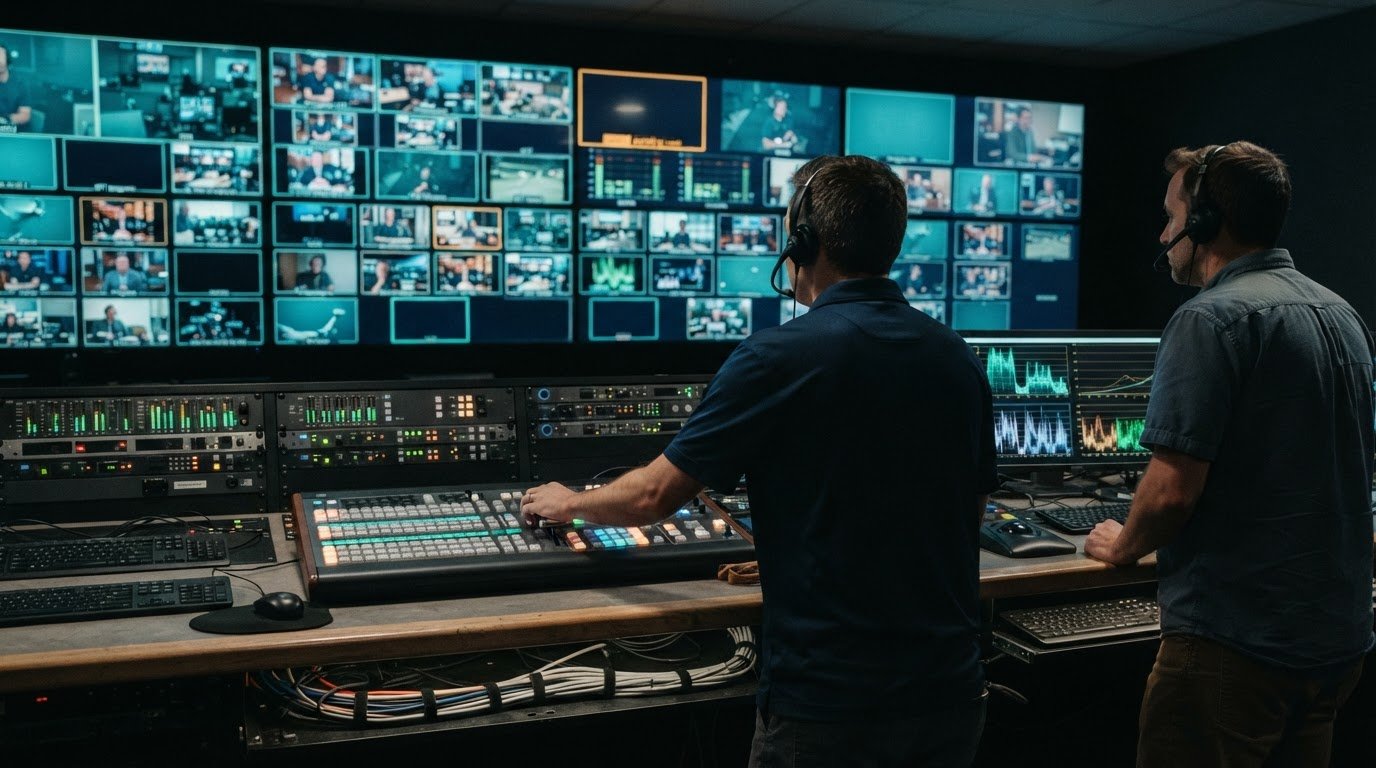
A room full of equipment can still leave operators without a clear operational picture. Effective broadcast master control room design connects signal monitoring, switching, automation, and operator decisions across broadcast and OTT workflows. It combines reliable integration with clear visibility into critical feeds, so teams can identify issues and respond without losing sight of the on-air operation.
Fragmented systems, data silos, and manual escalation can slow response, even when the necessary screens are already in place. What is often missing is a layer that organizes what appears on those screens and escalates conditions that need attention. This article explains how broadcast and OTT workflows can work together, where dashboards and traditional hardware fit, and how an operational intelligence layer can help operators act with greater clarity.
Key Takeaways
- Identify how fragmented systems, siloed data, and missing automatic escalation can weaken operators’ situational awareness.
- Assess where hardware-based workflows constrain flexibility across broadcast, OTT, live production, and distributed teams.
- Plan integration around existing systems, resilient signal paths, scalable infrastructure, and the workflows operators need to manage.
- Use dashboards and multiviewers to prioritize relevant information, while keeping human decisions at the center of response.
- Explore how an operational intelligence layer can unify tools and make timely information visible across control rooms and remote teams.
The Operational Gap in Broadcast Master Control Rooms
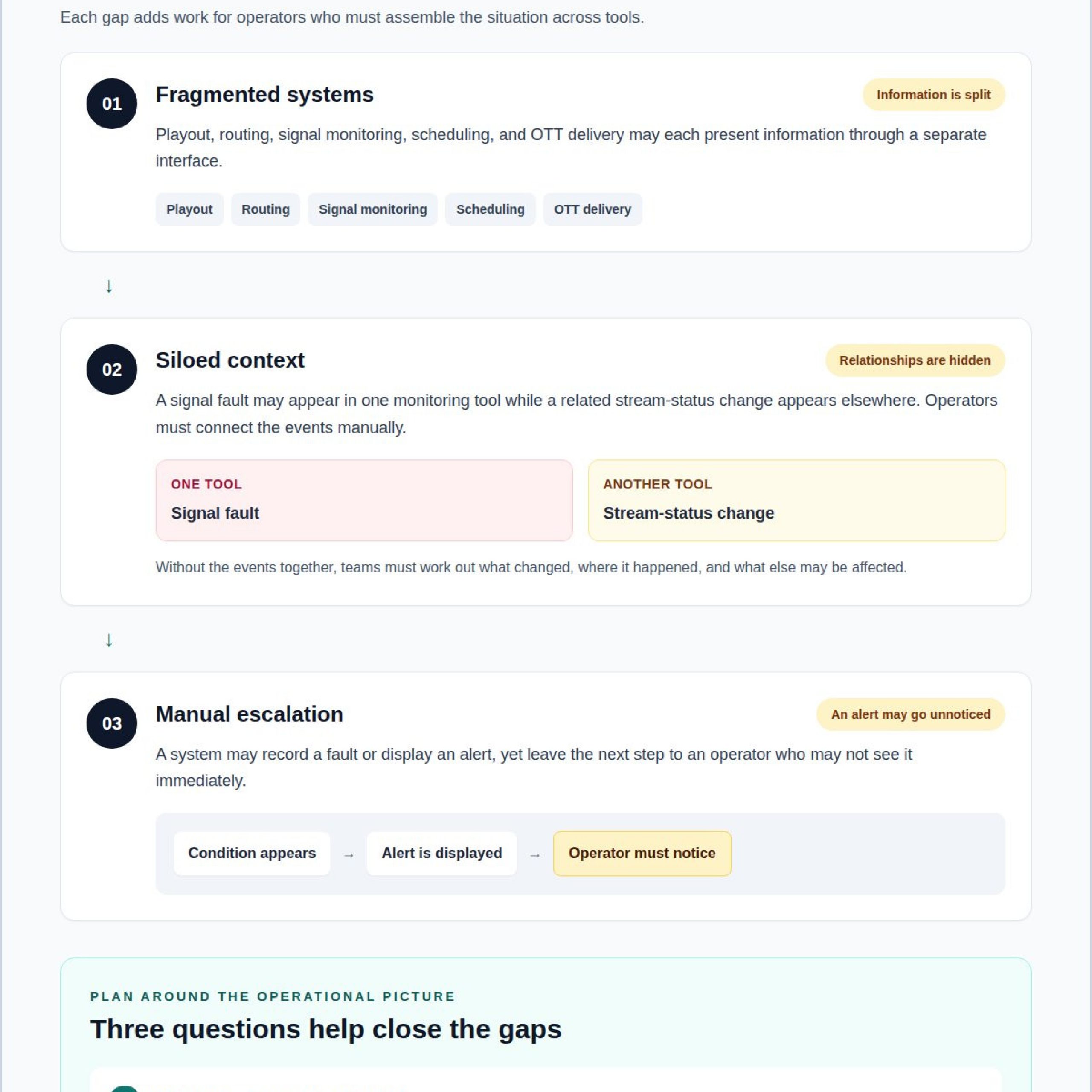
Fragmented systems make it harder to maintain a shared view of on-air operations. Playout, routing, signal monitoring, scheduling, and OTT delivery may each present information through a separate interface. Operators must move between tools and connect events that systems do not correlate. Effective broadcast master control room design starts by identifying which information operators need together and when they need it. The challenge is not simply the number of feeds, but the effort required to understand their relevance.
Siloed data adds friction. A signal fault may appear in one monitoring tool while a related stream-status change appears elsewhere. If operators cannot see those events together, they must recognize the relationship manually, potentially while managing another on-air task. An alert without context can create noise. Teams need to know what changed, where it happened, and what else may be affected before choosing a response.
The third gap is the lack of automatic escalation. A system may record a fault or display an alert, yet leave the next step to an operator who may not see it immediately. Most control rooms already have the screens. What they’re missing is the layer that decides what goes on them – and escalates automatically when something needs attention. Broadcast master control room design should account for how important conditions reach the right people with useful context.
Planning should start with the operational picture: which events require attention, which sources provide context, and how a developing issue should reach the responsible team. A unified view should bring relevant information together without forcing operators to abandon the tools they use to monitor and control broadcasts. Strong broadcast master control room design also makes escalation consistent, so response does not depend solely on someone spotting an alert in a crowded interface.
This challenge also appears in other operational environments. For example, manufacturing process control depends on connecting information sources to support timely decisions. In broadcasting, event-driven situational awareness can surface relevant changes within the wider operating picture. The objective is to reduce the effort operators spend assembling context, so they can focus on judging the situation and acting.
Limits of Traditional Hardware-Based Master Control Rooms
Hardware-based master control rooms can perform defined functions reliably, but fixed signal paths may limit how operators respond to changing needs. Adding an OTT stream to an established over-the-air chain may require new interfaces or routing changes, interrupting familiar workflows. A setup built around SDI sources, for example, may need additional processing when IP feeds join live production. Each change can affect what operators monitor, which controls they use, and where signals go. The original broadcast path may remain intact while newer streams depend on separate equipment and workflows.
That separation can make it harder for teams to coordinate across control rooms. A production team might need to move an event feed from one room to another or share selected signals with a remote operations team. Hardware configured for one room’s routing and displays may not support that change without additional integration, leaving operators to work around separate systems. Event-based work adds another demand: a special live production may require temporary sources, different monitoring priorities, or a revised signal route. A fixed configuration can slow those adjustments and make coordination more difficult.
Physical infrastructure can also constrain how teams adapt as systems evolve. Routing capacity, available connections, and equipment compatibility shape which sources operators can access. If a broadcaster adds channels or changes its mix of linear and OTT distribution, existing equipment may need expansion or replacement. Broadcast equipment is often replaced after five to seven years. During that cycle, teams may have to manage legacy signal paths alongside newer workflows, especially when upgrades happen in stages rather than as one coordinated change.
Traditional hardware still has a clear role in signal transport, switching, and monitoring. Its limitation is scope: a router or multiviewer can handle the feeds connected to it, but may not unify operational context across applications, events, and locations. A live production operator may see the program feed on one system and related status information elsewhere, making it harder to build a shared picture. Hardware performs its assigned function, while people bridge gaps between tools. Effective design therefore treats equipment as part of the operating model, not the whole solution. It plans for changing streams, shared information, and coordinated decisions across control rooms.
Integration of MCRs with Broadcast and OTT Workflows
A hybrid master control workflow coordinates over-the-air transmission, OTT delivery, and IP-based signal paths. A scheduled program might air through a broadcast chain while also reaching viewers through an online stream. Operators need a consistent view of playout status, source selection, and output condition across those routes. Integration connects the workflows so teams can manage distribution changes without treating each destination as an isolated operation.
Cloud-based MCR workflows can use SMPTE ST 2110 for IP-based processing and distribution of audio, video, and metadata streams. SRT and NDI can also support IP-based processing and distribution in cloud-based environments. RIST supports low-latency digital network transmission. These technologies serve different workflow needs, so planning should map each signal’s path, destination, and monitoring requirement before implementation. The result is a clearer basis for coordinating broadcast and OTT operations.
Automation can coordinate repeatable actions within a defined workflow. For example, SCTE-35 event triggers can support ad-insertion workflows alongside existing traffic systems. A playout event can prompt the relevant downstream action, while operators retain oversight of exceptions and live changes. Integrating these processes reduces reliance on manual handoffs between scheduling, transmission, and streaming teams. Testing should confirm how each trigger behaves across the intended signal paths.
Broadcast workflows also need room for different content and operational priorities. A live production may require a distinct source, routing path, or monitoring view from scheduled programming. A remote contribution feed may follow another path before reaching broadcast and OTT outputs. A customizable workflow maps these differences explicitly, including who acts when a source changes or an output needs attention. This keeps the operational sequence aligned with the event.
Facility planning should begin with workflows, not a fixed equipment layout. Designers can trace each signal from acquisition through processing, playout, and delivery, then identify where teams need visibility or control. That map informs connections between existing systems and newer IP or cloud services. It also highlights dependencies that affect reliability, including shared routing and failover paths. A workflow-first plan gives operators a coherent process across broadcast, OTT, and remote operations.
What Makes a Master Control Room Setup Truly Effective?
Effective broadcast master control room design helps operators monitor signals, make decisions, and manage workflows. Routing switchers, matrix systems, multiviewers, monitoring tools, redundant encoders, signal processors, intercom interfaces, centralized control, and automation can support these tasks. Together, they help teams monitor, route, switch, and manage signals for scheduled playout and live transmission. SDI carries signals over dedicated paths; IP-based designs move media through network infrastructure and can support cloud workflows. The right approach depends on the sources, destinations, and operating requirements operators need to manage.
Redundancy helps teams maintain operations when a component fails. Backup power, networking, and signal paths give operators alternatives to keep work moving. A master control room UPS should provide at least 30 minutes of continuous operation. Integration tests can confirm that equipment works together and that failover performs as intended. Automation reduces manual steps during routine switching, leaving operators available to handle exceptions and live decisions.
Shared, modular infrastructure helps teams accommodate planned expansion without disrupting established workflows. A router can begin at 16 inputs/outputs and expand as destinations increase. A broadcast master control room design should also reserve routing capacity beyond current demand and connect new systems with existing equipment. Testing interfaces and control systems as a whole helps expose compatibility issues before they disrupt operations.
Room dimensions and sightlines affect how easily operators can monitor feeds and reach controls. A two-operator room can work in 150 square feet; a facility with 6-10 positions typically needs 400-800 square feet. Nine feet is the minimum recommended ceiling height, while larger rooms with video walls ideally have 10-12 feet. Allowing 1.5-2 metres of desk space per operator supports comfortable access to workstations and controls.
The video wall is where the operational answer appears through vis/ability, an operational intelligence layer that surfaces through the video wall. Angling consoles 5-15° toward that display can support sightlines, while zoned, dimmable lighting between 300-500 lux allows adjustable viewing conditions. Effective broadcast master control room design connects room dimensions, visibility, equipment access, and workflow needs so teams can stay focused during extended operations.
System Integration, Testing, and Operator Training
For U.S. projects, identify the FCC requirements applicable to the facility’s operations. SMPTE and ITU standards provide references for checking master control room inputs and outputs. Connect those technical checks to the actual signal paths and workflows.
Cybersecurity and physical security need consideration across the same operating environment. A design should define who can access systems, how remote connections are controlled, and how equipment areas are protected. These decisions should account for network boundaries, user permissions, and the access operators need during routine work.
Integration starts by mapping the studio’s existing systems and dependencies. The technical plan should connect routing, monitoring, audio control, video infrastructure, and centralized control. It should also identify which existing components remain in service and how new systems exchange signals and status information with them.
Testing should verify the combined workflow, not just each device on its own. Teams can exercise normal playout, source changes, signal loss, and failover scenarios in a test environment. Documented emergency playbooks should reflect the tested response, giving operators a consistent reference when an unexpected event affects transmission.
Traffic systems and ad insertion need explicit integration points. For example, SCTE-35 event triggers can support ad workflows alongside existing traffic systems. Testing should trace each trigger through the intended signal path and confirm that timing, monitoring, and operator alerts align with the operational sequence.
Operator training should follow the room’s actual layout and workflows. Staff need to understand routing changes, monitoring views, escalation paths, and the steps for switching to a documented fallback. Training and system documentation help teams apply the same process across routine operations and live events.
Integrated master control room design brings these elements together before handover. A clear test record, current documentation, and role-based training connect technical readiness with confident operator decisions.
Identify the FCC requirements applicable to the facility’s operations. SMPTE standards provide technical references for checking master control room inputs and outputs against actual signal paths and workflows.
Multiviewers and Production Dashboards: Where Operational Intelligence Appears
A multiviewer can show program feeds, tally signals, and outputs together. That helps operators compare what is going on-air with the signal sources and distribution paths. Multi-channel playout systems also let teams control several streams simultaneously. A production dashboard is most useful when its layout prioritizes the feeds and status information relevant to the current operation.
Scale matters. Monitoring systems can range from 8 to 1,000 inputs across 50 displays, while an MCR may serve one channel or dozens. Operators need readable labels and a clear view of relevant status, not an undifferentiated grid. A dashboard with minimum 20/40 legibility from the furthest operator position helps make shared information usable across the physical room.
vis/ability is an operational intelligence layer that surfaces through the video wall. It acts as the central hub, bringing incoming applications and data together so the wall presents the operational answer. A multiviewer displays selected video sources; vis/ability connects those feeds with information from other tools. This gives operators a broader basis for decisions during live production, playout changes, or distribution issues. The vis/ability platform supports that unified operating picture.
The same view can support multi-use production environments. For example, an event team may need a live program feed and related operational information in the control room, while colleagues follow the same picture remotely. The shared view can also reach command centers, conference rooms, breakout rooms, and huddle rooms. Mobile vis/ability extends access to teams using mobile devices, helping keep distributed participants aligned.
Effective dashboards make information relevant to the decision at hand. Operators can organize views around production, channel, event, or distribution needs rather than showing every source at once. The video wall becomes a useful shared view when vis/ability selects and unifies relevant information. This combines multiviewer visibility with operational context, supporting coordination across physical and remote teams.
Activu Corporation: Control Room Design Services
Activu Corporation provides Control Room Design Services for teams planning a new master control room or addressing gaps in an existing operation. The service connects room design to how operators monitor signals, coordinate workflows, and respond to changing conditions. It is a practical next step when equipment, applications, and operational information need to function as a more coherent environment.
Design decisions should reflect the broadcast operation’s actual needs. The layout, signal sources, operator tasks, and connections to existing systems all shape how a room functions. Activu’s Control Room Design Services address those operational considerations, while its Video Wall Systems provide a shared visual environment for relevant information. The focus is helping operators access what they need to make decisions.
For teams managing multiple applications and data streams, the vis/ability Platform brings information together as a central operational hub. It provides an operational intelligence layer on the video wall, unifying tools and data so operators can see relevant context. Event-Driven Situational Awareness helps surface information when an event needs attention. Together, these offerings address the gap between separate systems and a useful operating picture.
The operating picture can extend beyond the main control room. Teams in command centers, remote locations, conference rooms, breakout rooms, and huddle rooms may need shared access to relevant information. Mobile vis/ability supports distributed teams using mobile devices. This broader access can help keep participants aligned during coordination, while the control room remains focused on broadcast operations.
Activu’s services are relevant when a facility needs a coordinated approach to room design, application integration, shared visual information, and event awareness. The appropriate design depends on the workflows, systems, and operational priorities involved. For a next step in planning those requirements, contact Activu Corporation.
Frequently Asked Questions
How can a professional design a broadcast master control room layout for efficient operator workflow?
A design process begins by mapping operator responsibilities, handoffs, and routine actions, then using that map to plan the layout. For example, someone responsible for switching sources needs practical access to relevant controls and monitoring, while a supervisor may need a broader operational view. Designers also account for communication between positions and access to shared information. The result should support the team’s actual workflow rather than impose an assumed operating pattern.
What video wall, monitoring, and display specifications should clients consider when planning a modern master control room?
Specify what each display must show, who needs to read it, and from which workstation or location. A program monitor, multiviewer, and operational dashboard serve different purposes, so their content should remain distinguishable. Consider viewing distance, text legibility, source identification, and how display layouts can adapt to changing productions. Also define which feeds and status indicators operators need together, so screen space supports decisions instead of simply accumulating inputs.
How should a provider plan acoustics, lighting, HVAC, and power for a master control room?
Room conditions affect operator concentration, communication, and continuity of operations. Acoustic planning should limit equipment noise that distracts operators while preserving clear conversation between positions. Lighting should support screen viewing and reduce glare, helping operators read information without unnecessary strain. HVAC planning should manage heat from installed systems to maintain comfortable working conditions. Power planning should account for equipment needs and backup arrangements, so teams can maintain operations during an interruption. Consider these factors alongside the room layout, since changes to one can affect comfort, visibility, and communication elsewhere.
How should a provider design redundancy, backup power, and disaster recovery for broadcast master control?
Document the failure scenarios that matter, then map each to a tested fallback. These can include loss of a signal path, network connection, or control-room power. The design should clarify which systems fail over, what operators will see, and who makes the next decision. For cloud workflows, geo-redundant storage can support security and compliance. Emergency playbooks and test environments help teams rehearse recovery before an outage occurs.
What should clients expect during the planning, build, testing, and commissioning of a broadcast master control room?
Expect a progression from requirements and workflow mapping to design, integration, testing, and operational handover. During planning, the team identifies existing systems, signal routes, and operator roles. Integration connects components and checks their behavior together. Commissioning should exercise realistic scenarios, record results, and address identified issues. Before handover, operators should receive system documentation and training tied to their duties, including routine operation and documented fallback procedures.
What are the FCC and SMPTE standards or regulations relevant to broadcast master control room design in the United States?
SMPTE standards are identified as references for checking MCR input and output compliance, and SMPTE ST 2110 can support IP-based processing and distribution. No FCC regulation is identified.