
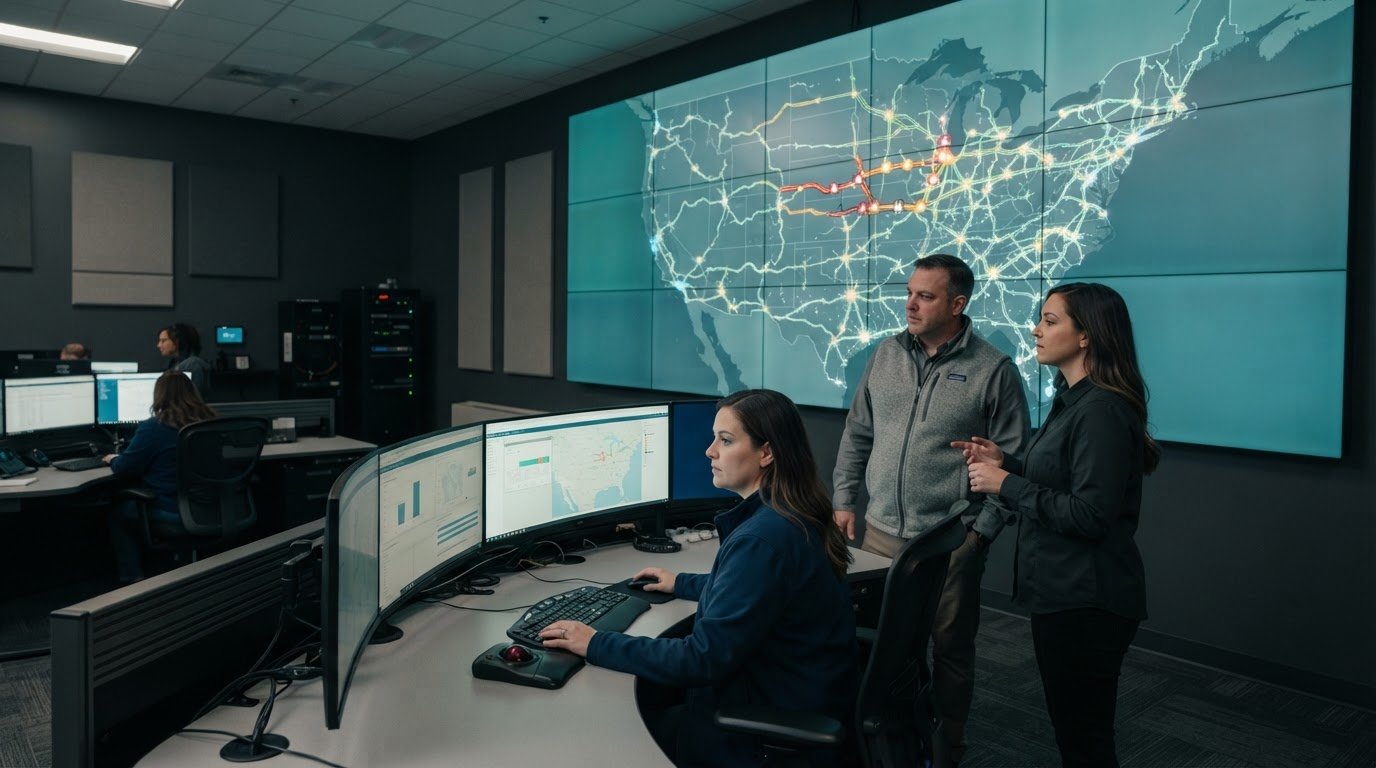
Fragmented systems, siloed data, and missing automatic escalation can leave supply chain teams reacting without a shared operational picture. Effective supply chain operations center design connects decisions to the information and workflows that matter, helping operators spot developing issues and coordinate clear responses.
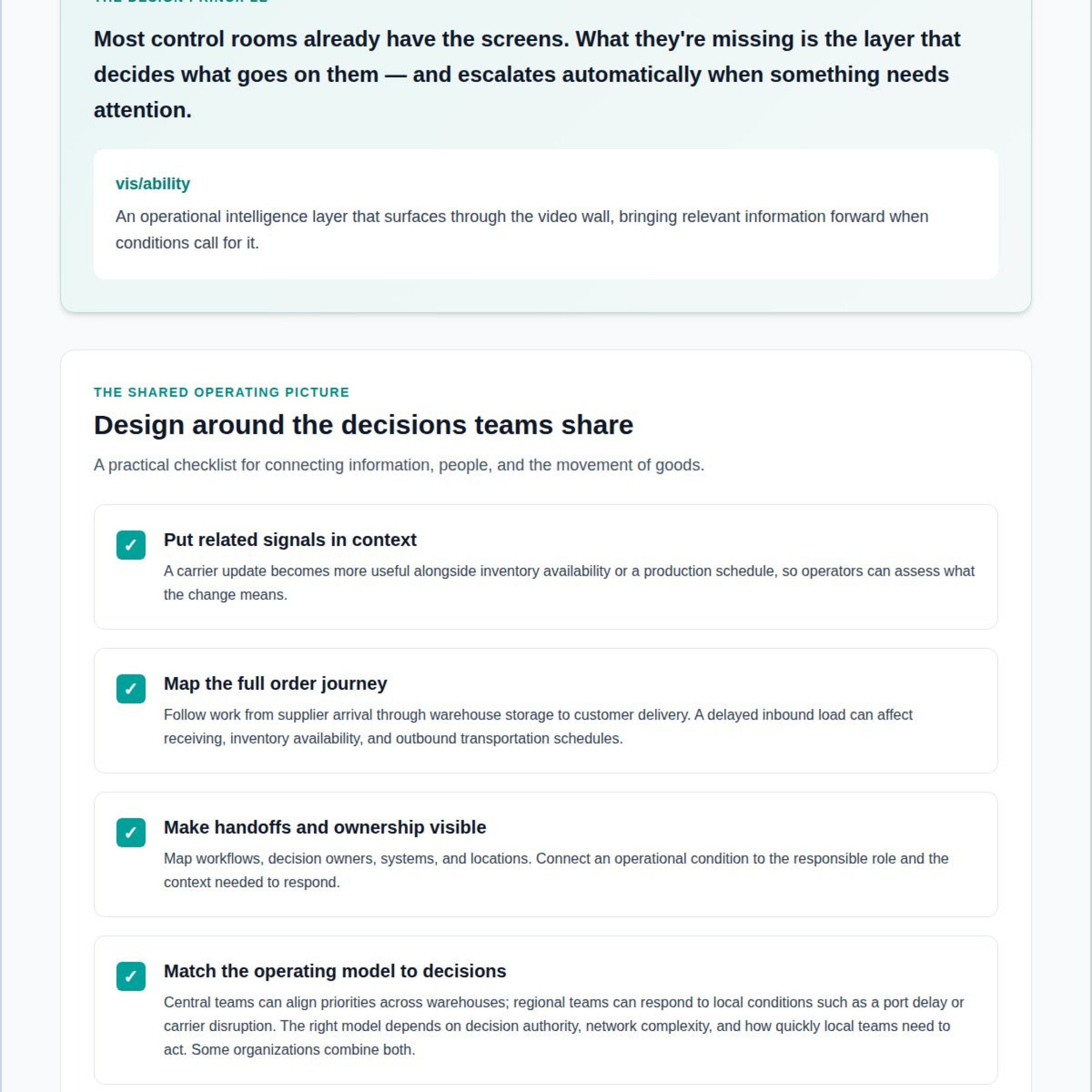
Most control rooms already have the screens. What they’re missing is the layer that decides what goes on them – and escalates automatically when something needs attention. vis/ability is an operational intelligence layer that surfaces through the video wall, bringing relevant information forward when conditions call for it.
A well-planned center also reflects how people work. This article explains how workflows, spatial planning, console furniture, video walls, and operational technology shape a supply chain operations center. It shows how these elements can create a clearer shared picture across planning, production, inventory, and logistics, while keeping operators and their decisions at the center.
Key Takeaways
- Identify how disconnected systems and data silos create blind spots, then see how automatic escalation can help teams direct attention to emerging issues.
- Learn how spatial planning can align operator workflows with the movement of goods through transportation, distribution, and warehouse operations.
- Explore design principles and staffing practices that support coordinated decisions, clear accountability, and consistent operational performance.
- Consider which inventory, workflow, and logistics indicators can help operators spot delays and adjust priorities.
- See how operational technology and Activu Corporation’s design services can bring relevant information into a shared view for teams across locations.
Why Supply Chain Operations Centers Lose Situational Awareness
Situational awareness erodes when information needed for a decision is scattered across systems. A supply chain team may track inventory in a warehouse platform, shipment progress in transportation software, and production demand in a planning tool. Each feed is useful, but operators must switch contexts and reconcile different timestamps, identifiers, and status labels. Effective supply chain operations center design addresses these gaps so teams can interpret changing conditions without piecing together disconnected views.
Data silos also make information harder to share. A distribution team may know a shipment missed its scheduled arrival while warehouse staff still plan labor around the original delivery time. If the update does not reach receiving, storage, and order coordination teams, each group acts on a different version of events. Their separate responses can compound a disruption. Supply chain operations center design should account for how information moves across organizational boundaries, not just how each application displays its own status.
More feeds do not automatically mean better oversight. Operators may face alerts, maps, status boards, emails, and application windows competing for attention. Without shared context, they must determine which signal matters, whether it is current, and who needs to act. A carrier update, for example, becomes more useful alongside inventory availability or a production schedule. If those relationships remain hidden, routine updates can crowd out consequential changes.
The gap widens when systems record events without escalating them automatically. An alert may remain in its originating application, rely on someone noticing it, or have no clear route to the responsible role. Effective escalation connects an operational condition to an owner and the context needed to respond. Supply chain operations center design must bring integration, shared visibility, and escalation together in one workflow, helping teams manage multiple feeds without constant manual scanning or informal handoffs.
Operations-center workflow and spatial planning
Plan around the full journey of an order, from supplier arrival to warehouse storage and customer delivery. A delayed inbound load, for example, can affect receiving, inventory availability, and outbound transportation schedules.
Centralized and Regional Operating Models
A centralized center coordinates supply chain decisions across locations, while regional centers manage local conditions and execution. A central team can align distribution priorities across warehouses; a regional team can respond directly to a port delay or local carrier disruption. The right model depends on decision authority, network complexity, and how quickly local teams need to act. Some organizations combine both.
Design Principles and Spatial Planning
Spatial planning arranges people and information around the decisions they share. Place transportation coordinators near colleagues managing warehouse capacity, for example, so they can assess a late truck against receiving schedules. Clear sightlines, manageable acoustics, accessible workstations, and space for briefings support coordination. Build and operating costs depend on facility scope, integration, staffing, and continuity requirements; pricing is project-specific and provided after a quote request.
Planning, Building, and Launching
A design professional begins by mapping workflows, decision owners, systems, and locations. The organization provides its operational priorities, current applications, user roles, and constraints. The design team then develops the room plan and integration approach, configures the environment, and tests representative workflows. Before launch, operators rehearse scenarios such as a missed delivery or inventory shortage, then refine escalation paths and operating procedures.
Risks and Design Examples
Risk planning addresses unauthorized access, system outages, inaccurate data, and unclear decision ownership. Cybersecurity controls should align with the organization’s policies, while continuity planning defines how teams coordinate if a facility or application becomes unavailable. A distribution-focused center might bring warehouse status, carrier updates, and order priorities together; a transportation-focused model might emphasize route conditions and shipment exceptions. Each design should support the decisions specific to its network.
An operations-center workflow can follow the full path of work. Supply chain management procedures cover planning, engineering, producing, and delivering goods or services from suppliers to final customers. Supply chain management also encompasses forecasting, procurement, production planning, distribution strategy, and customer fulfillment—coordinating everything from primary materials to industrial packaging from suppliers like OEM Materials & Supplies. Mapping these activities makes the center’s relevant handoffs and decisions visible, from supplier-facing planning through production and delivery. Operations also include manufacturing lines, workflow design, quality control, labor management, scheduling, maintenance, and continuous improvement initiatives such as Lean and Six Sigma. Spatial plans can group people and information around shared decisions while keeping workflows and responsibilities clear.
Integrated supply chain platforms can connect planning, procurement, logistics, and inventory data to support coordination across a network. In an operations center, connected data domains can inform the workflows teams use, rather than leaving planning, logistics, and inventory isolated. Tracking work-in-progress inventory can reveal when goods spend too long at a production stage and help teams consider workflow adjustments. Use that visibility in workflow review and spatial planning: position decision-makers and shared information so production delays can be considered alongside scheduling, quality control, maintenance, and downstream distribution. These connections help the center reflect the sequence of work and the coordination it requires.
What are the key design principles for a supply chain operations center?
Effective supply chain operations center design starts with the decisions operators must make. A team managing production constraints needs different information from one reviewing customer fulfillment. Map each decision to its owner, supporting context, and expected action. Strong operations aim to maximize throughput, minimize waste, and ensure consistent quality. These goals provide a practical basis for setting design priorities.
Prioritize information by operational consequence. A change in work-in-progress inventory, for example, can show that goods are spending too long at a production stage. Display the measure alongside relevant workflow context so planners can assess scheduling or resource adjustments. Keep routine status updates visually distinct from conditions requiring action. This hierarchy helps operators focus without treating every feed as equally urgent.
Use consistent definitions across functions. If procurement and fulfillment interpret “available” differently, even a shared dashboard can prompt conflicting decisions. Establish common labels for order status, inventory condition, and ownership. Then tailor views to each responsibility: a production lead may need stage-level work-in-progress, while a fulfillment coordinator needs order priorities. Each view should support a clear decision.
- Connect information to action: Pair each operational condition with a responsible role and response path.
- Preserve context: Show timestamps and source details so operators can interpret updates accurately.
- Support coordination: Align shared information with the dependencies between adjacent functions.
- Review performance: Use throughput, waste, and quality measures to identify workflows needing adjustment.
Design for changing operating conditions. A supplier delay, production constraint, or order surge can change which indicators deserve attention. Define how teams reprioritize work and communicate changes across functions. Test the layout and information hierarchy against a representative scenario, such as a production schedule affected by a component shortage. This can reveal missing context or unclear decision ownership.
Supply chain operations center design should keep operators’ tasks central. Workstations, shared information, and collaboration areas should support the sequence of decisions people make. Clear priorities and visible responsibilities help teams coordinate operational adjustments more precisely.
How should a supply chain operations center be staffed and organized?
Organize the team around operational decisions, not application ownership. A control-tower lead can coordinate priorities while transportation, warehouse, procurement, and production specialists interpret conditions in their areas. If a supplier delay threatens a production schedule, for example, procurement confirms the constraint, production assesses its impact, and the lead coordinates the response. Named decision owners keep important issues from drifting between functions.
Define accountability before an event occurs. The transportation coordinator should own carrier exceptions, while a warehouse lead assesses receiving capacity and inventory implications. A customer fulfillment representative can identify which orders need priority. For each issue type, document who detects it, assesses impact, approves a response, and communicates the decision. This structure lets teams act without requiring every specialist to monitor every feed.
Give the operations lead authority to convene the right functions when an issue crosses departmental boundaries. A delayed component may involve procurement, production planning, and customer fulfillment. The lead maintains a common action log recording the issue, owner, decision, and next update. This record supports shift handoffs and prevents teams from reopening decisions without new information.
Set a clear operating rhythm. At shift handover, the outgoing coordinator briefs the incoming lead on open exceptions, assigned owners, and pending decisions. During routine reviews, teams examine unresolved constraints and confirm whether earlier actions changed the operational picture. Escalation criteria should distinguish an informational update from an issue requiring immediate leadership attention, such as a production stoppage affecting priority orders.
Cross-train staff on adjacent workflows while preserving role accountability. A transportation analyst who understands warehouse receiving can explain why an arrival change matters; the warehouse lead still owns the capacity assessment. Scenario exercises can test handoffs involving a missed delivery, inventory discrepancy, or production delay. After each exercise, managers refine contact paths, decision authority, and role coverage. This supports dependable coordination when workloads shift or key specialists are unavailable.
What data, KPIs, and dashboards should an operations center monitor?
Monitor the data connecting planning with execution: forecasts, procurement status, production schedules, inventory, transportation, and customer fulfillment. A component shortage matters, for example, when it threatens a scheduled production run or an order commitment. Include timestamps, locations, and source context so operators can distinguish current conditions from older updates. Each feed should support a decision, not just add another display.
Choose KPIs that show whether the network is meeting operational priorities. Order fulfillment status reveals which commitments are at risk; inventory availability shows whether goods can meet demand. Transportation exceptions identify delayed or disrupted shipments, while production throughput and quality measures help locate constraints. Strong operations aim to maximize throughput, minimize waste, and ensure consistent quality. Use those goals to select actionable measures.
Track work-in-progress inventory by production stage. It can reveal when goods spend too long at a step, giving planners a basis for adjusting workflows. Reliable smart factory sensors, such as those from Contrinex, help automate this tracking across demanding production lines and feed real-time stage data back to the control room. Pair the measure with production schedule status and relevant inventory availability. If unfinished goods accumulate at a stage, operators can investigate its queue, resource needs, or upstream timing before the delay affects downstream orders.
Organize dashboards around decisions and roles. A production view can emphasize schedule status, work-in-progress, and quality exceptions. A distribution view can show order priorities, warehouse availability, and shipment progress. A leadership view can summarize cross-functional risks and unresolved decisions. Clear definitions matter: teams need to interpret “available inventory” consistently across procurement, production, and fulfillment.
- Inventory: Available stock, work-in-progress, and goods awaiting receipt.
- Production: Schedule adherence, throughput, quality exceptions, and stage queues.
- Transportation: Shipment status, route disruptions, and arrival changes affecting receiving.
- Fulfillment: Order status, priority commitments, and constraints affecting delivery.
Review each KPI against a defined owner and response. If a transportation exception threatens a priority order, the dashboard should help identify the affected shipment, fulfillment commitment, and responsible function. Retire measures that prompt no decision, and refine views as operational priorities change.
Video walls, console furniture, and operational technology
Supply chain management systems track procurement, inventory, demand, and shipments, but applications may present different priorities. A market change can affect sourcing decisions before it appears in a warehouse workflow. Operators need to relate those signals to the decisions at hand. Fragmented systems and siloed data make it harder to see how disruptions affect connected operations, while the lack of automatic escalation can leave important changes unnoticed.
Most control rooms already have the screens. What they’re missing is the layer that decides what goes on them – and escalates automatically when something needs attention.
vis/ability is an operational intelligence layer that surfaces through the video wall, bringing applications and data streams together as a central hub. Event-driven escalation can direct attention to developing conditions, with connected information available to support assessment. A supplier delay, for example, can be considered alongside procurement status and production demand. Operators use that context to judge the impact and coordinate an appropriate response.
The video wall is where the answer appears through vis/ability. Individual workstations can keep detailed applications available to specialists, while the wall provides a common reference for the team. Operators can see how an emerging disruption relates to broader priorities without giving every feed equal attention.
Console furniture should support the tasks performed at each position. A transportation coordinator may need shipment applications, while a procurement specialist reviews supplier updates. Place related roles where they can coordinate, and plan sightlines so operators can reference shared information from their workstations. Position equipment and controls to match the team’s actual workflow.
vis/ability connects teams in command centers, remote locations, conference rooms, breakout rooms, huddle rooms, and on mobile devices. Distributed participants can work from shared operational context. A cybersecurity common operating picture can bring security information into coordination, linking emerging concerns with the operational decisions they may affect.
Activu Corporation: Control Room Design Services
Activu Corporation’s Control Room Design Services help organizations plan an operations center around supply chain decisions. Use these services when workflows, applications, and operator needs must come together in a clearer operating environment. The design considers coordination across procurement, production, transportation, and fulfillment, then aligns the room and information flow with those demands.
Video Wall Systems provide a shared space for operational information. Their value depends on what appears, when it appears, and how it relates to team priorities. The vis/ability Platform unifies applications and data streams, helping teams bring relevant context into view instead of treating each source as a separate destination.
Event-Driven Situational Awareness helps teams focus on developing conditions. When an operational event requires attention, automatic escalation can surface it for the relevant team. Operators can focus on information connected to a decision, such as a shipment disruption alongside inventory or order context. Teams remain responsible for interpreting that information and deciding how to respond.
The operating picture can support collaboration beyond the primary control room. Teams can work across command centers, remote locations, conference rooms, breakout rooms, huddle rooms, and mobile devices. This matters when a supply chain issue involves specialists who are not together or leaders who need to understand the same developing situation from another location.
A design effort can bring together spatial planning, application integration, video wall presentation, and operational workflows. Activu’s offerings connect these elements through Control Room Design Services, Video Wall Systems, the vis/ability Platform, and Event-Driven Situational Awareness. The appropriate configuration depends on the organization’s functions, systems, and decision requirements.
For a discussion about your operations center requirements, contact Activu Corporation.
Frequently Asked Questions
What is a supply chain operations center and what functions does it support?
A supply chain operations center coordinates oversight across the movement of goods, from sourcing and production through delivery. It helps teams connect a change in one function to its consequences elsewhere. For example, procurement can flag a component shortage, production can assess its effect on planned output, and fulfillment can identify orders at risk. The center supports shared decisions across these functions rather than replacing their specialized systems.
What technology and software are needed for a supply chain operations center?
Technology should connect the applications operators rely on and bring useful information into a shared view. Activu’s vis/ability Platform can integrate sources such as SCADA, GIS, video management systems, and dashboards. It supports real-time maps, video feeds, dashboards, and event management. Teams can interpret operational issues with relevant system context, while mobile access supports coordination beyond the main operations room.
How do you design the layout and ergonomics of a supply chain operations center?
Design the layout around operator tasks, sightlines, collaboration, and access to frequently used controls. Position people who coordinate closely near one another, and make shared information visible from workstations and briefing areas. Adjustable work surfaces and seating can support different users and tasks. Account for screen glare, ambient noise, cable routing, and clear movement paths. Test the planned arrangement against representative workflows before finalizing the room.
What are examples of successful supply chain operations center designs?
A distribution-focused design can combine warehouse status, carrier updates, and order priorities. A transportation-focused design can emphasize route conditions and shipment exceptions.