
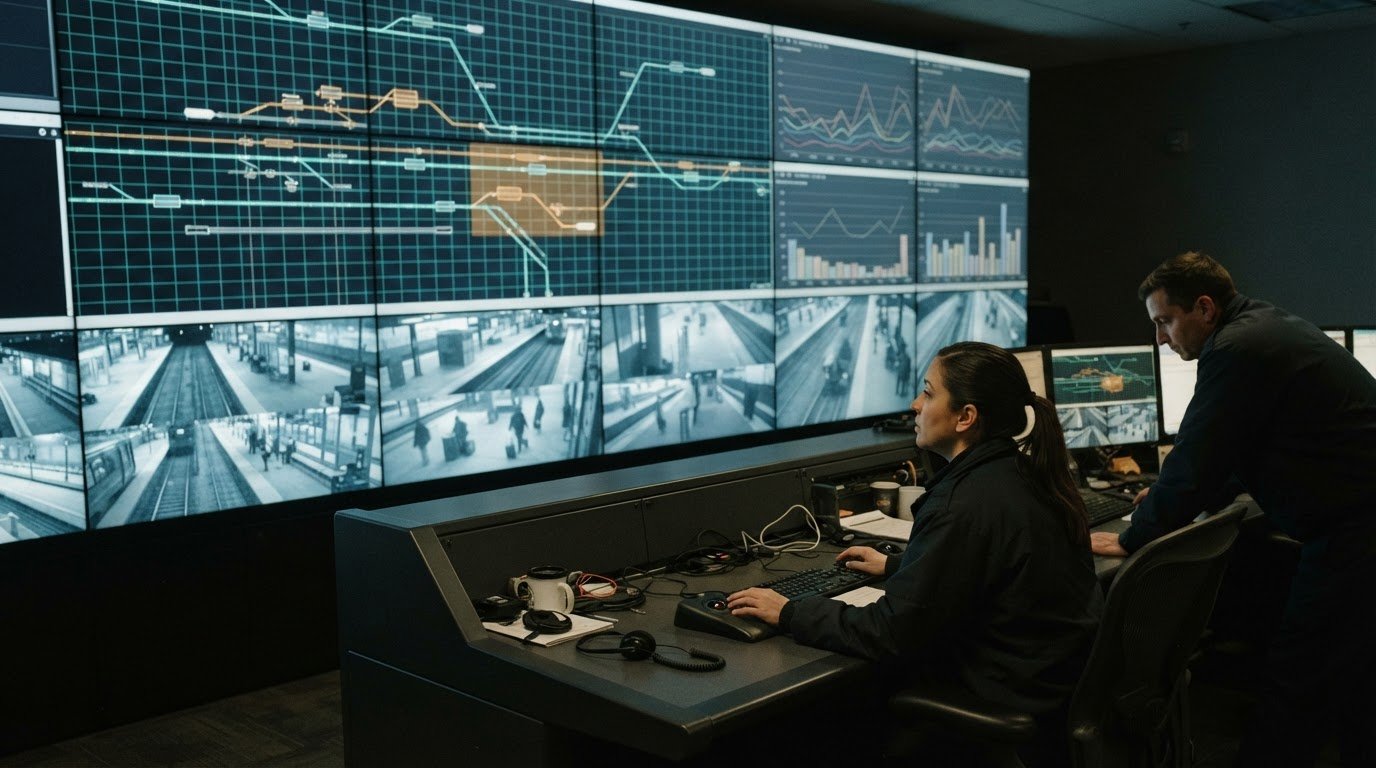
Situational awareness only becomes useful when it changes a decision. Understanding what situational intelligence is starts with that distinction: it combines awareness of what is happening now with context from historical data, helping teams interpret conditions, anticipate what may happen next, and choose a timely response. Real-time feeds reveal developing events; historical patterns help operators assess their significance.
That judgment becomes harder when information is scattered across systems and silos, or when an emerging issue is not escalated automatically. Operators need essential information prioritized and shared as a common operating picture, while people remain responsible for interpreting it and acting. Most control rooms already have the screens. What they’re missing is the layer that decides what goes on them – and escalates automatically when something needs attention. Activu’s vis/ability platform brings operational information together, with event-driven situational awareness that helps teams focus on changing conditions. This article explains how situational awareness supports decisions, how real-time and historical data work together, and how integrated information can help teams respond with greater clarity.
Key Takeaways
- Fragmented feeds, operational silos, and missing automatic escalation can delay recognition of developing incidents.
- Situational awareness means perceiving and understanding changing conditions, then anticipating what may happen next.
- Situational intelligence turns relevant information into timely decisions by combining interpretation, context, and response.
- Teams can assess effectiveness by examining whether they share an accurate operating picture, prioritize tasks, and coordinate decisions.
- Event-driven integration can bring essential information together so teams have a clearer basis for action across operational settings.
Why Control Rooms Struggle With Situational Awareness
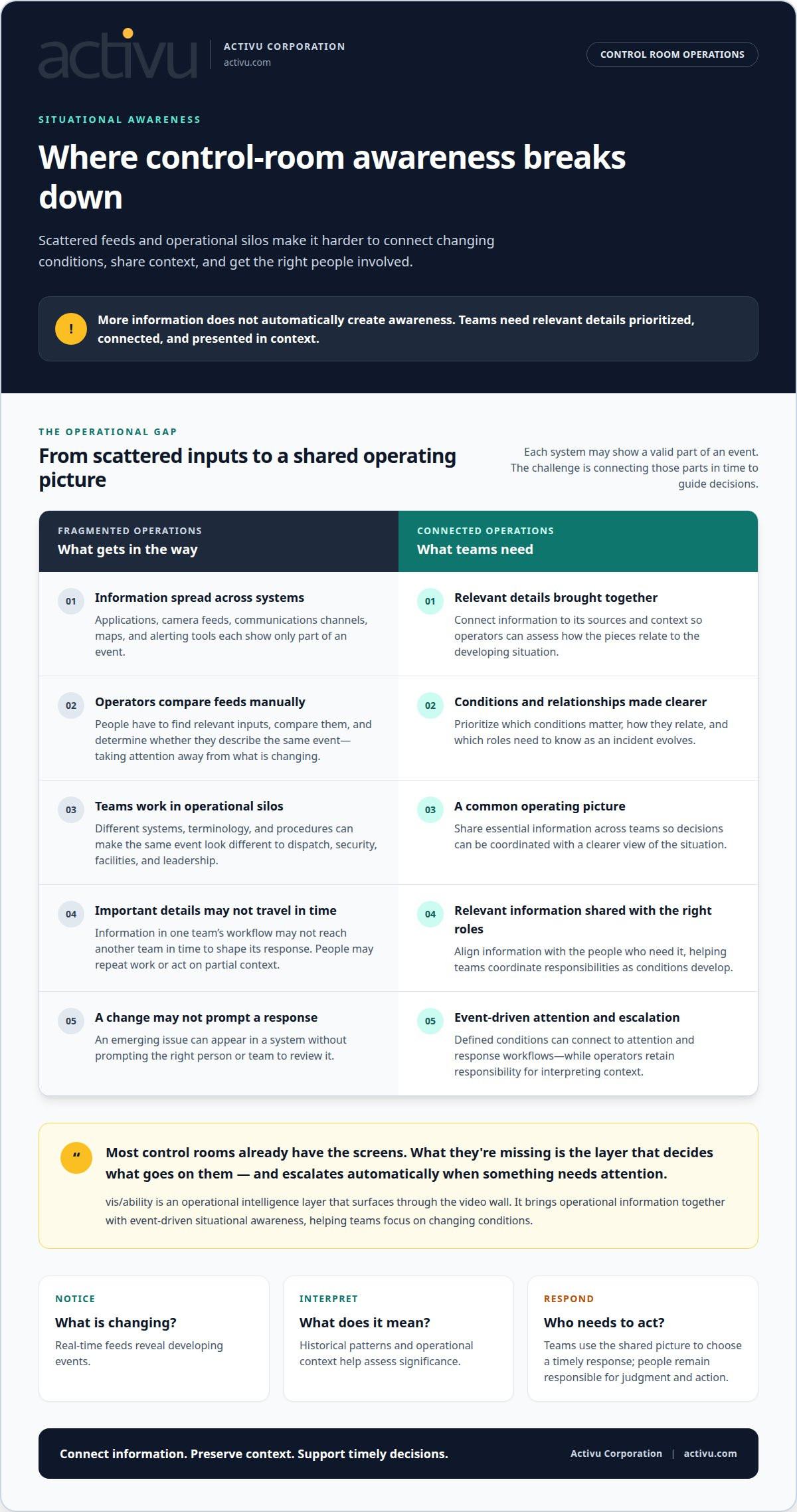
Control room situational awareness problems often begin before an incident reaches an operator. Information is spread across applications, camera feeds, communications channels, maps, and alerting tools. Each system may show a valid part of an event, but operators still have to find the relevant feeds, compare them, and determine whether they describe the same developing situation. That effort takes attention away from understanding what is changing and who needs to act.
Operational silos add to the problem. Teams may use different systems, terminology, and procedures, so the same event can look different to dispatch, security, facilities, and leadership. Details recorded in one team’s workflow may not reach another team in time to shape its response. Without a shared operating picture, people make decisions with partial context, repeat work, or act on assumptions others cannot see.
More information does not automatically create awareness. Operators need relevant details prioritized, connected to their sources, and presented in context. When every feed demands equal attention, it can be difficult to distinguish a developing incident from routine activity. Better coordination depends on identifying which conditions matter, how they relate, and which roles need to know.
Automatic escalation addresses a critical gap: a change may appear in a system without prompting the right person or team to review it. An event-driven approach can connect defined conditions to attention and response workflows, while operators retain the judgment needed to interpret context. This matters across public safety operations, where dispatch and command teams need relevant information aligned as an incident evolves.
Most control rooms already have the screens. What they’re missing is the layer that decides what goes on them – and escalates automatically when something needs attention. vis/ability is an operational intelligence layer that surfaces through the video wall, presenting relevant operational context according to team priorities. The wall is where the answer appears, giving operators a clearer view of what needs attention. The value is in connecting information and escalation logic to support human decisions, not in adding another display to manage.
What is situational awareness?
Situational awareness means noticing conditions, understanding their meaning, and anticipating what may happen next. Real-life examples include a dispatcher connecting a caller’s report with a location, or a supervisor recognizing concern in a team member’s behavior.
Situational Awareness in Security and Intelligence
The Homeland Security Act of 2002 defines situational awareness as information gathered from various sources and communicated to emergency managers and decision-makers for incident-management decisions. In security settings, that means interpreting reports, observations, and system data in context. An alert matters more when operators can relate it to a location, an active event, and the people responsible for responding.
Awareness also depends on what people can observe directly. A camera or drone may provide useful imagery outdoors, while a basement, tunnel, or enclosed facility may be beyond aerial observation. In those environments, staff reports, available sensors, and software can help teams gather and interpret relevant details.
Situational Awareness and Situational Intelligence
Situational awareness is an understanding of current and changing conditions; situational intelligence uses that understanding to support timely, informed decisions. The distinction matters because collecting information alone does not reveal which action is appropriate. Operators must interpret the context, identify what matters, and respond as conditions develop.
For example, a facilities alert may take on greater significance when considered alongside a staff report and information about the affected area. Sensemaking connects those details and considers what may happen next. Teams can then share the relevant picture, coordinate responsibilities, and prepare a suitable response instead of treating each input as an isolated event.
Practice can develop awareness. A manager might review a workplace interaction with a coach, identify missed cues, and consider how a colleague’s words or body language affected the conversation. The Institute for Social and Emotional Intelligence Coaching Toolkit describes situational awareness as an emotional intelligence competency. Recognizing emotion and social context can help leaders respond constructively.
In a workplace meeting, a leader might notice that an usually engaged employee has stopped contributing. That cue alone explains little, but a respectful follow-up may reveal a concern affecting the team. In places drones cannot reach, such as an underground service corridor, awareness instead depends on available observations and reports interpreted in their operational context.
What are the key components of situational intelligence?
To understand what situational intelligence means in practice, look at how people connect information to decisions. A team needs clear requirements, reliable ways to gather inputs, methods for sharing them, and processes for interpreting change. For example, a dispatch team assessing a road closure needs its location, current impact, and likely effect on nearby routes.
The team situation awareness model identifies four factors that help build shared awareness: requirements, devices, mechanisms, and processes. Each supports a distinct part of the decision cycle.
- Requirements: Define the information needed for a decision. A hospital operations team might prioritize an equipment outage’s location, affected services, and current status.
- Devices: Use appropriate tools to gather and display information. A team may draw on radios, sensors, maps, and incident-management software.
- Mechanisms: Establish how information moves between people and systems. A shared alert channel can connect a field report to the team monitoring the affected area.
- Processes: Set expectations for interpreting information and coordinating action. During a facility disruption, teams can assign responsibilities and update their shared picture.
Sensemaking helps explain situational intelligence by showing how people connect details and anticipate where events may lead. An isolated alarm may indicate equipment trouble; paired with a technician’s report and a service-area map, it can reveal which operations need attention first.
People also need knowledge relevant to their roles. In a company, employees gather information, consider stakeholders’ motives, make decisions, and anticipate what may happen next. A supervisor handling a schedule change, for example, weighs staffing availability and the effect on dependent teams.
Shared awareness requires team members to compare their understanding. Before acting, responders can question assumptions, identify conflicting reports, coordinate priorities, and plan contingencies. These practices help teams turn separate observations into a coordinated assessment, while people retain responsibility for judging meaning and choosing a response.
Sensemaking is an ongoing effort to understand connections and anticipate how events may develop so people can act effectively. It focuses on relationships among information and the possible direction of events.
Listening carefully to friends, family members, and colleagues can help someone recognize needs expressed beneath the words. Paying attention to what people say, and what it may indicate about their needs, can deepen understanding of a situation.
How does situational intelligence differ from situational awareness?
Situational awareness describes what a person perceives and understands about current conditions. To understand situational intelligence, consider how people use that awareness to guide decisions. In a dispatch center, an operator may notice a road obstruction on a map. Intelligence develops when the operator assesses its impact, considers available routes, and coordinates an appropriate response.
Awareness helps people understand what is happening and how conditions are changing. Situational intelligence adds interpretation and judgment, including consideration of what may happen next. A facilities team that sees water rising near electrical equipment can assess the location, identify potential operational effects, and decide whether preventive action is needed.
Sensemaking often explains events that have already occurred, while situational awareness supports a forward-looking view. John Boyd’s observe-orient-decide-act loop illustrates how these capabilities connect: observing and orienting build understanding, while deciding and acting apply it. A security team reviewing a door alert, camera view, and staff report can interpret the activity and choose a response in context.
- Awareness: A transit operator notices that a platform is becoming crowded.
- Interpretation: The operator connects the crowding with a service disruption and considers its cause.
- Projection: The team assesses whether passengers may move toward another platform or entrance.
- Action: Staff coordinate communication and response as conditions develop.
These capabilities work together. An alert can establish awareness, but its source, context, and relevance shape the decision. For example, a hospital operations team can consider an equipment report alongside its location and current service needs before setting priorities.
In short, situational intelligence means moving from perceiving a condition to interpreting its significance and selecting a response. Technology can bring information together, but people still judge its meaning and decide what action fits.
In imaging, situational awareness means understanding what is happening around you and interpreting collected data to identify what matters and support a timely response. It is not simply a record of what appears in an image: information must be understood in relation to surrounding conditions. Awareness also unfolds over time. A person perceives and understands the environment as it changes, then uses that understanding to anticipate future events early enough to help avoid bad outcomes. This forward-looking element makes awareness useful before a condition becomes a problem, not only after its effects are visible. Projecting a situation’s future status is therefore part of situation awareness, not a substitute for interpretation or decision-making.
Situational awareness can also mean a person’s understanding of their immediate surroundings. That knowledge is most useful when connected to what may happen next. Sensemaking generally looks backward to explain events that have already taken place; situation awareness looks forward, projecting what is likely to happen so decisions can be made in time. The distinction is one of emphasis, not a strict separation: making sense of information helps establish a useful picture, while projection gives that picture a future orientation. USAF pilots associated situational awareness with the observe and orient phases of John Boyd’s observe-orient-decide-act loop. Those phases help form an understanding of conditions; later decisions and actions can draw on that understanding. In practice, awareness depends not only on recognizing a signal, but also on assessing its relevance and anticipating how the situation may develop.
How is situational intelligence used in military, emergency response, and public safety
Military, emergency response, and public safety teams use situational intelligence to turn incoming reports into coordinated decisions. During a developing incident, information may arrive from field personnel, sensors, cameras, radio traffic, and public channels. Teams assess how each report relates to the event, identify what needs attention, and update operational priorities as conditions change.
In military operations, a field report can be interpreted alongside location data, unit updates, and mission objectives. Commanders use the combined picture to assess changing conditions, question assumptions, and coordinate tasks. If reports conflict, teams need to identify the discrepancy before acting. Planning contingencies helps units prepare for possible changes without treating uncertain information as fact.
Emergency managers may receive dozens or even hundreds of pieces of information at once. During a flood, for example, reports about road access, water levels, shelters, and resource needs can arrive through different channels. Teams filter information for quality, consider its source and context, and communicate through two-way channels so field responders can clarify details and command staff can share priorities.
Public safety teams use the same reasoning during incidents that require coordination across agencies. A reported hazard may involve dispatch, officers in the field, and emergency managers. Teams can compare perceptions, assign responsibilities, and prioritize tasks using a common picture. Body cameras, fingerprint scanners, and facial-recognition software can provide data, but people still interpret its relevance to the incident.
Early warning information also supports preventive decisions. If monitoring indicates a possible tsunami or earthquake threat, emergency teams can assess the warning, identify exposed areas, and prepare communications or response measures. The value comes from connecting the alert to the conditions and people affected, then conveying useful information to decision-makers and responders.
Across these settings, teams rely on a disciplined cycle: gather reports, assess their source and context, resolve conflicting accounts, share priorities, and revise plans as the situation develops. This helps military leaders, emergency managers, and public safety personnel move from scattered inputs toward informed, coordinated action.
How can situational intelligence be assessed or measured
Assess situational intelligence by examining how people interpret information and decide what to do. In a dispatch exercise, evaluators can track whether an operator identifies the relevant location, connects reports, recognizes conflicting details, and communicates a clear priority. Assessment should test judgment and coordination, not just whether someone can access a dashboard.
Use practical indicators tied to operational tasks. For example, a team can review whether members:
- Recognize which incoming reports relate to the same incident.
- Separate confirmed observations from assumptions during a briefing.
- Share an accurate picture of conditions with colleagues.
- Identify a likely next development and prepare a response.
- Update priorities when new information changes the situation.
After a simulated facility disruption, a team lead can compare each member’s assessment with the final incident timeline. This can reveal whether someone missed a cue, misunderstood its context, or communicated it too late. Reviewing the decision path helps distinguish a data-access problem from a sensemaking or coordination gap.
Research on situational competencies involving over 11,640 participants reported correlations of r = .34-.37 with leadership effectiveness. These results point to a measurable relationship, not a substitute for evaluating performance in a specific role. For workplace assessment, observers can examine how a manager notices changing conditions, considers stakeholder needs, and adjusts plans.
Decision quality offers another useful measure. Early validation reported a 67% improvement in decision-quality metrics. In operational settings, teams can assess decision quality by reviewing whether the chosen action matched available evidence, addressed the most relevant risk, and reflected the information known at that time. A later outcome alone cannot show whether the original decision was sound.
Track patterns across exercises and real incidents. If a public safety team repeatedly receives conflicting field reports, assess how effectively it identifies discrepancies and updates its shared picture. Combine structured observation, incident reviews, and staff feedback to locate strengths and gaps. The resulting assessment shows whether people can move from incoming information to coordinated, context-aware action.
Activu Corporation: Event-Driven Situational Awareness
Activu Corporation helps operational teams connect information and bring relevant context into view when fragmented applications and delayed escalation hinder decisions. Its event-driven situational awareness solutions support a more coordinated operating picture, helping people focus on developing conditions rather than searching manually across disconnected sources.
The vis/ability Platform serves as the central hub for information from integrated applications and operational tools. It is an operational intelligence layer that surfaces through the video wall. The wall becomes the place where an answer appears because vis/ability organizes and presents the information teams need. Operators can see relevant context together and make decisions using their judgment.
This approach fits environments where dispatchers, security staff, and leaders need different views of the same evolving event. When an alert arrives alongside camera information and operational data, application integration can bring those sources into a common picture. Event-driven awareness helps focus attention on changing conditions and supports escalation when something needs attention.
Operational work also extends beyond a single control room. Activu’s offerings include Video Wall Systems and Mobile vis/ability, supporting teams across command centers, remote locations, conference rooms, breakout rooms, huddle rooms, and mobile devices. The aim is continuity: teams can work from shared operational context even when their roles and locations differ.
Consider Activu when disconnected systems, manual monitoring, or limited information sharing make developing events difficult to understand. The right approach depends on the operational environment, the applications in use, and how teams need information organized. Activu’s control room design services and application integration can align the operating picture with the decisions people need to make, keeping essential information visible and useful.
To discuss your operational needs, contact Activu Corporation.
Frequently Asked Questions
How is situational intelligence used in business and leadership?
Leaders use situational intelligence to adjust decisions as business conditions and stakeholder needs shift. For example, when a supplier delays a key component, a project manager can assess which milestones depend on it, consult affected teams, and revise priorities. The leader can then explain the decision, assign follow-up responsibilities, and monitor whether the revised plan addresses the disruption.
What skills improve situational intelligence?
Active listening, critical thinking, emotional self-awareness, and clear communication strengthen situational intelligence. A manager can practice by listening for concerns during a planning meeting, separating direct evidence from assumptions, and asking focused questions before deciding. Reviewing what changed and how the decision affected the team can help identify missed cues and improve judgment in future situations.
What are the limitations or risks of relying on situational intelligence?
Fragmented systems, information overload, and missing automatic escalation can delay recognition of developing incidents. Software can bring data together, but it cannot ensure users understand it. Situational-awareness systems can also be vulnerable to enemy attacks.