

How can a security team act quickly when the signals that matter are scattered across systems and departments? Fragmented feeds, operational silos, and missing automatic escalation make it harder to distinguish urgent incidents from routine activity. Situational awareness for corporate security teams starts with bringing relevant information together and giving operators a consistent basis for assessing events.
Most control rooms already have the screens. What they’re missing is the layer that decides what goes on them – and escalates automatically when something needs attention. vis/ability is an operational intelligence layer that surfaces through the video wall, connecting information from other tools in a shared operational picture.
This article explains how to assess situational awareness approaches, connect security information, and structure escalation and response around what operators need to know. You’ll learn what to look for in an evaluation framework and how a central platform can support teams across command centers, remote locations, meeting spaces, and mobile devices. The goal is clearer coordination, with technology supporting human judgment at the moment decisions matter.
Key Takeaways
- Situational awareness for corporate security teams improves when disconnected information, competing alerts, and escalation gaps are addressed together.
- Build a shared operational picture by defining decision needs, connecting relevant sources, prioritizing events, and sharing context.
- Compare solutions by how well they integrate information, prioritize events, support escalation, and give teams shared access.
- Start implementation with a workflow review and clear ownership for reviewing, acknowledging, escalating, and communicating events.
- Learn how vis/ability brings operational information together to support coordinated decisions across teams and locations.
Why situational awareness for corporate security teams breaks down
Security teams often work across separate access control, video, incident management, and communication tools. Whether signals originate from door entry intercoms provided by specialists like Mathfel GmbH & Co. KG or wider surveillance sensors, each system may provide a useful signal, but the information can remain isolated from the workflows and people who need to interpret it. Operators must piece together context while alerts compete for attention. Without a defined escalation path, an important event may not reach the right decision-maker with enough context to support a coordinated response.
Collected data becomes shared awareness only when people can understand what it means, who it affects, and what action may be needed.
What situational awareness means for corporate security
Situational awareness describes three connected capabilities: perceiving relevant conditions, understanding their implications, and anticipating how they may change. For security operations, that means more than seeing an alert. A door-access notification, for example, matters differently depending on its location, the people or assets nearby, and other activity unfolding at the same time.
Technology can bring signals and context together, helping teams interpret and communicate what they see. People still assess uncertainty, apply operational knowledge, and decide how to respond. Strong situational awareness for corporate security teams supports that judgment with timely, relevant information rather than replacing it with an automated conclusion.
How fragmented feeds and silos obscure incidents
Separate applications can leave each role with only part of the picture. A security operator may see an alarm, while another team holds the related site information or response update in a different workflow. If staff have to switch systems, contact colleagues, or manually pass details along, shared understanding depends on handoffs that may be delayed or incomplete.
Unprioritized notifications add another challenge. Routine updates and events that may require immediate attention can arrive through competing feeds, making it harder to identify what deserves focus. The answer is not simply to expose more information. Teams need to determine which signals support current decisions, connect them to relevant context, and define who reviews, acknowledges, and escalates each event category.
Most control rooms already have the screens. What they’re missing is the layer that decides what goes on them – and escalates automatically when something needs attention.
A shared operational view and a clear escalation path help security roles work from the same event context. That gives people a better basis to coordinate, verify what is happening, and act with appropriate judgment.
How corporate security teams build a shared operational picture
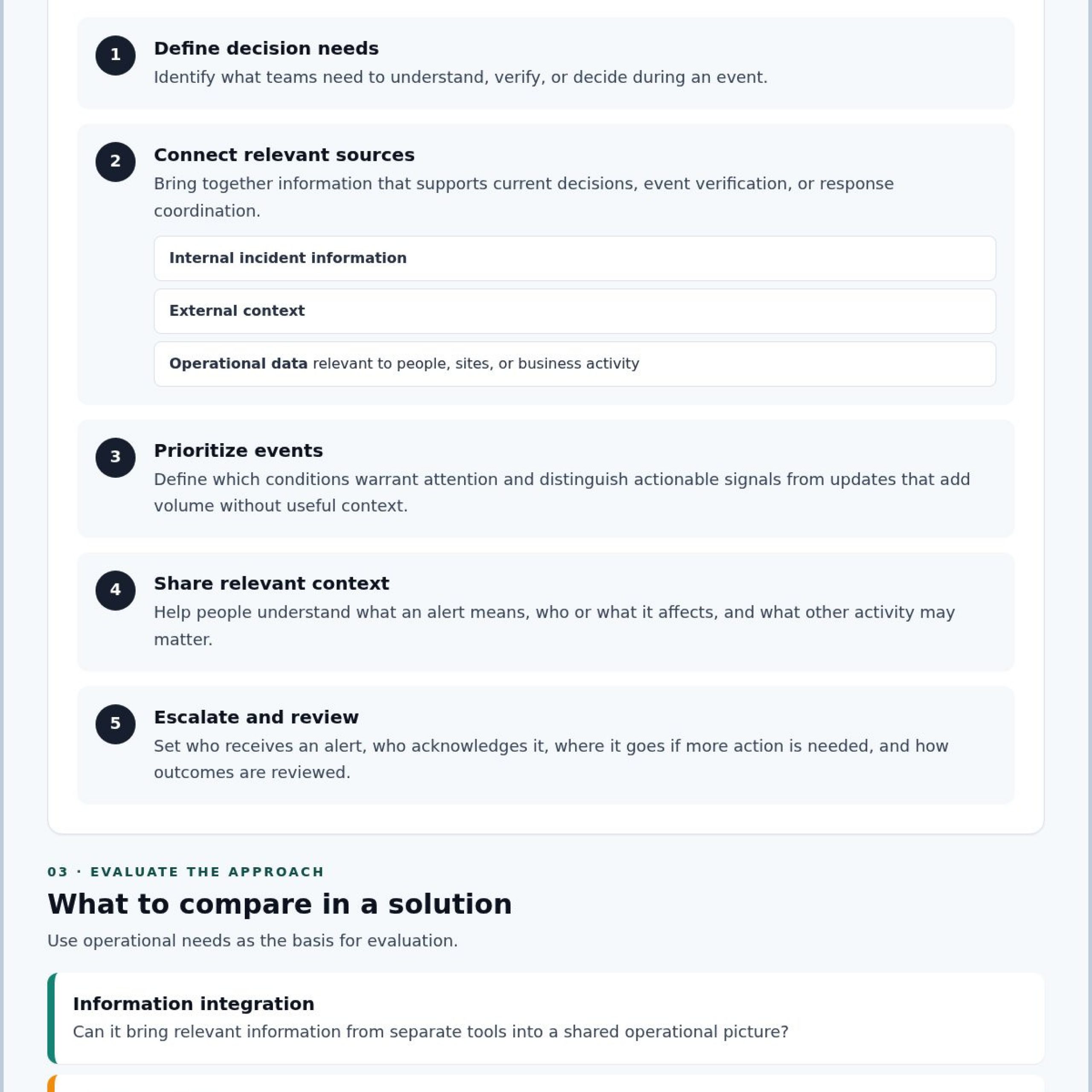
A shared operational picture takes shape through a deliberate information flow. Teams first identify the decisions they need to make, then connect relevant sources, prioritize events, share context, and review outcomes. This sequence keeps the work grounded in operational needs rather than the volume of data available.
A common operating picture gives people a shared, current view of relevant conditions so they can coordinate decisions without surrendering their judgment. For situational awareness for corporate security teams, the aim is to put essential information in context and make it accessible to the people responsible for assessing and responding to events.
Which security information should teams bring together?
Start with the decisions, not a list of systems. Consider three adaptable categories: internal incident information, external context, and operational data relevant to people, sites, or business activity. The useful mix depends on the organization’s risks, existing systems, and workflows. Ask of each source: does it help someone make a current decision, verify an event, or coordinate a response? If it doesn’t, it may not belong in the operational view.
Security teams can improve situational awareness by developing the practices that help them notice, interpret, and communicate relevant conditions. Those practices also help distinguish actionable signals from feeds that add volume without useful context.
How prioritization and escalation turn data into action
Once relevant sources are identified, define how an event should move through the team. Specify the conditions that warrant attention, who receives the alert, who acknowledges it, and where it goes if more action is needed. Event-driven workflows can bring forward information associated with defined conditions and prompt escalation according to those pathways.
Give the recipient useful context alongside the alert, such as the related location, event details, or information needed to assess the situation. The right details depend on the event and the decision at hand. Keep the operating picture available to authorized teams as work shifts between command centers, remote locations, conference rooms, breakout rooms, huddle rooms, and mobile devices.
Then review the workflow after incidents and exercises. Identify where information arrived late, context was missing, or ownership was unclear. Use those findings to refine event conditions, recipients, and escalation paths. Teams considering how to unify operational information can explore Activu’s operational awareness platform.
How to compare situational awareness solutions for security teams
Evaluate each approach against the decisions your security team must make, not the length of its feature list. A single-purpose tool may support one task while leaving teams to gather context elsewhere. Disconnected applications preserve separate workflows, which can keep information siloed. A unifying operational layer can bring relevant sources and teams into a shared workflow, but only if it reduces handoffs and fits how your organization operates.
Use the same criteria for every option:
| Evaluation area | Questions to ask |
|---|---|
| Integration | Can it bring together the applications and data streams relevant to your decisions? |
| Prioritization | Can teams distinguish events that need attention from information that does not support a current decision? |
| Escalation | Can teams define event conditions, recipients, and escalation paths using shared context? |
| Shared access | Can the right people access the operational picture from control rooms, remote locations, and mobile devices? |
| Operational fit | Does the approach align with existing roles, workflows, and response procedures? |
For situational awareness for corporate security teams, integration should support a coherent operational picture, not simply place more feeds in front of operators. Ask how the system presents an event alongside relevant context, and how teams can coordinate around it.
What should an evaluation framework measure?
Confirm which sources can be aggregated and what dependencies or limitations apply. Test whether an event can be surfaced with useful context and routed through an agreed escalation workflow. Check how the picture is accessed across locations and devices. Keep confirmed capabilities separate from assumptions that still need validation.
How can teams test operational fit before choosing?
Map representative scenarios to the information and decisions each requires. For example, trace how an event is identified, reviewed, escalated, and communicated across the roles involved. Have stakeholders test those steps in the settings where they work, including control rooms and remote locations.
Record gaps, dependencies, and unverified requirements before comparing proposals. A new platform can add complexity if it creates another destination or leaves handoffs unchanged. Assess whether it can reduce fragmentation, and distinguish what technology supports from what the organization must establish through procedures, role ownership, and operator training. For related incident workflow considerations, consult this overview of operational awareness capabilities.
How to put corporate security situational awareness into practice
Start with the work teams already perform. Review current workflows, ask stakeholders where information or ownership breaks down, then select a limited set of decision-focused scenarios to examine. This keeps implementation tied to real operational needs and gives teams a clear way to test whether information reaches the right people in a usable form.
How should teams map information to decisions?
For each scenario, identify the decision, the role responsible, the context needed, and the conditions that require escalation. Map those needs to existing data sources, then record gaps such as unclear source ownership or information that may not be available when needed. Keep procedures direct and easy to follow under pressure.
- Review: Who evaluates the incoming information?
- Acknowledge: Who confirms that the event is being handled?
- Escalate: What conditions move the event to another role or team?
- Communicate: Who needs updates, and what context should they receive?
Assign these responsibilities by event category, rather than relying on informal assumptions. After an exercise or incident, ask where the information was unclear, which steps slowed coordination, and whether the escalation criteria matched the situation. Use the findings to refine source selection, procedures, and role ownership.
How can awareness support distributed security operations?
Security coordination may involve a command center, a remote location, and mobile users working from different parts of an organization. A shared operational picture can help those teams discuss the same event with relevant context, while access should be planned around each role and location. Avoid assuming every user needs the same information or access configuration. To maintain dependable and secure connectivity across distributed environments, organizations often lean on managed IT and cybersecurity providers like Trinity Networx, LLC to support underlying networks and endpoints.
Conference rooms can support broader incident briefings, while breakout and huddle rooms may help smaller groups review an event or coordinate next steps. Define how information moves between these settings and the primary security workflow so discussions remain connected to operational decisions. For related environment considerations, see SOC, NOC, and GSOC control room solutions.
These practices give situational awareness for corporate security teams a working structure: relevant information, clear responsibilities, and procedures that improve through review. To discuss how Activu’s vis/ability platform may support your operational visibility needs, contact Activu.
How Activu connects corporate security information to coordinated action
Fragmented applications, isolated teams, and unclear escalation paths can leave operators assembling context at the moment they need to decide. The evaluation criteria from the previous section offer a practical test: can the approach connect relevant sources, help teams focus on events, support escalation, and extend a shared operational picture to the people who need it? The answer should fit existing roles and procedures, while keeping human judgment at the center.
Most control rooms already have the screens. What they’re missing is the layer that decides what goes on them – and escalates automatically when something needs attention.
Activu’s vis/ability is an operational intelligence layer that surfaces through the video wall. The wall is where the answer appears because of vis/ability, not the starting point for building awareness. As a central operational hub, vis/ability brings relevant information from other tools into a shared view, helping teams assess conditions and coordinate their response.
How vis/ability serves as a central operational hub
vis/ability aggregates real-time data and video streams and supports application integration and event-driven situational awareness. This can help teams bring operational information together rather than relying on separate applications and manual handoffs to assemble context. The platform supports event-driven workflows; teams should define the event conditions, responsibilities, and procedures that fit their own operations.
That distinction matters. Technology can surface and share relevant information, while operators interpret the situation, validate context, and decide how to act. vis/ability supports their work as the unifying platform through which operational tools flow, helping teams build a common view without transferring decision authority from people to software.
Where teams can access the shared operational picture
Security work may span command centers, remote locations, conference rooms, breakout rooms, and huddle rooms. Mobile vis/ability extends visibility to mobile users. The information and access available in each setting should reflect the user’s role and operational need, rather than assuming one configuration fits every team or location.
For product details, review the vis/ability platform overview. If your team is assessing how to connect corporate security information and coordinate action, discuss corporate security situational awareness with Activu.
Turn a clearer operational picture into coordinated action
Situational awareness for corporate security teams depends on more than collecting alerts. Teams need relevant information in context, clear ownership for reviewing and escalating events, and procedures they can improve through exercises and incident reviews. A consistent evaluation framework helps decision-makers assess whether an approach reduces fragmentation and supports the way people work across locations.
Activu’s vis/ability platform aggregates real-time data and video streams and supports application integration, mobile visibility, and event-driven situational awareness. It serves as an operational intelligence layer that surfaces through the video wall, where the answer appears because of vis/ability. Activu also provides control room design services. These capabilities support human decision-making by helping teams access and coordinate around relevant information.
Build from your operational requirements, test workflows with the people who use them, and keep judgment where it belongs: with your security team. Discuss your corporate security operations needs with Activu and explore how a shared operational picture could support your team. Clearer information flow can help people coordinate with greater confidence.
Frequently Asked Questions
What does situational awareness mean for a corporate security team?
Situational awareness means understanding relevant conditions, what they mean, and how they may change. For situational awareness for corporate security teams, separate alerts need enough shared context for people to assess an event and coordinate a response. For example, an alert becomes more useful when operators can relate it to the affected location or operational activity. Technology can help teams access and communicate information, while people apply judgment and decide how to act.
How can security teams manage multiple data feeds in a dispatch center?
Start by identifying the decisions operators must make and the information that supports each one. Connect relevant feeds where appropriate, prioritize events, present useful context, and define who reviews and escalates each event type. Avoid adding feeds simply because they are available. Workflow design matters alongside platform capabilities: operators need clear responsibilities and information they can interpret within their existing procedures.
What should a corporate security common operating picture include?
A common operating picture should include information that supports the organization’s actual risks and decisions. Depending on operational needs, this may include relevant internal incident information, external context, and data about sites, people, or business activity. The goal is a shared view that helps teams communicate and coordinate. Including every available feed can obscure priorities, so decide what each source contributes before adding it to the picture.
How do situational awareness platforms help security teams respond to incidents?
A situational awareness platform can bring relevant data and applications into a shared view, surface events, and support escalation and coordination. Its value depends on the sources it can connect, the workflows the organization defines, and how teams use the information. Operators still need to assess context, verify what is happening, and make response decisions. A platform supports that work; it doesn’t guarantee a particular outcome.
Can a video wall improve situational awareness on its own?
Fragmented information and unclear escalation remain problems even when a team can display multiple feeds. Most control rooms already have the screens. What they’re missing is the layer that decides what goes on them – and escalates automatically when something needs attention. Activu defines vis/ability as an operational intelligence layer that surfaces through the video wall, helping present relevant information for shared understanding. People still assess events and decide how to respond.
How should corporate security teams evaluate a situational awareness solution?
Assess whether a solution can connect relevant applications and data, prioritize events, support defined escalation workflows, and provide appropriate shared access. Test it against representative operational scenarios with the people who will use it, including teams working across locations. Document dependencies, gaps, and requirements that still need verification. Compare confirmed capabilities with your organization’s needs, procedures, and training requirements before making a selection.