
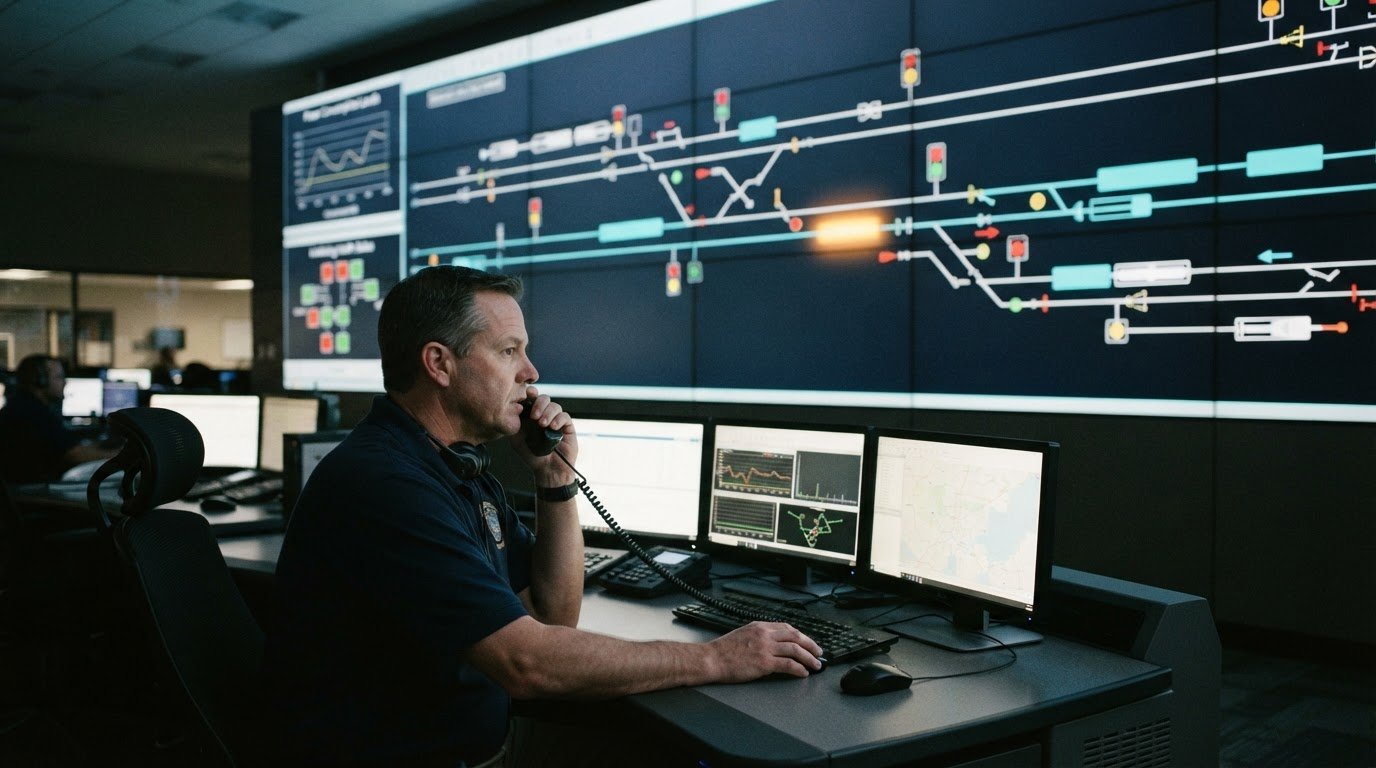
A railway operations control center is where operators manage train movements and monitor network performance in real time. Teams bring together information from signaling systems, track circuits, power monitoring, dispatch platforms, and crew communications to understand conditions across the network. This shared operational picture helps them coordinate service and respond to disruptions.
Coordination takes more than viewing individual feeds. Most control rooms already have screens; the challenge is deciding what appears on them and bringing important changes to operators’ attention. This article explains how control center teams support safe operations, manage dispatch, and coordinate responses to equipment failures, signal faults, and severe weather. It also explores how digital platforms can connect fragmented information so operators can focus on relevant details as conditions change.
Key Takeaways
- See how operating procedures and a shared network picture help teams keep safety central during routine service.
- Understand how dispatchers coordinate train movements and maintain service oversight across operating shifts.
- Learn how control teams assess disruptions, coordinate field staff, and adapt service plans as conditions change.
- Clarify how supervisors and dispatchers divide responsibilities so operational information can support timely decisions.
- Explore how Activu Corporation’s Control Room Design Services, vis/ability Platform, and Event-Driven Situational Awareness can help unify operational information.
ROCC safety culture and operating procedures
A railway operations control center supports safe, reliable service through clear procedures and disciplined communication. Teams use current network information to identify hazards, coordinate decisions, and keep actions consistent across rail operations.
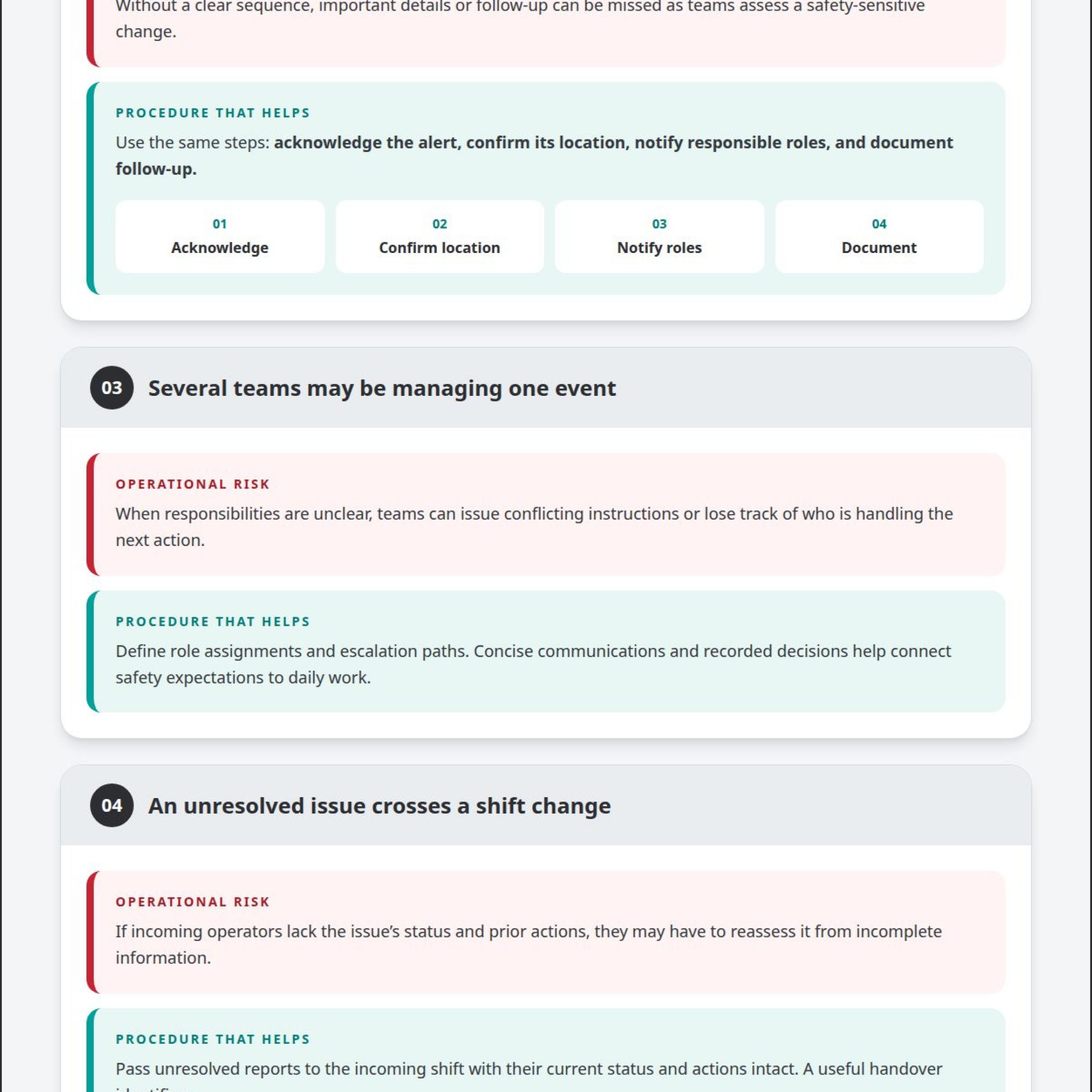
Safety culture shows in how operators handle routine changes as well as major incidents. When a dispatcher receives a track-status alert, for example, they need to assess its operational relevance, notify affected teams, and record the decision according to established procedures. Clear role assignments help prevent conflicting instructions when several teams are managing the same event.
Procedures give operators a consistent sequence for handling safety-sensitive information. Teams can define how to acknowledge an alert, confirm its location, notify responsible roles, and document follow-up. A consistent process also makes shift handovers clearer: unresolved reports pass to incoming operators with their status and actions intact.
Good operating discipline distinguishes verified information from an initial report. If a crew reports an obstruction, the control team can retain the report, identify the relevant track area, and coordinate follow-up through established channels. This gives decision-makers useful context without treating an unverified observation as a confirmed network condition.
Operating environments differ, so procedures should reflect the actual systems and responsibilities in each control room. Clear escalation paths, concise communications, and recorded decisions help connect safety expectations to daily work. The same focus on operational visibility also applies to manufacturing process control, where teams need relevant information to support timely decisions.
Train Safety and Service Reliability
Train safety and service reliability depend on managing movements and operational changes with both safety conditions and service impacts in view. A local issue can affect connected services, staff coordination, and passenger information. For example, a report of a track obstruction calls for clear communication between control staff and the teams responsible for the affected area before service plans change.
Operators also need to distinguish immediate safety concerns from service-recovery decisions. A signal fault may require a different response from a delay caused by platform crowding. Keeping the event type, location, and status clear helps dispatchers coordinate the appropriate response and gives colleagues a shared basis for their next decisions.
Cybersecurity and Safety Risks
Cybersecurity risks arise when disruption or unauthorized access affects the information and communications used in control operations. A delayed status update, unavailable dispatch platform, or misleading message can undermine the operational picture. Decisions depend on information being accurate, available, and understood by the people responsible for acting on it.
Control teams can reduce confusion by following access practices, reporting unusual system behavior, and using established channels for operational decisions. If a platform status conflicts with a crew report, for example, operators should follow their procedures to resolve the discrepancy before relying on that information. Clear escalation and documentation preserve context while teams address the issue.
Around-the-clock dispatch operations
Rail dispatch requires continuous oversight because train movements and network conditions change throughout operating service. MBTA Operations Control Center dispatchers work around the clock to oversee service and respond to operational issues. This 24/7 coverage gives the operation a dispatch function across changing conditions, including overnight infrastructure work, service adjustments, and reports from crews.
During a shift, dispatchers use current operating information to understand conditions across their assigned network. A crew report of a delay, for example, needs to be connected to the relevant train and location. This context helps dispatchers assess service effects, communicate updates, and determine whether further coordination is needed.
Shift handovers maintain continuity between outgoing and incoming staff. A useful handover identifies active issues, actions already taken, and decisions still pending. If a train is awaiting direction after an infrastructure problem is reported, for example, the incoming dispatcher needs the location, latest status, and communications already sent. This keeps unfinished work visible instead of forcing a fresh assessment from incomplete information.
Dispatchers also balance competing operational priorities. A service delay and a maintenance-related restriction may affect connected parts of the network at the same time. Before communicating changes, staff need to understand each issue’s location and status. Clear updates distinguish confirmed conditions from developing reports and reduce the risk of conflicting instructions.
Communications connect dispatch teams with train crews and other operational personnel. A structured exchange identifies the train or affected area, describes the reported condition, and confirms the next action. Dispatchers can clarify whether a crew report concerns a specific track segment before sharing an update with other teams. Accurate context supports coordinated decisions.
Continuous dispatch relies on infrastructure information that is useful at the moment of decision. Signaling status, track conditions, power monitoring, and crew communications each describe part of the operation. When a report conflicts with another status, the discrepancy needs attention before it informs a service decision. Teams use established communication and escalation paths to resolve uncertainty.
Dispatch decisions shape how service changes are managed and communicated to passengers and operating staff. If an issue affects a train’s planned movement, control staff assess current conditions, coordinate the response, and send relevant updates to affected teams. This keeps dispatch focused on what is happening now while maintaining continuity across the network.
Disruption response and rerouting
Equipment failures, signal faults, and severe weather can disrupt planned rail service. A rail control center coordinates rerouting, emergency instructions, and field staff as conditions develop. Operators establish the event’s location and status, then assess which trains and connected routes may be affected. This sequence turns incoming reports into coordinated operational decisions.
Take a signal fault on a busy corridor. The control team needs to understand which track section is affected and what the signaling system reports. Dispatchers can then coordinate with field staff, communicate the operating status, and assess possible service changes. Each update matters because a developing fault may change the options available to operators.
Rerouting involves more than selecting another line on a map. Operators consider the reported location, signaling conditions, track availability, power status, and movements of other trains. If an alternate route is operationally available, dispatchers coordinate the change with relevant staff. They also track which trains need revised instructions and which services remain on their planned paths.
Severe weather creates a different pattern of disruption. A storm, for example, may generate reports from several locations, each with a different operational status. The control team needs to distinguish confirmed impacts from developing reports, identify affected routes, and communicate relevant changes. A shared account of location, condition, and response helps prevent teams from acting on outdated information.
Field coordination is central to disruption response. A dispatcher may relay an emergency instruction or request an update from staff near the affected area. The exchange should establish the reported condition, its location, and its current status. As information arrives, operators can reassess the response and communicate changes to teams managing affected trains.
Passenger service decisions depend on the disruption’s scope. A local equipment failure may affect one train, while a network-level issue can affect connected services. Control teams assess how affected infrastructure relates to train movements before communicating service changes. This helps keep updates aligned with current conditions rather than earlier assumptions.
Accurate status tracking supports recovery as well as the initial response. Operators need to know whether a fault remains active, whether field staff have reported a change, and whether the route plan still applies. Recording updates creates a usable sequence of events and helps incoming shift teams inherit the current operating picture.
When conditions stabilize, control teams coordinate a return to planned service or maintain adjusted routing as needed. They communicate the current status, account for trains already redirected, and update affected staff. A railway operations control center brings these decisions together, linking field reports and network conditions to the next operational action.
OCC supervisor and dispatcher roles
An operations control center supervisor maintains coordination across dispatch functions, while dispatchers manage assigned rail movements and communications. Their responsibilities meet when an emerging issue calls for decisions across teams. A supervisor may coordinate priorities while a dispatcher tracks the affected train, relevant network status, and instructions already issued.
The supervisor monitors the broader operating picture in the control room. This includes identifying competing demands, ensuring key updates reach the right roles, and managing escalation when an issue crosses team boundaries. If a signal fault affects multiple services, the supervisor can coordinate discussion among dispatchers and keep the response aligned as reports arrive.
Dispatchers focus on movement-level detail. They interpret operating information, communicate with crews, and track trains within their assigned area. If a crew reports a delay, the dispatcher connects it to the train and location, then shares the relevant update through established channels. This keeps decisions grounded in the specific operating conditions.
Clear role boundaries matter during transit disruptions. A dispatcher may identify that a revised movement plan affects an adjacent area and raise the issue with the supervisor. The supervisor coordinates across the teams involved, while each dispatcher tracks instructions and movement status within their area of responsibility. This division helps prevent missed handovers and conflicting communications.
Supervisors also help manage information flow when several events compete for attention. A power-status change and a crew report, for instance, may arrive close together. The supervisor ensures both reach the appropriate decision-makers, while dispatchers clarify their locations and operational effects. Clear event ownership helps the room distinguish parallel issues.
During a shift handover, supervisors and dispatchers preserve continuity by transferring active issues, current status, and pending decisions. An outgoing dispatcher can explain which crew communication remains unresolved so the incoming dispatcher can take over with its context intact. Supervisors can confirm that cross-team issues have clear ownership and are not lost between shifts.
Effective coordination depends on concise, specific updates. “Service affected” is less useful than identifying the train, location, reported condition, and action underway. Dispatchers provide those details; supervisors use them to maintain a broader view and coordinate responses when needed. Together, these roles connect precise movement management with control-room oversight and support informed decisions across the rail operation.
Operation control and digital services platforms
Rail control centers use signaling, track circuits, power monitoring, dispatch platforms, and crew communications. When these sources remain fragmented, operators have to reconcile separate feeds and may not see important status changes in time.
Most control rooms already have screens. The challenge is deciding what appears on each screen and bringing important changes to operators’ attention.
Centralized and Decentralized Control Centers
A centralized model places operational oversight in one control location; a decentralized model distributes authority across locations or operating areas. Centralization can support a common network view, while distributed teams can make decisions closer to local conditions. The right arrangement depends on geography, responsibilities, and coordination needs. Either model requires clear decision authority and consistent status information across teams.
Coordination Across Railway Systems
Coordination links signaling, track maintenance, and power information so operators can understand how conditions interact. For example, a signal status can indicate a movement restriction, while maintenance information identifies work on the affected track and power monitoring shows supply conditions. Connecting these details helps control teams assess context and coordinate decisions. Rail teams can also use transportation control room operations as a framework for organizing information around the decisions staff make.
Designing and Implementing a Control Center
Design begins by mapping operational roles, decision needs, and the systems supplying data. Teams then define how information should be integrated, prioritized, displayed, and escalated. Configuration and workflow testing follow, with input from the people who will use the environment. This keeps the design tied to actual dispatch and coordination needs instead of treating technology selection as the starting point.
There is no single cost to build and operate a control center. An estimate depends on project scope, facility requirements, system integration, selected technology, and ongoing operating needs. Define those requirements first to establish the project scope.
vis/ability is an operational intelligence layer that brings information to the video wall. It connects operational sources, prioritizes relevant information, and helps operators see the answer where they work. Large displays and multi-screen workstations can present a coordinated view of live network conditions rather than a set of isolated feeds.
Activu Corporation: Control Room Design Services
Activu Corporation’s Control Room Design Services help rail teams align workflows and information with operational decisions. The vis/ability Platform acts as a central hub, bringing operational tools and data together so teams can work from a shared picture.
vis/ability is an operational intelligence layer that surfaces through the video wall. It supports collaboration across command centers, remote locations, conference rooms, breakout rooms, huddle rooms, and mobile devices. Event-Driven Situational Awareness helps bring relevant changes into view, while Video Wall Systems provide a shared display for control room teams.
Consider these capabilities when fragmented systems or disconnected teams make coordination harder. Contact Activu Corporation to discuss your control room requirements.
Shape the Next Operational Decision
Start by defining what operators need to see, understand, and act on during a changing rail event. Map the key decisions, the information behind them, and how teams should receive alerts. This operational blueprint can guide improvements to a railway operations control center while keeping the needs of its users in focus.
Activu Corporation can align control-room design and operational information with those priorities. A focused conversation can identify where fragmented feeds or unclear escalation paths affect your team’s daily work and which capabilities deserve attention first.
Contact Activu Corporation today to discuss your control room priorities and next steps. Clearer operational context starts with a deliberate plan, and your team can build that plan around the decisions it needs to make.
Frequently Asked Questions
What Is a Rail Control Center?
A rail control center is the operational hub where staff oversee train movements and network conditions. It connects dispatch decisions with information from systems and field communications. For example, an operator can consider a reported track condition alongside train-location information to understand which services may be affected. Field personnel provide observations and updates from the railway, while the control center coordinates activity across the network.
What is a railway operations control center and what does it do?
A railway operations control center coordinates the people and information needed to manage rail service. It helps operators monitor network status, communicate with train crews, and respond when operating conditions change. For example, staff can connect a power-system alert with the affected area and current service activity. This shared view helps teams decide which information needs attention and communicate operational changes to relevant personnel.
What systems and technology are used in a railway operations control center?
Control centers may combine signaling systems, track circuits, power monitoring, dispatch platforms, and crew communications. Operators also use multi-screen workstations and video walls to view network conditions. A useful setup connects information instead of leaving each source isolated. Relating a signal status to its track location, for example, helps an operator interpret the alert in the context of wider operations.
How does a railway control center manage train dispatching and scheduling?
Dispatchers use current operating information and established procedures to manage train movements against the service plan. When a delay affects a train’s progress, they assess the movement, communicate with the relevant crew, and coordinate necessary adjustments. They also consider the impact on connected movements. Clear status updates help colleagues work from current information instead of outdated assumptions.
What staffing roles and training are required in a railway operations control center?
Staffing commonly includes dispatchers overseeing assigned movements and supervisors coordinating broader control-room activity. Other roles depend on the operator’s systems and responsibilities. Preparation should familiarize staff with communication channels, operating procedures, escalation paths, and control systems. A practical exercise might ask a trainee to interpret a simulated status change, communicate its location, and follow the team’s response process.
What safety rules and regulations apply to railway operations control centers in the United States?
Control-room teams follow the operating rules, safety procedures, and emergency protocols that apply to their railway. Procedures should clarify who can issue instructions, how safety-related reports are escalated, and how decisions are recorded. A reported obstruction, for example, should be handled through the operator’s defined communication process, with its status kept clear as staff coordinate a response. Applicable requirements depend on the operation and its governing rules.
How do railway control centers respond to emergencies, delays, and service disruptions?
Control teams assess an event’s location and status, coordinate relevant field personnel, and determine how train movements may be affected. A severe-weather report, for example, can prompt operators to gather updates from affected areas, coordinate instructions, and communicate service changes. As conditions develop, staff update the operating picture and adjust the response. Clear event ownership helps new information reach the people managing the disruption.
What are the cybersecurity and operational risks for railway control centers?
Cybersecurity and operational risks include unavailable systems, delayed status information, unauthorized access, and conflicting reports. These conditions can make it harder for operators to understand what is happening across the network. If a displayed signal status conflicts with a crew communication, staff need a defined process to report and resolve the discrepancy. Access controls, clear escalation procedures, and careful recordkeeping help maintain information integrity.