
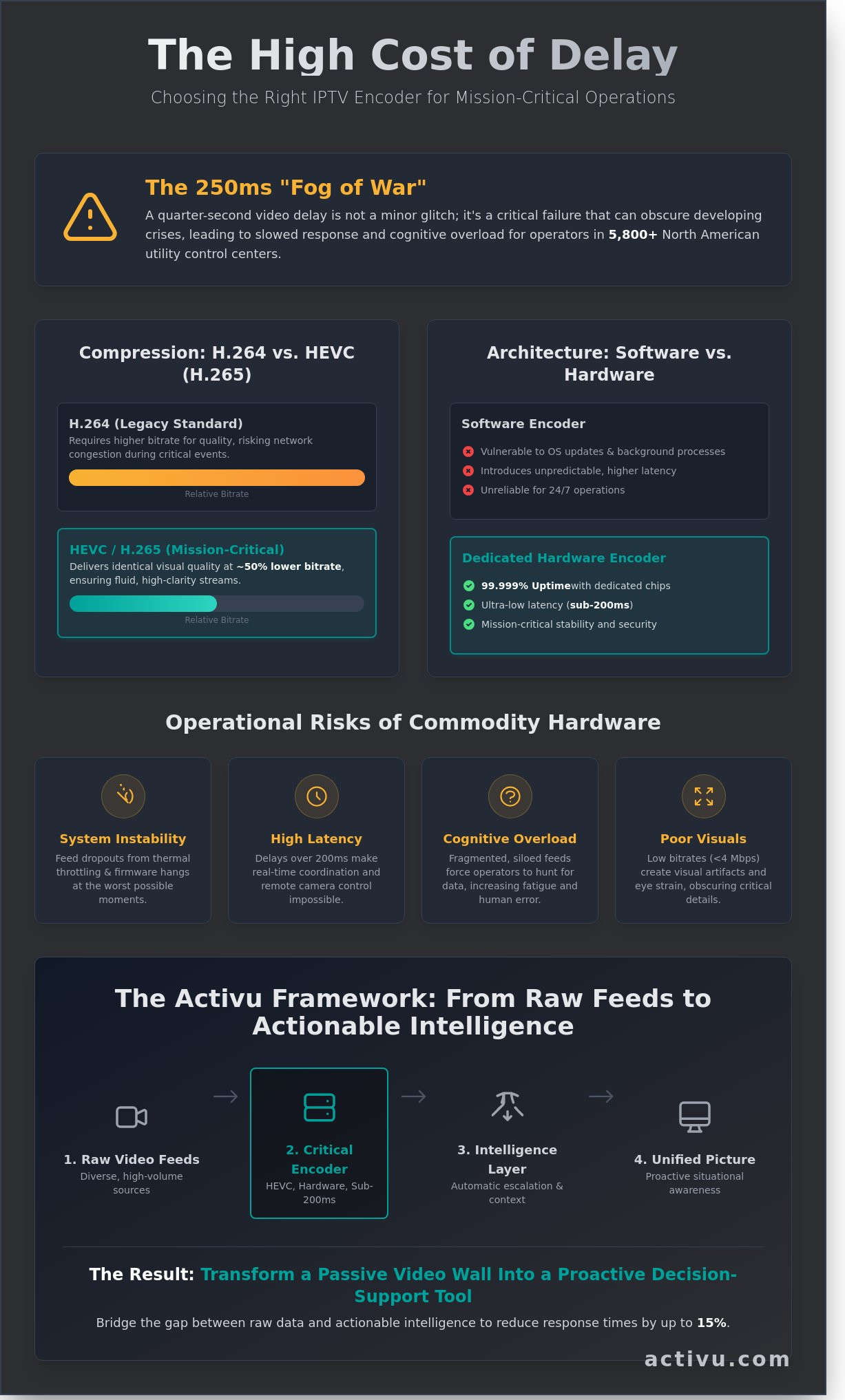
What if a 250-millisecond delay in your video stream is the primary reason your team fails to contain a critical infrastructure breach? In high-stakes environments like the 5,800 utility control centers across North America, selecting a subpar iptv encoder creates a dangerous fog of war that slows incident response. You recognize that fragmented data feeds and high latency are more than technical nuisances; they’re operational liabilities that lead to cognitive overload. Most control rooms already have the screens. What they’re missing is the layer that decides what goes on them, and escalates automatically when something needs attention.
This guide provides a strategic framework for choosing hardware that bridges the gap between raw video data and actionable situational awareness. You’ll learn how to reduce response times by 15% through optimized stream distribution and create a unified operating picture across your entire organization. We examine the technical specifications required to ensure your mission-critical operations remain resilient and clear under pressure.
Key Takeaways
- Understand the operational risks of treating hardware as a commodity and how to select an iptv encoder that maintains situational awareness during high-pressure events.
- Evaluate the technical trade-offs between H.264 and HEVC compression to ensure your network delivers maximum visual clarity without compromising stability.
- Compare COTS and specialized hardware architectures to determine which configuration best supports the unique demands of your mission-critical environment.
- Discover how to bridge the gap between raw video feeds and actionable intelligence by implementing a layer that automatically escalates critical data when attention is required.
- Transform your existing video wall into a proactive decision-support tool that surfaces the right information at the exact moment of a critical decision.
The Critical Gap: Why Your Choice of IPTV Encoder Matters
Selecting a high-performance iptv encoder dictates the speed and precision of a command center’s response. In mission-critical environments, this device serves as the primary gateway, converting visual data from diverse sources into a stream that travels across an IP network. While the technical definition of Internet Protocol Television (IPTV) is straightforward, its application in a 24/7 operations center involves far more than simple signal conversion. It represents the difference between a clear, actionable insight and a pixelated delay that obscures a developing crisis.
Treating encoders as commodity hardware introduces unacceptable operational risk. When organizations prioritize low cost over technical specifications, they often inherit instability. Off-the-shelf encoders frequently suffer from thermal throttling or firmware hangs, leading to feed dropouts at the exact moment an incident escalates. In a utility grid or a transit hub, a five-second delay is not a minor inconvenience; it is a failure in the chain of command. Fragmented video feeds, decoupled from their operational context, force operators to toggle between disparate systems, which rapidly accelerates cognitive fatigue.
Most control rooms already have the screens. What they’re missing is the layer that decides what goes on them, and escalates automatically when something needs attention. This intelligence layer, known as vis/ability, transforms the iptv encoder from a passive broadcaster into a proactive tool for decision support.
Common Situational Awareness Problems
Many command centers struggle with control room situational awareness problems because their visual systems are passive. Operators often fail to notice critical changes on a standard video wall because the human brain is not wired to monitor 50 static feeds simultaneously. This is why operators miss incidents video wall displays should have highlighted; the information is present, but it lacks prominence. Siloed video streams in emergency response prevent a unified view, forcing personnel to manually correlate data from dispatch centers with live field cameras. Furthermore, low-quality encoding with bitrates below 4 Mbps creates visual artifacts that lead to eye strain, increasing the likelihood of human error during long shifts.
From Hardware to Intelligence
Shifting the focus from pixels on a screen to actionable data requires a robust Common Operating Picture (COP). The encoder’s role is to ensure that every stream is synchronized and delivered with sub-200 millisecond latency. Latency remains the silent enemy of incident management; a delay of even half a second can make remote camera manipulation or real-time coordination impossible. By integrating intelligent encoding with EOC common operating picture solutions, organizations move beyond simple monitoring. They create an environment where the most relevant data find the operator, rather than the operator hunting for the data across a fragmented landscape. This ensures that every decision is backed by real-time, high-fidelity visual intelligence.
Technical Specifications for Mission-Critical Performance
The choice of an iptv encoder dictates the success or failure of a command center’s visual intelligence. While H.264 remains a standard for legacy systems, High Efficiency Video Coding (HEVC or H.265) is now essential for modern operations. HEVC delivers the same visual quality as H.264 at approximately half the bitrate. In a 24/7 Global Security Operations Center (GSOC), this efficiency prevents network congestion when dozens of high-definition feeds converge on a single backbone. It’s the difference between a fluid 60 frames-per-second feed and a stuttering image that misses a critical movement.
Hardware encoders are the standard for mission-critical reliability. They use dedicated chips to process video, which eliminates the latency and stability risks inherent in server-based software solutions. A hardware-based iptv encoder typically achieves 99.999% uptime, whereas software encoders remain vulnerable to operating system updates or background process interference. In a high-stakes environment where every second matters, relying on a general-purpose CPU for video processing introduces a point of failure that operators can’t afford. You can explore how these technical layers integrate into a larger operational picture by reviewing vis/ability.
Understanding the transport protocol is just as vital as the codec. RTSP (Real-Time Streaming Protocol) is common for local camera feeds, but it often struggles with firewalls. UDP (User Datagram Protocol) offers the lowest possible overhead but lacks the packet recovery needed for unstable connections. SRT solves these issues by providing a packet-loss recovery mechanism that maintains low latency even over public internet connections.
Video Compression and Bitrate Management
Balancing image quality with network performance requires precise bitrate tuning. For critical surveillance, High Dynamic Range (HDR) ensures that details aren’t lost in high-contrast environments, such as a dark tunnel entrance or a bright tarmac. Most control rooms already have the screens. What they’re missing is the layer that decides what goes on them, and escalates automatically when something needs attention. Effective bitrate management ensures that when an incident occurs, the visual data remains crisp and actionable without crashing the local network.
Latency and Secure Reliable Transport (SRT)
Sub-second latency is a hard requirement for real-time crime centers. Secure Reliable Transport (SRT) has emerged as the preferred protocol because it combines the speed of UDP with the error-correction of TCP. This ensures secure video delivery even over unpredictable public networks. For internal distribution, multicast is superior to unicast. It sends a single stream to multiple destinations simultaneously, which reduces the load on the encoder and core switch by up to 90% in large-scale deployments.
Comparing IPTV Encoder Architectures: COTS vs. Specialised
The choice between Commercial Off-the-Shelf (COTS) hardware and specialized architectures determines whether a control room remains agile or becomes trapped in a cycle of expensive, proprietary upgrades. Traditional specialized encoders often deliver high performance, yet they frequently create rigid silos that are difficult to patch or scale. In contrast, COTS hardware leverages standardized IT components that align with existing enterprise security protocols. Most control rooms already have the screens. What they’re missing is the layer that decides what goes on them, and escalates automatically when something needs attention.
The COTS Advantage in Modern Operations
Standardized hardware drastically reduces vendor lock-in. When a proprietary iptv encoder fails, operators often face long lead times for niche replacement parts. COTS solutions allow IT teams to source and replace components within hours, ensuring continuity during high-stakes incidents. Activu leverages COTS hardware to maximize resilience, allowing agencies to maintain a 99.999% uptime standard without relying on a single manufacturer’s supply chain. This approach ensures that technical infrastructure serves the mission rather than dictating its limits.
High-Density vs. Distributed Encoding
Strategic deployment requires balancing centralized power with edge flexibility. High-density rack-mount units are ideal for the server room, consolidating dozens of local feeds into a single chassis to optimize power and cooling. However, remote sites and mobile command centers require compact, ruggedized units to capture data at the source. Managing these diverse inputs into a centralized SOC or NOC requires a unified management layer. Scalability must be fluid; adding a new feed shouldn’t necessitate a total infrastructure overhaul. A modular iptv encoder strategy allows for incremental growth, ensuring that the common operating picture expands alongside the organization’s needs.
Cybersecurity serves as the final, essential pillar of encoder architecture. Every network-connected device is a potential target. Mission-critical encoders must support AES-256 encryption and Secure Reliable Transport (SRT) to prevent unauthorized access or data tampering. By treating the encoder as a hardened IT asset, operators eliminate the visibility gaps that often lead to missed incidents. This proactive security posture ensures that the flow of intelligence remains uninterrupted, providing the clarity needed to manage complex operations with absolute confidence. Reliability is not a feature; it is the bedrock of the entire command center.
Sector-Specific Selection: Matching Encoders to Your Mission
Mission-critical environments often face a significant bottleneck: the inability to synchronize legacy analogue equipment with modern digital networks. An iptv encoder acts as the physical translator for this transition, but hardware alone doesn’t solve the problem of fragmented data or siloed information. Most control rooms already have the screens. What they’re missing is the layer that decides what goes on them, and escalates automatically when something needs attention.
Utilities and Energy Operations
Grid operators must maintain 99.99% uptime while navigating strict NERC CIP regulatory standards. In these high-stakes environments, an iptv encoder must provide high-integrity streams that allow operators to visualize SCADA data alongside live substation video. This dual-view capability is essential for verifying physical breaches or equipment failures across thousands of miles of infrastructure. Reliable Utility Control Rooms use these streams to bridge the gap between digital sensors and visual confirmation. Choosing encoders with AES-256 encryption ensures that sensitive operational data remains protected while moving across the corporate LAN or dedicated fiber links.
Public Safety and Real-Time Crime Centres (RTCC)
Dispatchers in a modern RTCC manage a chaotic influx of body-cam, fixed CCTV, and drone feeds. The challenge isn’t just seeing the video; it’s seeing the right video at the exact moment a 911 call is placed. Effective Public Safety Situational Awareness relies on encoders that support rapid escalation and low-latency distribution. When a high-priority incident triggers an alarm, the system should automatically push relevant feeds to the front of the operator’s workspace. This capability reduces response times by an average of 12% to 15% in documented urban deployments, providing the clarity needed to coordinate ground units during active emergencies.
Transportation and Logistics
For rail and transit hubs, latency is the primary enemy. A delay of even 500 milliseconds can result in a missed safety event on a high-speed platform or a security breach at a terminal gate. Transportation Operations require encoders that maintain sub-100ms latency across distributed national networks. This ensures that security personnel see terminal activity in real-time, allowing for immediate intervention rather than post-event review. Managing thousands of distributed sensors requires a centralized management layer that can handle the massive bandwidth of H.264 and H.265 streams without compromising the stability of the primary network.
Achieving true operational intelligence requires moving beyond simple video distribution. It requires a system that understands the context of the data being encoded. When your iptv encoder is integrated into a larger vis/ability framework, it stops being a standalone box and becomes a vital organ in your command center’s decision-making process.
The Activu vis/ability Advantage: Beyond the Encoder
Selecting a high-performance iptv encoder is a vital step, but it’s only the beginning of a truly effective operational strategy. Hardware provides the signal, but it doesn’t provide the sense. In high-pressure environments, the gap isn’t a lack of video; it’s the overwhelming volume of it. Operators often find themselves staring at dozens of feeds, waiting for something to happen, which leads to fatigue and missed details. Most control rooms already have the screens. What they’re missing is the layer that decides what goes on them, and escalates automatically when something needs attention.
Activu vis/ability bridges this gap. It transforms the standard video wall from a passive display into an active participant in your incident response. By integrating directly with your iptv encoder network and existing data sources, vis/ability ensures that the right information reaches the right person at the precise moment it matters.
Event-Driven Situational Awareness
Traditional monitoring relies on human vigilance, which is subject to error. Activu vis/ability replaces this manual process with automated workflows. When an encoder delivers a stream, the software doesn’t just display it; it analyzes the context. If an external alarm triggers or a critical threshold is met in your SCADA system, the platform automatically promotes the relevant video feed to the main display. This event-driven approach reduces cognitive load by filtering out the 90% of data that’s irrelevant during a crisis.
In a 2023 utility sector deployment, this automation enabled a 28% faster response to substation breaches. The system doesn’t stop at the control room walls. It extends the common operating picture to mobile users in the field, ensuring that technicians and first responders see the same high-resolution intelligence as the dispatchers. This closes the loop between data capture and decisive action, moving your team from a reactive posture to a proactive one.
Seamless Integration and Design
Building a mission-critical environment requires more than just software. It demands a hardware ecosystem built for 24/7 reliability and future-proof scalability. Our Control Room Design Services ensure that every component of your visualization platform works in harmony across more than 1,200 global installations. We focus on the human element, ensuring that technology empowers operators rather than overwhelming them.
Whether you’re managing a global security operations center or a local utility grid, the goal is total clarity. We engineer environments that scale as your data requirements grow, eliminating technical debt and ensuring resilience for years to come. To begin your mission-critical assessment and see how vis/ability can enhance your operation, Contact Activu today.
Securing the Integrity of Your Operational Intelligence
Selecting the right iptv encoder isn’t just a hardware choice; it’s a decision that determines the speed and accuracy of your response during a crisis. Mission-critical environments can’t afford the latency or security vulnerabilities found in standard COTS architectures. You need specialized systems designed for 24/7 reliability and seamless integration into a wider operational picture. Most control rooms already have the screens. What they’re missing is the layer that decides what goes on them, and escalates automatically when something needs attention.
Activu brings over 40 years of control room engineering expertise to every deployment. As the pioneer in event-driven situational awareness, we provide the intelligence layer used by the US Federal Government and Defense sectors to maintain clarity. Our solutions transform raw data into actionable insights, ensuring your team sees exactly what matters when the stakes are highest. Don’t let fragmented data feeds compromise your mission. You can achieve total visibility by moving beyond basic hardware to a platform built for certainty.
Request a Demo of the vis/ability Platform
Frequently Asked Questions
What is the primary function of an IPTV encoder in a control room?
An IPTV encoder converts raw video signals from sources like workstations or cameras into digital streams for distribution across your IP network. It acts as the critical entry point for visual data, ensuring that high-resolution content is accessible to every operator workstation. Most control rooms already have the screens. What they’re missing is the layer that decides what goes on them, and escalates automatically when something needs attention.
How do I choose between H.264 and H.265 (HEVC) encoders?
Choose H.264 for maximum compatibility with legacy hardware, or H.265 when you need to reduce bandwidth consumption by 50 percent for 4K streams. While H.264 remains the standard for 1080p feeds, H.265 is essential for modern operations requiring high-density visual data without saturating the 1Gbps network backbone. The right iptv encoder selection depends on your current network throughput and the resolution of your mission-critical feeds.
What is the acceptable latency for mission-critical video feeds?
Mission-critical video feeds require glass-to-glass latency of less than 100 milliseconds to ensure operators can react to real-time events without delay. In high-stakes environments like utility dispatch or emergency response, a delay of 500 milliseconds can result in missed visual cues during a crisis. Selecting an iptv encoder with low-latency performance ensures that what the operator sees matches the physical reality of the field exactly as it happens.
Can I use COTS encoders with Activu’s vis/ability platform?
Yes, Activu’s vis/ability platform is designed to integrate seamlessly with Commercial Off-The-Shelf (COTS) encoders from leading manufacturers like Matrox and Teradek. This hardware-agnostic approach prevents vendor lock-in and allows you to leverage existing infrastructure. By focusing on the intelligence layer rather than proprietary hardware, vis/ability ensures that your operational data flows freely across the command center regardless of the specific encoder brand used.
How many video feeds can a single high-density IPTV encoder handle?
A single high-density encoder typically handles between 4 and 16 independent video feeds within a 1U rack space. For larger deployments, modular chassis systems can scale to support 64 or more streams. This density is vital for consolidating fragmented systems into a unified operating picture, reducing the physical footprint in your server room while maintaining the 99.999 percent uptime required for 24/7 operations.
What is the difference between an IPTV encoder and an IPTV decoder?
An IPTV encoder captures a source signal and pushes it onto the network, while a decoder takes that network stream and converts it back into a visual signal for a display. Think of the encoder as the broadcaster and the decoder as the receiver. In a modern EOC, the encoder digitizes the mission-critical data, and vis/ability manages how that data is intelligently routed to decoders at the video wall.
How does an IPTV encoder help in reducing operator fatigue?
IPTV encoders reduce operator fatigue by enabling the automated delivery of visual data only when a specific threshold is met. Instead of forcing staff to monitor 50 static screens, the system uses encoded feeds to surface incidents dynamically. Most control rooms already have the screens. What they’re missing is the layer that decides what goes on them, and escalates automatically when something needs attention, preventing cognitive overload during long shifts.
Does the encoder affect the cybersecurity of my control room network?
Every IPTV encoder acts as a networked endpoint and must support robust security protocols like AES-256 encryption and 802.1X authentication to protect your control room. Vulnerable encoders can serve as entry points for unauthorized access to sensitive video feeds. Since 2022, security audits in government command centers have prioritized hardware that supports HTTPS management and secure boot features to maintain a hardened perimeter against cyber threats.