
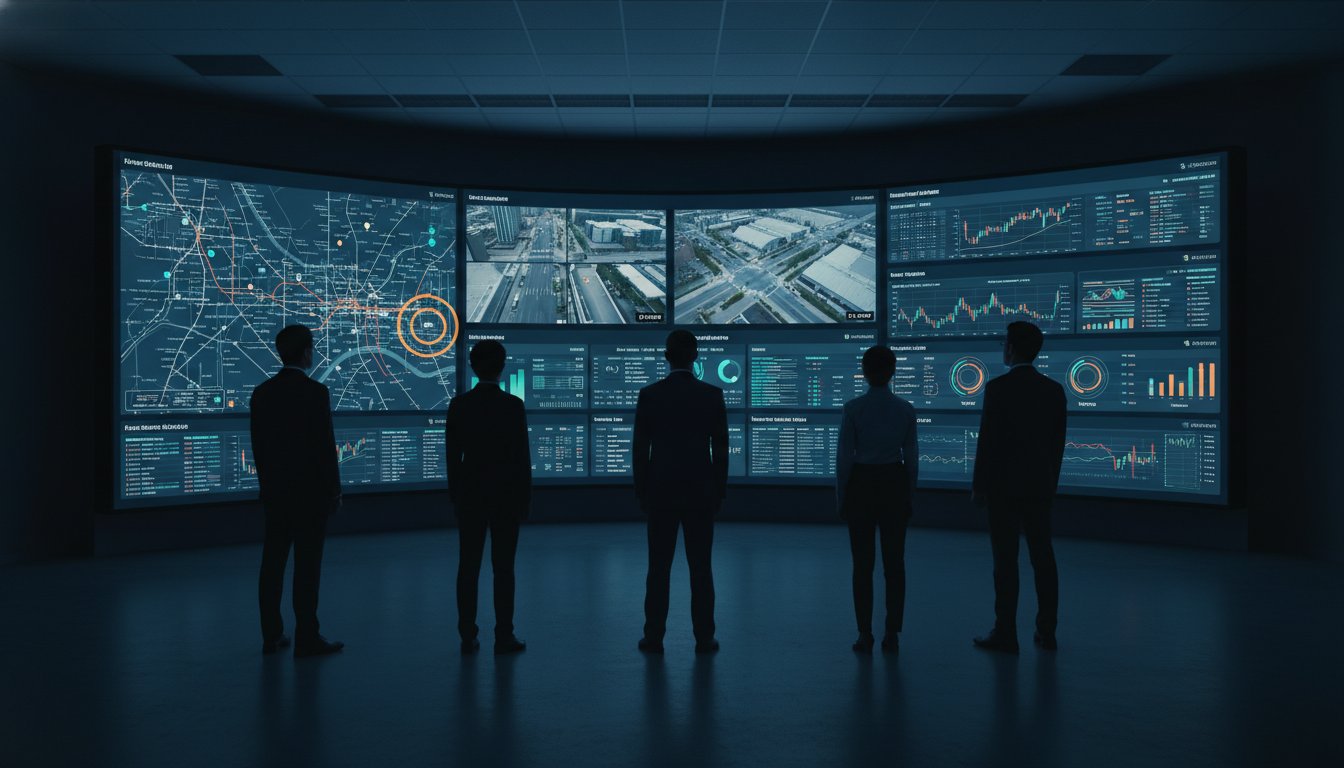
In mission-critical environments, the gap between receiving data and making a definitive decision is where the greatest operational risks reside. Success in these high-stakes moments depends on integrating disparate data sources on one display to provide immediate, actionable clarity. You likely recognize that fragmented systems and siloed streams remain the primary barriers to rapid incident response, especially when information cannot be shared seamlessly with remote or mobile teams.
Most control rooms already have the screens. What they’re missing is the layer that decides what goes on them – and escalates automatically when something needs attention. This article provides a technical roadmap for transforming disconnected feeds into a unified common operating picture that drives faster, more accurate decision-making. We will explore the limitations of traditional integration, the pillars of a functional situational awareness strategy, and the implementation of an operational intelligence layer designed for absolute reliability.
Key Takeaways
- Identify the operational risks of fragmented data displays and how cognitive overload directly impacts incident response times.
- Discover the technical framework for integrating disparate data sources on one display to eliminate the “swivel-chair effect” and establish a single source of truth.
- Learn why traditional integration methods and partial solutions fail to provide the comprehensive situational awareness required for high-stakes environments.
- Master the shift from reactive monitoring to event-driven intelligence; this ensures that critical data is automatically prioritized when seconds matter most.
- Explore how an operational intelligence layer unifies your existing tools into a common operating picture accessible to both command centers and mobile units.
The Operational Risk of Fragmented Data Displays
Why Siloed Information Delays Response
Friction is the enemy of rapid response. When an incident occurs, the requirement to log into separate systems for video, geospatial tracking, and sensors consumes valuable time. These control room situational awareness problems stem from data being trapped in individual silos that cannot communicate. Without a broader Common Operating Picture (COP), an operator might focus on one high-definition feed while missing a silent alarm on a secondary monitor. This tunnel vision occurs when fragmented views prevent collaboration, leaving remote teams in the dark about the full scope of the emergency. The delay in sharing a consistent view often leads to misaligned resources and a disjointed tactical approach.
The High Stakes of Cognitive Overload
The psychological toll on operators managing high-density data is immense. Human cognitive capacity has finite limits. When those limits are exceeded, the brain begins to filter out information, often discarding vital signals. In a typical fusion center, the point where more data produces less clarity is reached quickly. This overload results in missed indicators and delayed decisions that can have life-altering consequences. Most control rooms already have the screens. What they’re missing is the layer that decides what goes on them; and escalates automatically when something needs attention. By integrating disparate data sources on one display through an intelligent framework, organizations can reduce the mental load on their personnel. This shift allows operators to move from reactive searching to focused command, ensuring the most critical information is always the most visible and actionable.
Why Traditional Data Integration Fails the Control Room
Many IT leaders approach integration as a back-end database challenge, focusing on ETL processes and centralized repositories. While this works for retroactive reporting, it fails the stress test of a live command center. Operations teams don’t need historical trends when an incident is unfolding; they need immediate visual context. Traditional back-end integration is often too slow and lacks the front-end flexibility required for integrating disparate data sources on one display effectively. Real-time operations demand a solution that prioritizes visibility over simple storage.
The Limitation of Application-Specific Dashboards
Some organizations rely on specialized security management tools or specific SIEM platforms to manage their feeds. These tools are high-performance in their specific domains, but they only provide a narrow slice of the total operational environment. Relying solely on these application-specific dashboards creates a risk of vendor lock-in and forces operators to manage multiple, disconnected interfaces. Effective data integration for good decision-making requires a vendor-agnostic platform that acts as a central hub, making these individual tools more useful by placing them in a larger context.
There is also a common misconception that installing a large video wall inherently solves the integration problem. Hardware is merely a canvas. Without an intelligent way to route and prioritize information, a video wall becomes just another source of clutter. Most control rooms already have the screens. What they’re missing is the layer that decides what goes on them, and escalates automatically when something needs attention.
Data Lakes vs. Real-Time Visualization
Traditional data lakes are designed for deep analysis, not for the high-velocity environment of a NOC or SOC. The latency inherent in batch processing or complex ETL pipelines is unacceptable when lives or critical infrastructure are at stake. Operators require real-time application integration that delivers visual intelligence without the delay of traditional data warehousing. To bridge the gap between fragmented data and a unified response, teams must implement an operational intelligence layer that unifies disparate streams into a single, cohesive view. This approach ensures that your existing investments in software and hardware finally work together as a synchronized force.
By moving away from static data repositories and toward a dynamic visual interface, you empower your team to act with greater certainty. If you are ready to move beyond fragmented views, consider how a unified platform can streamline your SOC or NOC operations.
Building a Unified Common Operating Picture (COP)
A Common Operating Picture (COP) serves as the bedrock of situational awareness in mission-critical environments. It is not merely a collection of windows on a screen; it is a synchronized, real-time representation of an organization’s operational reality. Establishing a COP allows disparate teams to share a single version of the truth, ensuring that decision-makers at every level act on the same information. Research into Common Operational Picture (COP) and Common Tactical Picture (CTP) Management emphasizes that a consistent networked information stream is vital for maintaining tactical superiority. Most control rooms already have the screens. What they’re missing is the layer that decides what goes on them, and escalates automatically when something needs attention.
An effective COP rests on three functional pillars: Visibility, Collaboration, and Escalation. Visibility ensures that every relevant data point is accessible. Collaboration allows that data to be shared across the enterprise without friction. Escalation provides the automated intelligence necessary to highlight anomalies before they become catastrophes. You can explore a deeper definition in our guide on What is a Common Operating Picture (COP)?
Core Components of a Functional COP
A functional COP requires the seamless fusion of geospatial data, live video feeds, and real-time application data. Integrating disparate data sources on one display is the only way to achieve this level of synthesis. When an operator can see a weather alert overlaid on a map of utility assets alongside a live camera feed of the affected area, the time to decide drops significantly. This environment must also support role-based access. Not every team member needs the same level of detail; a field technician requires different insights than a shift supervisor. By tailoring the view to the user’s role, the system prevents information overload while maintaining a unified narrative across the department.
Extending Visibility Beyond the Control Room
Modern operations are rarely confined to a single room. A unified display strategy must extend visibility to field supervisors, remote stakeholders, and huddle rooms. If a crisis moves from the command center to a mobile unit, the data must follow. This ensures that field teams aren’t operating on stale information or verbal descriptions. Integrating disparate data sources on one display means that a tablet in the field and a video wall in the EOC show the same critical indicators. This continuity is essential for seamless hand-offs between shifts and locations. When every stakeholder has access to the same operational intelligence layer, the organization moves with a level of agility that siloed systems simply cannot support. This transition from static monitoring to a dynamic, shared environment is what defines a truly resilient operation.
Transforming Static Displays into Event-Driven Intelligence
Traditional monitoring relies on the vigilance of operators to catch anomalies across dozens of feeds. This reactive posture is inherently flawed; human attention is a finite resource that degrades under the pressure of constant surveillance. Moving toward integrating disparate data sources on one display is the first step, but true operational resilience requires a shift from static monitoring to event-driven intelligence. Research indicates that 72% of global organizations have already adopted event-driven architecture to power their applications, enabling real-time responsiveness. Most control rooms already have the screens. What they’re missing is the layer that decides what goes on them, and escalates automatically when something needs attention.
By implementing an automated logic layer, you ensure that the video wall is no longer a passive background element. Instead, it becomes an active participant in the response effort. This transition is fundamental to maintaining operational continuity, ensuring that your center remains functional and focused during the most intense phases of an incident.
Defining Critical Triggers and Alerts
The primary challenge in modern command centers is identifying the “signal” within a massive volume of “noise.” Effective event-driven operations rely on cross-platform triggers that bridge the gap between digital and physical security. For example, a cybersecurity alert indicating an unauthorized server room access attempt should automatically trigger the nearest physical security camera feed to the primary display. Integrating disparate data sources on one display allows the system to recognize these correlations instantly. When a threshold is met, the system executes an automated layout change, clearing away routine monitoring feeds to prioritize the data relevant to the emerging threat. This ensures that operators don’t waste time searching for the right camera or sensor data while a crisis is unfolding.
The Workflow of Automated Escalation
A structured escalation workflow removes the guesswork from emergency response. The process follows a logical progression designed to maximize clarity and minimize delay:
- Step 1: Detect. The operational intelligence layer identifies an anomaly across integrated sources, such as a sudden drop in grid pressure or a geospatial boundary breach.
- Step 2: Display. The system automatically populates the video wall with the relevant data streams, providing immediate visual context to the entire room.
- Step 3: Alert. The same visual context is pushed to mobile notifications for remote stakeholders, ensuring that the field team and the command center are looking at the exact same information.
This automated flow reduces operator fatigue by ensuring they only engage with data when it requires their judgment. If you’re ready to move beyond reactive monitoring, explore how the vis/ability platform can automate your situational awareness.
Implementing the Operational Intelligence Layer with vis/ability
Deploying specialized tools for video management or emergency dispatch provides essential functionality, yet these platforms often exist as isolated silos. To achieve a comprehensive common operating picture, organizations require a central hub that enhances the utility of every other tool in the stack. vis/ability functions as this operational intelligence layer. It serves as the unifying platform where diverse streams converge, ensuring that integrating disparate data sources on one display results in immediate clarity. By acting as the central nexus for the entire team, it empowers personnel in command centers, huddle rooms, and mobile units to act with absolute certainty.
Most control rooms already have the screens. What they’re missing is the layer that decides what goes on them – and escalates automatically when something needs attention. vis/ability provides this critical logic, managing the visual environment through a software-based approach that aggregates web applications, desktop software, and live video without the requirement for complex coding. This capability is vital for managing national infrastructure where information must move seamlessly across a distributed network. The platform’s reliance on COTS hardware further ensures technical reliability while preventing proprietary lock-in, allowing the system to evolve alongside shifting mission requirements.
Why vis/ability is the Bedrock of Modern Operations
The architecture of the platform prioritizes the human element within a digital context. By automating the prioritization of essential information, the system mitigates the fatigue that typically compromises high-stakes decision-making. Security remains a primary focus, with a design that meets the rigorous federal and defense standards necessary for protecting sensitive operational data. This security-first approach provides the steady reassurance that your data remains protected while remaining fully accessible to those who need it most.
Achieving Situational Awareness Today
Transitioning toward a resilient operational posture begins with addressing the specific gaps in your current visual workflow. Many organizations find that poor information delivery obscures critical events, which explains why operators miss incidents video wall setups often fail to highlight. Identifying these specific pain points allows for a more intentional implementation of the visual layer. Utilizing professional control room design services ensures that your physical space and digital interface are optimized for maximum visibility.
By integrating disparate data sources on one display, you transform your command center from a reactive environment into a proactive hub of intelligence. This shift ensures that during the moment of a pivotal decision, your team is supported by clear, actionable intelligence. If you are ready to explore how this operational intelligence layer can strengthen your response capabilities, contact our experts for a tailored demonstration of the vis/ability platform.
Secure Operational Clarity with Unified Intelligence
Achieving a common operating picture requires more than high-resolution hardware. It demands a strategic shift from passive monitoring to an active, event-driven posture. By integrating disparate data sources on one display, your organization eliminates the cognitive friction caused by fragmented application silos. This unification ensures that critical signals are never lost in the noise of routine operations, allowing your team to respond with precision when seconds matter most.
The vis/ability platform serves as the vendor-agnostic hub that makes your existing tools more effective. Trusted by federal agencies and Global 500 companies, our solution supports the event-driven automation and mobile situational awareness necessary for modern resilience. Most control rooms already have the screens. What they’re missing is the layer that decides what goes on them, and escalates automatically when something needs attention. You have the opportunity to transform your command center into a proactive engine of intelligence.
Take the next step in optimizing your mission-critical environment. Request a Demo of the vis/ability Platform to see how we can streamline your operations and empower your personnel with absolute certainty.
Frequently Asked Questions
What is the difference between data integration and visual application integration?
Data integration typically refers to back-end processes like ETL that move information between databases for retroactive analysis. Visual application integration focuses on the operational layer, allowing users to interact with the actual interface of multiple software tools simultaneously. This approach is essential for integrating disparate data sources on one display because it preserves the functionality of specialized tools while placing them in a unified, real-time context.
How do you integrate legacy software that doesn’t have an API onto one display?
Legacy systems lacking modern APIs are integrated through desktop capture or virtualized application streams. The vis/ability platform can ingest these streams as individual assets, treating them as dynamic windows within the common operating picture. This ensures that older, mission-critical software remains visible alongside modern web-based applications without requiring a complete system overhaul or complex custom coding. It maintains operational continuity while modernizing the visual interface.
Can disparate data sources be viewed on mobile devices as well as the video wall?
Yes, a unified intelligence layer ensures that the same situational awareness available on the video wall is accessible on mobile devices. Remote stakeholders and field supervisors can view synchronized layouts and live feeds on tablets or smartphones. This continuity is vital for maintaining a consistent narrative during multi-agency responses or distributed infrastructure incidents. It ensures that field teams aren’t operating on stale or incomplete information.
Why do operators often miss incidents even when they have a large video wall?
Operators miss incidents primarily due to cognitive overload caused by static, cluttered displays. A large video wall without an intelligent management layer often becomes background noise rather than a tool for clarity. Most control rooms already have the screens; what they’re missing is the layer that decides what goes on them, and escalates automatically when something needs attention. Without this prioritization, critical signals are lost in the volume of routine data.
How does event-driven visualization reduce operator fatigue in a NOC or SOC?
Event-driven visualization reduces fatigue by filtering out routine data and only presenting information that requires human judgment. Instead of forcing operators to scan dozens of idle feeds, the system uses automated triggers to surface anomalies. This proactive approach allows personnel to remain focused and analytical during high-stakes moments rather than becoming exhausted by constant monitoring. It ensures that the most important data is always the most visible.
Is it possible to integrate cybersecurity data with physical security feeds on one screen?
It is entirely possible to converge cybersecurity data with physical security feeds on a single display. Integrating disparate data sources on one display allows a security operations center to see a network intrusion alert alongside the physical access control logs for the affected server room. This cross-domain visibility is critical for identifying sophisticated threats that bridge the gap between digital and physical infrastructure, ensuring a comprehensive and rapid response.
What are the security implications of integrating multiple data sources into one display?
Integrating multiple data sources requires a security-first architecture that supports role-based access control and end-to-end encryption. The vis/ability platform is built to meet federal and defense standards, ensuring that sensitive data is only visible to authorized personnel. By centralizing the visual layer, organizations can more effectively manage who sees what information across the entire operational network. This approach minimizes the risk of unauthorized data exposure while maintaining a unified view.