
In the United States, the average cost of a data breach reached an all-time high of $10.22 million by May 2026. Despite these escalating stakes, many security teams remain trapped in a cycle of reactive firefighting, where fragmented systems and siloed data feeds obscure the most critical threats. Improving SOC analyst efficiency is no longer just a goal for operational excellence; it’s a necessity for survival in a regulatory environment defined by the Digital Operational Resilience Act and strict CIRCIA reporting timelines. Analyst burnout and high turnover are the direct results of this technical fragmentation and the mental tax of navigating disconnected tools.
Most control rooms already have the screens. What they’re missing is the layer that decides what goes on them, and escalates automatically when something needs attention. While specialized security platforms provide valuable telemetry, they often offer only a partial view that contributes to the noise. This article explores how implementing an event-driven operational intelligence layer can eliminate alert fatigue and streamline incident response. We’ll examine how a unified common operating picture transforms raw data into actionable intelligence, allowing your team to act with absolute certainty when the stakes are highest.
In this article, you will discover:
- The root causes of the cognitive load crisis and why fragmented data feeds lead to missed incidents in high-stakes environments.
- Specific strategies for improving SOC analyst efficiency by transitioning from reactive monitoring to event-driven situational awareness.
- The limitations of traditional security toolsets and why specialized platforms require a unifying layer to be truly effective.
- How to implement an operational intelligence layer that prioritizes essential information and automates critical escalations.
- The process for establishing a unified common operating picture that connects the command center to mobile devices.
Most control rooms already have the screens. What they’re missing is the layer that decides what goes on them, and escalates automatically when something needs attention.
Why Operators Miss Incidents: The Cognitive Load Crisis in the SOC
In a high-stakes Security Operations Center (SOC), cognitive load isn’t merely about the volume of data logs; it’s the mental energy required to process, correlate, and act upon that information under pressure. When analysts must manually bridge the gap between disparate data sources, their capacity for critical judgment diminishes. This mental tax leads to a dangerous state of “tunnel vision,” where an operator becomes so focused on a single dashboard or alert stream that they lose sight of the broader threat landscape. Improving SOC analyst efficiency depends on reclaiming this mental bandwidth by reducing the friction between raw data and human action.
Alert fatigue is often misdiagnosed as a problem of quantity. In reality, it’s a symptom of fragmented visualization. When security tools provide data without context, every notification carries the same perceived weight. This lack of prioritization forces analysts to treat non-critical noise with the same urgency as a sophisticated breach. Over time, this exhaustion leads to the failure to detect low-frequency, high-impact threats. These subtle indicators of a breach are easily buried under a mountain of routine logs when the team lacks a unified method for distinguishing signal from noise.
The Problem with Fragmented Systems and Siloed Data
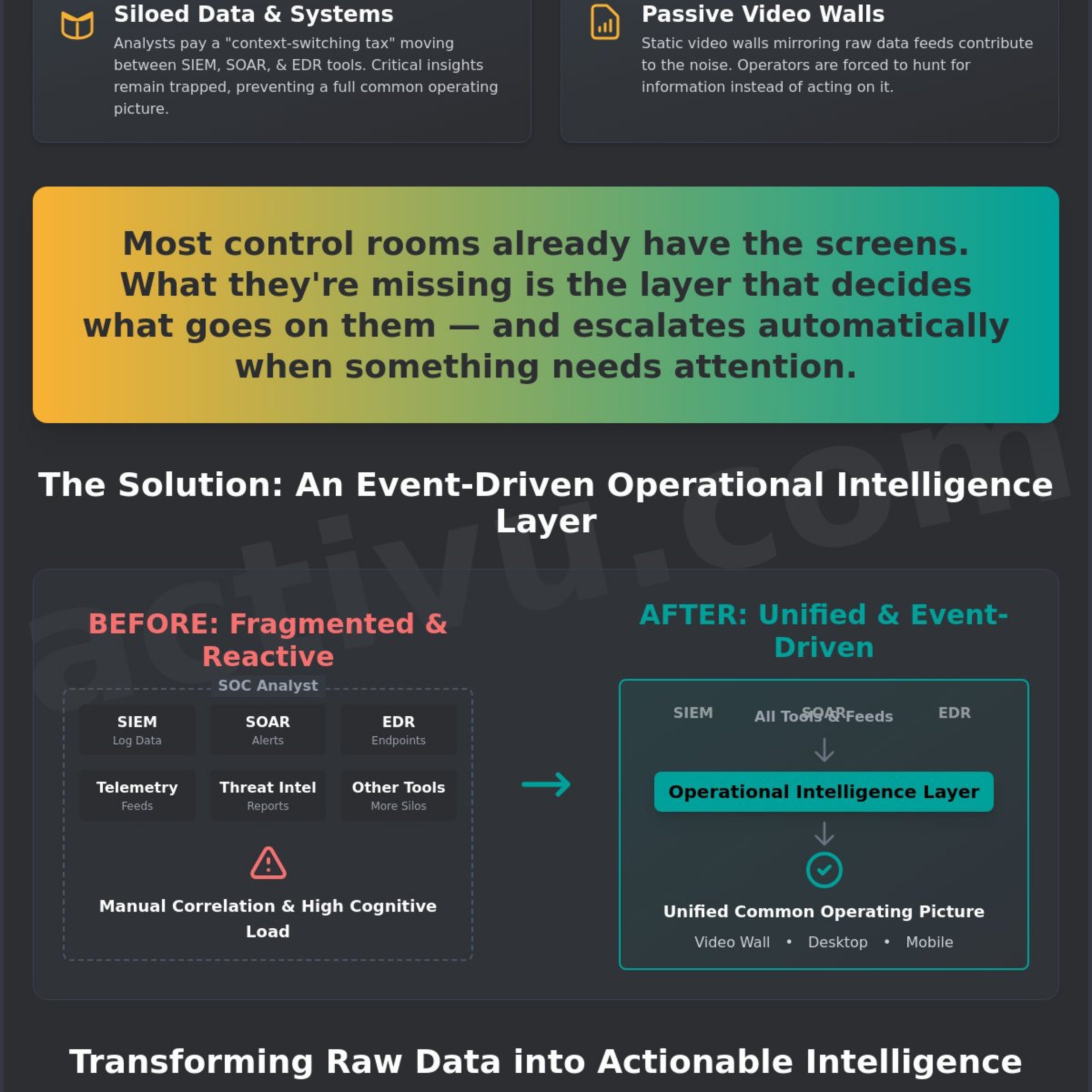
Analysts today are forced to manage an array of disconnected platforms, including SIEM, SOAR, and EDR. Every time an operator moves between these interfaces, they pay a “context-switching tax.” This disruption breaks their analytical flow and increases the likelihood of human error. Critical data points often exist in isolation; a suspicious login in one tool might only become a confirmed threat when correlated with an unusual file transfer in another. When these insights are trapped in silos, the mission suffers. Relying on individual tool dashboards creates a fragmented reality where no single team member has the full, authoritative picture required for rapid response.
Control Room Situational Awareness Problems
The physical environment of the command center can either empower or hinder an analyst. Many organizations struggle with mission-critical operations because their visualization strategy is passive. A static video wall that simply mirrors dozens of raw feeds often contributes to the noise rather than providing clarity. Most control rooms already have the screens. What they’re missing is the layer that decides what goes on them, and escalates automatically when something needs attention. Without this intelligence, the video wall becomes a distraction, forcing operators to hunt for information during a crisis instead of acting on it. True situational awareness requires a system that pushes the right information to the right person at the exact moment it matters most.
The Limitations of Traditional Security Toolsets
Traditional security stacks rely heavily on log aggregation and automated workflows provided by SIEM and SOAR systems. While these platforms are necessary for data collection, they possess inherent visualization gaps that hinder rapid decision-making. They provide a technical view of a potential threat but often fail to offer an operational one. This distinction is critical when improving SOC analyst efficiency. A technical log entry is merely a data point; a coordinated team response requires a common operating picture that SIEMs were never designed to provide.
Many organizations deploy specialized telemetry platforms to manage specific facets of their security posture. However, these tools frequently operate as high-performance silos. They excel at their specific function but require a unifying layer to make their data useful for the entire team. Without a central hub, analysts are forced to manually correlate information across multiple screens. Most control rooms already have the screens. What they’re missing is the layer that decides what goes on them, and escalates automatically when something needs attention. This intelligence gap between a triggered alert and a coordinated response is where critical minutes are lost.
Why SIEM and SOAR Are Not Enough
Automated alerts without visual context lead to slower human judgment. When an analyst receives a notification from a SOAR platform, they must still verify the event by digging through other interfaces. This manual verification process is time-consuming and prone to error. Organizations invest in advanced training to eliminate alert fatigue, yet the tools themselves often perpetuate the problem by presenting data in dense, non-intuitive formats. There is a clear need for a layer that translates technical logs into actionable operational intelligence that the entire team can understand simultaneously.
The Shortcomings of Partial Solutions
Specialized security tools often lead to data hoarding within specific technical teams. This isolation prevents leadership and non-technical stakeholders from understanding the real-time risk posture during a crisis. Additionally, mobile and remote analysts are frequently left out of the primary data loop, receiving alerts without the full visual context available on the command center video wall. This disparity creates a fragmented response that can compromise mission success. To bridge these gaps, organizations should consider how a Cybersecurity Common Operating Picture can unify distributed teams under a single, authoritative view. Exploring these integration points is the first step toward reclaiming operational control.
The Operational Intelligence Layer: Deciding What Matters in Real-Time
The operational intelligence layer serves as the critical bridge between raw telemetry and decisive human action. While traditional tools focus on the intake and storage of data, this layer focuses on its utility. Most control rooms already have the screens. What they’re missing is the layer that decides what goes on them, and escalates automatically when something needs attention. By prioritizing essential information, this layer significantly reduces the cognitive burden on analysts. It ensures that the team isn’t overwhelmed by the 181-day average detection window or the sheer noise of routine logs. Instead of reacting to every ping, the SOC shifts to a proactive model where the environment itself highlights the most critical threats.
Implementing a Cybersecurity Common Operating Picture
A Common Operating Picture (COP) in a SOC context is a single, high-integrity view that integrates disparate feeds into a unified display. It moves beyond the limitations of individual tool dashboards by correlating data from network traffic, endpoint security, and physical access controls. This unified view isn’t just for the video wall; it must be accessible within incident management software to ensure consistency across the entire operation. When a COP is established, the intelligence gap vanishes. Every team member, from the junior analyst to the CISO, sees the same reality in real time.
Event-Driven Situational Awareness
True situational awareness is dynamic. Through the vis/ability platform, automation triggers visual changes in the SOC environment based on the severity of a threat. If a high-impact breach is detected, the system can automatically reconfigure the video wall to show relevant camera feeds, network maps, and threat intelligence. This “escalation by exception” keeps analysts focused on what matters most by hiding non-essential noise until it becomes relevant. vis/ability acts as the bedrock for these decisions, ensuring that critical data reaches the right people on any device, whether they’re in a huddle room or responding via mobile. This automated delivery of intelligence is the engine behind reduced response times and improved team collaboration during critical incidents.
Five Steps to Improving SOC Analyst Efficiency
Improving SOC analyst efficiency requires a structured transition from passive data collection to active, intelligent orchestration. This process begins with a rigorous audit of existing data silos to identify where “blind spots” occur during incident response. Analysts often lose critical minutes searching for context across disconnected tools. Identifying these gaps allows organizations to prioritize which feeds require immediate integration into a unified view. Most control rooms already have the screens. What they’re missing is the layer that decides what goes on them, and escalates automatically when something needs attention. By establishing a unified visualization standard, you ensure that intelligence remains consistent across the command center, huddle rooms, and mobile devices.
The third step involves automating the escalation of high-priority alerts directly to the video wall. Automation should change the physical environment, not just a ticket status. When the system detects a high-severity threat, the visual environment must adapt instantly to show relevant network maps and camera feeds. Fourth, integrate mobile and remote collaboration tools to ensure field units see exactly what the SOC sees. Finally, shift your performance metrics. Measure efficiency based on decision speed and outcome clarity rather than simple alert volume. This approach prioritizes the quality of human judgment in high-stakes moments.
How to Manage Multiple Data Feeds in a Dispatch Center
Operators frequently struggle with how to manage multiple data feeds dispatch center environments present. Effective management requires aggregating geospatial, network, and video data into a single pane of glass. Through robust application integration, you can create a unified interface that prevents screen clutter. Instead of displaying every feed simultaneously, use intelligent content rotation and event-driven triggers. This ensures that only the data relevant to the current operational state occupies the primary viewing area, maintaining focus and reducing the mental tax on dispatchers.
Streamlining Collaboration Across Distributed Teams
Effective EOC common operating picture solutions must extend beyond the four walls of the command center. Extending the SOC view to huddle rooms and mobile users ensures that every stakeholder operates from “one version of the truth” during a critical incident. Mobile vis/ability plays a vital role here, allowing remote experts to contribute to the decision-making process with the same visual context as on-site analysts. This continuity is essential for maintaining operational momentum when a crisis moves faster than a centralized team can react. Speak with our design team to begin auditing your operational infrastructure for these critical integration points.
Accelerating Response Times with the vis/ability Platform
The vis/ability platform functions as the essential operational intelligence layer that unifies a fragmented security stack. While individual tools provide raw data, vis/ability provides the clarity required for decisive action. It serves as the central hub into which all other systems flow, including SIEM, SOAR, and Computer-Aided Dispatch (CAD). By integrating these disparate feeds, the platform ensures that improving SOC analyst efficiency is a byproduct of better system architecture rather than increased human effort. Most control rooms already have the screens. What they’re missing is the layer that decides what goes on them, and escalates automatically when something needs attention.
Implementing this layer transforms the SOC from a collection of siloed workstations into a cohesive command operation. This integration allows for a Cybersecurity Common Operating Picture that remains consistent whether an analyst is at their desk or collaborating in a huddle room. Unlike some platforms that attempt to replace your existing tools, vis/ability enhances their value by making their outputs visible and actionable for the entire team. It provides the absolute technical reliability needed when stakes are highest, serving as the bedrock upon which critical decisions are made.
The vis/ability Advantage for SOC Managers
For leadership, the primary benefit lies in the automation of visual workflows. When an incident occurs, the platform automatically presents the most relevant data, drastically reducing the Mean Time to Response (MTTR). This focused environment prevents the tunnel vision that often plagues high-pressure environments, allowing analysts to remain calm and analytical. Over time, this reduction in cognitive load leads to significant long-term benefits, including reduced analyst burnout and improved team retention. When operators feel empowered by their tools rather than overwhelmed by them, operational readiness becomes a sustainable reality.
Next Steps for Enhancing Operational Readiness
Achieving this level of clarity requires a deliberate evaluation of your current control room design and visualization gaps. Transitioning to an event-driven model ensures that your team is never blindsided by the volume of incoming logs or the complexity of a multi-vector attack. We encourage organizations to adopt a Cybersecurity Common Operating Picture to unify their distributed teams under one authoritative view. Contact Activu today for a tailored situational awareness assessment and discover how to bridge the gap between raw data and human judgment.
Securing the Future of High-Tempo Operations
Transitioning from a state of data saturation to one of operational clarity is the hallmark of a mature security posture. Improving SOC analyst efficiency depends on your ability to remove the friction between a technical alert and a human response. By prioritizing essential information, your team can navigate complex threat landscapes with greater certainty and speed. Federal defense and public safety agencies trust this methodology because it provides absolute technical reliability when the stakes are highest.
The vis/ability platform from Activu Corporation serves as the unifying hub for your existing investments, providing a seamless integration with SIEM and SOAR systems. This creates a resilient infrastructure that supports decisive action during critical incidents. Most control rooms already have the screens. What they’re missing is the layer that decides what goes on them, and escalates automatically when something needs attention. This event-driven approach is the primary engine that reduces MTTR and protects your most valuable asset: your analysts. Move beyond the noise of fragmented systems and empower your team to act with the confidence that only a unified operating picture can provide.
See how vis/ability unifies your SOC operations and reduces analyst burnout.
Frequently Asked Questions
How does alert fatigue specifically impact SOC analyst efficiency?
Alert fatigue degrades operational readiness by forcing analysts to spend mental energy on non-critical noise. This cognitive load leads to burnout and high turnover rates in high-stakes environments. Improving SOC analyst efficiency requires a system that prioritizes essential information, ensuring that critical indicators aren’t buried under a mountain of redundant logs. Without this prioritization, the quality of human judgment suffers when it is needed most.
What are the most common situational awareness problems in a modern SOC?
Data silos and fragmented visualization are the primary barriers to situational awareness. When analysts must manually correlate data across SIEM, SOAR, and EDR platforms, they lose the context required for rapid action. Most control rooms already have the screens. What they’re missing is the layer that decides what goes on them, and escalates automatically when something needs attention. This lack of a unified operating picture results in a reactive posture.
Can event-driven visualization work with our existing SIEM and SOAR tools?
Yes, event-driven visualization is designed to integrate seamlessly with your existing security stack. It acts as the operational intelligence layer that unifies outputs from SIEM and SOAR tools into a single view. While these tools provide valuable data, they often lack the visual orchestration needed for team-wide collaboration. vis/ability makes these tools more effective by translating technical logs into actionable intelligence for everyone in the command center.
Why do operators often miss critical incidents even with high-end video walls?
High-end video walls often fail because they are used as passive mirrors of raw data feeds. This creates visual clutter that contributes to the cognitive load crisis. Operators miss incidents when the most important information isn’t prioritized or highlighted. True situational awareness requires an active system that automatically reconfigures the display based on threat severity, ensuring that the team remains focused on the mission during a crisis.
How can we provide a common operating picture to remote or mobile analysts?
You can extend a common operating picture to remote units through mobile vis/ability platforms. These tools ensure that field analysts and stakeholders see the same authoritative view as the command center. Maintaining “one version of the truth” across distributed teams is vital for operational continuity. This approach eliminates the intelligence gap that often occurs when remote experts are left out of the primary data loop during a critical event.
What is the role of an operational intelligence layer in incident response?
The operational intelligence layer serves as the central hub that orchestrates how data is visually consumed and shared. It automates the escalation of critical alerts, allowing the team to move from complexity to clarity in seconds. By deciding what information is essential at any given moment, it empowers analysts to act with absolute certainty. This layer is the bedrock upon which high-stakes decisions are made in mission-critical environments.
How do we measure the ROI of improved SOC visualization and collaboration?
ROI is measured through the reduction in Mean Time to Response (MTTR) and the improvement in decision clarity. When you focus on improving SOC analyst efficiency, you also reduce the costs associated with burnout and turnover. Effective visualization prevents the $10.22 million average cost of a data breach from escalating by enabling faster containment. Measurable success is found in the team’s ability to resolve incidents before they cause significant damage.
Is it possible to automate video wall content based on threat intelligence levels?
Automation of video wall content is a core capability of the vis/ability platform. By setting specific event-driven triggers, the system can automatically display relevant network maps or camera feeds when threat levels escalate. This “escalation by exception” model ensures that the command center environment adapts to the operational reality. It removes the need for manual configuration, allowing analysts to stay focused on threat hunting and mitigation without distraction.
About Activu
Vis/ability makes any information visible, collaborative, and proactive for people tasked with monitoring critical operations. Users of the platform see, share, and respond to events in real time, with context, to improve incident response, decision-making, and management. Activu software, solutions, and services benefit the daily lives of billions of people around the globe. Founded in 1983 as the first U.S.-based company to develop command center visualization technology, more than 1,300 control rooms depend on Activu. activu.com.