
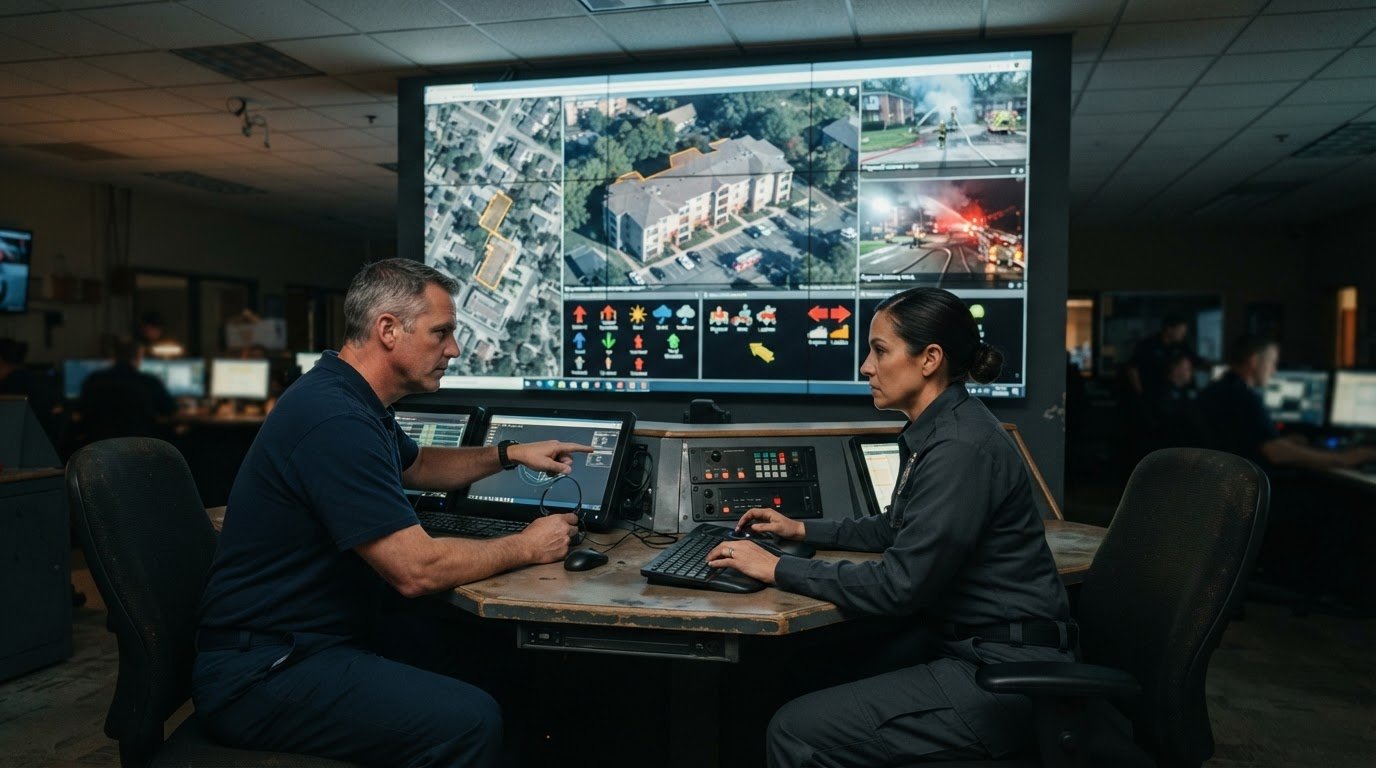
Clear command gives firefighters direction; coordinated control keeps people, equipment, procedures, and communications aligned as an incident develops. Effective fire department command and control relies on a shared structure for decisions and accountability, especially when multiple units respond to changing conditions at the scene.
The Incident Command System (ICS), developed in the 1970s, provides that standardized on-site management framework. It uses unity of command, so each person reports to one supervisor, and gives responders a common basis for organizing operations. Strong coordination also depends on more than the command structure: response plans, training, and timely information help leaders maintain situational awareness, while fragmented systems and information silos can make it harder to build a clear operational picture. This article explains how ICS works, how command roles guide emergency response, and how plans, training, and public service activities support coordinated operations. It also examines how integrated situational awareness can help teams bring essential information together when decisions matter.
Key Takeaways
- Use the Incident Command System to organize people, resources, communications, and decisions under a clear incident structure.
- Build command readiness through role-based training and practice that distinguishes directing an operation from controlling a specific activity.
- Turn response plans into clear tactical direction, with officers applying them to incident conditions and available resources.
- Maintain unity of command so each responder knows who they report to and where direction comes from.
- Address fragmented systems, silos, and missed escalations with an operational intelligence layer that surfaces through the video wall.
What is a Fire Incident Command System?
The Incident Command System (ICS) standardizes on-site response; it developed during the 1970s. Dispatch relays reported conditions and assignments, while communications update the incident commander and responding organizations.
Incident Size-Up and Action Planning
On arrival, the incident commander assesses conditions, hazards, people at risk, and available access. This size-up informs strategy, the overall direction of the response, and tactics, the specific actions crews take. An action plan turns those decisions into assignments and priorities. At a structure fire, for example, the commander might set a life-safety objective, assign defined tasks, then revise the plan as conditions change.
Commander Positioning and Resource Tracking
The commander needs a position that supports oversight, reliable communications, and timely decisions. The best location depends on incident conditions and the information command needs. Resource tracking records which units and personnel are assigned, available, or committed to tasks. Dispatch can relay arriving-unit status, for example, so command can match resources to assignments and identify changing needs.
Preparation and Incident Organization
Pre-incident preparation gives responders a useful starting point before conditions become urgent. Plans can capture facility access, known hazards, water sources, and relevant contacts. For facilities with complex production environments, manufacturing process control context can inform what command needs to see. At the incident, the commander organizes personnel into clear roles and assignments, then adjusts that structure as objectives or resource demands change.
Consistent Incident Management
The Incident Command System (ICS) gives fire departments a common structure for coordinating personnel, equipment, procedures, and communications. The National Incident Management System uses ICS as its central component and also addresses preparedness and resource management. Consistent fire department command and control means establishing an incident organization for each response and scaling it to the event. A clear reporting structure helps responders understand who directs their work as the incident develops.
The Incident Command System provides a common framework for coordinating personnel, equipment, procedures, and communications during firefighting operations. It gives everyone a consistent basis for organizing work around incident objectives, connecting command structure with the resources and information being managed. As conditions or priorities shift, command can use that framework to keep coordination focused on current needs, rather than treating each crew or resource as a separate effort.
Under the Incident Command System principle of unity of command, each individual reports to only one supervisor. This creates a clear route for direction and accountability: personnel know who gives their assignments, and supervisors know who reports to them. A single reporting relationship can reduce conflicting instructions and help updates move through the established organization. It supports clear reporting while allowing command to adjust roles and assignments as the incident develops. Unity of command defines supervision; it does not replace the need to communicate relevant information or coordinate the response.
Command and control during training and public service activities
Fire department command applies beyond emergency scenes. During an exercise or public service activity, leaders set direction, assign responsibilities, and keep participants informed. Dispatch and communications support that structure by relaying instructions, status updates, and changing conditions. For fire department command, the NIMS and ICS requirements depend on the course or jurisdiction: applicants for the course described in the training guidance must complete ICS-100-level and ICS-200-level training before attending. Most states require firefighters to complete NIMS courses 100, 200, and 700.
Training should turn command principles into repeatable decisions. Chief Alan Brunacini’s eight functions of command offer a starting point for structuring command-function exercises. Instructors can use a rescue-drill scenario to test how an officer sets direction, assigns tasks, communicates priorities, and adapts as conditions change. Review each decision afterward: what information informed it, whether assignments were understood, and how the officer maintained oversight. This makes command practice specific without treating every scenario as identical.
Command and control describe related but distinct responsibilities. Command directs the activities and movements of the people being commanded. Control means exercising restraint or keeping a situation in check; it can exist without one person commanding the entire operation. During a multi-company training exercise, for example, an instructor may control the drill area while an officer commands one crew. Briefing participants on authority, boundaries, communications, and stop conditions helps prevent conflicting directions.
Public service activities also need clear coordination. At a community demonstration, parade assignment, or safety event, organizers can identify a lead, define team responsibilities, and establish how participants report changing conditions. These activities may invite discussion and shared input, unlike urgent emergency-scene directives. A short briefing and after-action review can clarify what worked and what needs adjustment. Departments connecting exercises with operational visibility can explore public safety control room approaches as part of their broader planning.
Standardized response plans and tactical plays
Fireground standard operating procedures define how officers organize command, communicate assignments, and apply tactics. No single procedure fits every department; local plans set expectations for common incident types. A useful plan clarifies who establishes command, how incoming units report, and how officers communicate changing priorities. For each event, the incident commander adapts those procedures to conditions at the scene.
Standardized response plans turn preparation into practical starting points. Departments can organize them by incident type and geographic location, linking an alarm to relevant assignments and local conditions. One county spent 10 years developing response alarms for incident types and locations. That example shows how planning can reflect local response needs. A plan should help officers recognize the initial response framework, not prevent them from revising it as new information arrives.
Officers translate a plan into clear direction. They assess the scene, confirm the assigned objective, communicate tasks, and report developments through the command structure. At a reported building fire, an officer might receive an assignment, brief the crew, and update command when conditions affect the work. These steps connect tactics to incident priorities and help the commander understand resource status.
Tactical plays describe coordinated actions for recurring situations. Officers apply them by matching each play’s purpose to observed conditions, available resources, and current priorities. If the scene differs from the plan’s assumptions, the officer reports the gap and follows the commander’s revised direction. A tactical play supports disciplined action; it does not replace judgment or authorize crews to continue an unsuitable approach.
Departments can evaluate response plans through exercises and after-action reviews. Officers can identify unclear assignments, communication breakdowns, or steps that do not reflect local conditions. They can then revise the plan, brief affected teams, and use the updated version in later drills. This cycle keeps written procedures relevant to how crews and command coordinate at incidents.

Chain of command and unity of command
The Incident Command System establishes who directs each assignment and how information moves between responders. A clear chain helps fire, EMS, police, and mutual aid personnel coordinate without conflicting instructions.
Command Establishment and Transfer
The first incident commander establishes command by identifying the role, setting initial priorities, and communicating assignments. Responders need to know who holds command and how to report changing conditions. When command transfers, the incoming and outgoing commanders exchange an operational briefing covering incident status, objectives, assignments, hazards, and available resources. They communicate the transfer to affected personnel so everyone knows where direction comes from.
At a working fire, a company officer can report conditions and assigned actions to the commander. If another officer assumes command, a briefing gives that officer a current operating picture rather than leaving them to decide from incomplete information. Company and chief officers should expect firefighters to follow emergency-scene directives immediately, without debate or discussion. This helps the command structure function as conditions change.
Unity Across Responding Agencies
Unity of command means each individual reports to only one supervisor. At an incident involving fire crews, EMS, police, and mutual aid units, each responder should understand their reporting line and assignment. Agency representatives can coordinate priorities and share relevant updates through an agreed command structure. Clear communication aligns the work while preserving each responder’s direct supervisory relationship.
At a transportation accident, for example, police may manage traffic control while fire personnel handle assigned scene tasks and EMS coordinates patient care. Command coordination should establish shared priorities, clarify each agency’s responsibilities, and identify how updates reach the appropriate leaders. Mutual aid officers also need clear assignments and reporting contacts when they arrive. At working fires, building collapses, and transportation accidents, the incident commander’s directives should be followed and implemented without debate. That discipline supports coordinated action across organizations.
Command and control
Strategic command connects incident objectives with field actions and resource decisions. At a working fire, leaders must keep priorities, assignments, and changing conditions aligned.
Fireground Command Risks
Common risks include unclear authority, conflicting instructions, and delayed updates about changing conditions. At a large incident, too many units reporting directly to one commander can also strain oversight. FIRESCOPE was developed in California in the 1970s after major wildfires raised concerns about span of control and unit coordination. These risks can leave officers acting on incomplete information.
Commanders can reduce exposure by defining reporting relationships, setting objectives, and confirming assignments. They also need to track whether crews are available, committed, or require assistance. If a crew’s conditions change, for example, a prompt report lets command reassess priorities and direct resources. Without that feedback, the plan may no longer match what firefighters face.
Command and Control Failures
Failures often arise when command is assumed but not clearly communicated, or when updates fail to reach decision-makers. A captain receiving directions from multiple officers may not know which assignment takes priority. A commander without current status may allocate resources based on outdated conditions. Clear communication protocols and confirmed assignments help reveal these gaps before they disrupt coordination.
Strategic command also requires distinguishing emergency operations from routine department activity. At an emergency scene, company and chief officers should expect firefighters to implement directives immediately, without debate. For a routine task, a battalion chief might direct a captain to have an apparatus hosebed repacked during that shift, setting direction without further instruction. The appropriate approach depends on the activity and its urgency.
Departments can examine failures through structured after-action reviews. Trace the decision, the information available, and the message each affected unit received. If an assignment changed, identify when command communicated the change and whether crews acknowledged it. This review turns a specific breakdown into a practical adjustment to briefings, communications, or command procedures.
Operational Gaps in Fire Department Command and Control
Fragmented systems can force dispatchers and incident leaders to gather information from separate applications, radio channels, and reports. Each tool may show part of the situation without connecting updates to decisions. During a developing incident, an officer might receive a field report by radio while dispatch monitors a separate alert. Staff must then reconcile the updates, increasing the chance that important context remains isolated.
Operational silos deepen the problem. Dispatch, field command, emergency management, and partner agencies may each use different information sources. A change reported by one team may not reach another team that needs it to coordinate resources or revise priorities. This makes a common operating picture harder to maintain, particularly when information changes quickly or multiple teams need to act together.
Another gap arises when systems display information but do not automatically escalate events that need attention. An alert can remain buried among routine updates if no workflow directs it to the right operator. Staff may have to monitor several feeds, interpret each signal, and decide who should respond. That manual handoff adds to the demands on attention when priorities compete.
To identify these weaknesses, trace an event from its first signal to the decision it should inform. Note which system receives it, who sees it, how it reaches command, and what prompts escalation. Then map where a handoff depends on manual monitoring or separate communication. This review reveals whether the issue lies in fragmented data, unclear ownership, or missing escalation logic. It also clarifies which information incident leaders need first.
Most control rooms already have the screens. What they’re missing is the layer that decides what goes on them – and escalates automatically when something needs attention. vis/ability is an operational intelligence layer that surfaces through the video wall, where the answer appears for shared awareness. Discuss control room design for these operational gaps as a next step toward a more connected operating picture.
Activu Corporation: Control Room Design Services
Activu Corporation helps fire and emergency operations teams address fragmented information through Control Room Design Services, Video Wall Systems, the vis/ability Platform, and Event-Driven Situational Awareness. These offerings help create a clearer operating picture when dispatch, field command, and partner teams rely on different applications and information feeds.
vis/ability is the operational intelligence layer that surfaces through the video wall and serves as the central hub for operational information and connected tools. It helps teams prioritize what needs attention and escalate events. The video wall is where relevant information appears because vis/ability organizes and surfaces it to support a common operating picture. This approach keeps the focus on decisions, rather than managing disconnected displays or sources.
Control Room Design Services align the operational environment with team workflows, information needs, and collaboration. Through vis/ability, relevant information is surfaced for teams where they can see and act on it. Event-Driven Situational Awareness helps teams focus on developing events according to operational priorities. Together, these capabilities help dispatch centers manage multiple data feeds without requiring operators to treat every source as a separate task.
The platform supports teams across command centers, remote locations, conference rooms, breakout rooms, huddle rooms, and mobile devices. This reach matters when leaders, dispatchers, and field personnel need a common operating picture from different locations. Fire departments can consider this approach when information silos, manual monitoring, or missed escalations interfere with coordination. It supports operational awareness; it does not replace incident command, responder judgment, or established procedures.
To discuss control room design for your operational needs, contact Activu Corporation.
Turn Operational Priorities Into a Clear Next Step
Translate operating expectations into a practical information and coordination model. Define the decisions command staff must make, the information that informs them, and how updates reach the right people. Then map that flow across dispatch, command, field teams, and supporting locations. This gives planners a concrete basis for aligning technology with real procedures instead of adding another disconnected source.
Reliable fire department command and control depends on people having relevant information in context when decisions arise. Department leaders can use operational priorities, communication pathways, and escalation needs to guide a control room design discussion. Consider how those needs shift between routine monitoring and a developing incident, and how teams in different locations stay aligned. The goal is a design that supports human judgment and established command processes.
Activu Corporation can discuss how control room design relates to your operating environment and coordination needs. Contact Activu Corporation to explore a practical next step. A deliberate planning conversation can help your team move from complex information flows toward a clearer basis for action.
Frequently Asked Questions
What is the incident command system in fire departments?
The Incident Command System (ICS) is a standardized framework for managing on-scene emergency response. It helps departments organize personnel, equipment, procedures, and communications through a defined management structure. In practice, that structure connects assignments with incident priorities, even when organizations work together. The National Incident Management System uses ICS as its central component and also addresses preparedness, resource management, and communication.
How is fire department command structured at an incident scene?
Incident command follows a reporting structure in which each responder reports to one supervisor. A firefighter receives direction through their assigned officer, while officers relay information and needs through the command organization. As an incident grows, command can add roles or coordination layers to manage the work. For example, a crew member reports a changing condition to their officer, who passes relevant information to the incident commander.
What are the roles and responsibilities of an incident commander?
An incident commander sets response priorities, directs operational strategy, assigns resources, and maintains oversight as conditions change. The commander also establishes how information and decisions flow through the incident organization. If new information changes immediate priorities, for example, the commander assesses its effect, adjusts assignments, and communicates revised direction. The role requires balancing incoming reports with current objectives so resources support the incident’s needs.