

Why does a multi-million dollar command center often struggle with the same lag and connection failures as a standard office meeting? In high-stakes environments, relying on consumer-level mirroring tools creates dangerous visibility gaps that compromise operational readiness. This fragmentation is a primary reason why operators miss incidents video wall systems were installed to prevent. True enterprise-grade screen sharing for control rooms integrates live geospatial data and secure feeds with technical reliability to ensure mission success.
Most control rooms already have the screens. What they’re missing is the layer that decides what goes on them; and escalates automatically when something needs attention. Agencies seeking EOC common operating picture solutions often struggle with how to manage multiple data feeds dispatch center environments without creating cognitive overload. This article explores how an operational intelligence layer transforms fragmented data into actionable awareness, resolving the most persistent control room situational awareness problems. We will examine how vis/ability serves as the central hub to integrate disparate tools into a secure, collaborative environment.
Key Takeaways
- Identify why consumer casting protocols fail in high-stakes environments due to security gaps and unacceptable latency.
- Establish the non-negotiable technical standards for enterprise-grade screen sharing for control rooms, including 24/7 uptime and multi-VLAN support.
- Transition from fragmented data silos to a unified operating picture that enables proactive situational awareness across the entire organization.
- Learn how an operational intelligence layer manages your existing screens by automating which data feeds escalate during critical incidents.
- Discover how the vis/ability platform connects command centers with mobile field units to ensure every team member acts with absolute certainty.
The Failure of Boardroom Casting in Mission-Critical Environments
Consumer-grade protocols like AirPlay or Chromecast are designed for the simplicity of a boardroom, which presents significant risks in a high-security control room. These tools lack the robust architecture required to handle the 24/7 demands of high-security operations. In an emergency response scenario, signal dropouts or unpredictable lag can have catastrophic consequences. Relying on basic mirroring often forces operators to deal with pixelated feeds and connection failures that occur at the worst possible moments. Enterprise-grade screen sharing for control rooms eliminates these risks by providing technical reliability that far exceeds the capabilities of standard office equipment. Standard office equipment prioritizes user convenience over the constant, high-fidelity performance required for high-consequence operations.
High-stakes environments require absolute precision. Specialized data applications provide essential information, but they often represent only one piece of the puzzle. Fragmented visualization is a primary reason why operators miss incidents video wall setups are intended to prevent. When feeds aren’t integrated into a wider strategy, critical alerts stay trapped in silos. The inability to see how one data point affects another creates blind spots that lead to delayed decision-making. Most control rooms already have the screens. What they’re missing is the layer that decides what goes on them — and escalates automatically when something needs attention.
Fragmented Systems and the Cost of Siloed Data
Managing multiple browser tabs and disparate applications leads to immediate cognitive overload. Operators spend more time navigating software interfaces than analyzing the situation at hand. This fragmentation creates tunnel vision, where the focus on a single feed obscures the broader common operating picture. Fragmented data silos directly delay critical incident response times by forcing operators to manually correlate information during the most stressful moments of an operation. Every second spent switching between windows is a second lost in identifying a developing threat.
Security Vulnerabilities in Standard Enterprise Tools
Unencrypted casting poses a severe threat in federal or utility sectors. Standard meeting tools don’t provide the granular access control needed to protect sensitive feeds. For those operating in utilities and energy, adherence to NERC CIP compliance is a non-negotiable requirement. Using consumer-level tools introduces vulnerabilities that could be exploited, putting critical infrastructure and public safety at risk. These tools often allow any device on the network to attempt a connection, which is unacceptable in a secure command center where data integrity is paramount.
Defining Enterprise-Grade Requirements for Control Room Visualization
Enterprise-grade screen sharing for control rooms demands a technical foundation that standard office hardware cannot provide. Achieving mission success requires ultra-low latency, 24/7 uptime, and multi-VLAN support to ensure secure, real-time data distribution across complex networks. Hardware-only solutions often create a restrictive ceiling for operational growth because they lack the agility to adapt to new software requirements. These rigid systems struggle to integrate diverse feeds such as VMS, GIS, SIEM, and live IoT data into a single, cohesive view. When your infrastructure is locked into specific hardware, you lose the ability to pivot as your data landscape evolves and grows more complex.
True operational readiness prioritizes clarity over raw data volume. Speed of interpretation matters more than the sheer volume of data displayed, especially when making life-altering decisions. Implementing effective alarm management is vital to prevent operator fatigue and ensure that critical alerts don’t get lost in the noise of secondary feeds. Most control rooms already have the screens. What they’re missing is the layer that decides what goes on them, and escalates automatically when something needs attention. This intelligent oversight transforms monitors into a proactive tool for situational awareness.
Reliability Beyond the Boardroom
Boardrooms operate on a “reboot if it fails” mentality that is unacceptable in high-stakes environments. Mission-critical operations require a “zero-fail” standard where every component is built for absolute reliability and continuous performance. Redundant signal paths and automated failover capabilities are non-negotiable features that protect against hardware malfunction or network congestion. They ensure the video wall remains a strategic asset rather than just a collection of large displays. This infrastructure provides the bedrock upon which high-stakes decisions are made with total confidence, regardless of the complexity of the incoming data streams.
Cross-Platform Integration and Scalability
Modern operations are rarely confined to a single operating system or a localized site. Effective tools must support Windows, Linux, and specialized operational software without friction or data loss. Deep application integration allows teams to create a unified view that transcends individual workstations and geographical boundaries. This capability allows the system to scale fluidly from a single local display to interconnected global SOC and NOC networks. Strategic oversight begins with a platform designed for the highest stakes. You can evaluate your current infrastructure’s readiness by exploring our operational intelligence solutions.
Solving the Challenge of Managing Multiple Data Feeds
Managing multiple data feeds in a dispatch center is a constant battle against information overload. Operators are often surrounded by dozens of monitors, yet they still struggle to find the specific data required during a crisis. Simply adding more screens doesn’t equal better visibility. Without an intelligent management layer, a larger video wall only provides more space for fragmented data to hide. True enterprise-grade screen sharing for control rooms moves beyond manual input switching to provide a proactive, unified view. This shift from reactive monitoring to proactive situational awareness is what separates a modern command center from an outdated, hardware-heavy room.
Effective system design must account for the psychological pressure placed on operators. Federal regulations for high-consequence environments emphasize the use of state-of-the-art human factor principles to ensure that technology supports human judgment rather than hindering it. Most control rooms already have the screens. What they’re missing is the layer that decides what goes on them, and escalates automatically when something needs attention. By implementing an event-driven visualization strategy, organizations can reduce operator fatigue and ensure that critical incidents never go unnoticed.
Automating the Common Operating Picture
Manual screen sharing is a bottleneck in mission-critical environments. When an incident occurs, operators shouldn’t have to spend precious seconds navigating through menus to find the right camera or sensor feed. An intelligent software layer can automatically pull relevant data feeds based on specific alerts or triggers. For example, a perimeter breach can instantly push live video, geospatial maps, and personnel locations to the main display. This automated information delivery creates a common operating picture that is dynamic and responsive. While individual software platforms provide valuable data, they require a platform like vis/ability to weave that information into a cohesive, team-wide narrative.
Reducing Cognitive Load for Operators
Clarity is the ultimate goal of any visualization system. A strong visual hierarchy helps operators focus on what matters most during a crisis by emphasizing high-priority alerts while pushing routine data to the background. Smart layouts that adapt to the severity of an incident ensure that the most relevant information always occupies the most prominent position on the video wall. This prevents the “wall of noise” effect where every feed carries the same visual weight. Automated escalation prevents critical alerts from being buried under routine data. This allows the team to act with certainty, knowing that the most vital information is always front and center when it’s needed most.
The Operational Intelligence Layer: Orchestrating Mission-Critical Awareness
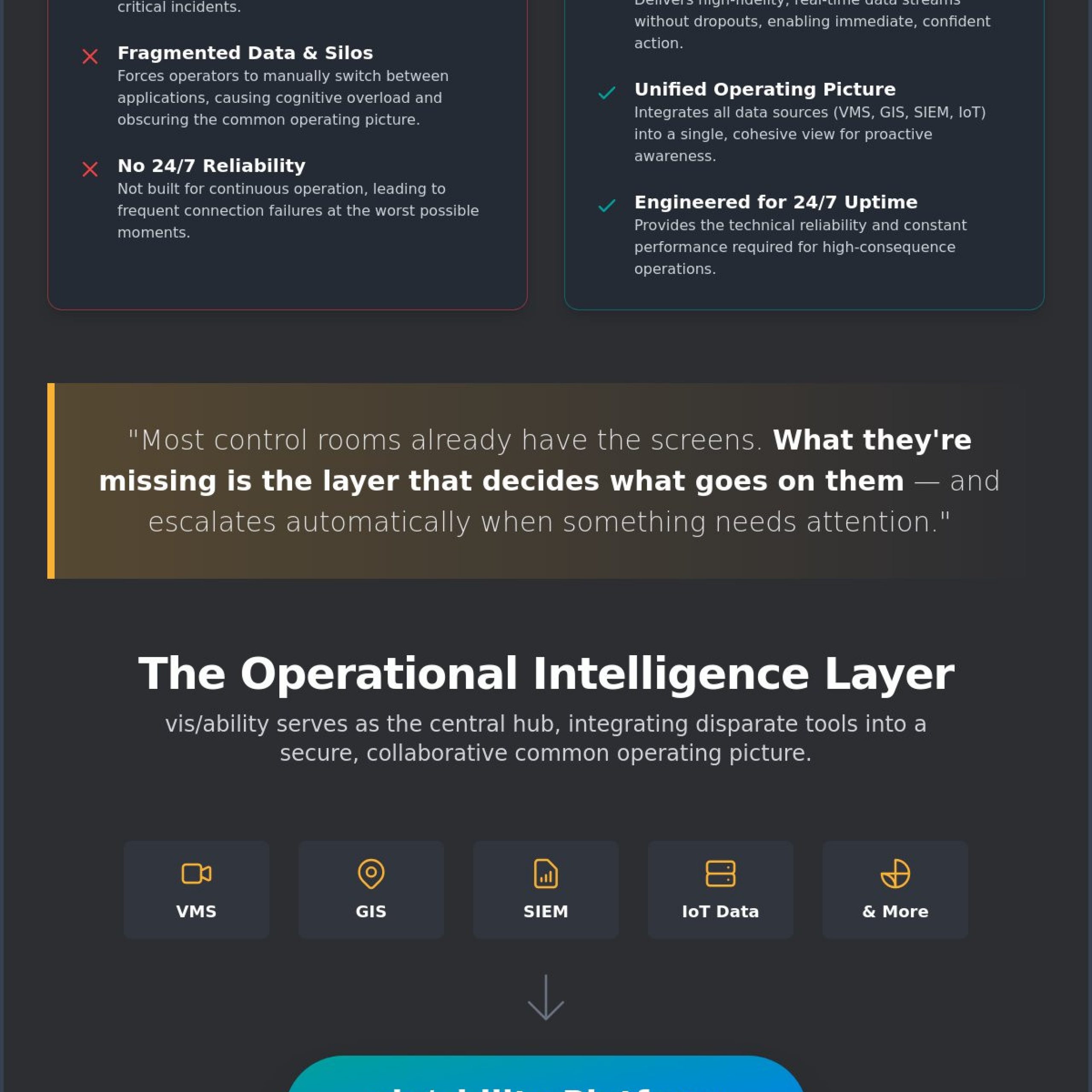
Enterprise-grade screen sharing for control rooms functions as more than a simple video transmission. It operates as an intelligent software layer acting as the central hub for mission-critical collaboration. Most control rooms already have the screens. What they’re missing is the layer that decides what goes on them — and escalates automatically when something needs attention. This operational intelligence layer serves as the unifying platform where fragmented data sources become a cohesive common operating picture, providing EOC common operating picture solutions that scale with the complexity of the crisis.
This software layer augments existing investments in VMS or geospatial software by providing a shared context for the entire team. By aggregating these disparate feeds into a single, secure environment, the intelligence layer ensures that every operator sees the same reality. It converts raw pixels into actionable awareness, allowing the team to move beyond watching screens to actively managing the mission. You can discover how this layer unifies your operations here to resolve persistent visibility challenges.
Event-Driven Awareness: Turning Data into Action
Real-world incidents require immediate responses that don’t wait for manual input. Event-driven awareness ensures that external triggers, such as a perimeter breach or a critical power outage, immediately change the state of the video wall. The system transitions from a quiet state of routine monitoring to an incident state without human intervention, instantly pushing relevant maps and camera feeds to the forefront. This level of automation is essential for maintaining operational continuity during high-stress events. It removes the friction of manual data retrieval, allowing the team to focus entirely on the tactical response.
The Role of Human Judgment in a Digital Context
Clear visualization provides the steady reassurance needed to act with absolute certainty during high-stakes moments. When the operational intelligence layer filters out the noise and highlights the most critical data points, it builds a functional bridge between raw information and certain action. This clarity allows leaders to make pivotal decisions based on a complete, real-time understanding of the situation. Human judgment remains the final word, supported by a bedrock of technical reliability and intelligent oversight that remains focused when the stakes are at their highest. This approach ensures that technical tools empower individuals to act with greater certainty.
Activu vis/ability: Empowering the Mission-Critical Team
The vis/ability platform serves as the definitive solution for organizations that have outgrown the limitations of passive mirroring and fragmented data feeds. It functions as a robust operational intelligence layer, unifying command centers, huddle rooms, and mobile units into a single, cohesive ecosystem. Most control rooms already have the screens. What they’re missing is the layer that decides what goes on them; and escalates automatically when something needs attention. By aggregating real-time data into a unified operating picture, Activu ensures that every stakeholder has access to the same high-fidelity information, regardless of their physical location. This approach provides the technical bedrock upon which critical decisions are made across diverse operational industries.
To support these unified ecosystems, high-quality hardware like a 360 conference camera Singapore can be deployed in huddle rooms to ensure that local visual data is captured with the precision required for enterprise-grade collaboration.
True enterprise-grade screen sharing for control rooms must bridge the gap between the stationary operator and the mobile responder. While some organizations use basic huddle room tools for simple collaboration, those products lack the scale and security required for a sophisticated public safety or defense operation. Activu fills this gap by ensuring that situational awareness is never confined to the four walls of a command center. Through the integration of mobile vis/ability, field units can contribute to and receive updates from the common operating picture, creating a seamless loop of intelligence that drives faster, more accurate responses.
Seamless Collaboration Across Distributed Teams
Effective mission management requires the secure extension of the control room picture to remote stakeholders and subject matter experts. The “Link” feature within the vis/ability platform enables the instant, secure sharing of the common operating picture with authorized users on any device. This capability is particularly vital for the transportation and federal defense sectors, where decision-makers are often geographically dispersed. By providing a secure, encrypted pathway for information, vis/ability maintains the integrity of the operation while ensuring that no one is left operating in a data silo. It prioritizes essential information, allowing teams to move with a purposeful flow from complexity to clear, actionable intelligence.
A Future-Proof Investment in Situational Awareness
Choosing a software-defined approach over proprietary hardware ensures that your command center remains agile in an evolving threat landscape. Activu vis/ability is designed to integrate seamlessly with future AI-driven analytics and IoT sensor arrays, preventing the “hardware ceiling” that often stalls operational growth. This flexibility allows your team to adopt new tools and data sources without requiring a complete overhaul of your existing infrastructure. As the volume of global data continues to grow, having a platform that can intelligently filter and escalate that data becomes a strategic necessity. We invite you to contact Activu for a tailored control room assessment to determine how our operational intelligence layer can transform your current environment into a proactive hub of situational awareness.
Advancing Toward Operational Certainty
Success in high-stakes environments depends on the speed and accuracy of human judgment. Moving beyond passive mirroring to enterprise-grade screen sharing for control rooms ensures your team isn’t blinded by fragmented data or unacceptable system latency. By implementing an operational intelligence layer, you replace manual switching with event-driven automation that reduces response times and eliminates cognitive overload. Most control rooms already have the screens. What they’re missing is the layer that decides what goes on them; and escalates automatically when something needs attention.
Activu brings over 40 years of mission-critical experience to the world’s most demanding environments, including top-tier Federal, Utility, and Public Safety agencies. Our platform provides the technical reliability needed to transform raw data into a unified common operating picture. This clarity allows your team to focus on the mission instead of the technology. Don’t let fragmented systems compromise your situational awareness. Request a vis/ability Demo to See Operational Intelligence in Action and secure the bedrock of your future operations.
Frequently Asked Questions
What is the difference between enterprise-grade screen sharing and consumer casting?
Enterprise-grade screen sharing for control rooms provides sub-second latency, multi-VLAN support, and end-to-end encryption. Consumer casting protocols like AirPlay or Chromecast are designed for casual use and lack the technical reliability for 24/7 mission-critical operations. While these consumer tools are perfect for streaming media from platforms like moviewala.tv, they cannot guarantee the stability required for high-consequence environments. Enterprise solutions ensure that high-resolution feeds remain stable and secure, preventing signal dropouts during the most pivotal moments of an operation.
How does situational awareness software reduce operator fatigue?
Situational awareness software reduces fatigue by filtering out secondary noise and highlighting only the most relevant data. Instead of forcing operators to manually monitor dozens of disconnected screens, the system uses automated layouts to prioritize critical alerts. This visual hierarchy prevents cognitive overload, allowing the team to focus on tactical decision-making rather than navigating through fragmented data silos.
Can enterprise screen sharing integrate with existing VMS and GIS systems?
Yes, enterprise-grade platforms are specifically built to aggregate disparate feeds from Video Management Systems (VMS) and Geographic Information Systems (GIS). This integration creates a unified view where geospatial data and live video feeds work together seamlessly. It transforms standalone tools into a collective asset for the entire command center team, ensuring that every data point contributes to a full common operating picture.
How do you ensure cybersecurity when sharing screens in a control room?
Cybersecurity is maintained through granular access controls, TAA compliance, and AES-256 encryption. Unlike basic office tools, enterprise solutions allow administrators to define exactly who can view or share specific feeds based on their credentials. This ensures that sensitive data remains within secure network segments while still supporting the necessary collaboration between the command center and authorized remote stakeholders.
What is an event-driven common operating picture?
An event-driven common operating picture is a dynamic visualization that changes automatically based on real-time triggers like security breaches or system failures. Most control rooms already have the screens. What they’re missing is the layer that decides what goes on them, and escalates automatically when something needs attention. This ensures that the most critical information always occupies the most prominent position on the video wall.
How does mobile integration enhance control room operations?
Mobile integration extends the common operating picture to field units and remote stakeholders in real time. It allows responders to see exactly what the command center sees, ensuring everyone acts with the same intelligence. This field-to-base collaboration accelerates response times and ensures that critical updates reach those on the front lines instantly, regardless of their physical location or device.
Why do standard HDMI switchers fail in mission-critical environments?
Standard HDMI switchers fail because they are hardware-centric and require manual intervention to change inputs. They lack the intelligence to automate data escalation and cannot scale to support distributed teams or remote sites. In a high-stakes crisis, the time lost manually switching inputs creates a dangerous visibility gap that software-defined solutions eliminate by providing automated, event-driven visualization.
What is the “operational intelligence layer” in a command center?
The operational intelligence layer is the central hub that unifies all other tools into a single, cohesive platform. It acts as the brain of the control room, managing how information flows from VMS, GIS, and IoT sensors to the display. It ensures that enterprise-grade screen sharing for control rooms is proactive rather than reactive, making every connected tool more effective for the entire mission-critical team.