

The hardest barrier to cross-agency data sharing is often cultural, not technical. A cross-agency data sharing platform can connect information across departments, but technology alone cannot resolve concerns about ownership, access, accountability, or trust.
Agencies know that fragmented systems and inconsistent standards slow coordination. The challenge is making information useful across organizational boundaries while protecting privacy, securing access, and clarifying responsibility for the data. This article explains how data sharing works and what makes it useful during incident response.
You’ll learn how governance, shared standards, security controls, and clear agreements support responsible exchange, and why cultural barriers can determine whether an effort succeeds. In control rooms, disconnected feeds and missing escalation processes can also limit what teams see in time to act. Most control rooms already have the screens. What they’re missing is the layer that decides what goes on them – and escalates automatically when something needs attention.
Key Takeaways
- Understand how shared governance and consistent data quality help agencies build a more reliable common operating picture.
- Identify how silos, disconnected feeds, and missing escalation can slow coordination when incidents unfold.
- Learn how data contracts, schemas, and service-level agreements clarify expectations for shared information and updates.
- Explore how privacy safeguards, security controls, consent, and clear accountability support responsible data exchange.
- Recognize why trust and organizational culture matter, and how an operational intelligence layer that surfaces through the video wall can bring operational information together.
What Is Cross-Agency Data Sharing?
A cross-agency data sharing platform helps state and local agencies exchange information through connected systems and agreed rules. It lets staff use information held across departments instead of relying on fragmented records.
Cross-Agency Government Data Sharing
In practice, this exchange connects information from agencies such as emergency management, public health, and transportation. A shared view can help staff understand how an incident affects services across jurisdictional boundaries. Without it, teams may work from different records, definitions, or update schedules. Since 2015, 42 U.S. states introduced 318 bills specific to data sharing, reflecting sustained policy attention to the issue.
Unified Governance and a Shared Source of Truth
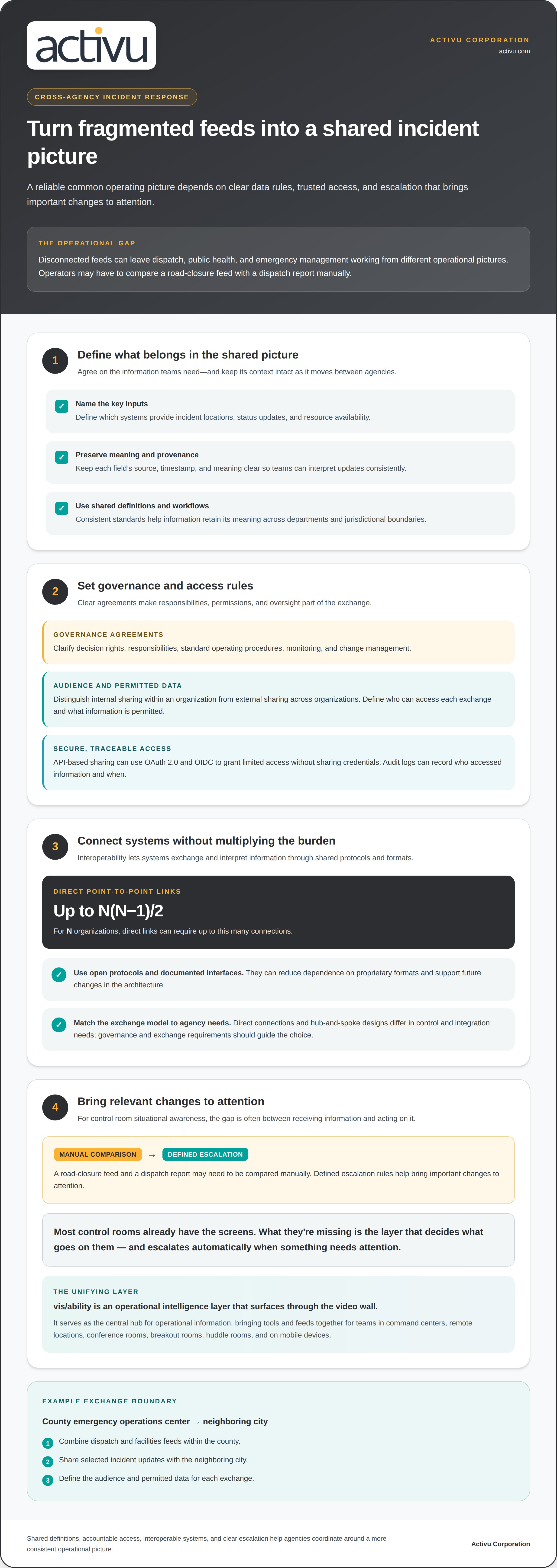
Unified data governance sets shared rules for data ownership, access, quality, and use. A single source of truth gives authorized teams a consistent reference while preserving each source agency’s responsibility for its records. For example, an emergency operations team could view current road closures alongside agency updates instead of reconciling conflicting spreadsheets. The source, timestamp, and meaning of each field should remain clear.
Agreements put those rules into practice. Agencies define decision rights, responsibilities, standard operating procedures, monitoring, and change management. They also establish shared definitions and data-entry workflows. These controls support data quality as systems change, staff roles shift, or agencies join. Reusing existing sources instead of creating duplicate datasets can also make shared services more sustainable.
Economic value comes from making existing information useful across programs and reducing duplicate collection and reconciliation. Government data sharing has no universal price: budgets depend on integration needs, hosting, security, governance, and agency participation. Procurement may use subscription, implementation, or shared-funding models, depending on the project.
U.S. agencies do not use one platform uniformly. Some arrangements connect systems directly, while hub-and-spoke designs centralize management. Each approach affects control and integration needs, so the model should match the agencies’ governance and exchange requirements.
A practical U.S. example is coordinated work around a Continuum of Care’s Homeless Management Information System. HUD’s Lead Improvement Evaluation Matrix describes a four-step workflow: Plan, Do, Study, and Act. Agencies can use that cycle to review joint workflows, identify data-quality gaps, and adjust responsibilities before expanding an exchange.
Inter-Agency Coordination and Incident Response
During an incident, disconnected feeds can leave dispatch, public health, and emergency management working from different operational pictures. Interoperability connects those inputs, while defined escalation rules help bring important changes to attention.
For control room situational awareness, the gap often lies between receiving information and acting on it. An operator may have to compare a road-closure feed with a dispatch report manually. Fragmented feeds and missing escalation can explain why operators miss incidents video wall searches describe. Most control rooms already have the screens. What they’re missing is the layer that decides what goes on them – and escalates automatically when something needs attention.
Interoperability and Vendor Flexibility
Interoperability lets systems exchange and interpret information through shared protocols and formats. It matters because an agency should be able to connect another organization’s data without rebuilding every integration. Direct point-to-point links among N organizations can require up to N(N-1)/2 connections. An open protocol and documented interfaces can reduce dependence on proprietary formats and support future changes in the architecture.
Teams searching for how to manage multiple data feeds dispatch center need clear ownership, relevant views, and automatic escalation. Define which systems provide incident locations, status updates, and resource availability. API-based sharing can use OAuth 2.0 and OIDC so organizations grant limited access without sharing credentials. Audit logs can record who accessed information and when. Together, these practices help teams trace exchanges and maintain a clear operational record.
Internal and External Data Sharing
Internal sharing moves information between teams within one organization; external sharing crosses organizational boundaries. For example, a county emergency operations center may combine its dispatch and facilities feeds, then share selected incident updates with a neighboring city. Defining the audience and permitted data for each exchange helps protect sensitive information while giving response partners relevant context.
HMIS interoperability shows why shared definitions matter beyond emergency response. A Continuum of Care may need participating service organizations to use compatible workflows and data-entry practices. Shared definitions help records retain their meaning as information moves between organizations. Agreements can also clarify roles and responsibilities, so partners know who contributes data and who can access it.
Benefits of Interagency Data Sharing
Interagency sharing can give decision-makers a fuller view of an incident and reduce manual reconciliation between separate systems. During a severe weather response, for example, transportation updates and local emergency reports can help teams identify affected routes and coordinate resources. For EOC common operating picture solutions, useful exchange depends on timely information, consistent interpretation, and clear access rules.
Better coordination still depends on people receiving the right information at the right time. Define event thresholds, escalation recipients, and follow-up responsibilities before operations begin. When an alert arrives, teams can assess shared context and coordinate a response instead of searching separate feeds. This structure supports faster decisions without treating every data source as equally relevant.
Data Contracts, Schemas, and Service-Level Agreements
A data contract defines what an agency shares, how it is structured, and what quality recipients can expect. For an incident feed, the contract might specify fields such as incident identifier, location, status, and update timestamp. It should also set update frequency, data-quality expectations, and ownership. These details give each organization a shared reference before automated exchange begins.
A schema describes the format and meaning of those fields. If a county sends a road-closure record, its partners need to interpret the location, status, and timestamp consistently. A schema registry can version and validate schemas as agencies update them. Without that control, one organization might rename a field while another system still relies on its original name, interrupting the exchange.
Service-level agreements document operational expectations for shared data services. Agencies can define update frequency, service ownership, maintenance communications, and how incidents affecting a feed are reported. These terms help teams distinguish stale information from a current operational update. They also clarify responsibilities when a source system or integration fails, rather than leaving response staff to guess why.
Automated updates work best when data producers and consumers agree on a reliable process. A transportation agency might publish a revised road-closure record, then an emergency operations system receives the changed status and timestamp. The contract defines which changes trigger an update, while validation checks that required fields remain present. This reduces manual transfer work and makes changes easier to trace.
Version control protects the process as systems evolve. A schema registry can retain each approved version, show when it changed, and validate incoming records against the correct structure. Cross-agency schema changes should follow backward- and forward-compatibility rules so updates do not break existing consumers. For example, adding an optional field may preserve older integrations, while removing a required field can disrupt them.
Agencies can manage changes through a clear sequence: propose the field or format change, assess affected consumers, document the new version, test compatibility, and schedule adoption. A shared change record gives each organization time to adjust its processes. This discipline helps prevent avoidable integration failures while keeping data contracts, schemas, and service expectations aligned as participation grows.
Set expectations explicitly. Organizations should define data contracts that cover schemas, update frequencies, and data-quality expectations, giving producers and consumers a consistent basis for exchange. When information is shared across organizations, schema registries can version and validate schemas, helping teams manage approved changes and check records against the expected structure.
Privacy, Security, and Liability Concerns
Agencies can secure data exchange by defining access, protecting information in transit, and recording its use. Start by identifying sensitive fields, approved recipients, and each organization’s responsibilities. Then apply role-based permissions, encryption, and audit logging. These controls help operational teams use relevant information while limiting unnecessary exposure and creating a record for security review.
Privacy requirements depend on the information and participating organizations. For external sharing involving covered health information, the U.S. Department of Health and Human Services identifies HIPAA business associate agreements as part of compliance analysis. Agencies should define each party’s role and permitted use before enabling the exchange. Written terms can also clarify how partners handle corrections, retention, and reports of suspected misuse.
Participant consent and privacy notices shape responsible data use. HUD’s HMIS privacy guidance says a Continuum of Care privacy notice must explain permitted uses and disclosures, including information used to provide or coordinate services. Agencies should explain these practices in plain language at intake and when relevant changes occur. This gives participants a clearer account of how their information may support coordinated services.
Technical safeguards should match data sensitivity. For information moving between organizations, TLS 1.3 or later can encrypt data in transit. Access controls should grant only the permissions needed for a defined task. Audit logs should record who accessed data and when, giving security teams a way to investigate unusual access. Together, these measures help establish traceability without granting broad access by default.
Liability concerns often arise when responsibilities are unclear. A data-sharing agreement can identify the source agency, receiving organization, permitted uses, and responsibility for correcting errors. For example, if a service record contains an outdated status, the agreement should specify which organization maintains that field and how partners report discrepancies. Clear escalation paths help staff route corrections to the appropriate data owner.
Data minimization further limits exposure: share only the fields needed for a specific operational purpose. An emergency coordination team may need a service availability status, not a participant’s full case history. Agencies can document the purpose of each field, restrict access to approved roles, and review whether shared information remains necessary. This makes privacy safeguards part of the exchange design, not an afterthought.
Cultural Barriers to Sharing Data
Technical integration can connect systems, but agencies still need a reason to share information. Cultural issues often present the biggest obstacles to a data-sharing program. A county emergency manager may see a shared incident feed as essential, while a department worries about losing control of its records. These concerns shape participation, trust, and the quality of contributed information. An effective analysis must consider organizational incentives alongside technical capabilities.
Different definitions can reinforce those concerns. A county and neighboring city, for example, may define an “active incident” differently or disagree about when a record is ready to share. If an agency fears blame for incomplete data, staff may delay updates or withhold context. Clarifying terms and responsibilities gives both organizations a basis for exchange and helps distinguish data-quality issues from reluctance to participate.
A practical framework starts with a shared purpose. An emergency management team, public health department, and transportation agency can identify the decisions that require shared information. They can then agree on who contributes each data type, who may access it, and how disagreements are resolved. Written governance agreements make these decisions visible. A named steward for each dataset gives participating agencies a clear point of accountability.
Trust grows through predictable processes, not broad promises. During onboarding, a program can explain how information will be used, train staff on shared definitions, and provide a way to report errors. For a county dashboard, staff should know whether a status update informs dispatch, public information, or resource allocation. These examples connect data sharing to daily work and help participants see its operational value.
Controls should support the agreed purpose without obstructing routine coordination. Access permissions, audit logs, and documented change processes can show who used information and how definitions evolve. Leaders can review participation, unresolved data issues, and feedback during regular governance meetings. If a fire department repeatedly declines to contribute a feed, the group can investigate whether the concern involves workload, ownership, or trust. Addressing the cause is more useful than adding another technical connection.
The central takeaway is that agencies must build a working relationship around the exchange. A platform can carry information, but shared definitions, accountable roles, and visible value determine whether people contribute it. Start with a specific joint decision, such as coordinating road closures during an emergency. Then use participating teams’ feedback to refine the framework, capabilities, and controls before expanding the effort.
Activu Corporation: vis/ability Platform
Activu Corporation helps control room teams unify operational information through the vis/ability Platform. When agency data, applications, and incident feeds remain fragmented, operators must piece together context across separate tools. vis/ability brings those tools together in a central hub, supporting a shared operational picture for decisions that depend on timely, relevant information.
Most control rooms already have the screens. What they’re missing is the layer that decides what goes on them – and escalates automatically when something needs attention. vis/ability is an operational intelligence layer that surfaces through the video wall. The wall becomes the place where answers appear, shaped by the information the platform brings together and the operational priorities teams define.
Through Application Integration, teams can bring complex applications and data streams into a single view. Event-Driven Situational Awareness helps surface information that needs attention, rather than requiring operators to monitor every feed equally. For example, a control room can align relevant operational applications around an emerging incident, helping staff understand the context and determine the next action.
This approach supports teams beyond a single command center. The vis/ability Platform supports operations in command centers, remote locations, conference rooms, breakout rooms, and huddle rooms. Mobile vis/ability extends access to mobile devices, helping distributed teams stay connected to operational information as they coordinate. Relevant information can reach people in the setting where they need to make or support a decision.
Activu’s Video Wall Systems provide a display environment for shared operational information, while vis/ability brings that information together and presents it. The focus remains on the operational picture, not the display alone. Teams can align application views with their workflows and make critical context visible to the people coordinating a response.
For agencies assessing a cross-agency data sharing platform, vis/ability supports the operational layer by integrating data streams, organizing relevant information, and bringing it into shared spaces. It complements the governance, privacy, and data-quality processes established by participating organizations. Activu Corporation helps make connected information usable across operational environments.
To discuss how these capabilities could support your operations, contact Activu Corporation.
Frequently Asked Questions
What are the benefits and use cases of cross-agency data sharing platforms?
A platform can help agencies coordinate decisions that depend on information held across organizational boundaries. During a regional outage, for example, emergency management teams may need transportation status and utility updates to plan public messaging and resource deployment. A cross-agency data sharing platform can bring those inputs into a shared operational context. Its practical value depends on whether participating teams can use the information to answer a defined operational question.
How do cross-agency data sharing platforms compare in features and interoperability?
Compare platforms by how they connect existing systems, control access, preserve data meaning, and support change over time. A useful evaluation scenario is adding a new agency’s incident feed without rebuilding every existing connection. Check whether the platform supports documented interfaces, clear data ownership, and traceable updates. Also assess how operators view relevant information across their workspaces, since technical connectivity alone does not ensure useful coordination.
What U.S. laws and regulations govern interagency data sharing and privacy?
Applicable requirements depend on the information, purpose, and organizations involved; no single rule covers every exchange. For external sharing involving health information, the U.S. Department of Health and Human Services identifies HIPAA business associate agreements as part of compliance analysis. Agencies should assess applicable federal, state, and program requirements for each use case, then document authorized use, disclosure, retention, and accountability in governing agreements.
What data standards and APIs enable interoperability across government agencies?
Interoperability depends on shared field definitions and interfaces that agencies can implement consistently. API-based exchange can use OAuth 2.0 or OIDC to grant limited access without sharing credentials. A schema registry can track and validate data formats as they evolve. For example, an agency adding a new incident-status field should preserve compatibility for existing consumers, so receiving systems continue to process earlier records correctly.
What are the security, privacy, and governance risks of cross-agency data sharing?
Key risks include excessive access, exposure of sensitive fields, unclear ownership, and inaccurate records influencing decisions. A practical review can trace one data item from its source to each recipient: who can access it, what purpose permits its use, and who corrects errors? Agencies should also consider whether shared information could reveal identities when combined with other records. Governance controls and documented accountability help contain these risks and support responses to misuse.