
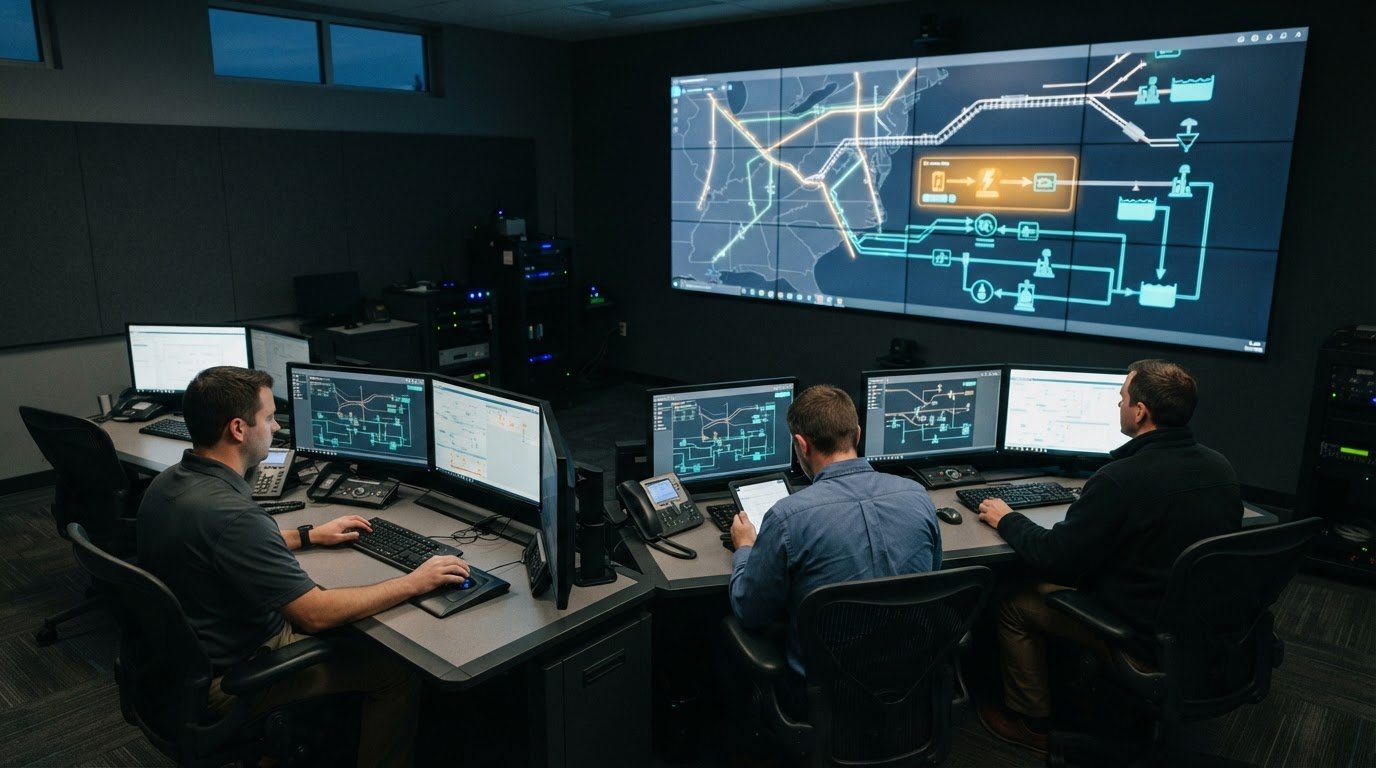
Operational clarity depends on how quickly teams can turn incoming information into coordinated action. A critical infrastructure command center brings monitoring, intelligence, and response coordination into a shared operational picture. The Cybersecurity and Infrastructure Security Agency identifies 16 critical infrastructure sectors, spanning assets and systems whose disruption could affect national security, economic security, public health, or safety.
Teams can struggle with fragmented data feeds, disconnected systems, and information silos that delay escalation. Most control rooms already have the screens. What they’re missing is the layer that decides what goes on them – and escalates automatically when something needs attention.
This article explains what a command center does, how operators use real-time intelligence, and how teams coordinate across infrastructure assets, systems, and networks. It also covers multiagency coordination and the capabilities that help decision-makers see essential information and act with greater confidence.
Key Takeaways
- Define the command center’s mission around the decisions teams must make and the incidents they need to coordinate.
- Bring real-time intelligence together so operators can prioritize relevant information and respond with greater clarity.
- Map how infrastructure assets, systems, and networks depend on one another to understand where disruptions may spread.
- Establish clear information-sharing and coordination practices across agencies, departments, and operational teams.
- Identify the capabilities that help teams manage incoming data, maintain situational awareness, and share a common operating picture.
Real-time intelligence and data integration
Command centers turn incoming intelligence into a shared operational picture that supports decisions across departments. This requires connecting relevant sources, identifying changes, and directing information to the people responsible for acting.
Real-Time Intelligence
Real-time intelligence is current information gathered from multiple sources and assessed to support operational decisions. In a maritime environment, for example, teams may combine agency databases, sensor reports, and intelligence from local Joint Terrorism Task Forces. Joint Harbor Operations Centers use this multiagency approach to fuse information and coordinate operations that protect maritime critical infrastructure.
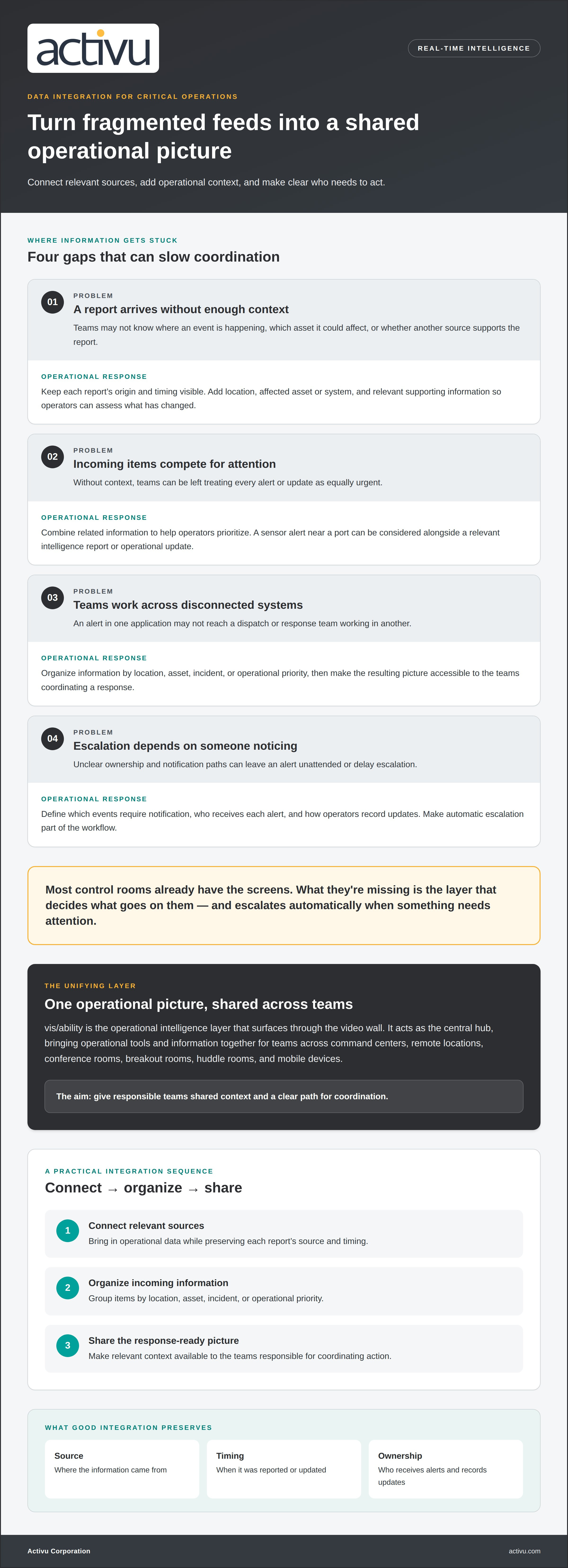
Integration makes reports useful by adding context. Operators need to know where an event is happening, which asset or system it could affect, and whether another source supports the report. A sensor alert near a port, for example, has different implications when paired with a relevant intelligence report or operational update. This shared context helps teams prioritize attention rather than treat every incoming item as equally urgent.
Presidential Policy Directive 21 supersedes Homeland Security Presidential Directive 7, according to The White House. For command center teams, policy context belongs alongside current operational information, not in a disconnected reference. Clear source attribution and timestamps help operators distinguish a new development from older intelligence. They also give departments a common basis for discussing what has changed and what response may be needed.
Software, Communications, and Monitoring Systems
Command centers use software to combine operational data, communications systems to coordinate teams, and monitoring systems to detect developing events. Common inputs include agency databases, sensor feeds, incident reports, and communication channels for sharing updates. The right combination depends on the center’s mission and the infrastructure it monitors.
Integrate information in a defined sequence. First, connect relevant data sources while preserving each report’s origin and timing. Next, organize incoming items by location, asset, incident, or operational priority. Then make the resulting picture accessible to the teams coordinating a response. For example, a port operations team needs to connect a sensor alert with its location and share that context with partner agencies.
Fragmented systems create gaps: an alert may appear in one application while a dispatch team works in another. Without a shared process that clarifies ownership, silos can delay escalation. Define which events require notification, who receives each alert, and how operators record updates. These steps make automatic escalation part of the workflow rather than relying only on someone to notice an item.
Most control rooms already have the screens. What they’re missing is the layer that decides what goes on them – and escalates automatically when something needs attention.
Defining a command center’s mission
A command center’s mission defines the outcomes its team must deliver and the decisions it must support. Clear priorities shape staffing, workflows, information access, and escalation paths.
Mission, Functions, and Capabilities
A command center mission sets out what the operation must monitor, coordinate, and achieve. Common functions include improving response times, supporting investigations, coordinating emergency response, and increasing situational awareness. An emergency operations center may prioritize incident coordination, while a military operations center may focus on force and threat information. Federal partners may need shared reporting paths with state, local, and private-sector teams.
Translate the mission into operational functions: detect relevant events, assess their impact, notify responsible teams, coordinate action, and document decisions. For example, a center overseeing transportation assets can define which disruptions require escalation and which teams own each response. These decisions make readiness, information flow, and incident coordination measurable.
Build the mission around decisions, not a list of available tools. Identify who needs to act, what information supports the action, and how updates reach the next team. These choices also clarify the center’s role in routine monitoring and emergency response.
Cost depends on facility scope, system integration, staffing, resilience needs, and security controls, and is established after a quote request. A center supporting multiple departments may need different workflows and integrations from one serving a narrower mission.
Common failure points include unclear ownership, fragmented information, delayed escalation, and workflows that do not match the mission. For example, an alert can go unattended if teams have no agreed notification path. Assigning responsibility and defining escalation criteria helps close that operational gap.
Security Requirements
Security requirements protect a command center’s people, information, systems, and physical operating environment. Cybersecurity planning should address access to operational systems, data handling, communications, and recovery processes. Physical security planning should consider who can enter sensitive work areas and how teams maintain operations during a facility disruption. Controls should reflect the center’s mission and the infrastructure it supports.
Requirements vary by sector, system, and operating role, so map applicable obligations before finalizing procedures. Separate access by responsibility, establish incident reporting paths, and define how authorized personnel maintain coordination during a disruption. These steps connect cybersecurity and physical security to actual command workflows.
For U.S. national policy context, Presidential Policy Directive 21 supersedes Homeland Security Presidential Directive 7, according to The White House. The applicable regulations and standards depend on the sector and systems involved; operators should align procedures with their specific obligations rather than assume one framework applies everywhere.
U.S. examples include Coast Guard Sector Command Centers and Joint Harbor Operations Centers. Sector organizations bring Coast Guard missions within a geographic area under one organization, while Joint Harbor Operations Centers fuse intelligence and coordinate multiagency operations. Their missions show why command authority, partner roles, and information-sharing procedures should be defined in advance.
Teams working to improve cybersecurity visibility can use a shared cybersecurity operating picture to align information with operational decisions.
Infrastructure assets, systems, and networks
An infrastructure asset is a facility, resource, or component that supports essential services. A system connects assets and processes to deliver those services, while a network links systems and organizations. Command centers support operations in sectors including energy, transportation, emergency services, healthcare, and communications. The Cybersecurity and Infrastructure Security Agency identifies 16 critical infrastructure sectors whose assets, systems, and networks are considered vital enough that their incapacitation or destruction could have a debilitating effect on national security, economic security, public health, or safety.
Energy assets include electricity, oil, and natural gas resources. Those resources help maintain steady energy supplies, and disruptions can affect other infrastructure operations. Dams provide water-retention and control services that support multiple sectors and industries. A command center responsible for utilities and energy operations needs awareness of relevant assets and the systems connecting them.
Transportation Systems move people and goods across the country every day. Their continuity depends on connected infrastructure and coordinated operations. A disruption affecting a transport hub, for example, may require teams to assess impacts on nearby facilities and routes. Command center teams can map the affected asset, the systems it depends on, and the agency responsible for the response.
Communications infrastructure enables organizations and communities to exchange information. Private-sector organizations are primarily responsible for protecting U.S. Communications Sector infrastructure and assets, while CISA helps predict, anticipate, and respond to sector outages. This makes agency coordination important: operators need to know who owns an asset and how an outage could affect dependent services.
Other sectors have distinct operational dependencies. The Chemical Sector manufactures, stores, uses, and transports chemicals that other sectors rely on. The Food and Agriculture Sector includes farms, restaurants, and food manufacturing, processing, and storage facilities. The Healthcare and Public Health Sector collaborates to protect all sectors from hazards, including infectious disease outbreaks and natural disasters.
Map dependencies in a consistent sequence. First, identify essential facilities and the services they support. Next, connect each facility to relevant systems, suppliers, communications, and response teams. Then record which events could disrupt those connections and which agency or operator owns the next action. For example, an energy disruption may require coordination with organizations that depend on steady power.
This map supports national situational awareness by showing how threats can cross sector boundaries. CISA identifies, assesses, prioritizes, and protects U.S. manufacturing industries of national significance against man-made or natural disasters. A command center can use this sector context to prioritize reports, identify affected dependencies, and direct updates to the teams responsible for protecting assets and maintaining operations.
Multiagency command and control
Multiagency command and control coordinates decisions, information, and responses across organizations with shared operational responsibilities. A critical infrastructure command center needs defined authority, communication paths, and coordination procedures before an emergency begins. Its design and staffing should reflect the mission, participating agencies, and incidents teams must manage.
Design starts by mapping how people coordinate during routine operations and emergencies. Include IT teams, operations personnel, end users, leadership, and community stakeholders in planning. Each group brings a different perspective on information access, system dependencies, and response needs. A transportation center, for example, may need workflows that connect infrastructure operators with public safety and government partners.
Staffing assigns clear responsibility for monitoring, assessment, coordination, and decisions. The center’s mission determines which roles are needed and how they work together. Teams should know who receives an alert, who evaluates its impact, and who communicates updates to other agencies. During an emergency, this structure clarifies the handoff between the person identifying an incident and the authority coordinating the response.
Joint Harbor Operations Centers provide a U.S. example of multiagency coordination. They combine agency databases, sensors, and liaison to collect, fuse, and share information for a tactical picture. Their purpose includes protecting maritime critical infrastructure through intelligence fusion and coordinated operations. This model shows how shared information and agency participation can support decisions across organizational boundaries.
Effective collaboration also requires agreement on what information can be shared, who needs it, and how teams communicate changes. Establish procedures for incident reporting, information visibility, emergency layout changes, and sharing information from analysts with decision-makers. A consistent operating picture helps partner agencies understand the same event without relying on separate updates or informal handoffs.
Command authority can vary by incident type. Established command-and-control authorities among local, state, and federal partners support responses to natural disasters and terrorist attacks. The same distinctions are not yet established for cyberattacks. Plans should account for this difference and define coordination paths for cyber incidents rather than assume disaster procedures apply directly.
Plan for continuity as well as initial response. Command center environments should support 24/7 reliability and operational continuity, with procedures for shift handoffs and ongoing maintenance. As operations grow, planning should consider additional operator positions, drone operations, expanded collaboration spaces, more video sources, new departments or partner agencies, and emerging AI capabilities. These decisions connect staffing and facility design to future operational demands.
During design, translate each mission requirement into a workflow, a responsible role, and an information-sharing path. This alignment helps teams coordinate across agencies while preserving clear accountability when incidents demand rapid action.
What functions and capabilities does a critical infrastructure command center provide?
A command center provides continuous monitoring, incident coordination, and decision support for essential operations. Its functions depend on the assets it oversees and the decisions its teams must make. Operators use the center to detect developments, assess operational impact, communicate priorities, and coordinate responses.
Continuous monitoring brings operational information into view so teams can identify events that need attention. A command center may display sensor reports, incident communications, and system status together. Operators assess each alert against its location, affected asset, and current conditions. This context helps distinguish an operational change requiring action from information needing routine follow-up.
Incident coordination connects information with responsibility. When an event develops, teams need to share updates, identify the decision-maker, and communicate response actions. A useful workflow shows who owns each step and how status changes reach other departments. During a transportation disruption, for example, operators may need to share incident details with agencies responsible for response and continuity.
Information visibility means presenting relevant operational data to the people making decisions. It should support several workflows:
- Incident communications: Route updates to the teams responsible for assessment and action.
- Emergency layout changes: Bring incident-specific sources into view as conditions change.
- Analyst-to-decision-maker sharing: Give leaders timely access to the information behind an assessment.
- Interdepartmental information flow: Keep affected teams aligned as response activity develops.
Operational continuity is the ability to sustain command functions during routine activity and incidents. Command center environments should support 24/7 reliability and continuity. Teams also need maintenance procedures and fast troubleshooting during incidents. Shift handoffs should capture active issues, decisions made, and pending actions so the next operators can continue work without losing context.
Communication and collaboration capabilities help operators coordinate across roles and locations. Secure communication lines and built-in redundancy support continued operations if a component or pathway fails. Multiple screens, integrated communication tools, and ergonomic consoles can help operators manage information during long shifts. The design should keep essential updates accessible without making teams search across disconnected workflows.
Decision support turns incoming information into an actionable assessment. AI can help operators process information, reduce overload, identify important events faster, and improve decision-making. Human judgment remains central: operators assess the event, weigh its operational impact, and determine the next action. This capability matters most when it puts relevant information in front of the right decision-maker at the moment of choice.
Evaluate each capability against a defined operational task, such as detecting an incident, escalating it, coordinating a response, or maintaining continuity. This keeps the center focused on the work teams must perform.
Activu Corporation
Activu Corporation helps critical infrastructure teams address fragmented systems, information silos, and missed escalations through integrated operational workflows. The vis/ability Platform is the central hub for connected tools and an operational intelligence layer that surfaces through the video wall. It serves teams in command centers, remote locations, conference rooms, breakout rooms, huddle rooms, and on mobile devices.
When operators need a clearer shared picture, Activu’s Application Integration and Event-Driven Situational Awareness connect relevant data and workflows with operational decisions. Activu’s Video Wall Systems use vis/ability to put information in view, helping teams focus on the incident and coordinate a response.
To discuss command center needs and operational priorities, contact Activu Corporation.
Set the Next Operational Priority
Start the next design decision with the operational gap your team needs to close. Identify where information becomes difficult to act on, which teams need a clearer shared picture, and how decisions should move between locations. That priority gives system planning a practical direction and keeps the focus on the people responsible for response.
For a critical infrastructure command center, Activu Corporation’s Video Wall Systems, vis/ability Platform, and Event-Driven Situational Awareness support a connected operational picture. These offerings help bring relevant information into view and connect it with team workflows. The aim is to give operators a clearer basis for judgment as conditions change and support coordination across the environments where teams work.
Start with the decision your teams need to make with greater clarity, then shape the operational environment around that need. Contact Activu Corporation to discuss your command center priorities and identify a practical next step.
Frequently Asked Questions
What is a Command Center?
A command center is a staffed operational hub where teams monitor activity and coordinate decisions. In a critical infrastructure command center, staff use operational information and communication tools to assess conditions affecting essential services. During a utility disruption, for example, operators can track incoming updates, identify the teams responsible for assessment, and communicate status changes. The center’s structure and tools should support the decisions its staff need to make.
What is a critical infrastructure command center?
A command center supports the operation and protection of services essential to communities and the national economy. Staff focus on assets, dependencies, and risks tied to a specific operational mission. If a power disruption affects a water facility, for example, operators can help identify the affected service, establish its status, and coordinate information among responsible teams. This gives decision-makers an operational setting for managing connected impacts.
How do command centers coordinate with government agencies, utilities, and emergency responders?
Command centers coordinate through agreed communication paths, clear role ownership, and shared incident updates. A critical infrastructure command center might receive a utility status report, field updates from emergency responders, and coordination information from a government liaison. Agreed incident labels and update formats can reduce ambiguity. Clear handoffs help each organization understand who is assessing conditions, who is making decisions, and when status changes.
Which U.S. regulations and standards govern critical infrastructure command centers?
Requirements vary by sector and system, so teams should identify applicable obligations and align procedures with them. Presidential Policy Directive 21 supersedes Homeland Security Presidential Directive 7.
Which critical infrastructure sectors use command centers in the United States?
Command centers support operations in sectors such as energy, transportation, emergency services, healthcare, and communications.