

AV-over-IP does not need to appear by name in every control room technology RFP. Start with operational requirements: how systems exchange information, how security events are monitored, and how incidents are escalated. Name a technology or protocol only when it makes a requirement clearer and easier to test.
A strong RFP does more than list equipment. It helps procurement, IT, security, and operations teams assess whether a proposed system supports reliable decisions when information is fragmented and incidents demand attention. Clear requirements also give vendors a consistent basis for explaining their approach.
This guide covers how to scope resources and milestones, set evaluation criteria, define supplier deliverables, and address security monitoring and incident response. It also explains how to make requirements measurable, so proposals can be compared against the operational outcomes your control room needs.
Key Takeaways
- Map project scope, staff responsibilities, dependencies, and milestones before releasing the RFP so vendors can propose against a clear implementation plan.
- Set measurable evaluation criteria and weighted scores that let the team compare technical fit, experience, delivery approach, and cost consistently.
- Separate mandatory requirements from preferences, then give vendors clear submission instructions, deadlines, and response formats.
- Define supplier deliverables and handover expectations, including project schedules, subcontractor details, references, and acceptance steps.
- Specify how the solution should monitor security events, escalate incidents, and bring relevant information together for operator decisions.
1. Project resources, milestones, and implementation planning
Public-sector technology RFPs follow the procurement rules that apply to the issuing agency, so requirements vary across federal, state, and local entities. Standard public procurement frameworks generally require appropriate administrative or technological review before a solicitation is publicly released.
Start with the operational gap, then define the result the project must deliver. A control room technology RFP template should give every vendor the same context: the control room’s role, current workflows, affected systems, and the decisions operators need to make. For example, a dispatch center replacing fragmented feeds should identify the sources operators use and where delayed escalation creates risk.
Assign a project lead and identify staff who can contribute requirements, access decisions, security needs, and acceptance criteria. Include operations, IT, procurement, security, facilities, and legal as relevant. A team may need to dedicate 100 hours of development work to support a smooth implementation, so identify internal capacity and competing work before setting the timeline.
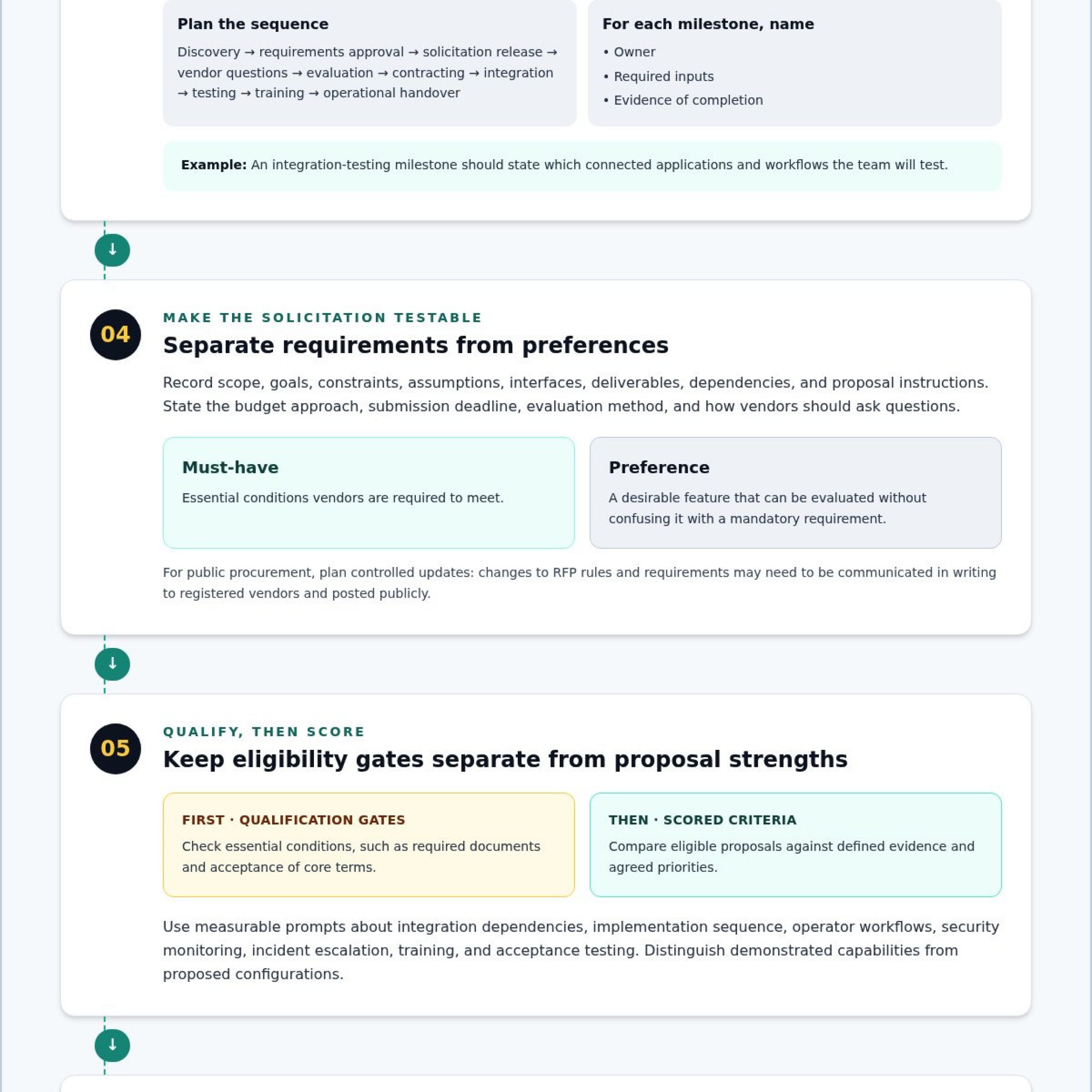
Build milestones around decisions and dependencies, not just installation. Map discovery, requirements approval, solicitation release, vendor questions, evaluation, contracting, integration, testing, training, and operational handover. For each stage, identify its owner, required inputs, and evidence of completion. An integration-testing milestone, for example, should specify which connected applications and workflows the team will test.
Before release, record project scope, goals, constraints, assumptions, existing system interfaces, required deliverables, implementation dependencies, and proposal instructions. Separate must-have requirements from preferences. State the budget approach, submission deadline, evaluation method, and how vendors should raise questions. Standard public procurement guidelines typically require changes to RFP rules and requirements to be communicated in writing to all registered vendors and posted publicly. Plan for controlled updates.
If the agency uses standardized project governance records, identify what information is publicly available, where readers can access it, and what the solicitation itself must explain. Confirm release details through the agency’s standard review process. Public agencies must regularly reassess procurement risk and revise their risk assessment plans when conditions change during the procurement lifecycle.
Keep project context usable. Link supporting documents to specific requirements, and explain how vendors should connect their proposed approach to operational outcomes. For manufacturing environments, define process-control dependencies alongside control-room workflows; manufacturing process control may affect the project boundary. A clear scope lets vendors plan resources and milestones against the same operational picture.
2. Vendor qualification and evaluation criteria
Build evaluation criteria around operational needs, and make every score traceable to proposal evidence. Procurement, operations, IT, security, and legal should agree on priorities before releasing the solicitation. Operators can identify workflow failures, IT can assess integration and architecture, security can examine monitoring and incident response, and legal can review contractual exposure.
Separate qualification gates from scored criteria. Gates determine whether a vendor meets essential conditions, such as submitting required documents or accepting core terms. Scored criteria compare the strengths of eligible proposals. For example, ask vendors to explain how the proposed system connects operational data feeds and escalates relevant events, then score each response against defined evidence rather than broad claims.
Assign a percentage weight to each scored criterion and ensure the full rubric totals 100%. One example model allocates 35% to technical requirements, 30% to cost estimate, 15% to management, 10% to approach, and 10% to innovation. Treat this as an illustrative structure, not a universal formula. Adjust weights to reflect project priorities, and describe what earns a strong, partial, or weak score.
Use measurable prompts to produce comparable responses. Ask vendors to describe integration dependencies, implementation sequence, operator workflows, security monitoring, incident escalation, training, and acceptance testing. Request examples or supporting documents where they substantiate a claim. Distinguish demonstrated capabilities from proposed configurations, and score every response against the same rubric.
For California RFPs, administrative and technical requirements generally account for 50% of the evaluation, with cost accounting for 50%. A different weighting must receive DGS/PD approval before solicitation release. Under California Public Contract Code Section 12102.2 (a)(2), administrative and technical scores must be available before the cost proposal is opened for value-effective acquisitions. Follow the applicable procurement process when setting the sequence.
Document the evaluation as it happens. Use a common scoring form, record evidence for each rating, note conflicts of interest, and capture how the panel resolved material differences. California requires an Evaluation and Selection Report when the RFP format is used. Preserve the criteria, scoring rationale, evaluation steps, and selection basis so the decision can be explained.
Keep the control room technology RFP evaluation focused on operational fit as well as price. A low-cost proposal that leaves key data sources isolated may not meet the project’s stated needs. Clear weights, consistent evidence standards, and a complete selection record help the team compare proposals against the outcomes that matter.
3. General RFP template and vendor submission advice
A useful request for proposal gives every vendor the same operating context and response structure. Include the organization’s purpose, project goals, current environment, scope, expected outcomes, timeline, budget approach, evaluation criteria, and submission instructions. A control room technology RFP template should distinguish mandatory requirements from preferences, so proposals address operational needs before optional features.
Ask vendors for a transparent cost breakdown. Request separate amounts for equipment, software, implementation, integration, training, support, maintenance, and optional components, with assumptions and exclusions stated for each item. Ask how recurring charges change over the contract term, and require the total contract amount in a format your procurement team can compare consistently.
Technical requirements should describe the capabilities the organization needs, not prescribe unsupported details. Specify required system interfaces, data sources, user workflows, security controls, monitoring, incident escalation, reliability expectations, and service-level agreements. State whether SOC 2 Type II, ISO 27001, PCI DSS, or another security requirement applies to the procurement. Mark each requirement as mandatory or desirable.
For integration with existing control room systems, identify the applications and data sources in scope, their owners, and the workflows they support. Require vendors to explain connection methods, dependencies, data handling, testing responsibilities, and how they will diagnose integration issues. For example, ask how an alert from one system will reach operators alongside relevant camera or operational data. Define acceptance tests around those workflows. Application integration for control rooms can help frame these operational questions.
Common RFP risks include vague outcomes, conflicting requirements, unclear ownership, and scoring criteria that do not reflect stated priorities. A requirement such as “easy to use” gives evaluators little evidence to score. Replace it with a scenario: ask the vendor to show how an operator finds a priority event, views supporting information, and follows the escalation workflow.
Make vendor questions measurable. Ask for a response, supporting evidence, and a description of how the requirement will be demonstrated. Weighted scoring helps evaluators compare proposals against agreed priorities; the BMC guidance suggests rating requirement importance on a scale from 1 to 10. Use the same scoring method across vendors, and explain how evaluators should treat partial answers or exceptions.
Set a single contact procedure for questions, clarifications, and submissions. State the contact role, question deadline, approved communication channel, response process, and final submission deadline. The sample RFP sets March 8 as the bidder-question deadline and March 22 as the proposal deadline. Give vendors the required file format, response order, page limit, and any requested attachments.
Before release, review the document as a vendor would: follow each instruction, locate every referenced attachment, and confirm that each requirement has a corresponding response field. This final review catches avoidable submission gaps and gives evaluators a consistent record for comparison.
4. Supplier process expectations and required documents
Set the supplier process before proposals arrive. State which documents vendors must submit, which meetings they should attend, and how the organization will assess completion. A clear format lets procurement track each requirement from proposal review through implementation, training, testing, and operational handover.
According to WSU Tech, its Control Room Move RFP requires vendors to provide proposed project completion timelines, subcontractor information, and references. These materials help evaluators assess schedule credibility, delivery responsibilities, and relevant experience. Request named project roles and a description of each subcontractor’s assigned work, so the organization can identify who owns every major task.
Define the materials needed to evaluate technical and operational readiness. Depending on project scope, request architecture diagrams, integration descriptions, software documentation, security responses, training plans, and a list of assumptions or exceptions. Ask vendors to identify each source system they expect to connect, what they need from its owner, and any dependencies that could affect delivery.
Make contract exceptions visible early. According to WSU Tech, its Control Room Move RFP requires offerors to state exceptions to the terms and conditions in their proposals, and some exceptions may disqualify a proposal from further review and evaluation. Include a dedicated section for exceptions, with space to identify the affected clause and explain the operational or delivery impact.
Describe the meetings and decisions that follow selection. A project kickoff should confirm roles, communication channels, access needs, dependencies, and the working schedule. Design reviews can resolve workflow and integration questions before configuration begins. Record decisions and assigned actions after each meeting, so they do not get lost in separate email threads.
Training should prepare operators for the workflows the project changes. Require a proposed agenda, intended audience, training materials, and a way to capture unresolved questions. For example, if the new system changes how staff acknowledge alerts, include that workflow in training and test it with intended users before handover.
Define acceptance testing in the RFP instead of leaving it to informal agreement after award. Specify test scenarios, expected results, responsible participants, defect recording, and the process for retesting failed items. A scenario might verify that an alert reaches the correct operator view and that associated information appears as intended. State what evidence the supplier must provide when each test passes.
Complete handover with an agreed document package. Require final diagrams, configuration records, software and system documentation, training materials, test results, open-issue status, and ownership assignments for ongoing tasks. Organize the materials so the organization can quickly find essential information during routine operations and incident response.
5. Security monitoring and incident response
Control room situational awareness problems often start when security alerts, operational data, and response communications remain in separate systems. An RFP should specify how teams detect, assess, communicate, and manage security events across those sources. Require vendors to describe monitoring coverage, alert conditions, escalation paths, operator roles, and incident records. This makes clear what responders need to see and do when an event requires coordinated action.
For industrial environments, identify applicable frameworks and systems in the solicitation. Organizations may reference the NIST Cybersecurity Framework, IEC 62443, ISA/IEC requirements, or NERC CIP where relevant. Federal technology procurements may reference NIST 800-171. Name the applicable framework and ask vendors to explain how their proposal addresses the requirements in scope.
Network requirements should define permitted connections, access boundaries, and how security events move between systems. Identify the operational technology, enterprise services, and control room applications that must exchange information. In Modbus, PROFINET, and EtherNet/IP environments, require passive, non-intrusive monitoring. Active scanning can cause PLCs, RTUs, and HMIs to fault, potentially disrupting production or creating safety hazards.
Make incident response testable with realistic scenarios. For example, ask vendors to demonstrate how a suspicious access event is detected, prioritized, routed, acknowledged, and recorded. Include a scenario where a data source becomes unavailable and another that requires coordination across teams. These tests reveal whether response steps remain clear when time-sensitive information comes from multiple systems.
If your dispatch center manages multiple data feeds, specify how operators should recognize related alerts and access supporting context. EOC common operating picture solutions should also clarify how security information reaches decision-makers across the response operation. Ask vendors to demonstrate the intended workflow, rather than simply listing data sources or interface features.
Why do operators miss incidents on a video wall? Alerts can compete for attention when displays lack prioritization or context. Require vendors to explain how significant events become visible, what information accompanies an alert, and how escalation reaches the responsible operator. Define expected display and notification behavior for each test scenario.
Require proposals to cover access controls, event logging, communications, and recovery procedures. Document who maintains alert rules, reviews records, approves access changes, and coordinates incident communications. Set weighted evaluation criteria for security architecture, response workflows, integration, and supporting evidence, then assess each vendor against the same scenarios.
Activu Corporation: Video Wall Systems
Activu Corporation helps control room teams address fragmented systems, information silos, and missed escalation through integrated operational awareness. Most control rooms already have screens. What they need is the layer that determines what appears on them and brings important events to operators’ attention.
Activu’s vis/ability Platform is an operational intelligence layer that brings information to the video wall. It unifies teams across command centers, remote locations, conference rooms, breakout rooms, huddle rooms, and mobile devices. With vis/ability, connected information appears on the video wall and other displays, giving operators a shared view.
Consider Activu when your RFP needs to connect operational systems and support event-driven situational awareness. Contact Activu to discuss how its control room solutions can meet your operational requirements.
Turn RFP requirements into operational clarity
Your procurement document can shape how teams interpret changing conditions and coordinate decisions. Treat it as an operational design tool: define how information should reach people, how relevant events should surface, and how teams should collaborate. A control room technology RFP template is most useful when it connects technical requirements to the decisions operators make.
Use the evaluation process to assess whether proposed approaches fit your workflows and support coordination across control room teams. Activu Corporation offers Video Wall Systems, the vis/ability Platform, and Event-Driven Situational Awareness.
When you’re ready to discuss how those offerings could fit your requirements, contact Activu Corporation. Move forward with a specification that helps your team act on the information that matters.
Frequently Asked Questions
Does the RFP need to specify AV-over-IP by name?
No. Specify AV-over-IP by name only when the project depends on that approach or procurement rules require it. Otherwise, describe the required outcomes: how systems exchange information, which sources operators need to access, how content reaches workstations or shared displays, and how access is controlled. Ask vendors to identify their proposed architecture and its limitations. This keeps the RFP focused on operational fit while allowing evaluators to compare technical approaches.
What should a control room technology RFP include?
Include the operational scenarios the project must support, such as coordinating a response when an alert and related video arrive from separate systems. Add a responsibility matrix showing who supplies access, data, approvals, and testing participation. An attachment register can identify diagrams, inventories, and other reference files, with a version date for each. These details help vendors understand dependencies and reduce ambiguity during proposal review and implementation.
Are there free control room technology RFP templates?
Public agencies or procurement offices may offer free templates, and previous solicitations can provide useful examples. Treat them as starting points, not complete specifications. Before adapting one, remove irrelevant provisions, align its instructions with your organization’s procurement process, and ensure its response fields match your requirements. A generic form may omit control room workflows, system dependencies, security responses, or acceptance evidence your project needs.
How should a control room RFP define video walls, consoles, and AV systems?
Describe the operator tasks and information each environment must support, then connect those needs to system requirements. For a video wall, explain what information should appear together during a defined event. For consoles, describe operator access and workflow needs. For AV systems, identify the sources and destinations that must connect. Request diagrams or demonstrations that show these relationships, rather than relying on labels such as “modern” or “easy to use.”
How should vendors be evaluated and scored in a control room technology RFP?
Use a consistent rubric and require evaluators to tie each score to proposal evidence. Add a practical scenario to distinguish claims from demonstrated understanding: ask vendors to explain how an operator would recognize, assess, and share a developing incident. Have evaluators score independently before discussing differences. Record the evidence behind each rating and any clarification that changes how the panel interprets a response.
What service, warranty, training, and support terms should a control room RFP specify?
Define required service coverage, warranty scope, support channels, issue severity categories, escalation process, and service-level measures. Ask vendors to state exclusions and explain how they handle software updates or unresolved defects. For training, specify the operator roles, materials, and workflows that need instruction. Tie support and training requirements to handover, so the team knows who owns each issue after acceptance.