
The most advanced hardware in your command center is a liability if it forces your operators to act as human filters for thousands of disconnected data points. In a market where the video wall controller sector exceeded $547 million in 2026, many organizations still struggle with the same fatigue and missed incidents that plagued them a decade ago. You likely recognize that managing multiple disparate feeds from platforms like Axon creates a fragmented environment where critical details slip through the cracks. It’s frustrating to invest in high-resolution displays only to find that your team is still drowning in siloed information.
Selecting a video wall processor for 24/7 operations requires looking beyond raw hardware specs to the software intelligence that drives it. Most control rooms already have the screens. What they’re missing is the layer that decides what goes on them, and escalates automatically when something needs attention. This article explores how to implement vis/ability as the operational intelligence layer that unifies your displays, automates event escalation, and creates a common operating picture across your entire enterprise. You’ll learn how to move from passive monitoring to proactive situational awareness by focusing on the processing layer that connects your command center to the field.
Key Takeaways
- Understand why hardware redundancy alone won’t prevent operator fatigue or missed incidents in high-stakes environments.
- Identify the essential technical traits of a video wall processor for 24/7 operations, including hot-swappable components and advanced thermal management.
- Move beyond static pixel management by implementing an operational intelligence layer. This software-driven approach automatically prioritizes and escalates critical data.
- Ensure long-term security and compliance by choosing processing platforms that meet rigorous standards, such as NERC CIP for the utility and energy sectors.
- Bridge the gap between the command center and field teams with a unified operating picture that facilitates faster and more certain decision-making.
Beyond the Hardware: Why 24/7 Operations Struggle with Data Saturation
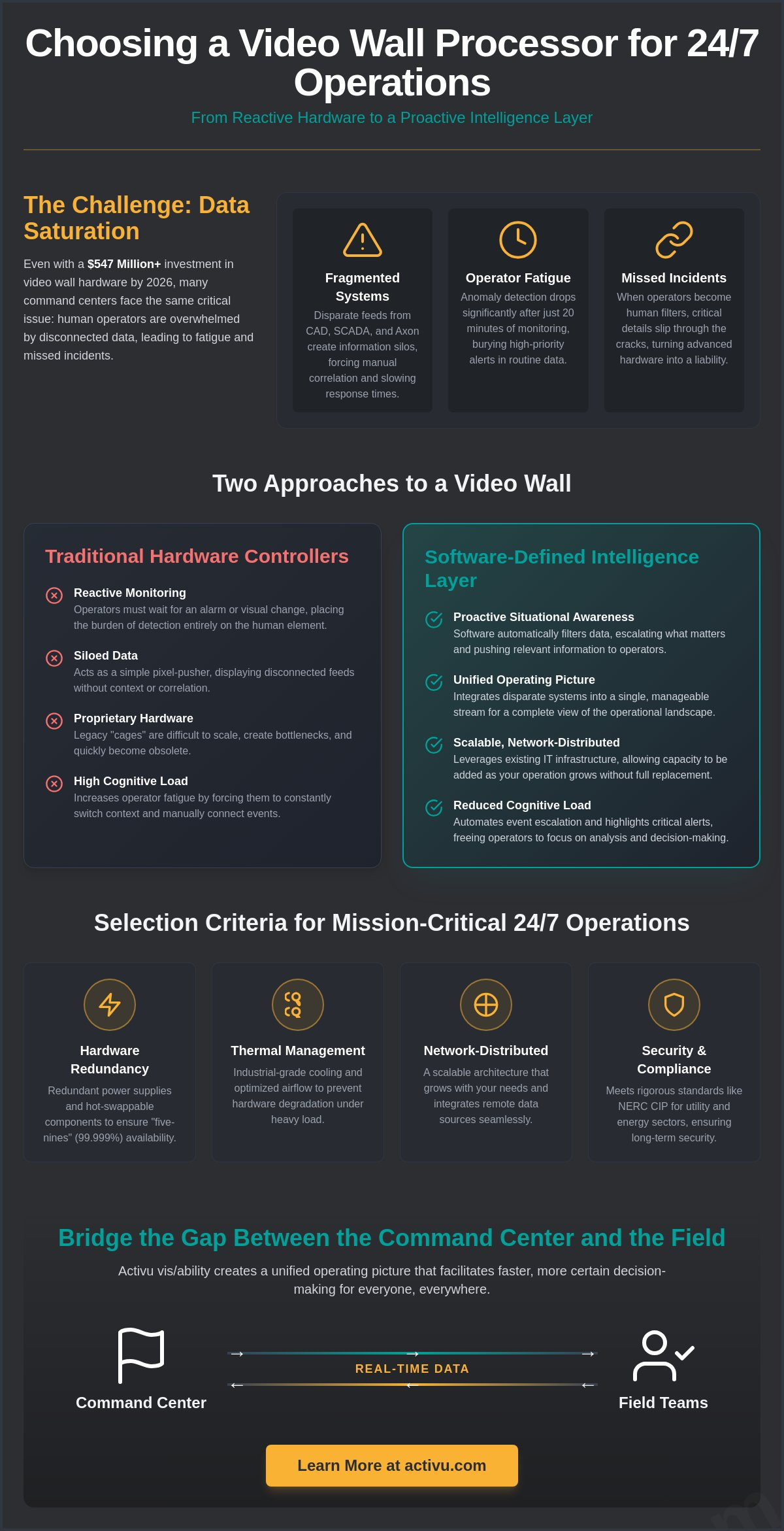
Modern command centers are often built on a paradox. Organizations invest heavily in high-definition displays, yet critical incidents are still missed because the volume of data overwhelms the human element. The global video wall controller market reached $547 million in 2026, reflecting a massive investment in visual hardware. However, a video wall is only as effective as the intelligence driving it. When you select a video wall processor for 24/7 operations, you aren’t just buying a box to move pixels. You’re choosing the foundation of your situational awareness.
Traditional monitoring models rely on a reactive stance. Operators wait for a screen to change or an alarm to sound. This approach fails when the volume of incoming data exceeds the capacity of the staff to interpret it. Most control rooms already have the screens. What they’re missing is the layer that decides what goes on them, and escalates automatically when something needs attention.
The Problem of Fragmented Systems and Siloed Data
Fragmented systems like Computer-Aided Dispatch (CAD) or Supervisory Control and Data Acquisition (SCADA) often operate in total isolation. While specialized tools like Axon provide essential video evidence, they offer only a partial view of the operational landscape. They require a unifying platform to create a full common operating picture. Without this, an operator must manually correlate a power grid fluctuation with a security breach or a weather event. This manual switching creates a high cognitive cost. It slows down response times during a crisis when every second counts. True efficiency requires a unified operating picture where these disparate feeds flow into a single, manageable stream.
Operator Fatigue and the Limits of Manual Monitoring
Human attention is a finite resource. Research into 24/7 surveillance shows that an operator’s ability to detect anomalies drops significantly after just 20 minutes of monitoring multiple screens. This “intelligence gap” occurs when routine telemetry buries high-priority alerts. A video wall processor for 24/7 operations must act as more than a display utility. It must function as a filter. Our vis/ability platform serves as this operational intelligence layer. It highlights only what matters, stripping away the digital noise. This ensures that your team remains focused and analytical when the stakes are at their highest, rather than being buried under a mountain of irrelevant data.
Essential Technical Specifications for 24/7 Video Wall Processors
Success in a command center depends on the physical reliability of the processing layer. While software provides the intelligence, the hardware must be capable of sustained, uninterrupted performance. Redundancy is essential. A video wall processor for 24/7 operations must feature redundant power supplies and hot-swappable components to ensure that a single component failure doesn’t result in total system downtime. High-performance thermal management is equally vital, as excessive heat is the primary cause of hardware degradation in enclosed rack environments. Industrial-grade cooling systems and front-to-back airflow paths keep internal temperatures stable, even when the processor is under heavy load from multiple 4K streams.
Modern operations are moving away from proprietary hardware cages that act as static silos. These legacy systems are difficult to scale and create bottlenecks when new data feeds are added. Instead, the industry is shifting toward scalable, network-distributed processing. This architecture allows you to add capacity as your operation grows without replacing the entire core. For organizations managing Video Wall Systems, this flexibility is the difference between a system that lasts five years and one that becomes obsolete in eighteen months. Leveraging existing IT infrastructure for signal distribution reduces the complexity of cable management and simplifies the integration of remote data sources.
Reliability and Redundancy in Mission-Critical Design
Achieving “five-nines” availability, or 99.999% uptime, is the benchmark for emergency operations centers and network operations centers. This level of reliability allows for only 5.26 minutes of downtime per year. To reach this goal, your architecture must eliminate single points of failure. This means including redundant network interfaces and mirrored storage drives. The Mean Time Between Failure (MTBF) represents the predicted elapsed time between inherent failures of the processor during 24/7 operation, and this value should exceed 100,000 hours for mission-critical hardware. When a system runs 24 hours a day, 365 days a year, the stresses on internal circuitry are immense. Only hardware designed specifically for these conditions can survive the operational cycle without unexpected blackouts.
I/O Flexibility: Managing IP, Analog, and Virtual Streams
A modern video wall processor for 24/7 operations must ingest a diverse range of signals, from legacy analog inputs to high-bitrate 4K IP streams. Supporting 4K resolution is no longer optional; it’s a requirement for the precision needed in geospatial mapping and forensic analysis. High-resolution feeds allow operators to see the fine details in a utility map or a surveillance stream without pixelation. You should prioritize processors that support HEVC and SRT protocols. These standards ensure low-latency delivery of field-based video over unmanaged networks, keeping the command center synchronized with the field. By adopting a Commercial Off-the-Shelf (COTS) approach, you can leverage standard IT hardware that is easier to maintain and upgrade than specialized, one-off hardware. If you’re currently designing a new space, you can contact our design team for a technical consultation.
Comparing Traditional Hardware Controllers vs. Software-Defined Intelligence
Traditional video wall controllers excel at moving pixels across a display array. They are designed to route signals from point A to point B with minimal latency. However, in high-stakes environments, simply seeing a feed isn’t enough. You need to understand the context behind the data. A standard video wall processor for 24/7 operations often functions as a static utility, requiring an operator to manually change layouts when an incident occurs. This manual intervention is a critical point of failure during time-sensitive operations. Most control rooms already have the screens. What they’re missing is the layer that decides what goes on them, and escalates automatically when something needs attention.
Why Hardware-Only Processors Fail in a Crisis
Some organizations opt for all-in-one hardware controllers designed for small to mid-sized rooms. While these might offer low-latency pixel routing, they lack the scalability required for global fusion centers or distributed networks. They remain static. Hardware-only solutions create a bottleneck effect because these systems are typically configured for a specific number of inputs and a fixed set of layouts. When a major incident unfolds, the demand for information often exceeds these preset configurations. If a controller is hard-wired for eight camera feeds but a crisis requires twelve, the system becomes a hindrance rather than an asset. Traditional controllers cannot listen to external data streams or trigger automated changes based on real-world events. In this architecture, the hardware is merely the body. Without an intelligent layer like vis/ability, the system lacks the brain required to prioritize information during a crisis.
The Role of Application Integration in a Common Operating Picture
True situational awareness requires the seamless integration of disparate tools. While many organizations utilize specialized platforms like Axon for video evidence, these tools only provide a partial solution. They remain siloed unless they are brought into a unifying platform that provides context. By integrating with identity management tools like Okta or emergency management software like Juvare, vis/ability creates a comprehensive Cybersecurity COP. This operational intelligence layer ensures that the right data reaches the right people at the right time. This capability isn’t limited to the main command center. Through Activu Link, the unified operating picture extends to huddle rooms and mobile devices. This ensures that field teams and decision-makers stay synchronized, regardless of their physical location. A software-defined approach transforms the video wall processor for 24/7 operations from a simple display tool into a central hub for global collaboration.
Selection Criteria for Mission-Critical 24/7 Operations
Procurement processes often focus on the lowest bid for hardware components. For a video wall processor for 24/7 operations, the true cost is measured in lost time and missed incidents. You must evaluate technology based on its ability to reduce cognitive load and improve response certainty. Most control rooms already have the screens. What they’re missing is the layer that decides what goes on them, and escalates automatically when something needs attention. Selecting a processor is not about pixel counts; it’s about the intelligence that ensures visibility into what matters during a crisis.
Cybersecurity and Network Integrity
In high-stakes sectors like utilities and energy, compliance with NERC CIP standards is a non-negotiable requirement. Your processing layer must support secure network integration without compromising the integrity of the bulk power system. While some organizations attempt to rely on air-gapped security, this often creates information silos that hinder real-time response. A modernized Common Operating Picture allows you to visualize network health and security threats simultaneously. Processors used in a Security Operations Center must be hardened against unauthorized access to prevent the video wall itself from becoming a vector for cyber attacks. This requires a platform that integrates with enterprise-grade identity management while maintaining a secure, encrypted data flow.
Scalability and Distributed Collaboration
Mission-critical environments rarely remain static. Your video wall processor for 24/7 operations must scale from a localized display to a global network of interconnected centers. This requires the ability to share digital “canvases” across geographic boundaries. In transportation and public safety, visibility must extend beyond the four walls of the command center. Field units and remote stakeholders need access to the same real-time data as the desk operators. A truly scalable system enables mobile situational awareness, ensuring that the same intelligence layer driving the main wall is accessible on any device, anywhere. This distributed visibility ensures that a unified operating picture is maintained across the entire organization.
Beyond the technical specs, consider the long-term partnership. Effective implementation requires professional control room design services to ensure the physical layout and the digital intelligence layer work in harmony. Vendor support should be proactive, offering more than just a hardware warranty. It should provide a roadmap for continuous operational resilience. If you’re ready to move beyond fragmented data, you can request a technical consultation to see how vis/ability unifies your operation.
Activu vis/ability: The Intelligence Layer for Proactive Operations
This platform moves your team from a state of raw data overload to one of clear, actionable intelligence. It acts as the central hub where all your existing tools flow together. By creating a unified operating picture, vis/ability ensures that your technology serves the human element of the operation. It provides the steady reassurance that no critical incident will go unnoticed because the system itself is monitoring the data for anomalies.
While the vis/ability platform manages the flow of intelligence, the quality of the custom web interfaces and visual assets used within these systems also plays a vital role. Agencies like REVI specialize in the production and development of high-tier digital content that ensures information is presented clearly and professionally across any enterprise display.
Automated Escalation and Event-Driven Awareness
The core strength of the vis/ability platform lies in its event-driven architecture. The system acts when the data changes. Traditional hardware processors require an operator to recognize an alert, interpret its severity, and manually select a display preset. This manual process is slow and prone to error during high-stress scenarios. In contrast, vis/ability automatically changes video wall layouts based on real-world triggers. If a security sensor is breached or a power frequency drops below a specific threshold, the platform instantly prioritizes that information on the main display and alerts relevant stakeholders. This automation is a cornerstone of any modern resilience strategy, ensuring that your response is immediate and based on real-time facts.
Unified Visibility Across the Enterprise
A unified operating picture is essential for complex sectors like Federal and Defense or Manufacturing. In these environments, siloed data isn’t just an inconvenience; it’s a risk to operational continuity. Activu vis/ability empowers people to act with greater certainty by providing a single source of truth that spans the entire enterprise. Whether your team is in a central command center, a remote huddle room, or using mobile devices in the field, everyone sees the same critical information at the same time. This seamless collaboration eliminates the intelligence gaps that lead to operational failure. You can contact Activu to design your mission-critical environment and ensure your team has the clarity they need when the stakes are highest.
Achieving Operational Clarity Through Intelligent Integration
Maintaining a resilient command center requires a shift from passive display to active intelligence. Selecting the right video wall processor for 24/7 operations is about more than power supplies or pixel counts; it’s about implementing a system that understands your data. By prioritizing an operational intelligence layer, you ensure that your team remains focused on critical decision-making rather than manual system management. This transition reduces cognitive load and allows operators to act with absolute certainty when every second counts.
Activu brings over 40 years of mission-critical experience to your project. Our solutions are trusted by the US Military and Fortune 500 utilities to provide unified visibility across command centers, huddle rooms, and mobile devices. You don’t have to settle for fragmented systems that lead to missed incidents. We provide the bedrock upon which your most critical decisions are made.
Your operation deserves a foundation built on absolute technical reliability and the clarity to act when it matters most.
Frequently Asked Questions
What is the difference between a video wall controller and a processor?
A video wall controller manages the physical display array, while a processor handles the signal ingestion and data manipulation. In a mission-critical video wall processor for 24/7 operations, the processing layer provides the intelligence to decode multiple 4K streams simultaneously. This ensures that raw data is transformed into a visual format that operators can interpret with absolute certainty. By managing both IP and analog inputs, the processor ensures that every critical detail is visible across the entire display array.
Can a video wall processor integrate with existing SIEM or CAD software?
Yes, vis/ability integrates directly with SIEM, CAD, and SCADA software to create a unified operating picture. It serves as the central hub where these disparate feeds are aggregated and contextualized for the entire team. Most control rooms already have the screens. What they’re missing is the layer that decides what goes on them, and escalates automatically when something needs attention. This integration eliminates the need for manual data correlation during a high-stakes crisis.
How do 24/7 video wall processors handle hardware failure?
Professional processors mitigate hardware failure through redundant power supplies and hot-swappable components. This design ensures that a single component failure does not lead to total system downtime. High-performance systems maintain an MTBF of 100,000 hours or more, providing the reliability required for continuous surveillance and emergency response. Only hardware designed for these conditions can survive the operational cycle without unexpected blackouts, ensuring that your mission-critical environment remains functional even during component maintenance.
Is it possible to share a control room view with mobile users in the field?
You can share a real-time view of the command center with mobile users through our Mobile vis/ability feature. This capability extends situational awareness beyond the physical walls of the NOC or EOC. Field teams receive the same critical data as desk operators, ensuring that collaboration remains seamless across the entire enterprise. This ensures that decision-makers stay synchronized regardless of their physical location by delivering low-latency video to any authorized device in the field.
What are the cybersecurity requirements for a video wall processor in a utility NOC?
Cybersecurity requirements for a utility NOC include NERC CIP compliance and enterprise-grade identity management. A video wall processor for 24/7 operations must support encrypted data streams and secure network integration to prevent unauthorized access. This hardening protects the common operating picture from becoming a vulnerability in the bulk power system. Our platform integrates with tools like Okta to ensure that only authorized personnel can access or modify the operational intelligence layer.
How does automated escalation work in a mission-critical video wall system?
Automated escalation works by linking the video wall layout to real-world data triggers. When a sensor detects a specific event, such as a security breach or a system failure, vis/ability automatically prioritizes that feed on the main display. This removes the need for manual intervention during the critical first seconds of an incident. By automating the visual response, the system ensures that operators stay focused on resolution rather than navigating through complex menus or manual presets.
Why is a software-defined intelligence layer better than traditional hardware presets?
Software-defined intelligence is superior because it responds dynamically to changing operational conditions in real time. Traditional hardware presets are static and require operators to manually select layouts when a crisis occurs. A software-driven layer acts as the brain of the operation, filtering through thousands of data points to highlight only the information that requires immediate human judgment. This proactive approach prevents cognitive overload and ensures that your team acts with greater certainty when stakes are high.
Can vis/ability work with my existing display hardware?
Activu vis/ability is designed to be hardware-agnostic and works with your existing display infrastructure. It integrates with standard LED and LCD panels, as well as legacy video wall controllers. This flexibility allows you to upgrade your operational intelligence without the need for a complete hardware overhaul. It protects your existing capital investments while enhancing your situational awareness, providing a clear path from fragmented data to a unified operating picture.