
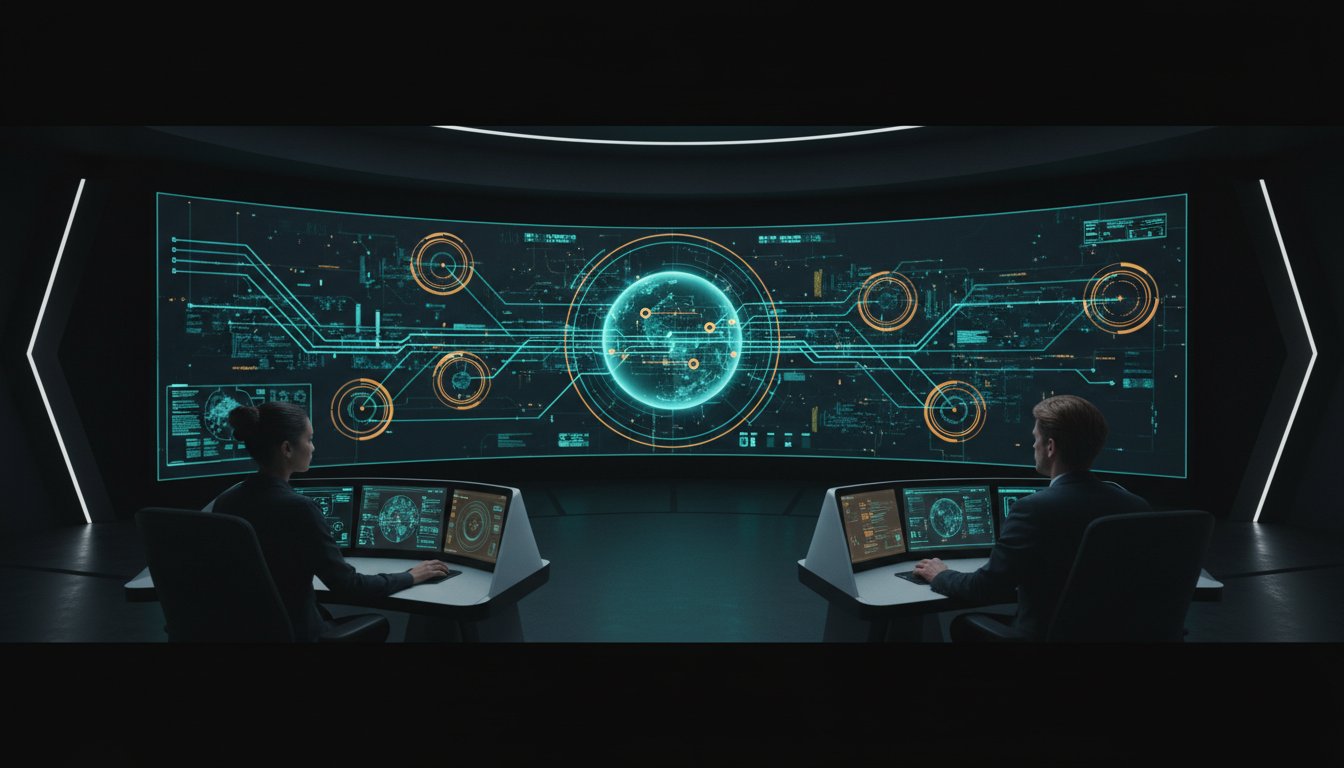
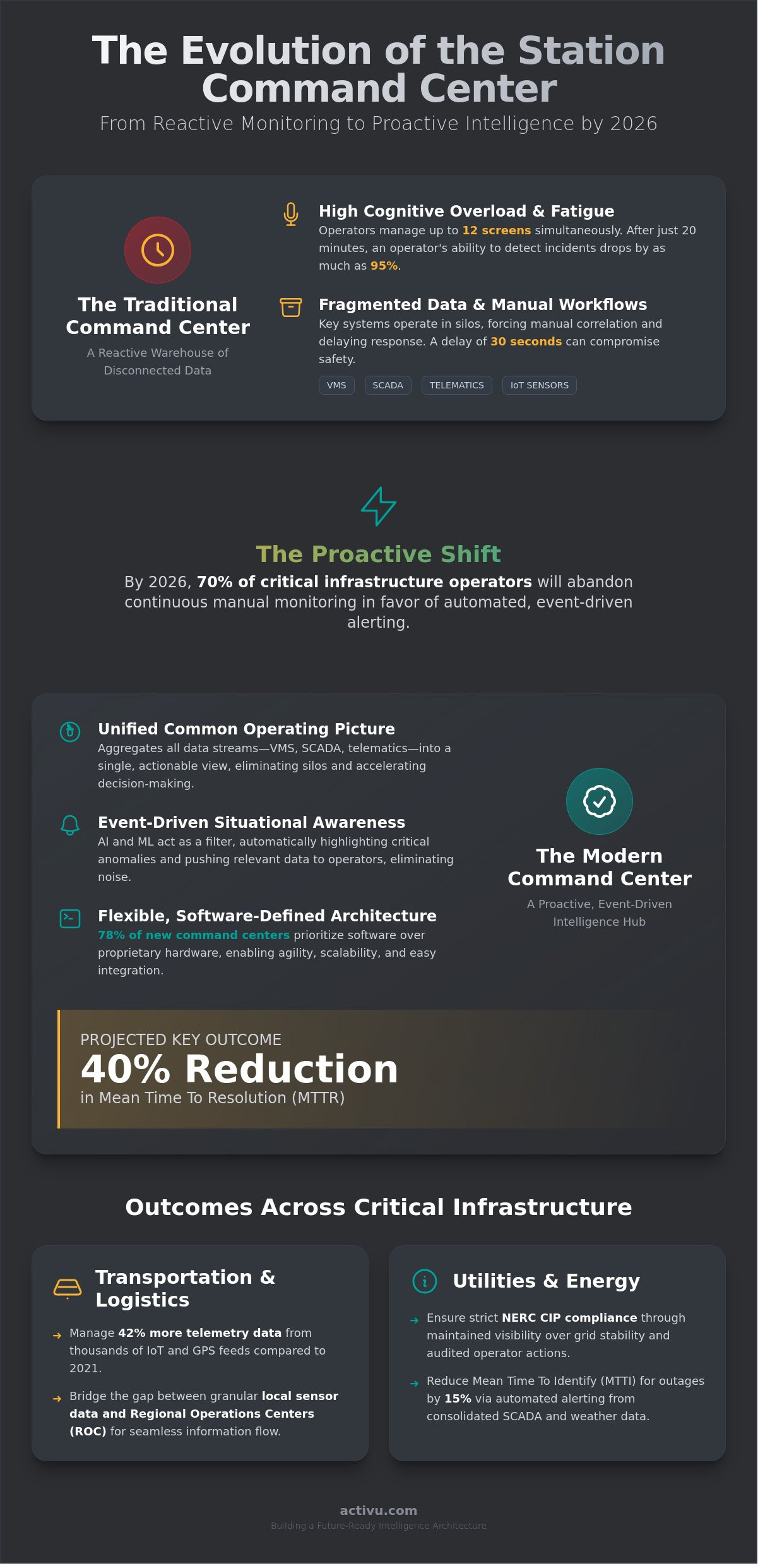
By 2026, 70% of critical infrastructure operators will abandon continuous manual monitoring in favor of automated, event-driven alerting. The traditional station command center often functions as a reactive warehouse for disconnected data, where operators struggle against fatigue caused by managing up to 12 screens simultaneously. You understand that in high-stakes environments, a delay of even 30 seconds can compromise safety and operational integrity. Data silos and manual workflows shouldn’t be the bottleneck when lives or essential services are on the line.
This analysis reveals how modern facilities are transitioning from reactive monitoring hubs into proactive, event-driven intelligence environments. You’ll discover the specific technological shifts that eliminate noise and provide visibility into what matters most. We’ll examine the 2026 roadmap for improving situational awareness, reducing mean time to resolution (MTTR) by a projected 40%, and building the scalable infrastructure required for future growth.
Key Takeaways
- Understand how the modern station command center is evolving from a physical room into a distributed, virtualized environment to enhance operational resilience.
- Transition from passive, high-fatigue monitoring to event-driven situational awareness that highlights critical anomalies automatically.
- Unify fragmented VMS, SCADA, and telematics data into a Common Operating Picture to eliminate silos and accelerate decision-making.
- Reduce mission-critical risks by implementing ergonomic console designs that minimize operator fatigue and cognitive overload.
- Establish a phased implementation strategy to upgrade legacy assets into a predictive, future-ready intelligence architecture.
Defining the Modern Station Command Center (SCC) in 2026
The modern station command center functions as the operational core of critical infrastructure. By 2026, this definition has moved beyond the traditional physical control room to encompass a hybrid of on-site oversight and virtualized, distributed intelligence. It acts as the central nervous system for complex environments, processing millions of data points every second to ensure stability and safety. The primary objective remains the centralization of disparate data streams into a single, actionable view. This transformation is driven by the need for real-time oversight in sectors where a five-second delay can disrupt a regional power grid or halt a metropolitan transit network. Organizations no longer view the SCC as a static desk but as a dynamic environment that provides visibility into what matters most.
The Role of the SCC in Critical Infrastructure
Operational demands in transportation and logistics require managing high-velocity data from thousands of IoT sensors and GPS feeds. In 2025, the average Tier 1 transit hub processed 42% more telemetry data than in 2021. This scale necessitates a station command center that bridges the gap between local sensor data and the Regional Operations Center (ROC). The SCC provides the granular detail needed for immediate response while keeping regional leadership informed through automated data sharing. For utility operations, the SCC ensures NERC CIP compliance by maintaining strict visibility over grid stability. Effective command centers in this sector focus on three primary requirements:
- Data Aggregation: Consolidating SCADA feeds and weather patterns to predict load spikes.
- Incident Response: Reducing the mean time to identify (MTTI) outages by 15% through automated alerts.
- Compliance Monitoring: Maintaining secure, audited logs of all operator actions and system changes.
Hardware vs. Software: The Balancing Act
A massive video wall is only as effective as the software that filters and displays the information. The industry is moving away from proprietary, rigid hardware toward flexible, COTS-based visualization. This shift allows operators to scale their systems without being locked into a single vendor’s ecosystem. By 2026, 78% of new command center installations prioritize software-defined architectures over traditional matrix switchers. The vis/ability platform serves as this critical integration layer. It aggregates data from legacy systems and modern cloud feeds into a unified interface. By prioritizing software-defined visualization, organizations gain the agility to adapt to new threats or operational changes within minutes. This approach ensures that hardware remains a tool for clarity rather than a barrier to integration.
The Evolution from Passive Monitoring to Proactive Intelligence
Traditional command centers operated under a "Wall of Glass" philosophy. Operators stared at dozens of screens, attempting to process every camera feed and data stream simultaneously. This method is fundamentally flawed. Research indicates that after just 20 minutes of monitoring, an operator’s ability to detect incidents drops by as much as 95 percent. The modern station command center can’t rely on human endurance to catch anomalies in a sea of static information.
The 2026 standard moves away from passive observation toward event-driven situational awareness. AI and machine learning now act as the primary filter, stripping away operational noise. The system no longer asks "What is happening?" across the entire network. Instead, it identifies "What requires immediate attention?" and presents that specific data to the decision-maker. This transition ensures that critical alerts aren’t buried under routine status updates.
Understanding Event-Driven Awareness
Event-driven awareness uses automated display changes triggered by predefined data thresholds. In a modern station, a sensor detecting an unauthorized entry or a 15 percent power surge doesn’t just log an error in a back-end database. It automatically pushes the relevant video feed and geospatial data to the main display. This shift mirrors the operational frameworks found in the Transportation Management Center Concepts Of Operation, where systems prioritize actionable intelligence over raw data. This eliminates the need for operators to manually search through thousands of data points during a crisis, saving seconds that define the outcome of an emergency.
The Impact on Response Times
Transitioning to a proactive model yields measurable results. Agencies often see a 30 to 40 percent reduction in Mean Time to Detect (MTTD) when they move away from manual monitoring. When an anomaly occurs, the system triggers an automated Standard Operating Procedure (SOP) display. This ensures every operator follows the exact same protocol, regardless of their experience level or the time of day.
- Standardization: Automated SOPs remove guesswork during high-stress events.
- Coordination: Real-time data sharing ensures field personnel and the station command center operate from a single version of the truth.
- Clarity: Filtering out 90 percent of non-critical data allows for faster cognitive processing.
Coordination becomes seamless because everyone sees the same validated intelligence. Leaders who want to improve their operational clarity often leverage advanced visualization platforms to bridge the gap between raw data and decisive action. This proactive stance transforms the command center from a reactive hub into a predictive asset.
Bridging Data Silos in Transportation and Utility Hubs
Operational efficiency in a modern station command center depends on the total collapse of data silos. Many hubs still struggle with fragmented feeds where Video Management Systems (VMS) operate independently from SCADA, telematics, and cybersecurity streams. This fragmentation creates blind spots that can delay emergency response times by nearly five minutes. By 2026, a Common Operating Picture (COP) is a mandatory standard for high-stakes environments. Operators must integrate 20-year-old legacy hardware with modern Power System Data Analytics to maintain a proactive stance. A central pillar of this evolution is the Cybersecurity COP. This requirement merges network threat intelligence directly into the physical security interface. It ensures a digital breach doesn’t compromise physical infrastructure before the team can react.
Unified Visualization Strategies
Modern hubs aggregate real-time data from manufacturing and process control environments into a single, cohesive display. In transit stations, this involves overlaying geospatial fleet tracking with live asset health metrics. A single pane of glass allows multi-agency teams to collaborate without the friction of switching between disparate software. Since 78% of control room errors stem from information overload, consolidating these views into one intelligent interface is the only way to manage the data density expected by 2026. This strategy provides the clarity needed to act with certainty when seconds matter.
Extending Visibility Beyond the Station
The station command center no longer stops at the physical walls of the facility. Mobile visibility now delivers the COP to supervisors in the field through secure, encrypted platforms. These tools allow distributed teams to share the exact operational view seen on the main video wall, ensuring every stakeholder acts on the same intelligence. Secure data access for remote experts is managed through zero-trust architectures, protecting the network while enabling collaboration. This shift ensures that mission-critical decisions are supported by the best available expertise, regardless of where that expert is located during a crisis.
Operational Design: Minimizing Cognitive Overload at the Console
Operator fatigue remains a critical risk factor in 24/7 environments. A 2023 analysis by the Health and Safety Executive indicated that fatigue contributes to approximately 20% of incidents in mission-critical sectors. To mitigate this, the modern station command center must prioritize ergonomic console furniture. Sit-stand capabilities and individual climate control at the workstation aren’t luxuries; they’re essential tools for maintaining operator alertness during long shifts.
The “Dark NOC” concept is a significant trend for 2026. This design philosophy minimizes visual distractions by keeping non-essential displays dimmed until an event triggers an alert. It ensures that when a change occurs, it’s immediately visible. Coupled with human-centric lighting that adjusts color temperature to match circadian rhythms and acoustic management to dampen ambient noise, these spaces foster a calm, focused atmosphere.
Psychology of Information Display
Effective data visualization relies on a strict visual hierarchy. Using specific color codes to signal urgency helps operators distinguish between a routine notification and a critical failure without inducing panic. Dashboard simplification is equally vital. By presenting complex datasets through intuitive infographics, the time to comprehension drops significantly. Strategic “white space” on large-scale video walls prevents sensory saturation, allowing the eye to gravitate toward what actually matters.
Control Room Design Services
Success starts with planning. Professional control room design must precede any hardware procurement to avoid costly integration errors. This process involves a deep workflow analysis to map how information flows from the station floor to the console. Proper design ensures the physical space is future-proofed for the next decade of technology refreshes. It creates a seamless bridge between raw data and human judgment.
Implementing a 2026-Ready Station Command Architecture
Modernizing a station command center requires a clear shift from reactive monitoring to predictive intelligence. Many legacy centers still rely on human observation of static video feeds, but 2026 standards demand a proactive posture. Organizations should evaluate their operational maturity by measuring the time between incident occurrence and operator notification. A mature architecture uses automated triggers to alert personnel before a threshold is breached, reducing response times by as much as 40% compared to manual workflows.
Successful transition involves a phased implementation that integrates the vis/ability platform with existing assets. You don’t need to replace every screen and sensor at once. Instead, focus on unifying disparate data streams into a single pane of glass. This approach preserves your previous investments while introducing advanced geospatial analysis and real-time collaboration tools. It’s about creating a cohesive ecosystem where legacy hardware and modern software work in tandem to provide total situational awareness.
Security remains the primary concern for critical infrastructure. A cybersecurity-first design ensures that every data point and visual stream is encrypted and authenticated. This level of rigor is standard when working with a partner experienced in federal government and defense protocols. These high-stakes environments demand 99.999% uptime and zero-trust architectures to protect against evolving digital threats. By adhering to these stringent requirements, operators can act with absolute confidence in the integrity of their data.
Key Requirements for Modern SCC Software
- Scalability: The system must process over 5,000 concurrent data points without latency, ensuring the station command center remains responsive during peak crisis events.
- Interoperability: Seamless connection with third-party APIs and legacy analog inputs is mandatory for a unified operating picture.
- Intuitive Interface: Operators need a UI that reduces cognitive load; training for core functions should take less than 30 minutes to ensure rapid onboarding during staff rotations.
Next Steps for Operations Leadership
Begin with a comprehensive situational awareness audit to identify blind spots in your current environment. Once you’ve mapped these gaps, develop a multi-year roadmap focused on event-driven automation. This strategy ensures that your technology evolves alongside your operational needs rather than becoming obsolete. To bridge the gap between your current vision and a functional 2026 reality, contact our experts to schedule a technical consultation and site assessment.
Securing Operational Resilience for 2026 and Beyond
The transition to a modern station command center demands a shift from passive monitoring to proactive intelligence. Success in 2026 hinges on your ability to bridge data silos and implement operational designs that actively prevent cognitive overload. Since 1983, Activu has served as the bedrock for mission-critical visualization, supporting top-tier utilities and defense agencies globally. Our cybersecurity-hardened solutions are built for high-stakes environments where every second impacts public safety and infrastructure stability. By prioritizing situational awareness, you ensure your team remains focused and analytical when pressure is highest. It’s time to replace fragmented data streams with a unified platform that empowers your operators to act with absolute certainty. We invite you to request a demo of the vis/ability platform for your command center and see how our legacy of reliability can safeguard your future operations. Your mission deserves the clarity that only decades of expertise can provide.
Frequently Asked Questions
What is the primary function of a station command center?
A station command center functions as the central nervous system for transport hubs, consolidating disparate data streams into a single point of control. It enables operators to monitor passenger flow, security feeds, and vehicle schedules simultaneously. By 2026, these centers prioritize proactive management over reactive response, ensuring that 100% of critical infrastructure remains under constant, high-fidelity surveillance to protect public safety and operational continuity.
How does event-driven situational awareness differ from traditional monitoring?
Traditional monitoring relies on operators manually scanning dozens of video feeds, a process that leads to fatigue and missed incidents. Event-driven situational awareness uses automated triggers to highlight only the data relevant to a specific occurrence. When a sensor detects an unauthorized track entry or a fire alarm, the system immediately pushes that specific visual to the foreground. This shift reduces noise and helps teams react up to 40% faster than manual observation methods.
Can legacy video walls be integrated into a modern station command center?
You can integrate legacy video walls into a modern station command center by using software-defined visualization platforms. These systems bridge the gap between 10-year-old hardware and modern IP-based data sources through high-performance encoders and decoders. This approach allows agencies to extend the lifecycle of their existing capital investments while gaining the ability to display dynamic, web-based content and real-time analytics alongside older analog feeds.
What are the most common challenges in managing a transport station command center?
Managing a transport command center involves overcoming data silos where security, logistics, and maintenance teams use separate, incompatible software. Operators often face cognitive overload while managing 5 or more distinct platforms during an 8-hour shift. Modernizing these environments requires breaking down these barriers to ensure that information moves freely between departments, preventing the critical delays that occur when data remains trapped in isolated systems.
How does a Common Operating Picture (COP) improve incident response?
A Common Operating Picture provides every stakeholder, from the dispatcher to the field officer, with the exact same real-time data. This shared visual context eliminates the confusion of verbal descriptions during a crisis. Implementing a COP can improve inter-agency coordination by 30% by ensuring that every decision is based on a single, verified source of truth rather than conflicting reports from different departments.
What ergonomic factors are most important for command center operators?
Operator performance depends on sightlines to the video wall and the adjustability of 24/7 rated consoles. Proper ergonomics reduce physical strain, which is vital during high-stress incidents. Lighting must be carefully calibrated to 300-500 lux to prevent screen glare while maintaining alertness. When operators have comfortable, intuitive workspaces, they maintain higher levels of focus, leading to more accurate decision-making during long shifts.
How can I integrate cybersecurity data into my physical command center?
You can integrate cybersecurity data by feeding Security Information and Event Management (SIEM) alerts directly into the visualization layer. This convergence allows physical security teams to see network threats, such as a breach of a ticket kiosk, in the same context as physical intrusions. Following 2024 NIST guidelines for infrastructure protection, this unified approach ensures that digital threats don’t compromise physical safety or station operations.
What is the role of mobile tools in a modern station command center?
Mobile tools extend the reach of the command center by allowing field personnel to send and receive live video streams on encrypted devices. Using 5G connectivity, a supervisor on a platform can view the same high-resolution data as the central operator. This capability ensures that the transition from the control room to the scene of an incident is seamless, providing field teams with the intelligence they need to act decisively.