
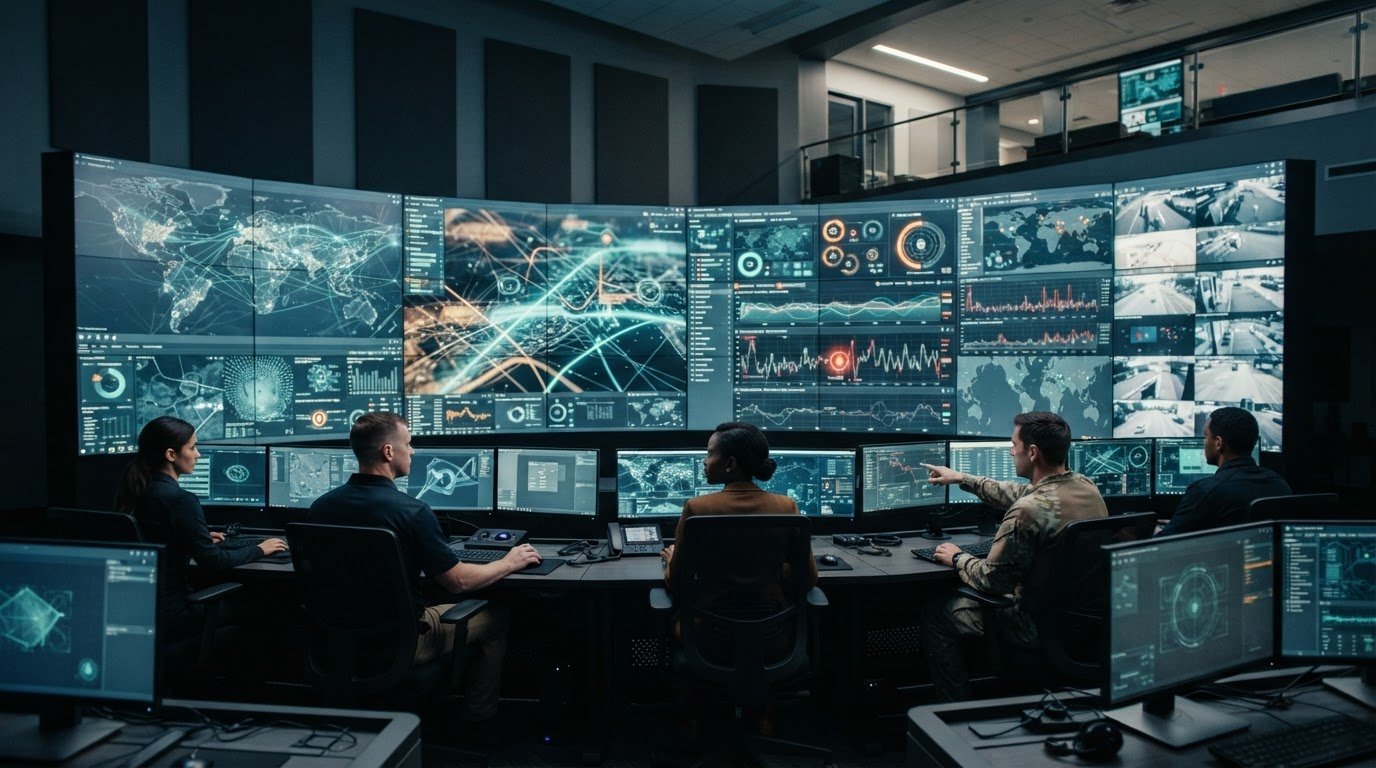
A fast response to a query doesn’t, by itself, make intelligence real-time. A real-time intelligence sharing platform continuously brings in information, processes changes as they occur, and presents relevant updates in a shared operational picture. The difference lies in the full path from data source to decision-maker, not query speed alone.
That distinction matters when teams work across fragmented systems, separate data feeds, and siloed communications. A dashboard may return an answer quickly yet miss the context or escalation operators need to respond. This guide explains what makes information timely and useful, where it comes from, and how streaming and visualization help teams interpret changing conditions.
Most control rooms already have screens. What they need is a layer that decides what appears on them and automatically escalates information when it needs attention. This guide explains how that layer connects incoming signals to dashboards, helping teams see essential information and make decisions with greater clarity.
Key Takeaways
- Assess timeliness across the full journey from incoming signal to operator awareness; a fast query alone doesn’t establish real-time intelligence.
- Trace how operational data enters the shared picture, then consider how streaming and event processing can make changing conditions visible.
- Design dashboards to prioritize relevant updates and context so teams can interpret what’s happening and decide what needs attention.
- Look for interoperability that helps connected systems exchange information in a form teams can use together.
- Learn how Activu Corporation’s vis/ability Platform, Event-Driven Situational Awareness, Application Integration, and Video Wall Systems can help bring operational information into a unified view.
Real-time dashboards and visualization
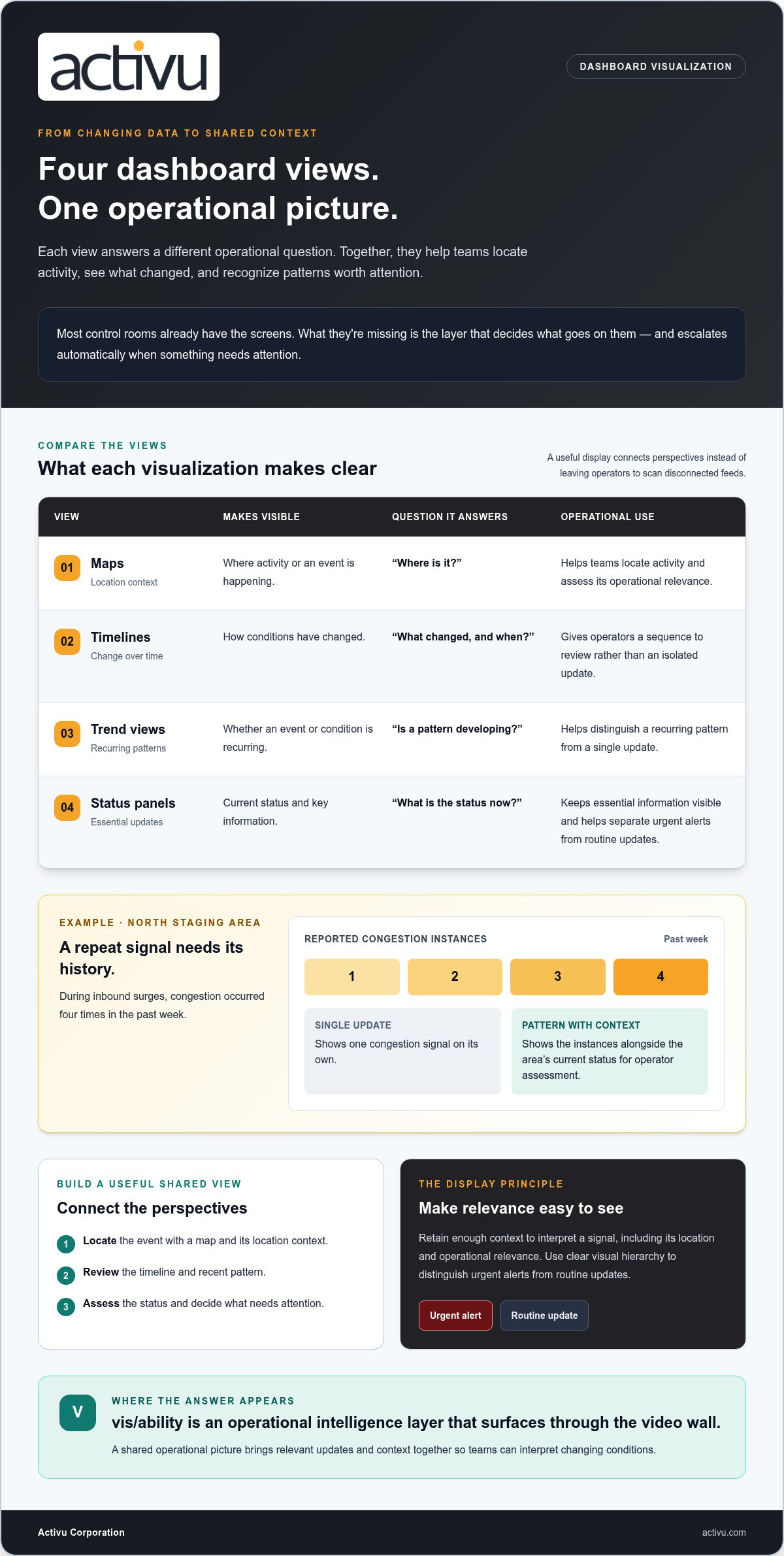
A dashboard turns changing operational data into visual cues that help teams prioritize. For example, a recurring congestion pattern in a north staging area can reveal a condition operators need to assess.
Dashboard Views and Visualizations
Dashboard views organize operational information into maps, status panels, timelines, and trend charts. Each view answers a different question: where an event is happening, what has changed, and whether a pattern is developing. The goal is to surface information that supports action, rather than make teams scan disconnected feeds for context.
Fragmented systems can leave operators switching between feeds, and the absence of automatic escalation can delay attention to emerging events. Most control rooms already have screens. What they need is a layer that decides what appears on them and automatically escalates information when it needs attention.
Consider the north staging area during inbound surges. If congestion occurred four times in the past week, a dashboard can show those instances alongside the area’s current status. Operators can then distinguish a recurring pattern from a single update. The display should retain enough context to interpret the signal, including its location and operational relevance, rather than show an isolated alert.
Maps help teams locate activity, timelines show how conditions change, and trend views make recurring events easier to spot. Status panels can keep essential information visible. A useful visualization connects these perspectives: an operator can locate an event, review its recent pattern, and decide what needs attention. Clear visual hierarchy also separates urgent alerts from routine updates.
Platform Features
A real-time intelligence sharing platform should connect relevant data, provide shared context, and draw attention to meaningful changes. Teams need to interpret the same operational picture across separate feeds and make decisions without losing time to manual comparisons. A dashboard is more useful when its information is organized around operational relevance, rather than displayed as a collection of available sources.
Useful capabilities include configurable views, clear event status, location context, and a way to surface changes that meet operational criteria. Teams can, for instance, distinguish emerging congestion from a routine status change by reviewing location and recurrence together. Event-driven presentation can bring important information forward, while a shared view gives operators a common reference point.
Evaluate a dashboard by tracing an event from its source to its display. Check whether it retains location and status, reveals relevant patterns, and helps the operator identify a next action. A real-time intelligence sharing platform should present information in a form that supports human judgment, making essential details immediate and understandable.
Real-time intelligence fundamentals and benefits
Real-time intelligence combines current information with context that supports operational decisions. A useful test is whether a new event reaches the people who need it soon enough to shape their response. One guideline treats data less than 15 minutes old as recent enough for real-time intelligence, though operational needs determine whether that interval is useful. A developing incident may demand faster awareness than a routine status review.
Real-time capability depends on more than query speed. A fast answer based on stale or incomplete data can mislead. Monitoring should account for when information was generated, when it entered the system, and whether it remains relevant. For example, dispatchers need current location and status details before acting on an alert about a closed road.
When comparing platforms, assess the features and integrations your operations require. Check whether the software connects relevant feeds, preserves shared context, and makes alerts visible to the teams that need them. Broad capabilities are less useful if limited integration leaves operators switching systems and manually reconciling updates.
In the United States, interoperability is a useful reference point for evaluating information exchange. The Centers for Disease Control and Prevention defines interoperability as applications, platforms, systems, and networks communicating electronically through standardized nomenclature, language, and architecture. The National Institute of Standards and Technology notes that many public safety messaging and situational-awareness platforms cannot exchange mutually intelligible real-time data.
Platform costs depend on the project and are provided after a quote request. Key cost factors include integration needs, data sources, deployment requirements, and scope. Compare quotes based on these requirements, not just software access, because implementation and connected systems shape the overall work.
In the United States, available options include platforms designed for public safety, emergency management, and enterprise operations. Compare the data sources they connect, how they handle alerts, and whether teams can share a common operational picture. The right fit depends on the information your teams need to bring together and how they will use it.
Security, privacy, and operational risks include unauthorized access, inappropriate disclosure, stale information, and alert overload. A system that shares sensitive details too broadly, for example, can expose information beyond its intended audience. Access controls, clear sharing rules, data freshness indicators, and tested response procedures help teams manage these risks.
For operations requiring continuous oversight, real-time intelligence can support 24/7 operational coverage by keeping incoming changes visible beyond a single shift. Teams can implement monitoring rules that surface relevant trends, then review alerts against current conditions before acting. That approach helps separate a meaningful change from routine activity and keeps human judgment central to the decision.
Sources of real-time information
Operational intelligence draws on systems that observe events, record activity, and report changing conditions. A dispatch center, for example, may combine sensor readings, operator reports, and incident records to understand a developing situation.
Physical sensors capture measurable conditions such as movement, temperature, equipment status, or environmental change. A facility sensor can report an open door, while a traffic sensor can indicate changing roadway conditions. Detection is more useful when each signal is linked to its location, timestamp, and operational context.
Video and other visual feeds add context to a sensor alert. If a perimeter sensor reports movement, an operator can review the corresponding camera view to assess what happened. The sensor flags a condition; video helps a person interpret it. Combining these sources supports more informed responses than either signal alone.
Operational software also provides structured information. Dispatch records, incident management tools, building systems, and equipment monitoring applications can report status changes as work unfolds. A dispatch update, for example, can clarify whether responders are en route, while a building system can show which areas remain accessible.
Human reports remain an important source of information. Field personnel may identify a blocked entrance or changing conditions before connected equipment captures them. A platform can bring these reports together with sensor and system data, giving decision-makers a fuller view while distinguishing observed facts from reported information.
External feeds can add context to internal operations. A weather feed, for example, can help explain changing conditions around a facility. Business intelligence systems may also reveal operational trends, such as recurring equipment issues. Analytics can compare these inputs continuously, helping teams recognize patterns rather than treat every update as an isolated event.
Before sharing information, decide which sources serve each operational purpose. Identify what event each source can detect, who needs the resulting information, and what context is required to act. A temperature alert, for instance, may matter to facilities staff, while an access event may need security review.
How do platforms protect sensitive information and control access? They can use role-based permissions so users see information relevant to their responsibilities, while access logs help administrators review activity. Clear sharing rules also help limit sensitive records to appropriate audiences.
Source quality affects the intelligence people receive. Delayed updates, unclear ownership, or inconsistent labels can complicate analysis and response. Preserve each source’s identity and update context so operators can distinguish a live sensor reading from an earlier report. This clarity supports more reliable decisions as conditions change.
Streaming and ingestion technologies
Streaming moves event data through a system as sources generate updates. In a dispatch environment, a sensor reading, camera event, or field report can enter an ingestion layer, where software receives and prepares it for processing. The system must preserve useful context, including the event’s source, time, location, and status. Without that context, an alert may reach an operator without enough information to interpret it.
Ingestion connects different sources to shared processing. A traffic sensor might report a sudden change while a separate incident system records a road closure. The platform can normalize those messages into a common structure, then associate them when their locations and event details align. This gives operators a clearer basis for assessing whether the signals describe one developing situation.
Stream processing evaluates incoming events continuously instead of waiting for a scheduled batch. Rules can identify anomalies, such as a sharp change in a sensor value or several related reports from one area. Commercial complex event processing platforms are designed to handle thousands or up to millions of events per second, with sub-millisecond responses to new event data. Actual operational value still depends on source quality and useful rules.
After processing, a platform can route selected updates to dashboards, alert channels, or other connected systems. For example, a rule might elevate an access-control event when a related camera feed shows activity. Automation helps prioritize attention, while a human operator reviews the context and decides on an appropriate response. Clear event ownership also helps teams avoid duplicate or conflicting actions.
How do organizations implement a real-time intelligence sharing platform? First, identify priority decisions and data sources, then define how each event should be ingested, interpreted, and shared. Teams can test these flows with representative scenarios, refine alert rules, and assess whether operators receive actionable context at the right point in their workflow.
Effective implementation also requires attention to data quality and system behavior. A delayed source can make an otherwise fast stream misleading, while inconsistent labels can prevent related events from connecting. Establish how updates are timestamped, how errors are surfaced, and who reviews changes to processing rules. These controls support reliable insight without treating automated output as a substitute for operational judgment.
Learning systems may help identify patterns across historical and incoming events, but their findings need operational context. An agent might flag an unusual sequence of equipment alerts; staff can compare it with current conditions before acting. Connecting ingestion, processing, and operator workflows through an integrated operational picture helps teams follow information from source to decision.
What features should an intelligence sharing platform include?
For a control room, the right features connect information, preserve its meaning, and help teams coordinate action. Evaluate each capability against a real operational task, such as linking an incoming incident report to its location and related system updates.
Interoperability should guide the assessment. The Centers for Disease Control and Prevention describes it as electronic communication among applications, platforms, systems, and networks using standardized nomenclature, language, and architecture. In practice, a shared event description should retain the same meaning as it moves between systems.
That requirement addresses a documented gap: the National Institute of Standards and Technology notes that many public safety messaging and situational-awareness platforms cannot exchange mutually intelligible real-time data. For example, a message labeled as an active incident in one system may arrive elsewhere without a usable status or consistent location.
- Integration: Connect relevant applications and feeds, then preserve source identity. A dispatcher reviewing a road closure should be able to distinguish the original report from a later update.
- Context: Keep location, timestamp, status, and related events together. A facility access alert becomes easier to assess when operators can associate it with the correct entrance.
- Alert management: Route events according to operational rules. For example, a change affecting a restricted area can reach the responsible team instead of appearing as an undifferentiated system notification.
- Access controls: Set permissions according to user responsibilities. A field team may need incident details, while another role may only require a general status update.
- Auditability: Retain an understandable record of updates and actions. During a later review, teams can trace how an event changed and who received the information.
These capabilities should work together as one operational workflow, not as isolated functions. If an emergency operations center receives a field report, relevant systems should preserve its meaning, make it available to authorized users, and show subsequent changes. That continuity supports a common operating picture across teams.
Usability deserves equal weight. During an incident, operators need clear labels, predictable navigation, and an efficient way to distinguish urgent events from routine updates. Test a representative scenario, such as a sensor alert followed by a field report, and observe whether staff can find the event, understand its status, and coordinate the next action.
Finally, assess how the platform handles changing conditions and system failures. Teams need to know when a source stops updating, an integration fails, or duplicate reports appear. Clear status indicators and defined escalation paths help operators recognize these problems before relying on incomplete information. A feature set is effective when it strengthens shared understanding and supports human decisions under pressure.
Activu Corporation: Video Wall Systems
Activu Corporation helps control-room teams address fragmented systems and missed escalations. Its vis/ability Platform brings operational applications and data feeds together in a shared operating picture. This operational intelligence layer surfaces information through the video wall, while event-driven situational awareness helps teams focus on relevant changes.
The video wall becomes the place where the answer appears because vis/ability organizes and presents information from connected tools. This approach supports teams across command centers, remote locations, conference rooms, breakout rooms, huddle rooms, and mobile devices. It’s relevant when separate systems leave operators without unified context or automatic escalation.
Contact Activu Corporation to discuss how its capabilities can support your operational environment.
Turn Operational Data Into Decisive Action
Set a clear operational objective before changing your information environment. Identify a decision teams need to make with greater confidence, then define what useful support looks like in practice. This gives your assessment of a real-time intelligence sharing platform a concrete focus and keeps technical choices connected to operators’ work.
Activu Corporation can help organizations consider how their operational environment should support that objective. Use your team’s priorities to guide a focused discussion about the information and workflows that matter most.
Take the next step when you’re ready. Contact Activu Corporation to discuss your operational requirements and move toward a clearer foundation for coordinated decisions.
Frequently Asked Questions
Does fast response time to a query imply real-time intelligence?
No. A fast query can return information quickly while relying on delayed, incomplete, or outdated inputs. Assess the full chain: when an event occurred, when the system received it, and when the relevant team could use it. A quick search of an old road-closure record, for example, will not tell dispatchers whether the route has reopened. Timeliness depends on fresh inputs and useful operational context.
What are the business benefits of real-time intelligence?
Real-time intelligence can help organizations coordinate decisions using current operational information. A facilities team responding to an equipment warning, for example, can compare it with work orders and access conditions before assigning a response. Shared context can reduce manual cross-checking and help teams prioritize incidents. Business value depends on whether information supports a decision, reaches the responsible people, and fits their workflows.
Where does real-time information come from?
It can come from sensors, video systems, dispatch applications, field reports, and external feeds. A transportation team, for example, might combine a roadway camera view with a traffic-system update and a responder’s report. Each source adds a different perspective. Timestamps, locations, and source identities help operators judge how the information relates to current conditions and whether it supports the decision at hand.
What is a real-time intelligence sharing platform?
A real-time intelligence sharing platform brings operational information together so authorized teams can interpret events and coordinate decisions. It connects incoming updates with relevant context, then makes that information available through shared views or workflows. An operations team, for example, could follow an incident from its initial report through status changes while keeping its source and current state clear to participating staff.
What data sources and systems can these platforms integrate with?
Depending on the platform and operational environment, integrations can include supervisory control and data acquisition (SCADA), geographic information systems (GIS), video management systems (VMS), dashboards, and incident applications. A utility, for example, may need equipment status alongside a map location and related video. Integration should preserve useful information as it moves between systems, so operators can understand updates without manually reconciling separate screens.