
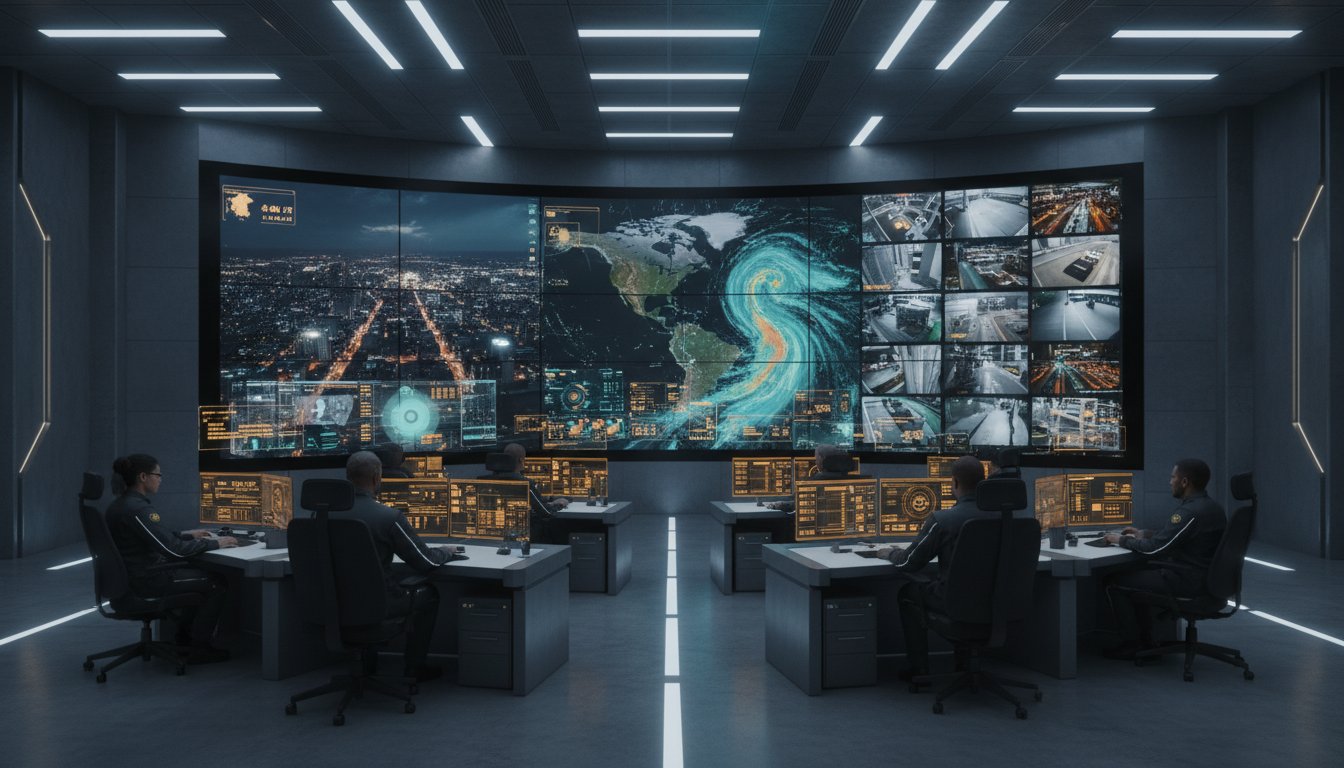
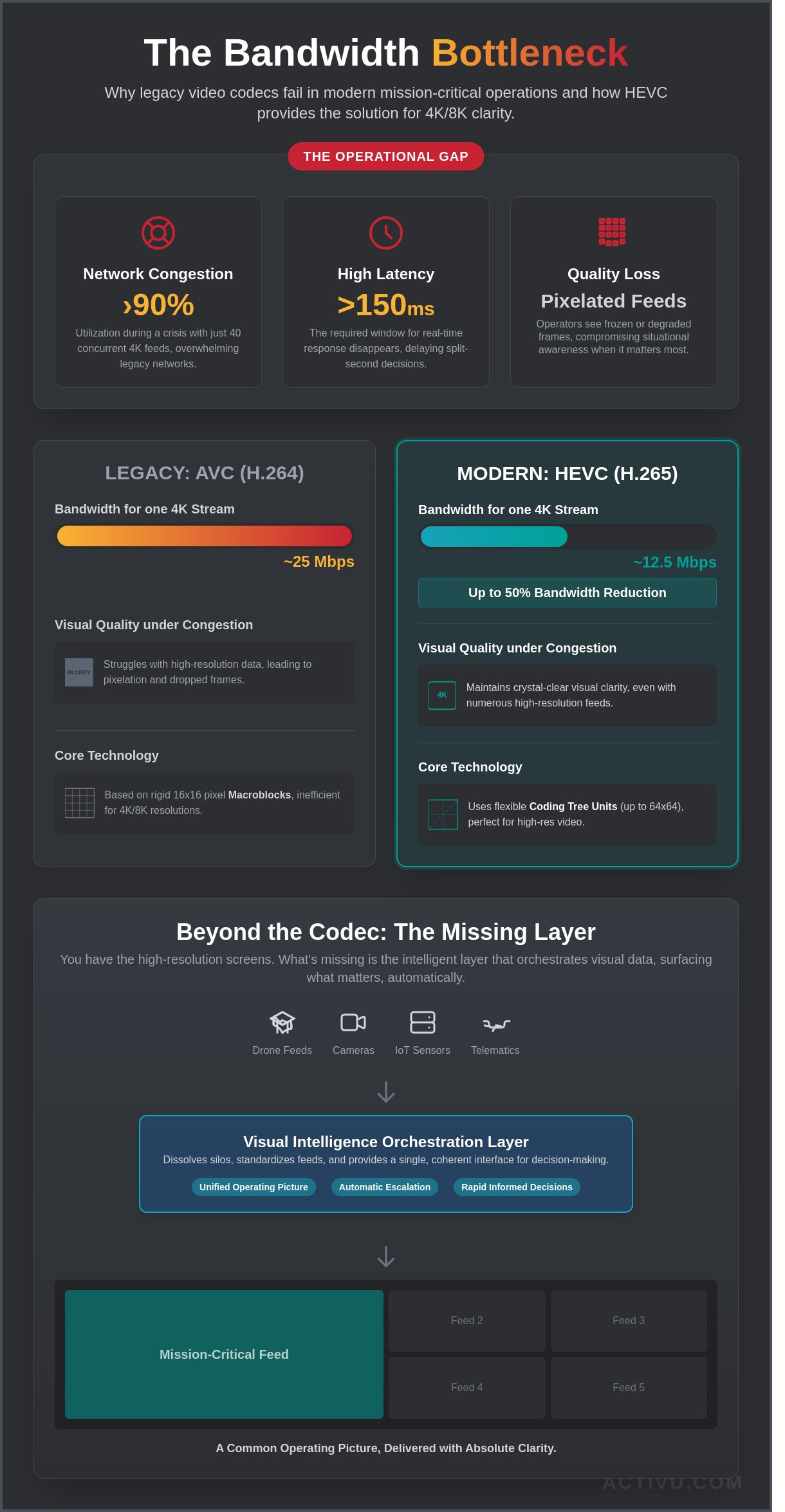
A single 4K video stream can consume up to 25 Mbps of bandwidth; however, a typical emergency operations center managing 40 concurrent feeds often sees network utilization spike above 90% during a crisis. When congestion hits this threshold, the 150 millisecond latency window required for real-time response disappears. You’ve likely seen the result: pixelated feeds or frozen frames just as an operator needs to make a split-second decision. Adopting hevc (High Efficiency Video Coding) isn’t just a technical upgrade; it’s a requirement for maintaining situational awareness when every second counts. Most control rooms already have the screens. What they’re missing is the layer that decides what goes on them, and escalates automatically when something needs attention.
You know that managing high-resolution data on legacy networks is a constant battle against lag and hardware limitations. This technical guide explains how to leverage hevc to reduce bandwidth consumption by 50% while maintaining the crystal-clear visualization your mission requires. We’ll explore how to integrate these efficiencies into your existing video wall systems to ensure your team always has visibility into what matters most in 2026.
Key Takeaways
- Identify the operational gaps created when legacy compression standards struggle to manage the transition to high-resolution 4K and 8K sensor data.
- Discover how hevc optimizes bandwidth by up to 50% to ensure absolute visual clarity and technical reliability in high-stakes environments.
- Evaluate the strategic trade-offs between hardware and software decoding to maintain high-availability performance across secure federal and defense networks.
- Understand that while most control rooms already have the screens, the critical missing component is the layer that decides what goes on them and escalates automatically.
- Learn how to orchestrate visual intelligence so that mission-critical feeds are surfaced precisely when they are required for rapid, informed decision-making.
The Bandwidth Bottleneck in Modern Mission-Critical Operations
Mission-critical operations currently face a widening gap between data acquisition and tactical utility. While sensor technology has advanced to provide unprecedented detail, the infrastructure required to transport that data often remains static. Fragmented data feeds and inconsistent resolution standards create an environment where information exists, but clarity does not. Operators frequently struggle with siloed views, losing precious seconds as they attempt to correlate events across mismatched visual formats.
The legacy H.264 (AVC) standard, which served as the backbone for video surveillance for over a decade, now struggles to support the transition to 4K and 8K sensors. These high-resolution inputs demand bitrates that overwhelm existing network pipes, leading to latency or dropped frames during critical incidents. Most control rooms already have the screens. What they’re missing is the layer that decides what goes on them, and escalates automatically when something needs attention.
Implementing High Efficiency Video Coding (HEVC) serves as the technical foundation for bridging this operational gap. By offering up to 50% better data compression than its predecessor, this standard allows agencies to maintain high-fidelity visuals without requiring a complete overhaul of their existing network backbones. This efficiency ensures that the most critical data reaches the decision-maker without compromise.
The Surge of Data in Command Centers
Command centers now manage a relentless influx of data from IoT sensors, high-resolution drone feeds, and real-time telematics. In a typical municipal fusion center, the number of active video streams has increased by an average of 40% since 2022. This volume creates immediate network congestion, which directly impacts decision-making speed. When a network bottlenecks, the resulting lag can delay emergency responses by several seconds, a margin that is unacceptable in life-safety scenarios. Maintaining operational resilience requires a more efficient way to process these high-density feeds to ensure that data remains an asset rather than a liability.
Fragmented Systems and the Need for a Unified Picture
Operations centers often operate with a mix of legacy and modern hardware, leading to a landscape of fragmented codecs. One department might use H.264 for fixed cameras while another uses hevc for mobile units. These silos prevent the creation of a common operating picture, as disparate systems cannot easily share or overlay data. Standardized compression is the only way to ensure that every feed, regardless of source, is accessible to every operator. The vis/ability platform leverages this technical standardization to dissolve these silos, providing a single, coherent interface for critical decision-making.
What is HEVC? The Technical Architecture of H.265
Mission-critical environments often face a specific gap: the inability to process high-resolution data feeds without saturating network bandwidth. This bottleneck leads to fragmented situational awareness and delayed response times. High Efficiency Video Coding (HEVC), also known as H.265, serves as the successor to the H.264/AVC standard. It was engineered to resolve these bandwidth constraints by providing a 25% to 50% improvement in data compression at identical quality levels. This efficiency allows operators to maintain crystal-clear visibility into what matters without overwhelming existing infrastructure.
The technical architecture of hevc enables support for resolutions up to 8K UHD (8192×4320). In a modern command center, this precision ensures that fine details in geospatial data or high-definition surveillance feeds remain sharp. Most control rooms already have the screens. What they’re missing is the layer that decides what goes on them; and escalates automatically when something needs attention. By implementing hevc, agencies can bridge the gap between raw data and human judgment, ensuring that the visual destination—the video wall—surfaces the most accurate information available.
Coding Tree Units (CTU) and Parallel Processing
The most significant architectural shift in H.265 is the transition from 16×16 macroblocks to Coding Tree Units (CTUs). CTUs allow for much larger block sizes, reaching up to 64×64 pixels. This flexibility is vital when encoding large areas of uniform color, such as a clear sky or a static background in a Security Operations Center. Larger blocks require fewer bits to describe, which directly reduces the overall bitrate.
- Parallel Encoding: HEVC leverages multi-core processors by utilizing “tiles” and “wavefront parallel processing.” This allows the encoder to split a single frame into independent regions that are processed simultaneously.
- Hardware Acceleration: Modern mission-critical consoles utilize dedicated hardware decoders to handle these complex computations. This reduces the CPU load on operator workstations, preventing system lag during high-intensity incidents.
- Efficiency Gains: By optimizing how pixels are grouped, the standard maintains 10-bit color depth and high dynamic range (HDR) without the massive file sizes typically associated with professional-grade video.
Intra-prediction and Motion Compensation Improvements
Precision in motion is where H.265 excels. While H.264 used only 9 intra-prediction directions to guess where a pixel might move in the next frame, HEVC utilizes 35 directions. This fourfold increase in predictive precision significantly reduces the “residual” data that the system must transmit. It ensures that complex movement, such as a vehicle moving through a crowded intersection, is rendered smoothly even at low bitrates.
CTUs are the fundamental building block of H.265 efficiency. This advanced motion compensation minimizes the risk of pixelation or artifacts that could cause an operator to miss a critical detail. When seconds matter, the technical reliability of the video stream becomes the bedrock of every life-saving decision. This methodical approach to data management creates a steady flow of actionable intelligence, moving from complex data overload to a state of absolute clarity.
HEVC vs. AVC (H.264): Strategic Comparison for Control Rooms
The shift from AVC to hevc represents a fundamental change in how mission-critical data moves across a network. While H.264 served as the industry standard for over a decade, its efficiency plateaus when handling the high-density 4K feeds now common in modern operations centers. HEVC provides a 50% reduction in bitrate requirements without sacrificing image quality. For a standard 1080p stream at 30fps, AVC typically demands 4 to 6 Mbps; hevc achieves the same visual result at 2 to 3 Mbps. This efficiency becomes even more pronounced with 4K video, where the codec drops the requirement from 25 Mbps to approximately 12 Mbps.
This bandwidth efficiency comes with a clear trade-off in processing requirements. HEVC encoding and decoding demand roughly 3 to 5 times more computational power than its predecessor. To prevent bottlenecks, agencies must align their hardware strategy with modern standards. Organizations should consult the COTS guide to ensure their workstations and decoders possess the GPU acceleration necessary to handle these loads. Most control rooms already have the screens. What they’re missing is the layer that decides what goes on them, and escalates automatically when something needs attention.
The impact on long-term storage is equally transformative. For incident logging and forensics, doubling the storage capacity through compression alone allows for longer retention periods or higher-resolution archives within the same hardware footprint. This ensures that when an after-action report is required, the data is both available and legible.
Latency: The Critical Factor in Real-Time Response
Seconds matter during a grid failure or a public safety emergency. Because hevc uses more complex algorithms, it can introduce “glass-to-glass” delay if not configured correctly. High-efficiency encoding often requires deeper look-ahead buffers, which can add 100 to 500 milliseconds of latency. To mitigate this, operators should utilize “Low Latency” profiles that prioritize speed over maximum compression. Integrating these streams with Secure Reliable Transport (SRT) provides a robust framework for managing packet loss on unpredictable networks, ensuring that the visual feed remains stable across the entire command structure.
Visual Fidelity and Operator Fatigue
Poor image quality isn’t just an aesthetic issue; it’s a cognitive one. H.264 often produces “blocking” artifacts in low-light or high-motion scenes, forcing operators to squint or second-guess what they see. This increased cognitive load leads to fatigue and missed cues. HEVC’s Main 10 profile supports 10-bit color depth, which eliminates the color banding often seen in dark environments. By delivering 1.07 billion colors instead of the 16.7 million found in 8-bit AVC, the codec ensures that subtle details, such as a specific vehicle color or a faint smoke plume, remain visible. This clarity allows the human element of the control room to function with greater certainty and less strain.
Implementing HEVC in Secure, High-Availability Networks
Deploying HEVC in mission-critical sectors isn’t a simple software update. It’s a fundamental shift in how data moves through Federal and Defense networks. Command centers often struggle with fragmented feeds that delay response times. Most control rooms already have the screens. What they’re missing is the layer that decides what goes on them, and escalates automatically when something needs attention. By utilizing this codec, agencies reduce bandwidth consumption by 50% without sacrificing the 4K clarity required for geospatial analysis.
Choosing between hardware and software decoding determines the stability of your common operating picture. Hardware-based decoders utilize dedicated ASICs to handle the heavy computational load of 10-bit HEVC streams, ensuring latency stays below 150 milliseconds. Software decoding offers flexibility for distributed teams but increases CPU utilization by roughly 35% on standard workstations. For a video wall, hardware decoders are the standard for 24/7 reliability, while software remains the choice for secondary tactical displays and remote monitoring.
Legacy compatibility remains a primary hurdle during a phased rollout. Many agencies can’t replace every endpoint simultaneously. Implementing transcoding gateways allows legacy H.264 systems to coexist with newer sources. This hybrid approach ensures that legacy 1080p monitors don’t go dark while the primary EOC upgrades to 4K. It’s a calculated transition that maintains operational continuity during the 18 to 24 month upgrade cycle, preventing the data silos that occur when systems can’t communicate.
Bandwidth Management in Air-Gapped Environments
Air-gapped networks and remote radio links often operate with throughput as low as 512 Kbps. High-efficiency coding makes high-definition video viable in these restricted environments. Dynamic bitrate adaptation ensures that if a satellite link degrades, the stream scales down instantly to prevent total signal loss. This capability is central to Mobile vis/ability, allowing field teams to transmit critical intelligence back to the base without saturating the link or losing situational awareness during a crisis.
Cybersecurity and Codec Vulnerabilities
Standard COTS decoders often lack the hardened security required for a high-security SOC. Vulnerabilities in bitstream parsing can allow malicious code to execute during the decoding process. We integrate stream health monitoring into Activu’s GSOC solutions to detect anomalies in real time. This ensures that every incoming feed is validated before it reaches the display layer, maintaining the integrity of the mission and protecting the network from edge-based threats.
Beyond the Codec: Orchestrating Visual Intelligence with vis/ability
Control room operators today are often drowning in data but starving for intelligence. Manual monitoring of hundreds of live feeds creates a dangerous gap where critical incidents remain unnoticed for minutes or even hours. This fragmentation leads to delayed responses and increased risk to life and infrastructure. Most control rooms already have the screens. What they’re missing is the layer that decides what goes on them; it escalates automatically when something needs attention. vis/ability provides this essential intelligence layer, ensuring that the video wall serves its true purpose as the destination for actionable insights rather than a wall of noise.
The efficiency of a mission-critical environment does not depend on the number of pixels on the wall. It depends on the relevance of the information displayed. While the video wall is the final destination for critical data, vis/ability acts as the intelligent driver. Relying on operators to manually toggle between high-density hevc streams leads to cognitive fatigue. By 2026, the volume of high-resolution data will exceed human monitoring capacity. vis/ability solves this by transforming the video wall from a passive display into a proactive asset that responds to the operational environment in real time.
Automated Escalation and Incident Response
Operators frequently face a “visibility gap” where critical events are buried in sub-menus or distant feeds. vis/ability bridges this gap by identifying specific triggers within hevc streams, such as a localized power surge in a utility grid or a security breach at a transit hub. It automatically pushes these high-priority feeds to the center of the display. This automation reduces “time to glass” by as much as 60 percent compared to manual workflows. For a deeper look at optimizing your display environment, consult The Video Wall: A Strategic Guide to Mission-Critical Situational Awareness.
Transitioning from reactive viewing to proactive, automated situational awareness is no longer optional. When an incident occurs, the system must recognize the event and alert the operator before they have to search for it. This shift ensures that distributed teams maintain a global common operating picture, regardless of their physical location. Decisions become faster and more accurate when everyone sees the same verified truth simultaneously.
Future-Proofing Your Operations Center
Hardware-centric designs fail because they are static and difficult to upgrade. A software-defined visualization layer allows your team to scale from 4K to 8K and beyond without replacing the entire physical infrastructure. Using H.265 as a foundation provides the bandwidth efficiency needed to handle these massive data loads over existing networks. This flexibility ensures that your command center remains resilient in the face of evolving technical demands and increasing data complexity.
- Seamless integration of legacy and next-generation video standards.
- Reduction in hardware footprint by leveraging software-defined streams.
- Enhanced collaboration through shared visual spaces across global sites.
Contact Activu to design your next-generation control room and ensure your operations are powered by the intelligence required for modern situational awareness.
Architecting Operational Resilience for 2026 and Beyond
Adopting hevc isn’t just about saving bits; it’s about ensuring critical visual data reaches decision-makers during high-stakes incidents. Organizations that transition to H.265 standards by 2026 can expect up to a 50 percent reduction in bandwidth load, allowing for the integration of more high-resolution 4K feeds without straining existing network infrastructure. Most control rooms already have the screens. What they’re missing is the layer that decides what goes on them, and escalates automatically when something needs attention. This is where technical architecture meets human judgment.
Activu has spent over 40 years refining control room design for Federal, Defense, and Public Safety agencies. By leveraging event-driven automation, we reduce operator cognitive load by filtering out noise and highlighting only the most vital data. Our vis/ability platform serves as that essential intelligence layer, turning fragmented feeds into a unified common operating picture. You’ve built the foundation; now it’s time to empower your team with the precision they need to act with absolute certainty.
Streamline your situational awareness—request a vis/ability demo today.
Frequently Asked Questions
What is the main difference between HEVC and H.264 for control rooms?
HEVC provides approximately 50 percent more data compression than H.264 while maintaining identical visual fidelity. This efficiency allows mission-critical environments to stream high-resolution video over existing network infrastructure without the need for costly bandwidth upgrades. Operators managing 25 or more concurrent feeds experience immediate reductions in network congestion and packet loss.
Does HEVC reduce video quality to save bandwidth?
HEVC preserves or improves video quality by using more sophisticated spatial and temporal compression techniques than its predecessors. It utilizes Coding Tree Units up to 64×64 pixels to identify redundant data more accurately than the 16×16 blocks found in H.264. This ensures that critical visual details remain sharp even when the hevc stream is highly compressed for remote transmission.
Can my existing video wall support HEVC (H.265) feeds?
Compatibility depends on the age of your decoding hardware, as most displays and controllers manufactured before 2017 lack native H.265 support. Most control rooms already have the screens. What they’re missing is the layer that decides what goes on them, and escalates automatically when something needs attention. Activu’s software layer manages these protocol differences to ensure seamless visualization across your entire infrastructure.
Is HEVC mandatory for 4K video wall installations?
While not strictly mandatory, HEVC is practically essential for 4K deployments because H.264 requires over 32 Mbps per stream to maintain professional clarity. A standard 1 Gbps network saturates quickly when multiple 4K feeds are active simultaneously. HEVC reduces this requirement to approximately 15 Mbps, making large-scale 4K situational awareness technically viable for modern command centers.
How does HEVC impact latency in mission-critical applications?
HEVC can introduce 20 to 45 milliseconds of additional latency compared to older standards due to the increased computational power required for decoding. This minor delay is typically unnoticeable in command center environments where high-resolution clarity is the priority for decision-making. Using dedicated hardware decoders minimizes this lag, ensuring that real-time visualization remains fluid during high-stakes operations.
Are there licensing fees associated with using HEVC in a private network?
End users typically don’t pay direct licensing fees for hevc because these costs are handled by the hardware and software manufacturers. Patent pools like Access Advance and MPEG LA collect royalties at the point of production for cameras, encoders, and decoders. Organizations should ensure their technology partners are fully compliant with these standards to prevent future operational or legal risks.
What hardware is required for HEVC hardware decoding?
Reliable HEVC decoding requires a GPU or CPU with a dedicated ASIC, such as NVIDIA’s Pascal architecture or Intel’s 6th Generation processors and newer. Relying on software decoding can consume up to 85 percent of a workstation’s CPU resources, leading to system instability. Dedicated hardware ensures the workstation remains responsive while managing complex data feeds during an emergency response.
How does Activu’s vis/ability platform handle HEVC streams?
Activu’s vis/ability platform integrates HEVC streams into a unified intelligence layer to provide visibility into what matters. It eliminates the problem of siloed data by automatically routing the most relevant H.265 feeds to the video wall based on real-time alerts. This approach transforms the video wall from a passive display into an active tool that empowers operators to act with absolute certainty.