
In high-stakes environments, the greatest threat isn’t a system failure; it’s a fragmented view of reality that costs organizations an average of $9,000 per minute of downtime according to 2023 industry benchmarks. You understand that managing operational industries requires more than just basic oversight. It demands a level of precision where information silos and operator fatigue are actively eliminated. Bridging the gap between legacy OT systems and modern IT infrastructure often feels like an uphill battle against increasing complexity. When seconds dictate the outcome of a mission-critical event, clarity is your most valuable asset.
This guide provides the framework to master that complexity by leveraging advanced visualization and data integration. You’ll discover how to establish a unified operating picture that reduces response times during critical incidents and fosters seamless cross-team collaboration. We’ll examine the technical methodologies that turn raw data into actionable intelligence, ensuring your command center remains the bedrock of reliability. This article provides visibility into what matters, detailing the path toward integrating disparate streams into a single, cohesive source of truth that empowers your team to act with absolute certainty.
Key Takeaways
- Establish a clear framework for distinguishing mission-critical infrastructure from standard industrial manufacturing environments.
- Identify methods for overcoming data fragmentation and cognitive overload to maintain operator focus during high-stakes events.
- Explore how the convergence of IT and OT systems creates a centralized nervous system for real-time situational awareness.
- Evaluate the security protocols and performance standards necessary when selecting software for complex operational industries.
- Learn how a unified visualization platform bridges the gap between disparate data streams and certain human judgment.
What Defines Operational Industries in a Mission-Critical Context?
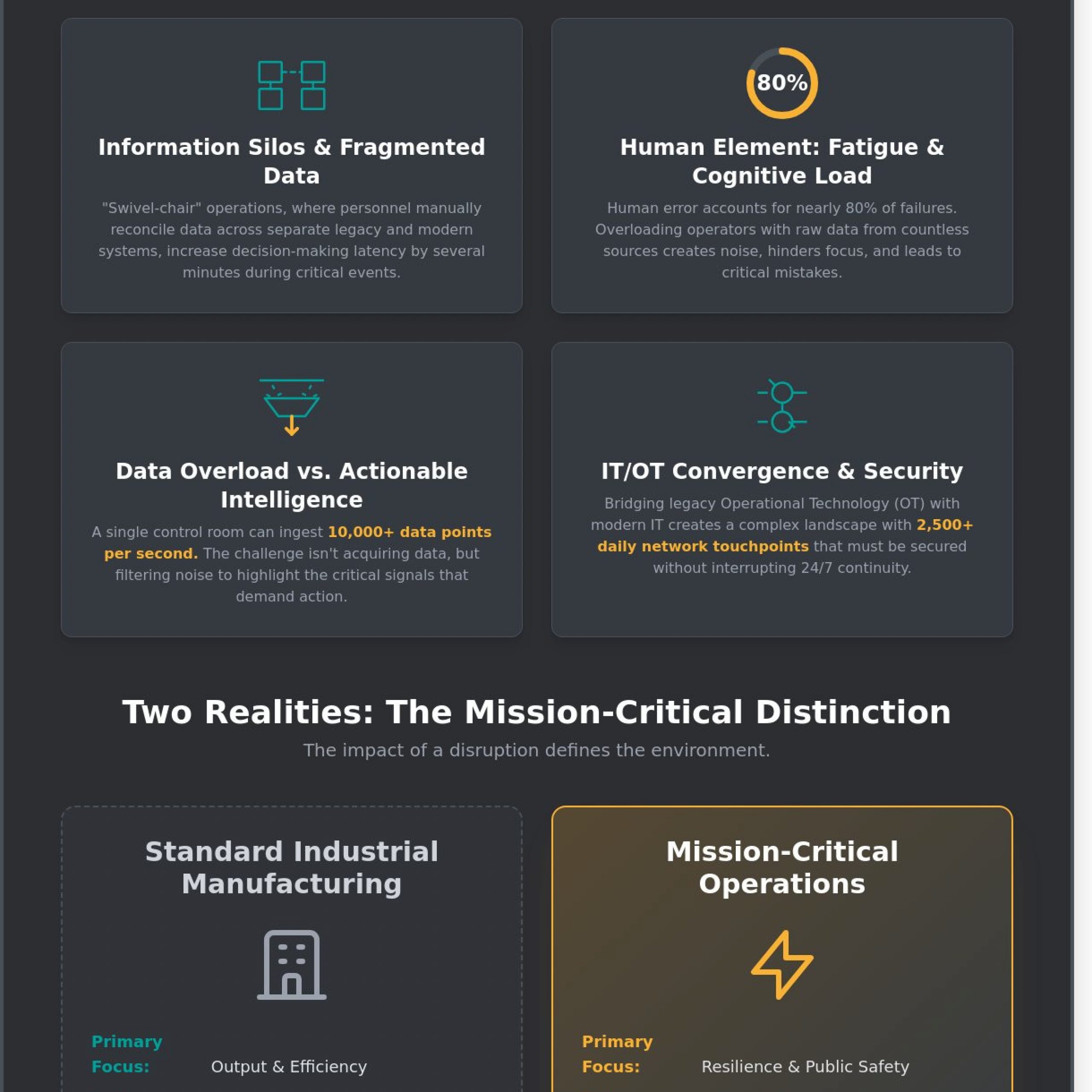
Operational industries constitute the essential framework of modern civilization. They manage high-consequence, real-time infrastructure where failure isn’t just an inconvenience; it’s a catastrophe. While standard industrial manufacturing prioritizes output and efficiency, mission-critical operations prioritize resilience and public safety. These environments demand 24/7 uptime, rigorous regulatory oversight, and an unwavering commitment to operational continuity. The stakes are fundamentally different; a factory stoppage affects profit margins, but a grid failure affects lives.
The distinction lies in the immediate impact of a disruption. In a typical warehouse, a 15-minute system lag is a nuisance. In a mission-critical utility environment, that same window of time could jeopardize the stability of a regional power grid serving 5 million people. This reality has forced a shift from reactive monitoring to proactive, event-driven situational awareness. Operators in operational industries no longer wait for an alarm to sound. They must anticipate disruptions through intelligent data synthesis before they escalate into full-scale incidents.
Key Sectors Within the Operational Landscape
Utilities and energy providers form a critical layer of this landscape, representing one of the 16 sectors identified by CISA as vital to national security. These organizations face intense scrutiny, particularly regarding NERC CIP compliance, which mandates strict standards for the North American bulk power system. In transportation, operators manage high-traffic transit hubs where a single delay can ripple across global supply chains. Within public safety and government agencies, the rise of Real-Time Crime Centers (RTCCs) allows for immediate coordination, turning disparate data points into life-saving actions.
The Role of Visibility in Operational Success
Industry leaders distinguish themselves through their ability to achieve visibility into what matters. Raw data often creates more noise than clarity; a single control room might ingest 10,000 data points every second. Successful operational industries filter this noise to highlight actionable intelligence. By establishing a Common Operating Picture, organizations build the resilience needed to withstand unexpected crises. This shared visual intelligence ensures that every stakeholder, from the technician on the floor to the executive in the boardroom, sees the same reality at the same time, enabling decisive action when every second counts.
The Core Challenges Facing Modern Operational Sectors
Managing mission-critical environments requires more than just raw data. It demands filtered, contextual intelligence. As operational industries transition from isolated hardware to interconnected digital ecosystems, the complexity of the landscape has increased exponentially. This shift creates a friction point where data exists in abundance, but actionable insights remain elusive. Operators don’t just need more information; they need the right information at the exact moment a decision is required.
The struggle to unify disparate software and hardware streams isn’t just a technical hurdle; it’s a safety risk. When critical infrastructure relies on a patchwork of legacy systems and modern cloud tools, gaps in visibility are inevitable. These gaps become vulnerabilities that can be exploited by cybersecurity threats or lead to catastrophic human error. Protecting 2,500 or more daily network touchpoints requires a security posture that’s integrated into the very fabric of the operational workflow. Scalability further complicates this, as organizations must expand their footprint without interrupting the 24/7 continuity of their services.
Managing Information Silos and Fragmented Data
Many organizations still rely on “swivel-chair” operations. This is where personnel must manually reconcile data across separate applications. This fragmentation increases decision-making latency by several minutes during critical events. Integrating legacy SCADA systems, some running on protocols established 20 years ago, with modern analytics tools is a primary obstacle. A unified interface is essential to bridge this gap. It reduces the time spent searching for data, allowing teams to maintain a constant state of situational awareness across the entire enterprise.
The Human Element: Reducing Fatigue and Cognitive Load
Human error accounts for nearly 80% of failures in complex operational systems. In high-pressure control rooms, an operator might face over 1,000 alerts during a single shift. This volume leads to alarm fatigue, where critical warnings are missed among routine notifications. Designing environments that support sustained attention is vital for 24/7 centers. Establishing a unified command center allows teams to bypass these silos and focus on mission-critical outcomes.
Event-driven alerts help operators move away from passive monitoring. Instead of watching screens for hours, they react to anomalies that the system identifies automatically. This strategy improves collaboration between distributed teams and field personnel. When everyone sees the same verified data, the path to resolution becomes clear. Reliability isn’t just about the machines; it’s about empowering the people who run them to act with absolute certainty.
Technological Frameworks for High-Consequence Operations
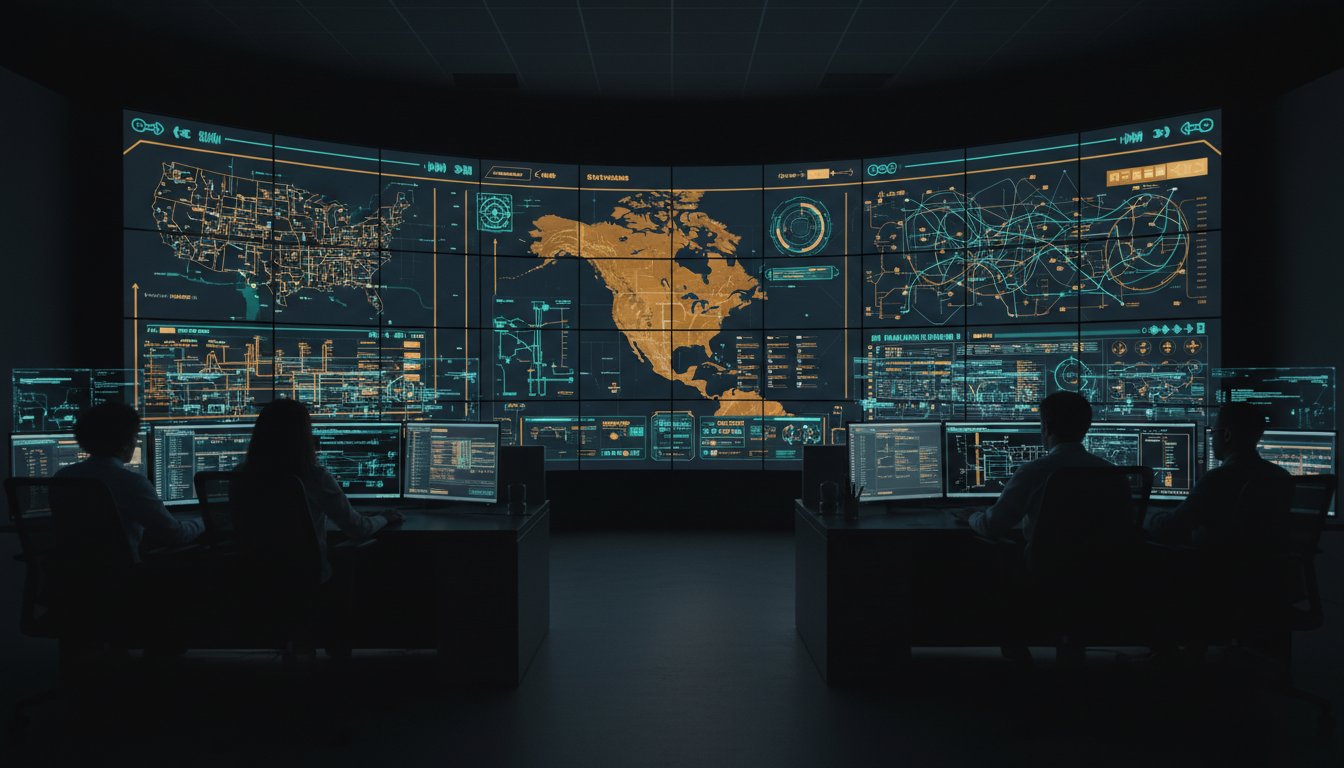
Modern operational industries rely on the convergence of Information Technology (IT) and Operational Technology (OT). This integration isn’t just about connecting computers to machines; it’s about creating a unified ecosystem where data from a remote sensor informs a global strategy. In high-consequence environments, the video wall acts as the central nervous system. It aggregates disparate data streams into a single pane of glass, allowing operators to see what matters most without the distraction of noise. This clarity is essential for maintaining stability across utilities, transportation networks, and public safety infrastructure.
Advanced Visualization and Video Wall Systems
Mission-critical video walls provide the visual foundation for situational awareness. To maintain real-time accuracy, these systems must handle high-resolution feeds, often 4K at 60 frames per second, with bitrates exceeding 20 Mbps. Traditional hardware-locked systems create silos that slow down communication and limit scalability. Software-defined visualization removes these barriers. It allows teams to share content across different displays and locations instantly, ensuring everyone sees the same reality. By decoupling the software from specific hardware, organizations gain the flexibility to upgrade components without disrupting the entire operational flow.
Integrating Event-Driven Intelligence
Efficiency in a command center is measured by the time elapsed between an event and the subsequent action. Event-driven intelligence automates this process to minimize human error. Instead of operators constantly scanning hundreds of static feeds, the software triggers specific layouts when a sensor threshold is met or an alarm sounds. This automation reduces the cognitive load on personnel, allowing them to focus on decision-making rather than data hunting.
- Reduced Response Times: In Network Operations Centers (NOCs), automating the display of critical alerts can reduce incident response times by 35% compared to manual monitoring.
- Extended Visibility: Mobile tools push these automated alerts beyond the physical command center, providing field technicians with the same real-time intelligence available to supervisors.
- Data-Driven Precision: Industry reports from 2023 indicate that facilities using event-driven triggers see a 40% improvement in resource allocation during emergencies.
The goal is to move operational industries from a reactive posture to one of managed control. When the software acts as a bridge between raw data and human judgment, teams act with greater certainty. This technological framework ensures that when a crisis occurs, the path to resolution is visible, documented, and immediate.
Evaluating Solutions for Operational Continuity
Decision makers in operational industries face a critical choice between custom-built software and commercial off the shelf solutions. While custom systems offer tailored workflows, they often carry a 40% higher lifecycle cost due to long-term maintenance and integration hurdles. High-stakes environments require COTS platforms that are specifically hardened for mission-critical use. These systems provide immediate deployment capabilities without sacrificing the technical rigor needed for 99.999% uptime. Security is the foundation of this infrastructure. Systems must utilize AES-256 encryption and comply with FIPS 140-2 standards to protect data integrity across the network.
Interoperability determines the success of any technological rollout. A platform that cannot communicate with existing Video Management Systems (VMS) or Geographic Information Systems (GIS) creates data silos that delay response times. Professional design services play a vital role here. They ensure that the software architecture and the physical control room layout work in tandem to minimize cognitive load. When operators don’t have to fight their tools, decision accuracy improves by 25% during high-stress incidents.
Criteria for Selecting an Operational Platform
Selecting the right foundation requires a focus on multi-source integration. The vis/ability platform excels by aggregating disparate data streams into a single, cohesive interface. You should prioritize vendor-neutral application integration to avoid costly lock-ins and ensure the system scales as new tools emerge. When evaluating the total cost of ownership, it’s essential to look beyond the initial purchase price. In sectors like utilities or manufacturing, the cost of a single hour of downtime can exceed $100,000. Investing in a resilient platform mitigates this operational risk.
Future-Proofing Your Operational Infrastructure
Maintaining visibility across operational industries requires a forward-looking strategy. Infrastructure must be ready for AI and predictive analytics, which are expected to automate 60% of routine sensor alerts by 2026. This transition shouldn’t require a total system overhaul. Scalable software allows for hardware upgrades and cloud migrations without breaking the continuity of the mission. By focusing on modularity, organizations ensure that their command center remains an asset rather than a legacy burden. This proactive planning secures long-term resilience and keeps the focus on actionable intelligence.
Optimizing Your Industry Operations with Activu
Activu has secured mission-critical environments since 1983. For over 40 years, we’ve served as the technical bedrock for organizations where failure isn’t an option. Our expertise isn’t limited to software; it encompasses the full lifecycle of command and control center development. Through the vis/ability platform, we provide a unified picture for complex operational industries. This system aggregates massive, disparate data sets into actionable intelligence, allowing teams to move past information overload. We empower operators to act with absolute certainty when every second counts. Our professional design and engineering services ensure that command and control centers are optimized for human performance. We focus on ergonomics, signal flow, and hardware reliability to create an environment that fosters calm during crises.
Specialized Solutions for Every Mission
Activu delivers precision-engineered tools for high-stakes environments. In Manufacturing and Process Control, our systems help mitigate the risks of unplanned downtime. For Federal Government and Defense, we provide secure visualization that meets stringent security protocols. We bridge the gap between the control room and the field using Activu Link. This integration ensures that critical data reaches decision-makers regardless of their physical location. It transforms isolated data points into a shared reality for the entire team.
- Manufacturing: Real-time monitoring to prevent costly production halts.
- Defense: Secure, multi-domain awareness for tactical and strategic planning.
- Enterprise: Seamless collaboration across global operations.
Taking the Next Step Toward Operational Clarity
Most organizations operate in a reactive state, responding to alarms after they trigger. We help you transition to a proactive stance. This shift relies on 100% visibility across your entire infrastructure. Our team conducts tailored assessments of existing control room environments to identify bottlenecks and technical gaps. We don’t just sell software; we engineer resilience. The process begins with a deep dive into your specific workflows and ends with a system designed for maximum uptime. Contact Activu to redefine your operational industries visibility and secure your mission-critical future.
Strengthen Your Mission-Critical Infrastructure
Success in modern operational industries depends on your ability to filter noise and focus on critical data. High-consequence environments don’t have room for error; they require a technological framework that provides absolute clarity. By integrating event-driven situational awareness, your team can move from a state of information overload to decisive, proactive action. It’s about ensuring the right person sees the right information at the exact moment it matters most.
Activu has served as a vigilant guardian for these sectors since 1983. Our solutions are the trusted choice for the US Military and Fortune 500 utilities, providing the technical reliability required for life-saving decisions. We specialize in creating the bridge between complex geospatial data and human judgment, ensuring your command center remains the steady engine of your organization. You’ve seen the challenges of operational continuity; now it’s time to implement the visibility required to overcome them.
Take the first step toward total situational awareness. Request a Demo of the vis/ability Platform and see how we empower your team to lead with confidence.
Frequently Asked Questions
What are the most common operational industries?
Operational industries encompass sectors like electric utilities, where 3,000 providers manage the North American grid, and transportation networks like the FAA, which oversees 45,000 daily flights. These mission-critical environments also include oil and gas refineries, water treatment plants, and emergency management centers. Each sector relies on continuous uptime to maintain public safety and economic stability. These industries demand specialized management to handle high-stakes data and complex physical infrastructure.
How does situational awareness software improve operational efficiency?
Situational awareness software improves efficiency by aggregating disparate data streams into a single, filtered view for the operator. This technology typically reduces the time required to identify a critical incident by 40% in many command centers. By automating the delivery of relevant information, teams avoid manual data searches and focus on decisive action. This clarity ensures that personnel respond to real threats rather than technical noise or irrelevant data points.
What is the difference between IT and OT in industrial settings?
IT manages digital information and business applications, while OT controls the physical hardware and industrial processes on the plant floor. In operational industries, OT includes SCADA systems and programmable logic controllers that manage 24/7 machinery. While IT prioritizes data confidentiality and integrity, OT prioritizes availability and real-time safety. Modern facilities now integrate these two domains to create a unified data architecture that supports better decision-making across the entire enterprise.
How can organizations reduce operator fatigue in control rooms?
Organizations reduce operator fatigue by implementing ISO 11064 ergonomic standards and dynamic lighting systems that mirror natural circadian rhythms. Automated alert filtering prevents alarm fatigue by only escalating critical anomalies that require human intervention. Shift managers should limit duty cycles to 12 hours and provide structured break intervals every 2 hours to maintain peak cognitive performance. These adjustments keep personnel sharp and focused during high-stakes monitoring tasks in the control room.
Why is a common operating picture (COP) essential for critical infrastructure?
A common operating picture is essential because it synchronizes multiple departments during a crisis, ensuring every stakeholder sees the same real-time data. This shared visibility eliminates communication silos that often delay response times by 15 minutes or more during emergencies. When utilities and first responders share a COP, they coordinate resources with 100% accuracy. It serves as the single source of truth, turning complex data into a clear, actionable roadmap for everyone.
What should I look for in a mission-critical video wall system?
Look for a video wall system with a 100,000-hour MTBF rating and sub-100 millisecond latency to ensure real-time accuracy for video feeds. The system must support diverse inputs, from geospatial maps to 4K camera streams, without requiring hardware proprietary locks. Scalability is vital; the platform should allow operators to push content to remote devices or secondary sites instantly. Reliability ensures the display remains operational during demanding 24/7/365 mission-critical cycles.
How do operational industries manage cybersecurity for remote monitoring?
Operational industries manage cybersecurity through AES-256 encryption and multi-factor authentication for every remote access point. Organizations often deploy data diodes to ensure one-way data flow, which protects the internal OT network from external internet threats. NIST 800-82 guidelines provide the necessary framework for securing these industrial control systems against modern attacks. Regular vulnerability scanning and strict user permissions further harden the perimeter, ensuring that only authorized personnel can access sensitive monitoring data.
Can legacy systems be integrated into modern visualization platforms?
Legacy systems integrate into modern platforms through software-defined visualization tools and industrial gateways that translate older protocols like Modbus into modern formats. This approach allows 20-year-old SCADA hardware to feed data into updated analytics dashboards without a total overhaul. You don’t need to rip and replace existing infrastructure to achieve modern situational awareness. Strategic integration preserves previous capital investments while adding the benefits of real-time visibility and advanced data processing.