
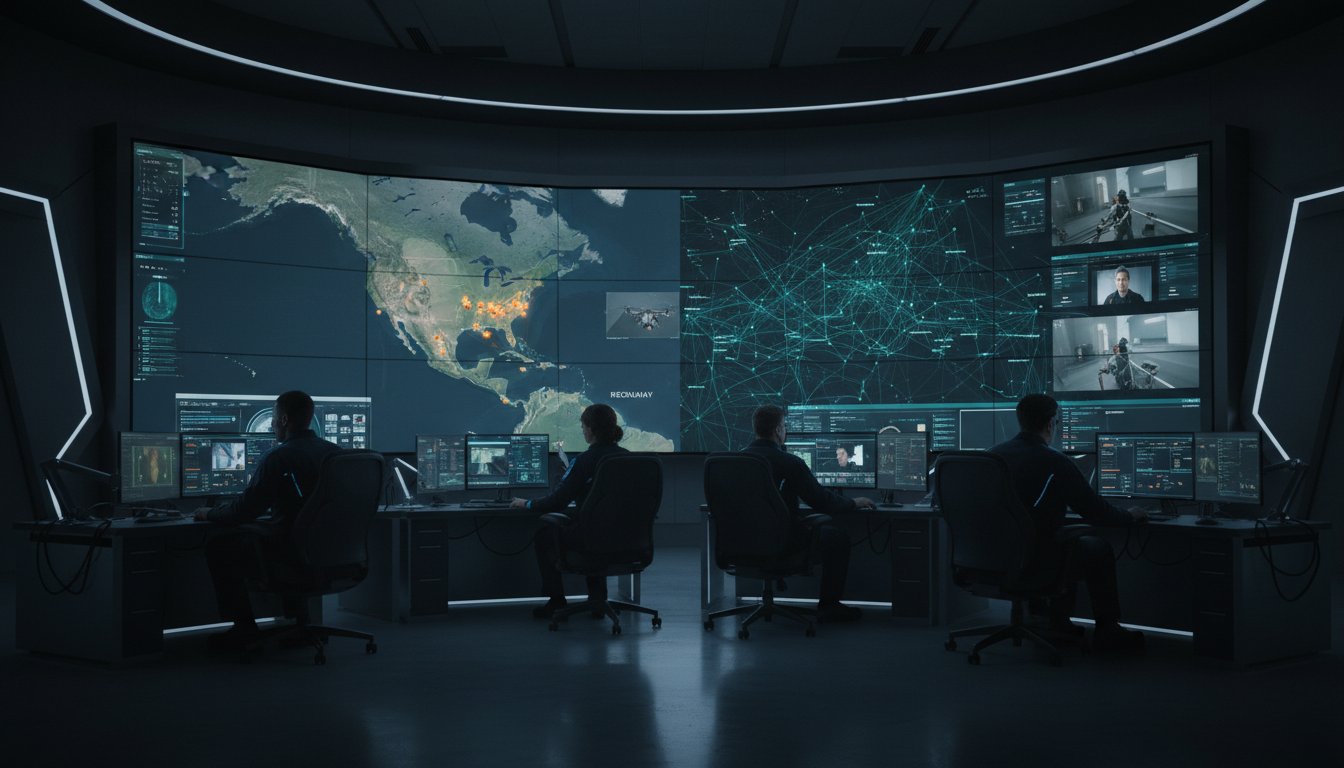
Custom software development cycles for mission-critical operations now frequently exceed 24 months, leaving operators trapped with outdated tools while threats evolve in real-time. You likely recognize the frustration of waiting years for a bespoke solution only to find it’s incompatible with your legacy hardware upon delivery. Relying on commercial off the shelf software isn’t just a budget decision; it’s a strategic move to close the gap between fragmented data silos and actionable intelligence.
Most control rooms already have the screens. What they’re missing is the layer that decides what goes on them; and escalates automatically when something needs attention. This guide examines how these solutions provide the necessary visibility into what matters without the prohibitive lead times of custom builds. You’ll learn how to integrate diverse data streams into a single view, reduce lifecycle costs by 30 percent, and ensure your technology empowers human judgment when the stakes are at their highest. We’ll analyze the balance between rapid deployment and the technical reliability required for high-stakes environments.
Key Takeaways
- Define the strategic differences between COTS, MOTS, and GOTS to select the most resilient framework for high-stakes operational environments.
- Analyze the long-term financial impact of commercial off the shelf solutions to balance rapid deployment with the necessity of technical reliability.
- Identify why fragmented data silos and disconnected applications cause operators to miss critical incidents during high-pressure events.
- Learn to bridge the gap between having screens and having actionable intelligence by implementing a layer that automates incident escalation.
- Master a “system of systems” procurement approach that prioritizes interoperability, ensuring disparate feeds function as a unified command tool.
Defining Commercial Off-the-Shelf (COTS) in 2026
A commercial off the shelf solution represents a fundamental shift in how mission-critical environments procure technology. By 2026, the reliance on bespoke, ground-up software development has plummeted as agencies prioritize speed and interoperability. COTS refers to ready-made hardware or software products available for purchase by the general public and designed to be installed with minimal customization. This shift is driven by the need for technical reliability in environments where failure isn’t an option.
Modern operations centers often struggle with fragmented data feeds and siloed intelligence. Operators face a cognitive load gap where they have too much information but zero actionable visibility. Most control rooms already have the screens. What they’re missing is the layer that decides what goes on them, and escalates automatically when something needs attention. This intelligence layer is now frequently delivered through COTS frameworks that prioritize situational awareness over static hardware displays.
The distinction between procurement models is critical for long-term operational success:
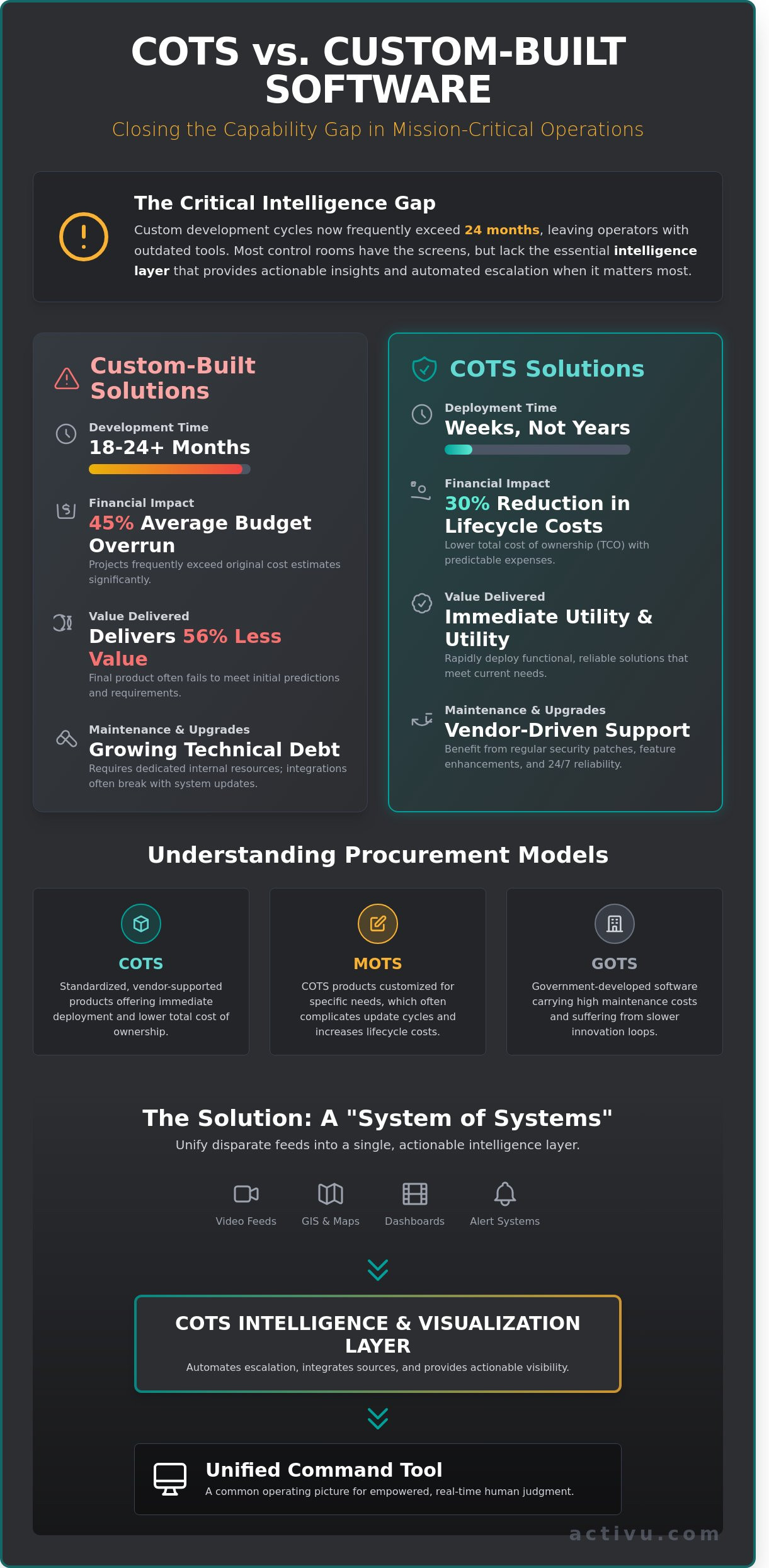
- COTS: Standardized, vendor-supported products that offer immediate deployment and lower total cost of ownership.
- MOTS (Modified Off-the-Shelf): COTS products customized for specific user needs, though this often complicates update cycles and increases costs.
- GOTS (Government Off-the-Shelf): Software developed by government agencies for their exclusive use, which typically carries high maintenance costs and slower innovation loops.
Federal and defense sectors are moving away from “sunk cost” custom builds. Research from 2024 indicates that custom-coded projects in the public sector see 45% budget overruns on average. COTS eliminates the risk of technical debt and orphaned code, providing a stable foundation for federal government and defense operations.
Key Characteristics of Modern COTS
Modern COTS solutions offer a low barrier to entry and rapid deployment timelines, often moving from procurement to full operational status in weeks rather than years. Vendor-driven update cycles ensure that security patches and feature enhancements arrive regularly without requiring internal development resources. Standardized support models provide 24/7 reliability, ensuring that mission-critical systems remain functional during high-stakes incidents.
The Evolution of Mil-COTS for Defense
The 2026 landscape for Mil-COTS focuses on adapting commercial speed for high-security environments. Under FAR Part 12, the Federal Acquisition Regulation prioritizes the procurement of commercial items to leverage private sector innovation. These solutions balance commercial speed with ruggedized reliability standards. This approach allows defense agencies to integrate real-time visualization and advanced analytics into their common operating picture without the decade-long lead times associated with legacy bespoke development.
COTS vs. Custom-Built: Evaluating the Capability Gap
Choosing between a commercial off the shelf solution and a custom-built platform often determines whether an operation stays agile or becomes stagnant. Research indicates that large-scale custom software projects frequently exceed their original budgets by 45% while delivering 56% less value than predicted. This financial strain is compounded by technical debt. Every line of custom code requires dedicated maintenance; it’s a burden that grows exponentially as external systems and security protocols update.
Time-to-market is the primary differentiator for mission-critical sectors. A custom build might take 18 to 24 months to reach initial deployment. In that window, operational threats and technological standards evolve. A commercial off the shelf software package provides immediate utility, allowing organizations to deploy in weeks rather than years. Scaling across multiple sites becomes a matter of licensing and configuration, not reinventing the architecture for every new facility.
Most control rooms already have the screens. What they’re missing is the layer that decides what goes on them, and escalates automatically when something needs attention. Relying on custom code to build this logic creates a liability during system upgrades. When the underlying operating system or a connected data feed changes, custom integrations often break, leaving operators blind during critical windows.
When Custom Development is Necessary
Bespoke software remains necessary for highly specialized regulatory environments where no commercial product meets 100% of unique compliance mandates. However, this path introduces the risk of “vendor lock-in” if the development is outsourced, or a heavy reliance on internal expertise that may depart the organization. Maintaining a custom stack requires a permanent team of developers to prevent the software from becoming a legacy anchor that hinders operational growth.
The Hybrid Approach: Configuring COTS for Mission Success
Modern operations achieve the best results by using APIs and middleware to tailor commercial tools to specific workflows. This hybrid method ensures the core system remains stable and supported by the vendor while allowing for specific data integrations. Configuration is inherently safer than customization because it preserves the upgrade path and ensures long-term reliability.
In transportation hubs, this approach allows agencies to ingest disparate sensor data without rewriting the entire platform. Similarly, utility control rooms use configured COTS layers to manage grid stability while maintaining strict NERC CIP compliance. These organizations prioritize situational awareness over software development, focusing their resources on response rather than coding. This strategy ensures the technology serves the mission, rather than the mission serving the technology.
The Mission-Critical Challenge: Why Standard COTS Often Falls Short
Standard commercial off the shelf software serves general business needs well, but it often falters in the high-pressure environment of a command center. These applications exist in isolation, creating fragmented workflows that force operators to act as the primary integration point. When a utility grid experiences a surge or a security breach occurs, operators shouldn’t waste seconds toggling between disparate browser tabs and legacy desktop apps. This manual process, often called swivel-chair integration, introduces a 15% to 20% delay in response times according to industry observations in emergency dispatch centers.
Most control rooms already have the screens. What they’re missing is the layer that decides what goes on them; it escalates automatically when something needs attention. Without this intelligence, the video wall becomes a passive display rather than an active tool. It’s a fundamental gap in standard commercial off the shelf deployments that leaves organizations vulnerable during rapid-onset emergencies. True operational efficiency requires a system that bridges the gap between raw data and human judgment.
Siloed Data and Cognitive Overload
Fragmented data feeds are a primary cause of decision paralysis. In a typical crisis, an operator might monitor 50 or more individual camera feeds and sensor alerts across twelve different monitors. Standard COTS tools don’t aggregate these into a unified common operating picture. This lack of synthesis leads to cognitive overload where critical details are buried. Operators often miss incidents because they’re focused on the wrong screen at the wrong time. A standard video wall setup without an intelligence layer lacks the context to highlight a specific breach among hundreds of routine events. It’s not enough to see the data; the system must provide visibility into what matters most at that exact moment.
Cybersecurity and Compliance Risks
Maintaining rigorous security standards like NERC CIP for utilities or CJIS for law enforcement is difficult with generic software. Standard vendors don’t always prioritize the specific vulnerability management required for mission-critical infrastructure. Organizations need a cybersecurity common operating picture to visualize threats across the entire network. Relying on basic COTS means waiting for general patches that might not address the specific vectors used against critical sectors. Reliability depends on a system that treats security as a constant operational state, not an occasional update. High-stakes environments require a proactive stance where every component is vetted for its impact on the total security posture.
Navigating COTS Procurement for Operations Centers
Procurement for critical environments often fails because it focuses on individual hardware specs instead of mission outcomes. Most control rooms already have the screens. What they’re missing is the layer that decides what goes on them, and escalates automatically when something needs attention. Selecting a commercial off the shelf solution requires shifting the focus from buying boxes to achieving total situational awareness. This transition ensures that the technology serves the operator, rather than forcing the operator to manage the technology.
Technical Requirements for Interoperability
RFPs must prioritize open standards and documented APIs over proprietary closed loops. Hardware-agnostic software ensures your center isn’t held hostage by a specific display manufacturer’s five year lifecycle. We recommend testing commercial off the shelf performance under 100% CPU load within a SOC or NOC environment to ensure zero latency during a crisis. This approach treats the command center as a system of systems where data flows freely between disparate platforms. When drafting requirements, include these non-negotiables:
- Verification of RESTful API availability for rapid third-party software integration.
- Mandatory support for open geospatial data standards to ensure map layer accuracy.
- Requirement for software that operates independently of specific video wall processor brands.
Evaluating Vendor Support and Longevity
Mission-critical operations can’t afford downtime caused by a vendor’s financial instability or a sudden product sunset. For federal government and defense sectors, 24/7 technical support isn’t a luxury; it’s a requirement for operational continuity. Evaluate the vendor’s roadmap to confirm they’ve planned for at least seven years of software updates. This prevents the obsolescence trap where a purchase becomes a liability because the vendor shifted focus to a different market.
Successful procurement replaces siloed data with a unified operating picture. It’s about the moment of decision. If your procurement process doesn’t account for how an operator identifies a 15% spike in server temperature or a security breach in real time, the hardware is irrelevant. You aren’t just buying software; you’re buying the ability to see what matters when it matters most.
Beyond the Hardware: Unifying COTS into an Intelligence Layer
Deploying commercial off the shelf components is only the first step toward operational readiness. A stack of high-definition monitors or a high-speed server rack provides the raw capacity for data, but capacity isn’t clarity. Operators in high-stakes environments often find themselves drowning in a sea of fragmented video feeds and sensor alerts. They’re forced to toggle between disparate systems to find the one piece of data that actually matters. This manual process introduces delay. In a mission-critical setting, a 30-second delay can lead to a 100% loss of containment or safety.
The gap exists between the hardware and the human. Most control rooms already have the screens. What they’re missing is the layer that decides what goes on them; and escalates automatically when something needs attention. Activu fills this void by turning a collection of standalone commercial off the shelf tools into a cohesive intelligence ecosystem. This bridge ensures that the focus remains on the situation, not the software.
Event-Driven Situational Awareness
The traditional model of passive monitoring is broken. It relies on operators to spot a flickering pixel among dozens of screens. Research shows that operator fatigue sets in after just 20 minutes of continuous monitoring, which causes a 25% drop in incident detection rates. The vis/ability platform changes this dynamic by prioritizing information based on real-time triggers. When a sensor threshold is breached or a security alarm sounds, the system automatically surfaces the relevant data. It filters out the background noise. This ensures that the operating picture remains lean and focused. It also extends this awareness beyond the physical control room, pushing critical alerts to mobile users so that field teams and decision-makers stay synchronized regardless of their location.
Building a Resilient Common Operating Picture (COP)
True resilience requires more than just seeing data; it requires a unified response. Fragmented feeds from various sources must be synthesized into a single, high-performance interface. By unifying disparate data streams, organizations achieve a steady state of reassurance even during operational chaos. This creates a resilient common operating picture where every stakeholder sees the same truth at the same time. The focus shifts from managing the technology to managing the mission. This clarity allows for faster intervention and more precise resource allocation. It transforms the video wall from a passive display into a proactive tool for survival and success.
Mastering Operational Clarity with Integrated COTS
Success in modern mission-critical environments requires more than just high-end hardware. While commercial off the shelf solutions provide the necessary physical infrastructure, they frequently leave operators struggling with fragmented data and siloed systems. This capability gap creates a dangerous delay in response times when every second is vital to public safety or grid stability. Most control rooms already have the screens. What they’re missing is the layer that decides what goes on them, and escalates automatically when something needs attention.
Activu has spent over 40 years refining the situational awareness software that serves as this essential intelligence layer. Our hardware-agnostic platform is trusted by federal agencies and Fortune 500 utilities to turn raw data into decisive action. We don’t just provide visibility; we provide the certainty required to manage complex infrastructure under pressure. By unifying your environment, you ensure that your team remains focused on the mission instead of the technology. You can rely on our proven expertise to maintain steady control over your most critical operations.
See how vis/ability unifies your COTS environment: Request a Demo
Frequently Asked Questions
What does COTS stand for in government contracting?
COTS stands for Commercial Off-the-Shelf. In government contracting, this refers to a specific category of commercial items available in the general marketplace that can be bought through standard contracts. Under Federal Acquisition Regulation (FAR) Part 2.101, these products require no unique government modifications. Agencies prioritize these solutions because they reduce development costs by 30% and significantly shorten the procurement cycle for urgent mission needs.
Is COTS software secure enough for a military or utility control room?
COTS software is secure enough for high-stakes environments when it adheres to rigorous federal standards. Most control rooms already have the screens. What they’re missing is the layer that decides what goes on them, and escalates automatically when something needs attention. Secure COTS solutions must meet FIPS 140-2 encryption standards and maintain a place on the DoDIN APL. These certifications ensure the software survives the 2,000 daily cyberattacks typical for modern utility providers.
What is the difference between COTS and MOTS?
COTS products are used exactly as they’re sold in the commercial market without modification. In contrast, Modified Off-the-Shelf (MOTS) solutions allow a vendor or buyer to alter the source code to meet specific mission requirements. While MOTS offers more flexibility, it often increases the total cost of ownership by 25% due to custom maintenance needs. COTS remains the standard for organizations seeking rapid deployment and lower long-term technical risk.
Why is COTS preferred over custom-built solutions in 2026?
COTS is preferred because it allows organizations to bypass the five year development cycle typical of custom software. By 2026, the pace of technological change makes custom builds obsolete before they’re even deployed. Choosing a commercial off the shelf solution ensures your center benefits from continuous R&D and security patches funded by a global user base. This model reduces initial capital expenditure by approximately 40% while ensuring the system remains modern.
Can COTS products be integrated with legacy mission-critical systems?
Modern COTS products integrate with legacy systems using open APIs and protocols like SNMP or Modbus. This connectivity bridges the gap between 20 year old SCADA systems and modern visualization layers. Most control rooms already have the screens. What they’re missing is the layer that decides what goes on them, and escalates automatically when something needs attention. Effective integration ensures that siloed data from older hardware becomes visible and actionable in real time.
What are the biggest risks of using COTS in a 24/7 operations center?
The primary risks include vendor obsolescence and rigid update schedules that might disrupt 24/7 operations. If a vendor discontinues a product, the center faces a forced migration that can cost upwards of $500,000 in unplanned labor. Operators also risk feature bloat, where unnecessary updates complicate the user interface. Mitigating these risks requires selecting partners who prioritize backward compatibility and offer 99.999% uptime SLAs for mission-critical environments.
How do I ensure a COTS vendor meets my specific industry compliance standards?
You ensure compliance by demanding documented proof of industry specific certifications like NERC CIP for utilities or HIPAA for healthcare. Don’t rely on self-attestation. Request a SOC 2 Type II report and verify the vendor’s history in similar high-stakes deployments. A commercial off the shelf provider should demonstrate a 100% compliance rate during annual audits to prove their software handles sensitive data according to legal mandates.
What is a Mil-COTS product and how does it differ from standard COTS?
Mil-COTS refers to commercial products adapted to meet military specifications, such as MIL-STD-810G for environmental durability. While standard COTS focuses on office or data center use, Mil-COTS hardware can withstand extreme temperatures ranging from -40 to 85 degrees Celsius. The software components often include enhanced signals intelligence or geospatial layers. This approach provides the military with advanced technology at 50% of the cost of traditional custom hardware.